Fourth Frontier X3 review: going beyond your sports watch

A lightweight chest-worn heart rate monitor that helps runners look beyond pace and distance with deeper insights into training load, performance and recovery.
I’m used to checking my sports watch for the usual training data: pace, distance, heart rate, and maybe an estimate of VO₂ max. But while these figures tell me plenty about a run, they don’t always explain the full story of how my body is responding to training. That’s where the Fourth Frontier X3 takes a different approach.
It can work alongside your existing sports watch; it combines chest-based heart rate measurement with performance and recovery insights to help you better understand your training. With up to four months of battery life, personalised vibration alerts and a screen-free design, it’s built for runners and endurance athletes who want more from their training data without adding another screen to check.
Right now, AW readers can claim a special 30% discount off the Fourth Frontier X3 USE CODE AW30
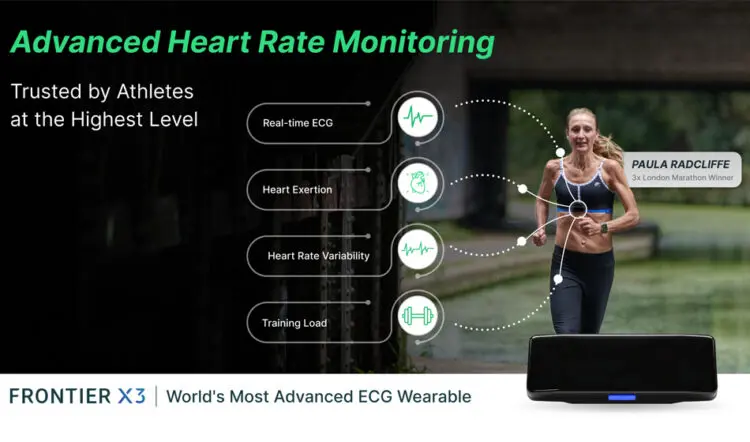
More than a heart-rate monitor
The X3 is a compact, screen-free wearable that sits against the chest using an elastic strap. Weighing just 23g, it’s designed to be unobtrusive during training, with Bluetooth connectivity and USB-C charging, it is simple to set up and use. Being a chest-worn device, the Frontier X3 provides more reliable heart-rate readings during movement than wrist-based optical sensors.
Battery life is one of its biggest practical advantages. With typical use of around an hour a day, the X3 offers up to four months on a single charge, making it well suited to regular training without the need for frequent charging.
Its biggest difference from a conventional sports watch is how it measures heart rate. Most watches use optical sensors to estimate pulse from changes in blood flow beneath the skin. The X3 uses chest-based ECG technology to detect the electrical signals associated with each heartbeat.
An advantage of this is that changes in heart rate are recorded more quickly when compared to a wrist-based device, giving a more accurate recording.
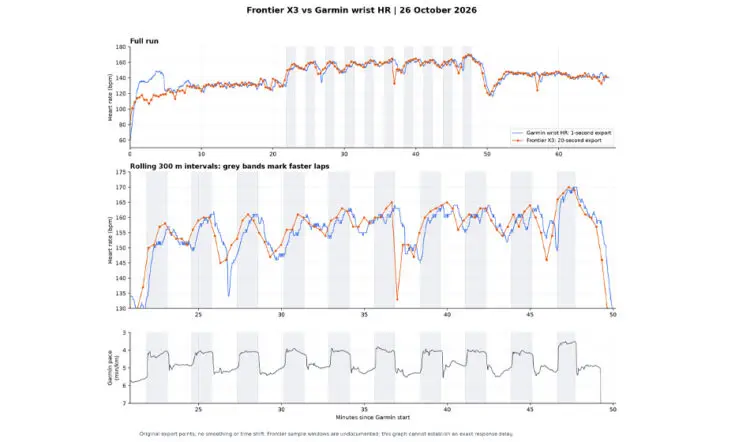
* See here for more details
That distinction matters during harder sessions. Wrist-based optical readings can be affected by movement, sweat and poor sensor contact, whereas a chest-based ECG signal can provide more consistent heart-rate data during intervals, tempo runs and races. For anyone who uses heart rate to monitor training intensity, having this more dependable data is a real benefit.
The deeper insight: understanding how hard you’re working
For me, the most interesting part of the X3 isn’t simply measuring heart rate more accurately. It’s what the device does with that information.
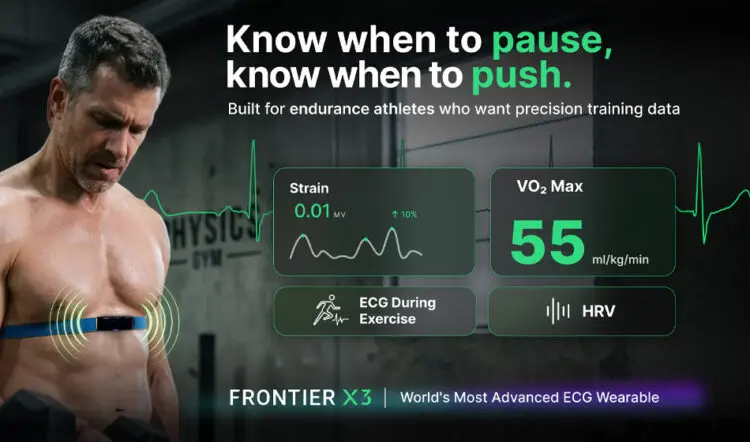
The accompanying app brings together a range of performance and recovery metrics, including heart-rate variability (HRV), training load, cardiovascular strain and VO₂ max trends.
Here’s how some of the key metrics can help:
Right now, AW readers can claim a special 30% discount off the Fourth Frontier X3 USE CODE AW30
The benefit is having more information to help guide training decisions. If a familiar pace suddenly produces a higher cardiovascular response, or recovery indicators trend down during a demanding training block, that may be a reason to review your workload, sleep or recovery. These metrics aren’t definitive answers, but they can help identify patterns that pace and distance alone might miss.
A useful partner for your sports watch
Whilst the X3 isn’t a replacement for my running watch, it is an excellent companion. A GPS watch remains convenient for viewing pace, distance, route and splits in real time. The X3 is better understood as a specialist tool that adds another layer of physiological data.
It supports more than 20 activities and can connect to compatible devices and platforms, including Garmin and Strava. You can therefore keep using the equipment you already rely on while adding the X3’s heart-rate and training insights to the bigger picture.
I also like the personalised vibration alerts. Rather than continually checking a screen, you can use alerts to help stay within a chosen training zone or respond when a selected threshold is crossed. This is particularly useful during steady aerobic sessions, when it’s easy to drift into a harder effort than intended.
The verdict
The X3 is a specialist piece of kit, and makes sense if you regularly structure training around heart-rate zones, want to monitor recovery trends or enjoy analysing how your body responds to different workloads.
The Fourth Frontier X3 appeals to runners who want to understand more than how fast or how far they’ve gone. Its chest-based ECG technology offers a more direct way of measuring heart rate during exercise, while the app turns that data into a broader picture of cardiovascular strain, training load and recovery.
Where the X3 stands out is in the additional context it brings to your existing training setup. A sports watch tells you how fast and how far you went; the X3 helps you explore how your body responded. For data-minded runners and endurance athletes looking to fine-tune their training, that extra perspective can be genuinely useful.
Some advanced features, including ventilatory-threshold training zones and Readiness Score, require the optional Frontier Premium subscription.