Sprint and middle-distance approaches in competition strategies and sports odds
AW promotion
Understanding the intricacies of sprint and middle-distance racing can provide valuable insights into the dynamics of sports betting odds. These races, characterised by a blend of speed and tactical acumen, reflect broader strategies employed in athletic competition. By examining race tactics, one gains a clearer perspective on interpreting odds in sports.
Sprint and middle-distance events are cornerstones of track and field athletics, each demanding a unique combination of explosive speed and strategic pacing. These races challenge athletes to balance raw power with precise timing, making them fascinating to both participants and spectators. The strategies employed by runners can shed light on broader sporting principles, offering a framework for understanding odds in sports betting and various outcomes in athletics.
Performance Variables Influencing Race Outcomes
The complexities of sprinting lie in mastering acceleration phases, optimising stride length, and maintaining a high turnover rate. In contrast, middle-distance races demand keen awareness of pacing strategies and endurance management. Small adjustments in these variables can significantly alter an athlete's finishing position, underlining the importance of tactical precision.
As you delve into these dynamics, understanding odds in sports betting becomes pivotal. Factors such as an athlete's current form, recent performances, and prevailing environmental conditions play a crucial role in shaping the perceived likelihood of different race outcomes. By analysing these elements, enthusiasts can gain deeper insights into the nuanced interplay between athletic performance and betting odds.
For those keen to explore more about race demands and athlete preparation, reputable sources like the official World Athletics page offer comprehensive information. This enables a better grasp of how small variances in tactics can influence not just individual races but also broader betting perspectives.
Weather conditions and track surfaces also play pivotal roles in determining race outcomes. Athletes must adapt their strategies based on factors like wind resistance, temperature, and track composition. These environmental variables can significantly impact performance metrics, making them crucial considerations when analysing potential results. Understanding how different athletes perform under varying conditions provides valuable context for interpreting race dynamics and associated odds.
Practical Insights for Interpreting Racing Form
From an online sports betting perspective, the demands of each race, alongside athlete preparation, provide essential insights. Many platforms offer opportunities to explore diverse sports markets through a visually engaging interface. Understanding how athletes' strengths align with seasonal trends enhances one's ability to evaluate potential outcomes accurately.
The intersection of racing tactics with online gaming is profound. Observers who meticulously analyse each athlete’s form can make informed decisions that reflect both current performances and historical data trends. The emphasis is on responsible engagement, where observing patterns over time helps refine predictions within both athletic contexts and online platforms.
The strategic alignment seen in racing forms a parallel to understanding odds in sports betting, where careful observation is key to making educated guesses about future performances. This approach not only enriches your understanding but also elevates your overall experience within the competitive world of sports wagering.
Common Challenges in Sprint and Middle-Distance Tactics
The path to mastering sprint and middle-distance events is fraught with challenges such as overexertion during early phases or inconsistent pacing leading to mental fatigue. Recognising these pitfalls is crucial for enthusiasts aiming to better assess potential race outcomes. By acknowledging these hurdles, you enhance your ability to interpret athletic performances accurately.
What's more, the mental aspect plays a significant role in determining success on the track. Overcoming psychological barriers is as critical as physical preparation; thus, having insight into these elements can significantly influence your assessment process.
Understanding these common challenges allows you to appreciate the intricate nature of racing tactics. This knowledge not only aids in evaluating athlete readiness but also informs your broader perspective on sports odds assessment.
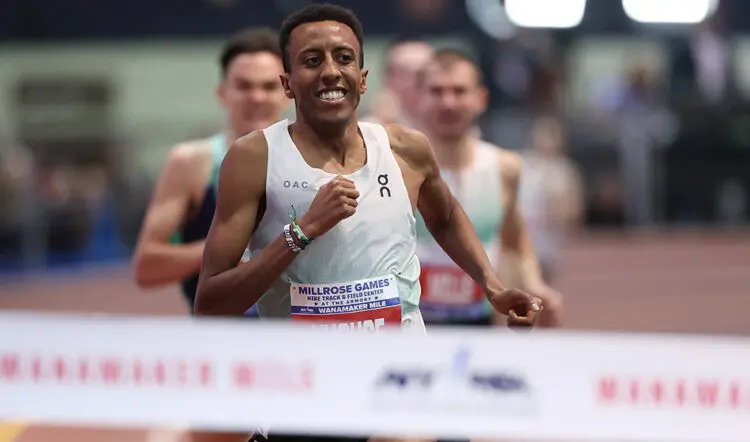
Yared Nuguse: "I want to be myself in every way"
You might not be about to find Yared Nuguse engaging in any wars of words, but the Olympic 1500m bronze medallist explains why he expects to be a contender for the big middle-distance prizes again
Yared Nuguse wants to make something clear. He is not about to suddenly throw himself into the headline-making, hype-creating, tension-inducing trash talking that has become such a big feature of men’s middle distance running in recent years. What you can expect from the softly spoken American, however, is for him to be right in contention for the sport’s major honours once more in 2025.
Rather than making any resolutions every January, instead the Olympic 1500m bronze medallist who kept defending Olympic champion Jakob Ingebrigtsen off the Paris podium sets himself a theme for the 12 months to come.
“It helps to align my goals for what I generally want to be doing in that year,” he says. “For example, last year was a year of fulfilment. I wanted to go and fulfil the things that I felt I was capable of doing – seizing my moment and not being as afraid to take risks and do things that scared me a little bit. That was something I was able to do well at the Olympics, as well as in my normal day to day life.”
The theme for this year?
“Authenticity. I've always been a person who has wanted to be myself in every way that I present myself. A lot of the time I can hide a little bit or I'm not quite as forthcoming with who I really am, just because I was always nervous about what people would think. But over the last couple of years, and especially this year, I really want to focus on being unapologetically myself, doing the stuff I want to do, not caring what people think about it and always being me because I'm the only person who can be me.”
Who is Yared Nuguse, in that case? He is an athlete who didn’t take up running until high school, when one of his teachers suggested he could be very good at it, and now admits to being “addicted” to the process of putting one foot in front of the other.
Yet his interests away from the track are many. Following the LA Olympics he plans to go to dental school to fulfil another very different ambition, while his downtime is usually spent drawing, reading fantasy novels and also looking after his pet tortoise, Tyro.
All of that means that, when Ingebrigtsen and Josh Kerr, the arch rivals who have made a second job out of tearing verbal strips from one another, you won’t find Nuguse stepping up to the microphone to throw his own barbs.
Yared Nuguse and Jakob Ingebrigtsen (Getty)
“People may expect some of that from me, but that wouldn't really be authentic to myself,” he says. “I'm not the kind of person to just start boasting about how confident I am about a race right before, or anything like that. Some people's personalities are more like that, and mine is more to keep it to myself. I might think those things but I would never say those things. I'm not much of an entertainment person when it comes to track and field. I'm more just like my silly little self.
“I don't pay as much attention [to the trash talking] as other people do, but I think it's been really fun and interesting to get a lot more interest and intrigue in track and field. But then having Cole upset all that at the Olympics was an even greater result – all of it is just like poetry.
“It's been fun to be a part of that and not really be at the centre of it because, again, I wouldn't really want to be. I’ve enjoyed seeing it all shake out and I'm very curious to see how it continues on this year, especially with Cole now as the Olympic champion.”
The watching athletics world feels exactly the same. The Cole to whom Nuguse refers is, of course, Cole Hocker – another quiet American whose closing surge saw him cross the line ahead of world champion Kerr in the Stade de France.
“I was underestimated and Cole was definitely underestimated,” says Nuguse of that race. “Cole beat me at the US trials [Nuguse was second], so I knew he was going to be good, but I feel like a lot of people were just not really paying attention to him because he hadn't done a lot of international racing or winning at that stage before the Olympics.
“There was a lot of rivalry going on, so that’s why that was so hyped up, and those guys did race extremely well before the Olympics so it makes sense why they were as highly rated as they were. But that’s why we race these races. You never know what’s going to happen.”
Yared Nuguse (Getty)
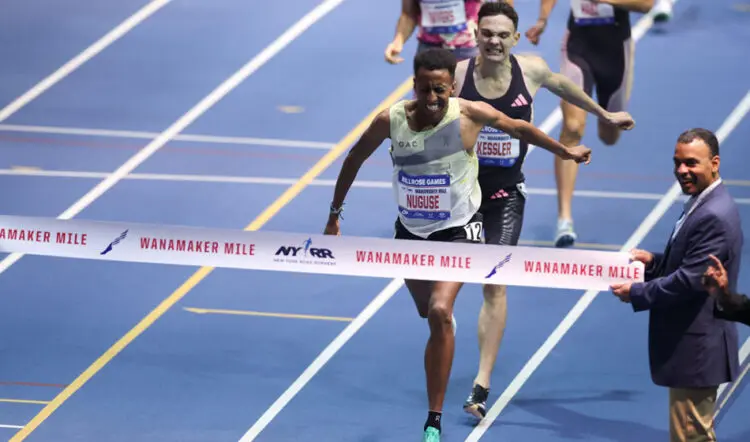
One of the early indications as to how this year might shape up is about to arrive in the form of the Wanamaker Mile at the Millrose Games in New York. It’s an event Nuguse has won for the past two years but he will be coming up against Kerr, to whom he came second over 3000m at the World Indoor Championships in Glasgow last March. Nuguse, second on the all-time list, set his indoor mile PB of 3:47.38 at the Armory in 2023, while Kerr’s PB is 3:48.87 from the previous year.
Along with Ingebrigtsen and Hocker, those two form a formidable quartet that look likely to have the final say in where the big prizes will end up this year. Yet, with athletes such as 2022 world champion Jake Wightman on the comeback trail, young Dutchman Niels Laros growing in stature and another American, Hobbs Kessler, also improving and racing at Millrose, the threats are numerous.
The year will come to a climax with the World Championships in Tokyo in September and it’s telling that Asbel Kiprop, who was banned for doping in 2019, was the last man to win successive world 1500m titles when he took gold in 2015. Since then Elijah Manangoi, Timothy Cheruiyot, Wightman and Kerr have all taken the crown.
“It's insanely deep, and that's what's made this point of 1500m running so much fun,” says Nuguse of the current landscape. “It's basically the best that it's been in many, many years and it has just made me feel really grateful to be a part of it.
Yared Nuguse pips Josh Kerr (Getty)
“You don't want to look back and be like: ‘Man, my era of 1500m running kind of sucked!’. I'm going to look back and think: ‘This was a crazy time for 1500m running’.
“The Olympics was obviously the most evident of how close the four of us were and I think every race for us is going to be different, it's just the little things that are going to determine who wins. But all of us are definitely in contention [for the world title] and I'm definitely going to believe in myself now, especially after last year.
“So much of it is confidence and just believing that you can do that. I'm sure all of us are thinking we’re going to win this and I'm definitely no different. We're all good enough to do it so it's just a matter of who wants it most and who makes the right play on the day.”
Nuguse will also take confidence from the man who has been guiding him since 2022. He is part of the Boulder-based On Athletics Club (OAC) led by Dathan Ritzenhein and, under the watchful eye of the two-time Olympian, has not only won global medals but also become the American record-holder over 1500m and the mile.
“My relationship with Dathan has always been good,” says the 25-year-old. “From the beginning it felt like he really knew what he was doing and was able to train me well without overdoing it, which I really appreciate. I'm not quite the ‘hundreds of miles a week distance runner kind of guy’, so it really helps that the coach understands that and really believes in you the way that you believe in yourself a lot of the time.
“He'll tell me: ‘You can win this race. You’ve got to just believe in it and make it happen’, and it's good hearing it from someone else that knows how I've been training and knows how good I am because, a lot of the time, it carries a little more weight. I've always appreciated Dathan.”
Nuguse will also be part of one of the most talked about additions to the athletics calendar this year – Grand Slam Track. He, Kerr and Hocker are all signed up to compete in the four-event series that will see them all tackle both the 800m and 1500m.
For the former, racing the short distance will be another sizeable step outside of his comfort zone.
Yared Nuguse and Hobbs Kessler (Getty)
“I'm very excited to see how Grand Slam goes because I feel like it's something completely new,” he says. “In my second year [as a pro] I thought: ‘Wow, you kind of just do the same things over and over again. The same races, same people’, but I think Grand Slam turns that on its head a little bit.
“I get to race the guys who I know are the best and really hone my racing skills against them versus just straight out time trialing like most other races I do are. I think I'm better at the 800m than I give myself credit for. I have a lot of confidence in the 1500m, but not so much in the 5000m or 800m but that's okay because I know I am fit.
“I think a lot of the time 800m races are just very aggressive and I bogged down in a lot of aggressive kind of races. So maybe I'll finally learn to get at least a little aggressive myself and not get caught up at the back, but we will see. I'm excited. I think I'm going to do well. It'll definitely help me hone a little more speed and more racing tactics, because even though I have learned a lot, I think there's always more to learn.”
Nuguse’s opponents should take note, though. There is an ever growing body of evidence to suggest that the quiet man is capable of making a big noise.
“I've been through so many very serious moments and races and experiences where I feel more confident coming into those spaces than I ever did when I first joined OAC as a professional runner,” he says. “I think a lot of the time I was nervous but now I've done a World Championships, I've done an Olympics, I got a medal, so it feels like nothing can really surprise me any more. It’s just growing a little older and wiser.”
This interview first appeared in the February issue of AW magazine, which you can buy here, and was done before his world indoor mile record at the Millrose Games on February 8
Glasgow 2026 to boost Scotstoun's athletics legacy
The stadium will be host to the athletics during the scaled-back version of the Commonwealth Games
With the 2026 Commonwealth Games officially set for Glasgow, Scotstoun is poised to take centre stage as it hosts the athletics in the scaled-back event.
Known for its distinctive blue track, the stadium plans to expand its current capacity from 4765 to accommodate between 10,000-11,000 spectators with temporary seating.
The decision to host the Games in Glasgow comes after the Australian state of Victoria withdrew due to rising costs.
Glasgow has a strong track record in hosting the event, having successfully managed the Games in 2014 with the athletics taking place at Hampden.
Hampden accommodated 40,000 athletics fans while the Alexander Stadium in Birmingham welcomed 30,000 for the Games in 2022.
Scotstoun's more intimate setting will be a unique atmosphere as the smaller version of the Games will be distinctly different.
Scotstoun Stadium (Getty)
AW spoke with Jon Doig OBE, the Chief Executive of the Commonwealth Games Federation Scotland at the official launch of the Games in Glasgow. He said: "We have been working on this for just under 12 months, looking over it in terms of the concept and if we could go through and deliver it.
"The earliest thing we had to look at was athletics and whether we could deliver athletics in Scotstoun Stadium and the answer we got back in terms of feasibility was yes.
"We have obviously already got a main stand at Scotstoun but the rest of the seats will be wrapped around with temporary seating.
"The temporary seating will take the number to 10,000-11,000 and in that aspect we can create an absolutely brilliant atmosphere when the athletes are competing and running around."
Dwain Chambers (Getty)
The stadium holds a historic legacy in athletics that dates back to the late 1890s, when it first hosted cross country events.
From 1903 to 1913, the Scottish National Cross Country Championships took place annually at Scotstoun, with the exception of 1907, when they were held in Portobello, Edinburgh.
It has also been the home of Victoria Park AAC since its foundation in 1930.
Since its renovation with the all-weather track in the mid-90s, the stadium has hosted numerous prestigious events.
The British Milers' Club held grand prix meetings at the stadium in 1999, 2000 and 2001, attracting top athletes from across the UK.
International events were also held, including in 2000 when Great Britain & Northern Ireland took on the USA, in 2003 it was Great Britain & Northern Ireland v USA v Russia and, in 2005, the same three nations challenged each other again.
The stadium also welcomed the Scottish Senior Championships from 2001 to 2007, along with various other competitions, including the Combined Events Championships (2002) and the Masters Championships (2006).
The last major event that was held at the Glasgow stadium was the Norwich Union Glasgow Grand Prix in 2007. In 2014 the stadium was used as a training venue for the Commonwealth Games.
Kelly Holmes (Getty)
Today, Scotstoun remains the home of Victoria Park AAC, but it also shares the space with Glasgow Warriors rugby club, which has taken a prominent role in recent years.
The focus on rugby has limited the staging of large-scale events, as the Warriors require exclusive access for their fixtures, often setting up temporary stands on the track.
However, the announcement of Scotstoun as the host for the 2026 Commonwealth Games could signify a shift in this trend. As Doig says: "Scotstoun has a very long history of athletics and it has been there for over 100 years in different ways and hosting international events.
"It is great that we can bring athletics back to the stadium and hopefully we will be able to leave a legacy there as well for athletics.
"It will be a completely different Games compared to 2014, we are in different times but it will still be exciting and a world-class event. This is a reset and re-imagination.
"This will not only inspire the athletes who are competing to get good performances but it will also inspire the youngsters who will be in the crowds feeling inspired.
"We've had a number of our athletes that were in the stands in 2014 now making Scottish and GB teams so we look forward to that stimulus being there in the future."
» Subscribe to AW magazine here, check out our new podcast here or sign up to our digital archive of back issues from 1945 to the present day here
Fast times for Mboma and Thompson-Herah at Diamond League final
Women's sprints in Zurich see 10.65 for Jamaica's Olympic champion and 21.78 for Namibian teenager as Keely Hodgkinson wins the 800m in 1:57.98
The Wanda Diamond League final, held at the Weltklasse meeting in Zurich on Thursday night, lived up to its billing as the greatest one-day meeting in the world with one stunning women's track event after another.
The 100m might not have been as quick as the Olympic final – Elaine Thompson-Herah running a superb meeting record 10.65 compared to her 10.61 in Japan – but the depth was comparable as fifth place clocked 10.94 compared to 10.97 in Tokyo.
Dina Asher-Smith, who is improving race by race after her injury struggles this summer, started quickly and was level with the Jamaican until 60m as Thompson-Herah began to pull away. The Briton's run of 10.87 in second place was not only a season's best but also equal to her third-best ever time, only bettered by her Doha silver (10.83) and Berlin European gold (10.85).
It was close for third, with well-matched rivals Ajla del Ponte and Daryll Neita sharing 10.93 (the Swiss edging it by four thousandths of a second) just ahead of Mujinga Kambundji's 10.94.
This was the first time two British women had run under 11 seconds in the same 100m race as Neita again improved her PB.
Thompson-Herah said: "It has been a crazy season, a long one and a tiring one. I was so consistent because I was just keeping the faith in me and did not allow any negativity. I would describe this season with one word: amazing, yet with ups and downs.
"The audience was very warm and cheerful, I wish we had had so many people to cheer in Tokyo on the finish line. It was a long season but, next year, the world record is definitely on my mind."
While the 100m saw a clear and dominant winner, the 200m was a superb battle that went to the wire and resulted in yet another world junior record for Christine Mboma.
Asher-Smith ran the best bend and led into the straight but, gradually, Olympic 100m bronze medallist Shericka Jackson edged ahead in what is her best event when she does not ease off in races prematurely!
This time, unlike her Olympic heat, she held her form and ran through the line. However, while Jackson finished fast, Mboma was faster. Her performance followed a familiar pattern of a relatively sluggish bend followed by an incredible straight and her time of 21.78 (0.6) was another world under-20, as well as African, record.
"When I crossed the finish line, I did not know that I had won," said Mboma, who had to switch to the half-lap event from her favoured 400m earlier this summer due to DSD regulations. "Then I just saw my name and I was like: 'Wow!'
"This season was quite tough and very busy. I did a lot of races so now I am feeling a bit tired. This trophy means a lot to me. I am glad I was able to run here and get this victory, but I still have some two more competitions in my schedule."
Jackson was rewarded with a PB 21.81, edging her previous 21.82, while Asher-Smith held on to third in 22.19 just ahead of Kambundji's 22.27 for her second top-three finish of the night. Britain took three of the top six places, with Neita completing a memorable evening with a PB 22.81, just ahead of Beth Dobbin's 22.88.
“It’s been a great evening for me and I’m super happy. I was hoping for a slightly faster 200m but honestly, after running a 10.8 100m, I’m taking whatever!”@dinaashersmith on her night at the DL final in Zurich. #WDLFinal 🇨🇭 pic.twitter.com/0zAUoCCEkD
"It's been a great evening for me and I'm super happy," said Asher-Smith in what was her final event of the season. "I was hoping for a slightly faster 200m but, after running a 10.8 100m, I'm taking whatever."
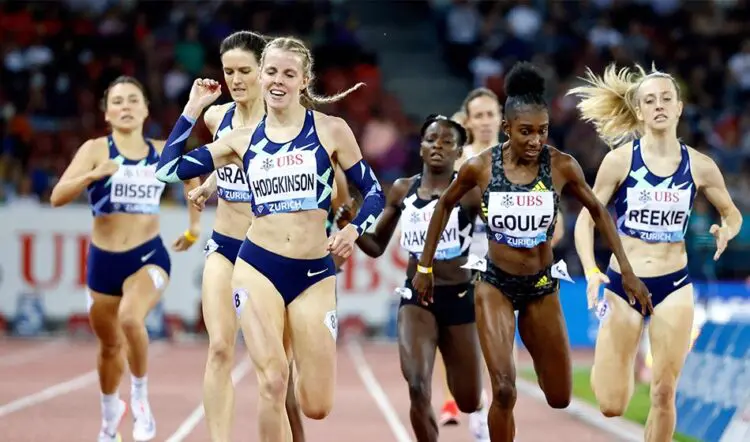
In the Brussels 800m, Olympic silver medallist Keely Hodgkinson narrowly lost to Natoya Goule and the Zurich race looked like following a similar pattern. Noelle Yarigo led through 400m in 57.11 before Goule took command down the backstraight and reached 600m in 1:28.63, with Hodgkinson on her shoulder and Jemma Reekie clawing the inside and shortest route.
Also as in Brussels, Goule eased back a little on the final bend and kicked in the final straight again but this time Hodgkinson was closer, had not run as wide and was able to ease past to win comfortably in 1:57.98, with Kate Grace catching Goule as both ran 1:58.34.
Reekie maintained her consistency with fourth in 1:58.61, again beating world champion Halimah Nakaayi (1:58.89) and 1:56.71 performer Habitam Alemu.
Keely Hodgkinson wins in Zurich (Getty)
To the relief of Britain's other 800m runners, Hodgkinson's third-fastest time ever sealed her World Championships place for next year and leaves three qualifying spots remaining. She said: "My aim here today was to win and it was not going to be easy with a field which is very strong. I just wanted to make sure I gave it my all.
"It was my last race [of the season], so I think I did that, and to come home with a win, it's the icing on the cake really. Now I am going home and I am going straight on a plane [to Greece], and I am not going home for 10 days. I don't want to see a track for those 10 days and I am leaving my running shoes at home."
“This season’s been crazy and I couldn’t be happier really. I feel like I had the strength in the last 150m [tonight] and it was a good race!” @keelyhodgkinson reflects on a spectacular 2021. #WDLFinal 🇨🇭 pic.twitter.com/wnvWUopDK6
There were no records in the women's 1500m, though the final 300m of 42.92 was one of the fastest ever as the world champion Sifan Hassan again did battle with the Olympic champion Faith Kipyegon.
Chanelle Price did her usual good job of 63.32 at 400m and 2:08.94 at 800m but had to slow down as clearly no one was interested in the advertised 2:06 pace. The field slowed even more through 1200m, in 3:15.41, before Kipyegon picked things up considerably with Hassan looking strong on her shoulder.
As they came into the straight, it seemed like the Dutch athlete might get by but the Kenyan showed her usual determined finish and eased away in the final 10 metres to take first in 3:58.33 to the Olympic 5000m and 10,000m champion's 3:58.55.
Kipyegon was second to Hassan in Doha in 2019 and lost to her rival in her opening 1500m in Florence this year but, just as in Monaco and Tokyo, she proved herself the best current or indeed greatest ever 1500m runner with her last 200m of 28.0.
"I knew it would be a tactical race today and we gave the leading girl a big gap," said Kipyegon. "I was controlling the pace in front. I was confident that in the last lap I could do better and it worked. This is my second Diamond League Trophy and my first as a mother. I won almost all my competitions including the Olympic final."
Hassan said: "Faith is really one of the greatest athletes and I wanted to give everything in my last race. This year I struggled with my training, I could not go to the US. Next year, I will train my speed and I will be amazing."
Josette Norris, who ran the 5000m in the US Olympic Trials where she placed eighth, continued her great post-Olympic form by easily being the best of the rest with third place in 4:00.41. Katie Snowden was ninth in 4:06.48.
The women's 100m hurdles provided another track highlight with three of the top four setting PBs.
Nigerian Tobi Amusan won in an African record 12.42 (0.4) and the Olympic fourth-placer beat fifth-placer Nadine Visser's Dutch record 12.51. Megan Tapper was third in 12.55 ahead of Payton Chadwick's PB 12.62, with Britain's Cindy Sember a solid fifth in 12.71.
The women's 400m started the track final programme and it featured an exciting four-way race for the title. It seemed that the reward of a guaranteed World Championships place gave American champion Quanera Hayes the added stimulus of winning and her 49.88 – close to her 49.78 season's best – gave the Olympic seventh-placer a narrow win over Toyko silver medallist Marileidy Paulino's 49.96. Sada Williams was third in 50.24, just edging Stephenie Ann McPherson's 50.25.
The women's steeplechase was also competitive, with six athletes together at the bell. The first kilometre was run in 3:00.23 though the pace dropped and Norah Jeruto was ahead at 2000m in a slow 6:08.10.
On the last lap Jeruto, who missed the Olympics, maintained her unbeaten record with a very strong last lap to win by around eight metres in 9:07.33.
Hyvin Kiyeng, the Olympic bronze medallist, looked in contention until the final water jump but landed flat-footed and effectively lost her eventual final margin to Jeruto as she went deep in the water. However, she did well over the final barrier to repel the challenge of Tokyo runner-up Courtney Frerichs – 9:08.55 to 9:08.74.
Olympic champion Peruth Chemutai was seventh in 9:20.16, equalling her Diamond League best of the year.
In the 400m hurdles, Femke Bol resumed her battle with Shamier Little and again it was the Dutchwoman who came out on top as she set a meeting record 52.80. Little looked menacing as she hit the straight level but Bol, keeping her form superbly, eased away to win by half a second from the American's 53.35, with Anna Ryzhykova's 53.70 beating compatriot Viktoriya Tkachuk's 53.76 PB.
Bol said: "Before the race I made a plan with my coach to get a good time and win with the meeting record and I got both. On the last 100m I was full of lactic acid, I had to push so hard. I wanted to win so badly, I heard the crowd cheer. It gave me so much energy.
"It is great to run such a time this late in the season. It is amazing – I won all the Diamond League meetings and I won here. My season is really a dream! Everything I could dream about came true this season."
To read about day one of the Diamond League finals in Zurich, CLICK HERE
» For the latest athletics news, events coverage and updates, check out the AW homepage and our social media channels on Twitter, Facebook and Instagram
Final push to save Willesden’s indoor track
Plans to turn their winter training home into a gym are on hold, but hundreds of young athletes have until Friday to make the case for keeping it.
Brent Council has paused plans to remove the indoor track at Willesden Sports Centre in north-west London, with campaigners urging supporters to make their voices heard by 5pm on Friday November 20.
The council says it will hear further representations before a decision is taken by November 25. The BBC reported that its chief executive, Kim Wright, said the council had decided to “listen further before a decision is taken” after some communication with stakeholders had suggested a decision had already been made.
The track is due to go as part of a £1.4 million investment package to modernise the centre’s gym and fitness facilities. The indoor 60m track, known as the running tube, would be reconfigured into an enlarged gym, growing it from about 110 fitness stations to 172. Track Academy, a charity based at the centre, says it was told in June that the track would close within weeks, while opposition councillors said the decision, originally approved in June, was not included in cabinet papers or communicated to athletics groups beforehand.
Track Academy says it supported 519 young people in the past year, including 259 on the indoor track in January alone. It says 58% of its participants are girls, 64% come from low-income families and 90% are from Black, Asian, mixed and other minoritised ethnic backgrounds.
Chief executive Patrik Ewe has described the track as “a vital safe space for our community” and says the alternatives offered are not like-for-like. Campaigners say groups such as Queens Park Harriers also use the facility.
Three-time Olympian Adam Gemili has backed the campaign, telling BBC London that the loss of indoor facilities is making winter training harder for athletes.
Brent’s own equality impact assessment identifies adverse impacts on girls, disabled young people and ethnically diverse communities, while also identifying potential benefits for those groups and for others, including older people and people with long-term health conditions. The council acknowledges that the alternatives – mainly the centre’s four-court hall and a proposed multi-use space – are not like-for-like replacements for indoor athletics. Liz Dixon, cabinet member for community safety and public health, said Track Academy would still have access to indoor provision and that the outdoor 400m track is not affected.
The council also points to usage figures. It says the tube has not been used in its original 60m indoor athletics configuration since Covid, and that formal athletics bookings average about 6.5 hours a week over about 34 weeks a year, although it acknowledges that informal and weather-dependent use is not captured in those records.
Ewe said a petition, which campaigners say has been signed by more than 1,500 people, and a joint letter from the leaders of the council’s Liberal Democrat and Green groups had urged the council to pause the work. Existing and recent past users, including clubs, organisations and individuals, can respond by emailing [email protected] before the deadline, and representations already submitted will still be considered. Supporters can also sign the petition on the Track Academy campaign page, which offers a pre-filled email to send to the council’s leisure team.
Parent Ana Perez, whose children have trained extensively at the track, said on the campaign page: “It would truly be an absolute shame to lose the indoor track.”
Wakefield and Davies on top at Brampton to Carlisle
Harry Wakefield, usually at his best in relays, ran his fastest 10 miles by some three minutes to beat two Morpeth rivals in the Cumbrian rain, while Esme Davies retained the women’s title.
BRAMPTON TO CARLISLE 10, Cumbria, November 15
Wind-free conditions but steady rain greeted the runners in this traditional point-to-point course, where times are not counted for record purposes due to the directional nature of the course.
That did not stop Harry Wakefield posting his fastest ever time for the distance when handing out a solid defeat to the Morpeth pair of Chris Coulson and now veteran Carl Avery.
The Salford Harrier’s 47:47 clocking was some three minutes inside his previous time over the distance. He has, until now, made his mark over shorter racing distances, although he did post a fastest stage time in this year’s Welsh Castles Relay over 9.6 miles.
Brampton to Carlisle 10 mile Road Race (David Hewitson)
The 37-year-old was fastest in the North of England cross-country relays in Graves Park last month and is always at his best when running for his club in relays.
The women’s race also saw a runaway winner as Border’s Esme Davies won by more than two minutes over Steph Pennycook after a 54:05 clocking, her fastest over the distance.
Davies successfully retained her title here after a 54:27 clocking in 2025, in a race where Pennycook was a close second after winning here in 2024.
Harry Wakefield (David Hewitson)
Overall (point to point): 1 H Wakefield (Salf) 47:47; 2 C Coulson (Morp) 48:23; 3 C Avery (Morp, M40) 48:55; 4 M Brown (Salf) 49:29; 5 L Taylor (Leeds) 49:33; 6 J Birmingham (Salf) 49:47; 7 S Hancocx (Morp) 49:45; 8 A Baker (W Tempo, M40) 49:51; 9 J Monk (B’burn) 50:08; 10 J Doherty (St Hel, M40) 50:24; 11 A Sayers (Crook) 50:34; 12 G Lowry (Morp) 50:47
M40: 4 T Cornthwaite (Salf) 51:08; 5 J Anderson (NSP) 52:02
M45: 1 M Kearney (Elvet) 54:37
M50: 1 A Wright (PH RC) 54:43; 2 L O’Hare (C’nauld) 54:48
M55: 1 W Pearson (Elvet) 57:44
M60: 1 G Illingworth (Kesw) 61:02
Esme Davies (David Hewitson)
Women: 1 E Davies (Border) 54:05; 2 S Pennycook (Leeds) 56:08; 3 R Brown (Border, W40) 56:16; 4 G Tindall (R4U) 56:41; 5 L Armoush (Leeds, W35) 57:01; 6 H Warburton (Tyne Br) 58:41; 7 H Lawrence (Morp) 58:50; 8 L Rank (Morp) 59:12; 9 E Neil (Eden, W40) 59:20
W50: 1 L Osborn (Kesw) 66:31
W55: 1 L Finlay (Dumf) 62:33
BATTERSEA PARK HALF-MARATHON & 5km, November 15
Overall (13.1M): 1 J Clements-Nash (Herne H) 68:57; 2 J Edgerton (C&C) 69:30
M50: 1 V Makkar (S Lon) 79:02
Women: 1 L Holt (Wilms) 79:18
Overall (5km): 1 M Clark (Norw, U20) 15:00; 2 W Percival (Norw) 15:12; 3 T Clerkin (Herne H, U17) 15:39
Women: 1 H Lewis 17:28
BRIGHTON 10km, East Sussex, November 15
Overall: 1 J Hobbs (B&H) 29:49; 2 C Gibbens (Ton) 29:58; 3 J Moynihan (C&C) 30:01; 4 C Charleston (AFD) 30:35; 5 R Hoyte (Phoe) 30:55; 6 T Doran (AFD) 31:04; 7 M Waddington (Ware) 31:09; 8 C Walker (Ports) 31:11
M40: 1 A Jones (Ports) 31:17; 2 J Connor (B’wood) 31:32
M50: 1 O Gosden (G&G) 34:01; 2 C Compton 34:04; 3 N Tufnell (B&W) 34:24
M55: 1 T Mardall 34:17
M60: 1 A Ridley (Phoe) 35:30; 2 C Ridley (Col H) 37:00
M65: 1 K Myazaki (AFD) 38:57
Women: 1 D Glover (Fram, W35) 33:09; 2 P Law (Strag) 33:33; 3 K Estlea-Morris (AFD) 33:54; 4 M Trafford (Phoe) 34:18; 5 H Dos Santos (Vegan) 34:42; 6 F Weddell (St Alb) 34:52; 7 J Judd (Chelm) 35:15; 8 R Navesey (Ports) 35:23
W40: 1 N Evans (Ton) 37:07
W45: 1 E Leggate (C&C) 36:04
W50: 1 C Coulon 38:10
W55: 1 C Carter (New J) 40:10; 2 C Hoyte (Arena) 41:14
DERBY 10, November 15
Overall: 1 B Draper (NEB) 52:15; 2 J Wragg (Roth) 53:46; 3 T Aldridge (Ruge) 53:52
M45: 1 M Blair (Mansf) 54:35; 2 D Hawley (L Eaton) 54:39
M50: 1 M Ince (BRAT) 55:34
M55: 1 C Nicholl (Derb Tri) 57:45
M60: 1 R Billington (Desf) 63:30
Women: 1 M Robinson (BRAT) 56:20; 2 C Frankland (W End, W35) 57:40; 3 R Doherty (Higham, W35) 61:57
W50: 1 N Neville (Steel) 68:15
FULHAM 10km, London, November 15
After setting a personal best 31:37 in Jarrow last month, Canadian Olympian Gabriela DeBuis-Stafford won again on the roads, this time in 31:52.
Behind, it was Herne Hill’s World Championship middle-distance representative, Katie Snowdon, who took second in 32:04, in her first outing over a longer road distance than hitherto.
In third, Grace Baker continued her comeback to the top table with a massive 32:44 personal best, just a week after winning a Sussex League race.
For the men, it was Denis Kiplagat who comfortably headed Jonathan Escalante-Phillips when winning in 29:14.
Overall: 1 D Kiplagat (KEN) 29:14; 2 J Escalante-Phillips (C&C) 29:43; 3 I Crowe-Wright (B&H) 29:45; 4 D Evans (SB) 29:47; 5 S Jamaal (Lon H) 29:47; 6 J Cornish (HW) 29:49; 7 H Bell (Herne H) 30:02; 8 T Lefroy (B&W) 30:17; 9 K Wilkinson (Kent, M40) 30:29; 10 J Collier (Kent) 30:33; 11 F Conway (Orion) 30:33; 12 S Stevens (Norw) 30:35
M50: 1 W Green (Serp) 31:49
Women: 1 G Debuis-Stafford (CAN) 31:52; 2 K Snowdon (Herne H) 32:04; 3 G Baker (Hast) 32:44; 4 M Gadsby (Norw) 33:20; 5 M Stewartov (CZE) 33:48; 6 E Fennelly (Belg) 33:57; 7 R Weston (Inv EK) 33:58; 8 Maddie Jordan-Lee (AFD) 34:18; 9 I Sweir (TVH) 34:22; 10 H Archer (C&C) 34:22
W45: 1 L Bailey (Strag) 35:39
GOSPORT HALF-MARATHON, Hampshire, November 15
Overall: 1 D Hawkins (Newb) 69:27; 2 R Weston (Guern) 69:56; 3 J Baker (Chich R, M45) 72:32
M50: 1 J Isherwood (Fareham) 78:19
M60: 1 K Gale (Denm) 84:00
M65: 1 D Esposito (Mid M) 89:33
M70: 1 M Hargreaves (Ports) 97:31
Women: 1 L May (Farn R) 84:41
W50: 1 V Sesto (N For) 88:53
W55: 1 A Martin 94:05
WIMBORNE 10, Dorset, November 15
Overall: 1 J Cole (B’mth) 52:38; 2 T Corbin (Poole) 54:23
M50: 1 B Underwood (Poole) 55:11
M70: 1 H Murray (Purb) 72:32
Women: 1 M Johnson (Eg H) 60:56
YORK 5km SERIES, North Yorkshire, November 13
Overall: 1 J Dagar (Leeds) 14:35; 2 L Davis (W Tempo) 14:41; 3 B Hodgson (B’ham) 14:49; 4 C Gateley (Hali, U20) 14:54; 5 J Largey (Darl) 14:55; 6 F Friedersdorf (Leic C, U20) 14:57; 7 A Robson (H’gate, U18) 14:58; 8 B Marr (Morp) 15:00
M40: 1 B Jarvis (Holmf) 15:21
M45: 1 W Singleton (Barns) 15:51
M50: 1 C Jones (R&Z) 16:38
U18: 2 T Matthews (H’gate) 15:02
Women: 1 N Drakeford (Barns) 16:59
W60: 1 D Broom (Peni) 21:32
FRASERBURGH HALF-MARATHON, Fraserburgh, November 15
Women: 1 Margarita Radeva 81:15; 2 C Cook (Metro) 86:39
W40: G Horne (Metro) 89:48
W50: Marie Baxter 98:25
Multi-terrain
FOXTRAIL SERIES, November 14
Overall (13km): 1 A Fraser (NBR, M40) 46:41; 2 N Trowell (NBR, M40) 48:28; 3 E Mullen (Vanity) 48:59
M50: Keith Froude 51:50
M60: R Peppiette (NBR) 56:13
M70: Michael Hurst 59:32
U20: Freddy Fendick 51:47
Women: 1 Erin McFadden 55:29; 2 Mia Lutsch (W40) 55:53; 3 N Hyland (Triw Ed) 57:48
W50: Seona Burnett 61:47
W60: A Binns (Lass) 76:25
GLENTRESS TRAIL HALF-MARATHON, Peebles, November 14
Overall: 1 R Boswood (C’thy) 86:25; 2 Jamie Brogan 98:06; 3 D Carter-Brown (Moorf, M40) 98:16
M50: G Walker (Harm) 1:44:37
M60: J Duffy (Shett) 1:56:41
Women: 1 Isla Cubitt 1:42:23; 2 Rachel Normand 1:47:03; 3 Kim Brechin 1:57:46
W40: L Turner (Edin RW) 2:12:43
W50: H Carswell (Giff N) 2:14:45
W60: Jacqui Donaldson 2:30:31
Fell
DAVE SHINN MEMORIAL ARNSIDE KNOTT, Far Arnside, November 15
Overall (6M/1093ft): 1 W Barton (Amble) 35:54; 2 M Heppenstall (Barl) 36:04; 3 M Briggs (Helm H) 36:33; 4 W Weatherhall (Amble) 36:59; 5 Gareth Winter 37:02; 6 J Hartley (B Combe) 37:41
M40: I Thompson (Helm H) 41:00
M45: J Parsons (Helm H) 43:20
M65: D Griffin (Helm H) 46:30
M70: N Hewitt (Bowl) 56:03
M75: J Taylor (Bowl) 63:14
Women: 1 R Woodhams (Kend) 42:12; 2 S Taylor (Helm H, W45) 43:36; 3 L Mitchell (Helm H) 44:03; 4 K Moore (B Combe) 46:42
PENMAENMAWR, Gwynedd, November 14
Overall (16.1km/594m): 1 C Larkin (N’land F) 69:20; 2 G Roberts (Calder V, M40) 70:47; 3 S Edwards (Eryri) 74:42; 4 T Evans (Meirion, M40) 79:00; 5 A Evans (Denbigh) 81:32; 6 J Brown (Buck, M50) 84:48
M60: T Hall (Eryri) 94:39
M65: G Dawson (Bowl) 96:03
M70: Derek Weaver 1:48:47
Women: 1 J Roberts (GOG TC, W45) 88:02; 2 Becky Hill 90:26; 3 B Shircore (Eryri) 90:47; 4 R Probert (Mynydd D, W55) 90:51
W60: J Scarf (Tod) 1:59:29
W65: K Ayres (Amble) 2:00:26
Student power on show in cross-country league action
Holly Weedall led Birmingham University to team victory at the Midland Women's League, while Oxford University runners filled the first three places in the Chiltern League men’s race as we bring you our weekly round-up from around the UK.
Coverage from the British and Irish Masters Cross Country International in Dublin is here.
BIRMINGHAM LEAGUE, Division 1, Match 1, Northampton, November 14
After some doubts about its availability, Abington Park hosted the joint fixture with the Midland Women’s League Division 1 match, as Rugby & Northampton played host.
It was close throughout in the top-flight match, but the Western Tempo pairing of Peter Molloy and Dom James saw off a challenge from BRAT’s Joe Tuffin and Birchfield’s Alex Burrows to justify their long trip across country from Gloucestershire.
The Tempo pair were always at the head of affairs and it was Molloy who opened out a gap on his three rivals to secure overall victory.
Western Tempo lead Birmingham (Toby Gosnall)
In the final match of last winter, the veteran pair of Phil Wylie and Ed Banks led home the older runners, but here, after a close battle, their positions were reversed as Banks got the nod.
In the team stakes, it was Western Tempo who came out on top of Birmingham University, but it was the students who closed their scoring six in first as, again, the positions from last winter were swapped.
Men: 1 P Molloy (W Tempo) 29:56; 2 D James (W Tempo) 30:00; 3 J Tuffin (BRAT) 30:01; 4 A Burrows (Bir) 30:02; 5 J Lay (R&N) 30:06; 6 F Ward (R&N) 30:13; 7 D Gillett (W Tempo) 30:18; 8 J Wilson (Birm U) 30:21; 9 M Pearce (BRAT) 30:31; 10 J Stolberg (BRAT) 30:37
M40: 1 E Banks (Bir) 32:20; 2 P Wylie (W Tempo) 32:24
U20: 1 E Dowlatley (BRAT) 32:09
Peter Molloy (Toby Gosnall)
TEAM: 1 Western Tempo 68; 2 Birmingham U 83; 3 BRAT 143; 4 Rugby & Northampton 167; 5 Birchfield 178; 6 Warwick U 262
B TEAM: 1 Birm U 289
M40 TEAM: 1 Coventry Godiva 58; 2 Bromsgrove & Redditch 86; 3 BRAT 91
B TEAM: 1 Coventry G 149
BIRMINGHAM LEAGUE, Division 2, Match 1, Burton, Warwickshire, November 14
Burton Dassett Country Park saw Spa Striders play host and Callum Hanlon came out on top for Leamington, but a trio of Loughborough students followed to comfortably take the team race as they packed their six scorers in the top 11.
Men: 1 C Hanlon (Leam) 32:53; 2 F Hart (Lough) 33:19; 3 P Barnes (Lough) 33:54; 4 D McNamara (Lough) 34:05; 5 T Fisher (Strat, U20) 34:19; 6 D Garnett (Strat, U20) 34:52
M40: 1 H Jolly (Strat) 36:04
U20: D Garnett (Strat) 38:21
BIRMINGHAM LEAGUE, Division 3, Match 1, Walsall, West Midlands, November 14
West Bromwich Harriers hosted at Aldridge Common, as the Midland Women’s League second flight match joined in the fun.
Roberto Ortolan won overall but it was second-placed Jamie Hudson who led new club TRX Wolves to a solid victory, also taking the B and masters team awards.
The club states that TRX Wolves is a brand-new England Athletics-accredited running club based in Wolverhampton and was officially founded on February 1, 2026 after evolving from TRX Run Club (The Renegades).
Men: 1 R Ortolan (Sphinx) 33:19; 2 J Hudson (TRX) 33:21; 3 W Irvine (S&SH, U20) 33:50
M45: 1 R Michaelson-Yeates (S&SH) 34:32
The Shotover course at Horsepath finds itself an increasingly popular venue and, as it has been for the past 60 years, was again pressed into service and saw Chiltern Harriers turn the tables on first match winners Milton Keynes, as Wycombe Phoenix took second overall.
Numbers were boosted by Oxford University students who were preparing for their upcoming Blues match against Cambridge University next month and, in the men’s race, the dark blue vests filled not only the first three places home but seven of the top nine.
Chris Parker, Tom Wood and Alex Gruen dominated on what is effectively their home course, but former league winner Richard Slade interrupted the younger runners’ progress with a close-up fourth spot.
It was a similar story in the senior women’s race, where the Oxford University women filled 10 of the top dozen spots.
However, it was league regular Alex Eykelbosch who finished first, ahead of the university’s Tilly Black, while first match winner Kirsten Stillwell, who has come back well in recent years after winning well in under-13 events a decade or so ago, took third.
Topping the veteran lists was Kate Rennie, who might have been picked for the Masters International in Dublin, but here the Dacorum 53-year-old had to be content with a local run-out.
Another veteran missing the Masters International was top W75 Sarah Roberts.
Men: 1 C Parker (Oxf U) 28:52; 2 T Wood (Oxf U) 29:08; 3 A Gruen (Oxf U) 29:15; 4 R Slade (Chilt) 29:18; 5 R Morrow (Oxf U) 29:36; 6 M Falle (Oxf U, U20) 29:38
M40: 1 T Lawrence (Chilt) 32:20; 2 J Farmer (L Buzz Tri) 32:26; 3 S Buckle (St Alb) 32:35
M50: 1 P Gilbert (Wyc P) 34:46
M60: 1 A Turnbull (Bed C) 36:43
U20: S Boyce (Oxf U) 30:48
Div 1
Senior TEAM: 1 Chiltern 2075; 2 Wycombe Phoenix 1931; 3 Milton Keynes 1910
M40 TEAM: 1 Wycombe P 787
U20 TEAM: 1 Mil K 637
Standings after 2 matches:
TEAM: 1 Milton Keynes 3933
M40 TEAM: 1 Wycombe P 1598
U20 TEAM: 1 Milton K 1289
Div 2
Senior TEAM: 1 Oxford U 1036
Standings after 2 matches: 1 QPH 1213
M40 TEAM: 1 QPH 314
Standings after 2 matches: 1 QPH 686
U20 TEAM: 1 Oxford U 365
Standings after 2 matches:
U20 TEAM: 1 Oxf U 365
U18: 1 E Langley-Aybar (Brack) 18:09; 2 L Bray (Wyc P) 18:25; 3 S Cotson (Bic) 18:30
Div 1 TEAM: 1 Wycombe P 146; 2 Bed C 140; 3 Vale of Aylesbury 129
Standings after 2 matches:
TEAM: 1 Bed C 249
Div 2 TEAM: 1 Daventry 79
Standings after 2 matches: 1 Daventry 131
U16: 1 L Dolan (VoA) 11:59; 2 E Rowe (Wyc P) 12:09; 3 N Spruce (Abing) 12:09
Div 1 TEAM: 1 Vale of Aylesbury 197; 2 Chiltern 185; 3 Mil K 182
Standings after 2 matches:
TEAM: 1 VoA 418
Div 2 TEAM: 1 Abingdon 49
Standings after 2 matches: 1 Abingdon 99
U14: 1 W Clasby (Chilt) 9:25; 2 H Gutteridge (VoA) 9:33; 3 W Goode (Banb) 9:38
Div 1 TEAM: 1 Chiltern 210; 2 Mil K 192; 3 Watford 161
Standings after 2 matches:
TEAM: 1 Chiltern 415
Div 2 TEAM: 1 Abingdon 76
Standings after 2 matches: 1 Luton 134
Women: 1 A Eykelbosch (Dac) 20:03; 2 T Black (Oxf U, U20) 20:35; 3 K Stillwell (Wyc P) 20:50; 4 C Tan (Oxf U) 20:56; 5 E Davey (Oxf U) 21:03; 6 H Clayton (Oxf U) 21:09
W50: 1 K Rennie (Dac) 22:15; 2 B Nkoane (Chilt) 24:28
W60: 1 V Sheldon (VoA) 26:58
W70: 1 I Wilson (Gade) 30:00
W75: 1 S Roberts (Dac) 30:54
U20: 2 Y Grant (Oxf U) 22:08
Div 1
Senior TEAM: 1 Wycombe P 864; 2 Dacorum 820; 3 Chiltern 812
W35 TEAM: 1 Dacorum 539
U20 TEAM: 1 Milton K 446
Standings after 2 matches:
Senior TEAM: 1 Wycombe P 1750
W35 TEAM: 1 Dacorum 1072
U20 TEAM: 1 Mil K 446
Div 2 TEAM: 1 Oxf U 555
W35 TEAM: 1 Diamond R 249
U20 TEAM: 1 Oxf U 310
Standings after 2 matches:
Senior TEAM: 1 Northampton 590
W35 TEAM: 1 Diamond 434
U20 TEAM: 1 Oxf U 310
U18: 1 A Lorimer (Oxf C) 16:57; 2 E McGinley (Wat) 17:04; 3 M Davis (Chilt) 18:20
Div 1 TEAM: 1 Watford 62; 2 Oxf C 58; 3 VoA 56
Standings after 2 matches:
TEAM: 1 Watford 143
Div 2 TEAM: 1 S&NH 31
Standings after 2 matches: 1 S&NH 56
U16: 1 M Peasgood (VoA) 13:55; 2 J McDougal (Chilt) 14:00; 3 A Rochester (Wat) 14:14
Div 1 TEAM: 1 Chiltern 149; 2 VoA 140; 3 Bed C 124
Standings after 2 matches:
TEAM: 1 Chiltern 335
Div 2 TEAM: 1 Luton 41
Standings after 2 matches: 1 Abingdon 73
U14: 1 I Murphy (Bed C) 10:19; 2 C Willson (Chilt) 10:31; 3 L Nevzat (Bed C) 10:42
Div 1 TEAM: 1 Bed C 167; 2 Chiltern 144; 3 Wycombe P 140
Standings after 2 matches:
TEAM: 1 Bed C 387
Div 2 TEAM: 1 Biggleswade 24
Standings after 2 matches: 1 Bracknell 48
Overall Div 1 TEAM (M&W): 1 Chiltern 3727; 2 Wycombe Phoenix 3412; 3 Milton Keynes 3280
Div 2 TEAM: 1 Oxford University 1591
Standings after 2 matches:
Div 1: 1 Chiltern 7207; 2 Wycombe P 6868; 3 Milton Keynes 6857
Div 2: 1 Northampton 1778
Jed Starvis (Richard Craig-McFeely)
KENT CROSS-COUNTRY LEAGUE, Match 3, Bexley, November 14
Danson Park played host and Jed Starvis of Blackheath & Bromley was top under-20 and first over the line in the men's race as Jordan Chambers of Tonbridge was runner-up.
For this fixture the women had a weekend off, while the fourth match sees the men miss out.
Men: 1 J Starvis (B&B, U20) 26:23; 2 J Chambers (Ton) 26:45; 3 A Taylor (Bex) 26:47; 4 C Laing (Ton) 26:49; 5 A Martin (B&B, U20) 27:07; 6 D Poungui (Camb H) 27:13; 7 D Kendall (Camb H, M45) 27:18; 8 H Fage (B&B) 27:23
M45: 2 J MacDonald (Camb H) 27:58
M50: 1 B Shearer (Ton) 28:13
M60: 1 A Rodgers (M&M) 31:11
TEAM (4 to score): 1 Tonbridge 30; 2 Blackheath & Bromley 36; 3 Cambridge H 51
U18: 1 E Banwo (Ton) 17:23; 2 B Cook (M&M) 17:36; 3 K Farrell (B&B) 17:39
TEAM: 1 B&B 12; 2 Tonbridge 23; 3 Medway & Maidstone 27
U16: 1 Z Evans (B&B) 14:26; 2 J Leader (Ton) 14:29; 3 S Shearer (Ton) 14:30
TEAM: 1 Tonbridge 10; 2 B&B 16; 3 Central Park 40
U14: 1 J Tyrrell (Ton) 10:53; 2 W Smith (Camb H) 10:56; 3 M Foster (Camb H) 11:02
TEAM: 1 Tonbridge 17; 2 B&B 25
Overall W65: 1 C Costiff (Ashf) 26:56; 2 J Lenton (Orp) 27:13
W70: 1 E Batty (Cant) 29:54
U18: 1 S Alden (Weald Tri) 19:37; 2 M Cummings (Camb H) 20:35; 3 P Hutchings (Ton) 20:41 TEAM: 1 Tonbridge 17; 2 B&B 27; 3 Cambridge H 28
U16: 1 C Foster (Camb H) 15:08; 2 L Sanders (Camb H) 16:05; 3 J Stephens (B&B) 16:35
TEAM: 1 B&B 16; 2 Camb H 16; 3 Tonbridge 20
U14: 1 S James (B&B) 12:06
TEAM: 1 Blackheath & Bromley
HAMPSHIRE LEAGUE, Match 2, Wokingham, Berkshire, November 14
Again, the league strayed outside the county of its title as Dinton Pastures Country Park was pressed into service by hosts Reading AC.
Millie-Ann Jordan-Lee scored a repeat victory in the league after also taking the opening fixture, but Aldershot were headed in the team stakes by Winchester Running Club, who had Helen Hall home second, 60 metres down.
Jordan-Lee has not been afraid to race this year, with a string of PBs on the track and road as well as outings over the country.
Aldershot had earlier taken other wins in the under-14 and under-16 girls’ races through Isabelle McNair and Koko O’Neill.
For the men, Tom Chandler, who was 13th in the 2026 Inter-Counties, notched up a second victory of the campaign
Men: 1 T Chandler (AFD) 27:18; 2 S Wilkinson (Win RC, U20) 27:37; 3 R James (Soton) 27:41; 4 S Hudson (Soton U) 27:50; 5 C Wilson (Win RC, U20) 28:00; 6 R Corney (Read RR) 28:04
M40: 1 L Jolly (Read) 28:55 M50: 1 A Rennie (Read) 30:56 M60: 1 M Webber (And) 34:16 Div 1 TEAM: 1 Winchester RC 52; 2 Southampton U 75; 3 Basingstoke & Mid Hants 96 Div 2 TEAM: 1 Andover 311 Div 3 TEAM: 1 Portsmouth U 340 M40 TEAM: 1 Reading 12; 2 AFD 19; 3 Winchester RC 29 U18: 1 E Galloway (Ports) 18:53; 2 T Moore (BMH) 19:21; 3 T Saville (Win RC) 19:27 TEAM: 1 Fleet &C 25; 2 Portsmouth 29; 3 Basingstoke & Mid Hants 30 U16: 1 R Weeks (AFD) 14:49; 2 H Samways (Poole) 14:50’ 3 W Stock (Win &D) 15:10 TEAM: 1 Winchester & D 25; 2 Reading 33; 3 BMH 52 U14: 1 Z Armitage (N For J) 10:54; 2 J Holt (Win SD) 11:22; 3 H Mariner (Soton) 11:27 TEAM: 1 Southampton 20; 2 Winchester & D 28; 3 Reading 44
Women: 1 M Jordan-Lee (AFD) 20:45; 2 H Hall (Win RC) 21:00; 3 I Lee (Win RC) 21:28; 4 F East (Ports, U20) 21:33; 5 A Morris (Win RC) 22:03; 6 A Lawrence (B’mth) 22:04
W40: 1 L Wright (AFD) 22:24
W50: 1 E Montiel (Ports) 24:59
W60: 1 L Elliott (Win RC) 22:28
U20: 2 E Phillips (Win RC) 22:56
U18: 1 A Klidjian (Ports) 21:30; 2 C Oakley (Ports) 22:44; 3 A Spiers (BMH) 23:11
TEAM: 1 Portsmouth 10; 2 Southampton 21; 3 BMH 32
U16: 1 K O’Neill (AFD) 16:51; 2 I Shaw (Ports) 16:54; 3 H Saunders (BMH) 17:17
TEAM: 1 Portsmouth 11; 2 BMH 18; 3 Winchester & District 46
U14: 1 I McNair (AFD) 11:33; 2 E Jones (AFD) 11:35; 3 A Ramirez (B’mth) 11:43
TEAM: 1 AFD 18; 2 BMH 21; 3 Southampton 32
MANCHESTER LEAGUE, St Helens, Lancashire, November 14
The match, at Sherdley Park, has been postponed due to issues with permission from the local council and is likely to be rescheduled for March 6.
MIDLAND WOMEN’S LEAGUE, Division 1, Match 1, Northampton, November 14
The match joined forces with the Birmingham Men’s League at Abington Park and it was the students from Birmingham University who dominated.
They were led home by Holly Weedall, as Ava James and Tilly Nickell followed.
Holly Weedall (Toby Gosnall)
It was only the second outing over the country for the 21-year-old, who improved her 5000m best on the track this year to 15:54.10.
In the team stakes it was again the students who came out on top, with Birmingham University again ahead of Loughborough.
Women: 1 H Weedall (Birm U) 20:37; 2 A James (Birm U) 20:41; 3 T Nickell (Birm U) 20:48; 4 E Tate (Gate) 20:54; 5 F Gibbs (Cov G) 20:58; 6 J Emmerson (Cov G) 21:10
W40: 1 N Sykes (B’ville) 22:23; 2 N Eaton (W Tempo) 23:20; 3 J Nolan (B&R) 23:21
Midland Women's League (Toby Gosnall)
TEAM: 1 Birmingham U 23; 2 Loughborough U 44; 3 W Tempo 48
W35 TEAM: 1 CLC 52; 2 Bromsgrove & Redditch 52; 3 Stoke 55
DIVISION 2, Match 1, Aldridge, November 14
The second flight joined forces with the Birmingham League Division 3 at Aldridge Airport, and it was Lola Barker who led the women home, but hosts Aldridge took the team honours.
Women: 1 L Barker (S&SH) 26:49; 2 E McKinlay (Sphinx) 27:02; 3 O Bailey (Nun) 27:11
W40: 1 C Baldwyn (Ald) 28:11
W45: 1 J Evans (Knowle & D) 28:00; 2 D Thomas (Trenth) 28:54
NORTH MIDLANDS LEAGUE, Match 2, Corby, November 14
Glebe Park played host and there was a sense of déjà vu at the head of the senior men’s field as Eliott Smith-Rasmusson again won from Mansfield’s James McRae, as Edward Holden was a distant third.
The women’s race saw 18-year-old Faith Taylor, who was fifth junior in the Parliament Hill leg of the UK Cross Challenge, win comfortably over Aimee Seager.
Men: 1 E Smith-Rasmusson (Newark) 28:34; 2 J McRae (Mansf) 28:45; 3 E Holden (Mansf) 30:03
M40: 1 L Watson (Mansf) 30:18
M45: 1 S Fell (P’boro & NV) 32:40
M50: 1 D Nugent (Mansf) 31:46
M55: 1 T Hartley (Notts) 32:42
M60: 1 J Hunt (Beest) 35:58
U20: 1 W Griffiths (Corby) 30:27
U18: 1 A Paget (R’cliffe) 18:23; 2 L Hemmings (P’boro & NV) 18:26; 3 L Wayman (OWLS) 18:30
TEAM: 1 Rushcliffe 26; 2 Charnwood 27; 3 Burton 72
U16: 1 J Dutton (Burt) 16:45; 2 T Hurry (Notts) 16:51; 3 X Gunn (Yax) 16:53
TEAM: 1 Charnwood 31; 2 Notts 33; 3 Lincoln Wellington 59
U14: 1 H Don (Charn) 12:33; 2 Power (Kett) 12:42; 3 E Hutton (Charn) 12:44
TEAM: 1 Charnwood 20; 2 Derby 22; 3 Lincoln Wellington 31
Women: 1 F Taylor (Linc W, U20) 20:42; 2 A Seager (Charn) 20:56; 3 L Hatfield (Notts U) 21:07
W40: 1 R Taylor (Newark) 22:47
W60: 1 R Loutit (Yax) 24:39
U18: 1 I Bell (Worksop) 18:20; 2 M Cheetham (Burton) 18:48; 3 S Wheeler (Der) 19:14
TEAM: 1 Burton 17; 2 Derby 18; 3 Mansfield 36
U16: 1 M Porter (Linc W) 13:08; 2 E Clifton (Mansf) 13:20; 3 J Riley (Charn) 13:31
TEAM: 1 Lincoln W 12; 2 Mansfield 39; 3 Burton 40
U14: 1 M Coltherd (Wreake) 10:33; 2 D Windle (Linc W) 10:41; 3 S Brumfitt (Mansf) 11:12
TEAM: 1 Lincoln W 13; 2 Wreake 20; 3 Charnwood 31
Flurry Grierson (Mike Lepps)
MET LEAGUE, Match 2, Trent Park, November 14
Flurry Grierson, who was fourth in January’s South of England Championships, moved up from third in the first-round match to run out a narrow winner over Oscar Bell.
His Highgate team increased their victory margin over Victoria Park & Tower Hamlets from the first match to around 200 points.
Molly Bryan scored a repeat win in the senior women’s race and these two wins this year have built on earlier placings in the league in previous years without making the number one slot.
Men: 1 F Grierson (High) 23:23; 2 O Bell (Herts P) 23:28; 3 J Grange (High, U20) 23:52; 4 R Brown (High) 23:57; 5 N Armitage-Hookes (VP&TH) 24:03; 6 S McCauley (Lon H) 24:23
M40: 1 T Aldred (Lon H) 25:52; 2 T Beedell (Lon H) 26:00
M50: 1 R Scott (High) 27:14
M60: 1 R Rigby (SB) 30:52
U20: B Murphy (Herts P) 27:37
TEAM: 1 Highgate 2011; 2 VP&TH 1808; 3 Highgate B 1677; 4 London Heathside 1441; 5 VP&TH 1240; 6 Trent P 1136
M40 TEAM: 1 Trent P 442; 2 Lon H 426; 3 Ealing Eagles 392
U18: 1 K Hussein (VP&TH) 17:09; 2 J Summers (Herts P) 17:21; 3 D Lewis (Hill) 17:36
TEAM: 1 Herts Phoenix 115; 2 VP&TH 96; 3 Shaftesbury 91
U16: 1 L Da Silva (TVH) 15:09; 2 W Godsave (WG&EL) 15:11; 3 J Maiden (Herts P) 15:12
TEAM: 1 Herts P 201; 2 WG&EL 193; 3 VP&TH 167
U14: 1 L Vernal (VP&TH) 12:00; 2 J Geller (WG&EL) 12:09; 3 R Thomas (WG&EL) 12:17
TEAM: 1 WG&EL 217; 2 VP&TH 183; 3 WG&EL B 172
Molly Bryan (Mike Lepps)
Women: 1 M Bryan (VP&TH) 28:02; 2 J Dos Santos (VP&TH) 29:11; 3 D Smith (High) 29:25; 4 K Johnson (High) 29:34; 5 H Davies (VP&TH) 29:37; 6 L Gilbert (WG&EL) 29:40
W40: 1 L Samuels (Ealing E) 30:49
W50: 1 S Judd (Herts P) 34:03; 2 L Faherty (High) 34:09
W55: 1 L Cendrowicz (High) 34:36
W60: 1 K O’Rourke (Hill) 36:47
U20: 1 A Reid (WG&EL) 30:08
U18/U16: 1 L Graham (St Mary’s, U16) 16:12; 2 E Hunt (St Mary’s, U16) 16:28; 3 C Naylor (Herts P) 16:56; 4 R Schofield (Lon H) 16:58; 5 G Peters (Herts P, U16) 17:14; 6 E Broatfoot (VP&TH, U16) 17:18
TEAM: 1 St Mary’s 288; 2 VP&TH 286; 3 Hillingdon 278
U14: 1 A Clements (E&H) 12:51; 2 A Samuels (E&H) 12:56; 3 S Ramdane (WG&EL) 13:03
TEAM: 1 WG&EL 174; 2 Harrow 155; 3 Barnet 140
SURREY LEAGUE, Division 1, Match 2A, Beckenham Place, November 14
The top-flight divisions in the men’s and women’s sections again combined in a match alongside the young athletes at this long-standing host venue, as former overall men’s winners Kent AC hosted.
Jack Kavanagh continued his recent run of league success for Holland Sports ahead of Herne Hill’s Sam Bramwell, but it was third-placed Ollie Fox who led a resurgent Thames Hare & Hounds to team victory over Belgrave Harriers.
Third-placed Guildford & Godalming pushed league holders Hercules Wimbledon down to fourth on the day as they look set to concede their title.
Down in the league basement, Dulwich Runners, Woking and Ranelagh look to be in a battle to avoid a drop at the end of the season.
The women’s race was the final one on the programme and Herne Hill dominated at the front with the first four home, as Lucy Jones led Molly Smith to the line and Ruby Carter and Sophie Tooley followed.
First match winners Belgrave Harriers brought their top three, led by Abbey Brooke, home next but were soundly beaten on the day.
The younger age groups in men/boys and women/girls suffered a considerable drop in numbers from the first match and, in the former, South London and Herne Hill replaced Hercules Wimbledon in the under-18 and under-16 team competitions.
However, it was Herne Hill’s under-18 Lucas Heath who led the combined age groups home while, further back, Thomas Henigan was again top under-16.
For the younger women and under-16 girls, Skyla O’Brien won for Herne Hill as third-placed Daisy Larkin led Belgrave to another team win.
Men (no times): 1 J Kavanagh (Holl Sp); 2 S Bramwell (Herne H); 3 O Fox (THH); 4 N Mapperley (THH); 5 L Ryan (Belg); 6 E McColgan (THH); 7 A Green (Holl Sp); 8 C Reilly (G&G); 9 T Foster (G&G); 10 J Collier (Kent)
M40: 1 P J Hutchins (Wok); 2 C High (G&G)
M45: 1 N Torry (Kent); 2 M McCarthy (Belg)
M50: 1 N Chisholm (THH); 2 C Blackburn (Holl Sp)
M55: 1 I Acreman (G&G)
M60: 1 N Urquia (Herne H)
TEAM (10 to score): 1 Thames Hare & Hounds 215; 2 Belgrave 283; 3 Guildford & Godalming 408; 4 Hercules Wimbledon 432; 5 Holland Sports 438; 6 Herne Hill 455
B TEAM: 1 Belgrave 128
U18/U16 (no times): 1 L Heath (Herne H); 2 W Hughes (S Lon); 3 O Jayasingha (S Lon)
U16: 1 T Henigan (HW); 2 A Williams (HW); 3 T Jones (Herne H)
U18 TEAM (4 to score): 1 S London 119; 2 Hercules W 104; 3 Epsom & Ewell 69
U16 TEAM (4 to score): 1 Herne Hill 197; 2 S London 188; 3 HW 171
U14 (no times): 1 J McCerney (S&D); 2 J Lotter (Herne H); 3 C Jenkyn (S Lon)
TEAM: 1 S London 214; 2 Herne H 207; 3 Woking 129
Women (no times): 1 L Jones (Herne H); 2 M Smith (Herne H); 3 R Carter (Herne H); 4 S Tooley (Herne H); 5 A Brooke (Belg); 6 J Hodder (Belg); 7 A Barbour (Belg); 8 M Coogan (Herne H); 9 S Harvey (G&G); 10 E Warren (G&G)
W40: 1 A Clements (Kent); 2 L Bromilow (Kent)
W45: 1 L Bailey (Strag); 2 C Grima (HW)
W50: 1 M Jovani (Rane)
W55: 1 V Filsell (THH)
W60: 1 R Haydon (Kent)
W65: 1 A Morris (Rei P)
TEAM (7 to score): 1 Herne Hill 51; 2 Belgrave 77; 3 G&G 152; 4 Kent 248; 5 HW 268; 6 S London 324
B TEAM: 1 Belgrave 33
U18/U16 (no times): 1 S O’Brien (Herne H, U16); 2 S Lange (S&D, U16); 3 D Larkin (Belg)
U18 TEAM (4 to score): 1 Belgrave 40; 2 Sutton & D 56; 3 Herne H 68
U16 TEAM: 1 Herne H 31; 2 S London 35; 3 HW 58
U14 (no times): 1 M Clowe-Wilson (Imp); 2 A Frye (K&P); 3 C Saville (K&P)
TEAM: 1 S London 49; 2 Herne Hill 58; 3 Kingston & Poly 77.5
SURREY LEAGUE, Match 2B, Morden Park, November 14
Wimbledon Windmilers moved away from their home venue to host the match in Morden Park, as all of the lower divisions of the league were involved, with three separate senior races, two for the men and one for the second flight of the women.
Alice Crane, who was 13th in the Inter-Counties Championships earlier this year, again won in a league match where the women raced over the shorter of their two race options.
For the lower men’s divisions there was a repeat result, as Felix Vaughan again led South London Harriers to a resounding team win as they look to bounce back from relegation last winter.
Vaughan led a club one-two-three as Harrison Hayman and Paul Bailey followed, and all 10 of their scorers were in the first 20 runners to finish.
The men’s third and fourth tiers raced together, and it was Lingfield’s Ashley Middleton who led them home.
Men Div 2: 1 F Vaughan (S Lon) 24:33; 2 H Hayman (S Lon, U20) 24:55; 3 P Bailey (S Lon) 25:10; 4 P Rodgers (Rei P, M40) 25:12; 5 P Symons (Croy) 25:26; 6 E Sone (S Lon, U20) 25:39
M40: 2 D Gaffney (S Lon) 25:59
M45: 1 B Harrold (S Lon) 26:29
M50: 1 N Atkinson (K&P) 28:31
M55: 1 S Winder (E&E) 28:15
M60: 1 S Chamberlain (S Lon) 33:52
M65: 1 S Bean (E&E) 34:05
TEAM: 1 S London 95; 2 Croydon 320; 3 Epsom & Ewell 407; 4 Clapham Chasers 496
B TEAM: 1 S London 63
Men Div 3 and 4: 1 A Middleton (Ling) 26:07; 2 S Emery (26.2RRC) 26:49; 3 M Cummings (Vets, M40) 26:52
M45: 1 G Dunk (Elmb) 26:54
M50: 1 T Harvey (Ling) 27:51
M55: 1 E Francis (26.2RRC) 29:06
M60: 1 S Corfield (SoC) 30:12
M70: 1 N Critoph (Vets) 32:03
TEAM Div 3: 1 Fulham 148; 2 26.2RRC 334; 3 Striders of Croydon 384
B TEAM: 1 Fulham 68
TEAM Div 4: 1 Elmbridge 140; 2 Sutton R 452; 3 Vets 452
Women Div 2/3: 1 A Crane (MDMV) 21:36; 2 R Keddie (26.2RRC) 22:09; 3 P Rutherfoord (FoT, W45) 22:34; 4 S Pursell (Fulham) 22:54; 5 A Malin (Fulham) 22:56; 6 Z Cowell-Jones (Elmb, W45) 23:08
W40: 1 M Cecconi (E&E) 24:15
W50: 1 L Palmer (Tad) 25:51
W55: 1 S Riddell-Webster (Fulham) 23:14; 2 N Richmond (Dulw R) 25:33; 3 O Balme (Dulw R) 27:09
W60: 1 P Adams (W4H) 27:26
W65: 1 F Shrimpton (Sutt R) 30:57; 2 V Victor (DMV) 33:41
W70: 1 S Smith (Dulw PR) 31:35
Div 2 TEAM: 1 Fulham 140; 2 Epsom & Ewell 146; 3 FoT 167
B TEAM: 1 Fulham 112
Div 3 TEAM: 1 Tadworth 116; 2 Sutton S 172; 3 Ealing E 188
B TEAM: 1 Tadworth 75
WESTWARD LEAGUE, inc CORNWALL CHAMPIONSHIPS, Newquay, November 15
Men: 1 F Fielding (Corn) 26:06; 2 J Harrison (Corn) 26:20; 3 J Rowe (Corn) 26:37 M40+: 1 M Jenkin (Bide, M45) 28:21 U18: 1 E Young (Tav) 21:22; 2 I Malton (Exe) 21:50; 3 A Norton (Tav) 22:18 U16: 1 O Williams (Corn) 16:37; 2 J Burchall (Exe) 16:44; 3 L Sweeney (Plym) 16:46 U14: 1 J Dixon (Corn) 14:00; 2 F Pochee (Corn) 14:09; 3 K Hipwell (Corn) 14:31
Women: 1 L Small (AFD) 21:53; 2 T Beach (Corn) 22:41; 3 G Leyland (Corn) 22:51 W45: 1 J Meek (Tav) 24;40 W55: 1 Z Morrall (Corn) 26:43 U18: 1 I Bater (N Dev) 23:45; 2 E Goodspeed Plym) 24:50; 3 S Muscott (Torbay) 25:00 U16: 1 A Little (Torbay) 18:09; 2 P Ryan (Exe) 18:49; 3 E Hamilton (Taunt) 19:00 U14: 1 O Walkerdine (Plym) 15:16; 2 I moore 15:47; 3 A Ishmael ( Corn) 15:48
AYRSHIRE CHAMPIONSHIPS, Irvine, November 14
Men (7.5km): 1 C Ferguson (Kil’k) 26:49; 2 C Wilson (Kil’k, M40) 27:12; 3 K Neill (Ayr S, M40) 27:34; 4 E Clark (Irv) 27:59; 5 S Daye (Irv) 28:48
M50: A Allardyce (Irv) 31:29
M60: J McCabe (Troon) 33:59
M70: P Taylor (Irv) 41:00
TEAM: 1 Irv 49; 2 Kil’k 56
U18 (5km): 1 C Ghosh (Ayr S) 18:31; 2 J Walker (Kil’k) 18:47; 3 L Hume (Kil’k) 19:47
U16 (3.7km): 1 A Hutchinson (Nith) 13:30; 2 L Sinclair (Kil’k) 13:51; 3 M Graham (Nith) 14:10
TEAM: 1 Nith 8; 2 Kil’k 13; 3 Irv 36
U14 (2.5km): 1 F Edgar (Kil’k) 9:40; 2 F Hognet (Irv) 9:46; 3 F Hastie (Ayr S) 9:51
TEAM: 1 Ayr S 12; 2 Kil’k 16
U12 (1.2km): 1 H Brown (Ayr S) 4:49; 2 N Sharpe (Kil’k) 4:50; 3 T McNally (Nith) 5:01
TEAM: 1 Ayr S 10; 2 Kil’k 19
Women (7.5km): 1 H Terrance (Ayr S) 29:30; 2 L Baird (Kil’k) 30:34; 3 A Blake (Ayr S) 31:54; 4 N McGregor (Nith) 32:00
W40: J Beattie (Kil’k) 34:46
W50: C Millar (Troon) 36:53
W60: A Noble (Troon) 39:25
TEAM: 1 Kil’k 13; 2 Ayr S 14; 3 Nith 19
U18 (5km): 1 O Tadourian (Ayr S) 20:00; 2 L Finnigan (Nith) 20:32; 3 E McMillan (Nith) 20:32
TEAM: 1 Ayr S 10; 2 Nith 12
U16 (3.7km): 1 A Good (Ayr S) 15:12; 2 L Brown (Kil’k) 15:47; 3 K McCue (Nith) 16:08
TEAM: 1 Nith 14; 2 Kil’k 14
U14 (2.5km): 1 E Ng (Ayr S) 10:04; 2 M de Sylva (Ayr S) 11:11; 3 I Mowbray (Kil’k) 11:17
TEAM: 1 Ayr S 8; 2 Kil’k 13
U12 (1.2km): 1 I Graham (Nith) 5:00; 2 P Naismith (Kil’k) 5:22; 3 H Corrigan (Kil’k) 5:27
TEAM: 1 Kil’k 9; 2 Nith 16
NORTH DISTRICT LEAGUE, Forres, November 14
Men (8.1km): 1 R Regan (I’ness) 25:01; 2 J Wilson (Moray) 26:08; 3 R MacKay (L’ber) 26:30; 4 B Tot (L’ber) 27:34; 5 C MacRae (Moray) 27:40; 6 G Lennox (E Suth, M40) 27:50
TEAM: 1 I’ness 377; 2 Moray 371; 3 HHR 345
U18 (5.7km): 1 E Thompson (I’ness) 17:57; 2 F Ferguson (Ross C) 18:24; 3 A Leuchars (NEW) 19:35
TEAM: 1 Ross C 287; 2 Storn 281; 3 I’ness 193
U16 (4.8km): 1 Archie Grant (I’ness) 16:57; 2 F Herron (Forres) 17:26; 3 Austin Grant (I’ness) 17:45
TEAM: 1 I’ness 295; 2 Ross C 260; 3 Storn 178
U14 (3.2km): 1 E Broadbent (Ross C) 11:28; 2 G Cameron (I’ness) 11:32; 3 S Islei (I’ness) 11:33
TEAM: 1 I’ness 292; 2 Ross C 271; 3 Storn 246
U12 (1.6km): 1 M Souter (I’ness) 5:47; 2 J Shearer (HHR) 6:05; 3 C Robertson (I’ness) 6:08
TEAM: 1 I’ness 292; 2 Cal Pent 285; 3 Moray 179
Women (8.1km): 1 M Davie (Forres, W40) 30:09; 2 G Waterston (Moray) 30:31; 3 K Wilson (I’ness) 30:59; 4 C Fraser-Lennox (I’ness) 31:23
TEAM: 1 I’ness 379; 2 Forres 357; 3 Moray 338
U18 (4.8km): 1 C Comisso (Ross C) 18:14; 2 E Margallo-Fernandez (Moray) 20:14; 3 C Tymons (ABR) 20:24
TEAM: 1 I’ness 288; 2 Ross C 281; 3 P’head 274
U16 (4.8km): 1 I Soutar (I’ness) 18:19; 2 N Doorley (I’ness) 19:04; 3 H Reid (P’head) 19:19
TEAM: 1 I’ness 296; 2 Ross C 282; 3 Storn 177
U14 (3.2km): 1 V Mackenzie (Cal Pent) 11:23; 2 J Davidson (Cal Pent) 11:31; 3 K Grant (I’ness) 12:48
TEAM: 1 I’ness 284; 2 Forres 272; 3 Storn 249
U12 (1.6km): 1 C Stewart (I’ness) 6:45; 2 E Thomson (I’ness) 6:52; 3 C Millett (Dev) 7:01
TEAM: 1 I’ness 296; 2 Dev 98; 3 HHR 92
Coverage from the British and Irish Masters Cross Country International in Dublin is here.
Destination Doha: Racing on the fast Doha Corniche
Olympic champion Tamirat Tola returned to winning ways on the waterfront in January 2026. Now the Doha Marathon by Ooredoo is back for a milestone 15th edition – with a redesigned route and its biggest field yet.
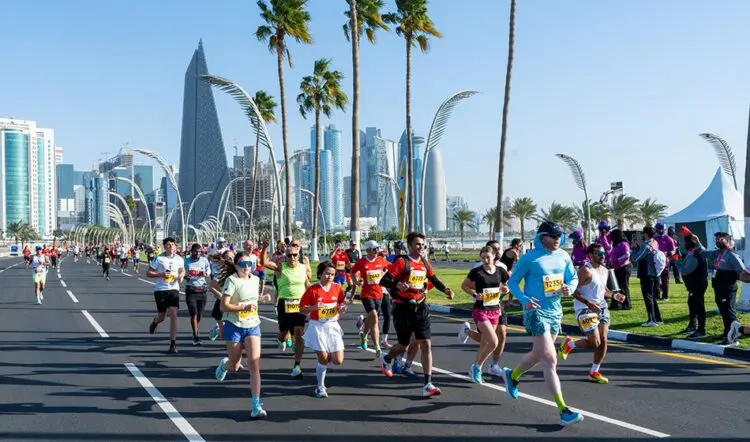
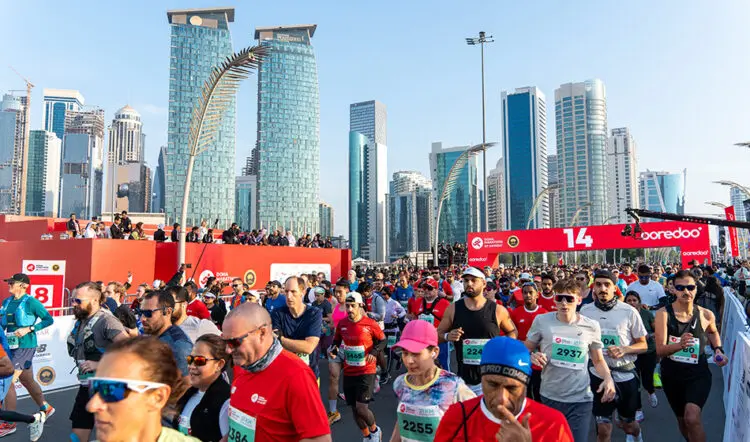
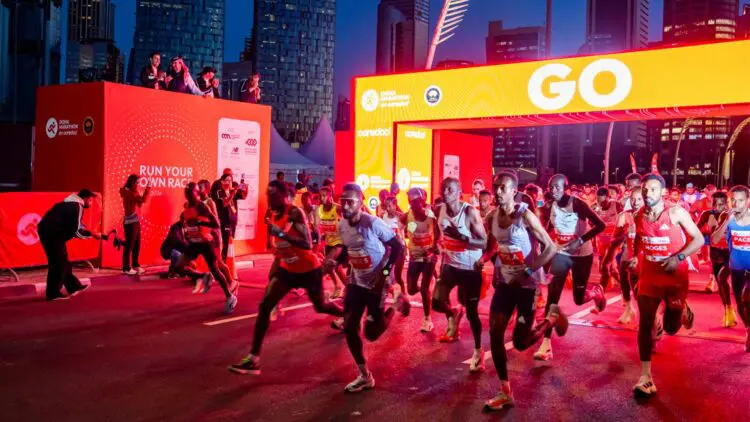
The 15th Doha Marathon by Ooredoo takes place on Friday, January 15, 2027, and is expected to be the biggest yet, with 25,000 participants. The race has earned the World Athletics Gold Label for three consecutive years. According to organisers, it ranks among the world’s top 25 marathons, and they are now working toward Platinum Label status.
Built for fast times
At the last edition, in January 2026, Ethiopia’s Tamirat Tola won in a course record of 2:05:40 – his first victory since taking Olympic gold in Paris in 2024. He took 69 seconds off the previous best of 2:06:49, set by Morocco’s Mouhcine Outalha in 2023, and finished ahead of compatriots Asefa Boki (2:05:55) and Boki Diriba (2:06:26) in an Ethiopian sweep of the top five.
In the women’s race, Tigist Gezahagn won in 2:21:14, with Tigist Girma (2:22:33) and Muluhabt Tsega (2:23:21) completing an all-Ethiopian podium. Gezahagn was 28 seconds outside the women’s course record of 2:20:46, set by her compatriot Meseret Belete in 2023.
The course is flat, January is the cool season in Qatar and the marathon starts at 6am, so conditions favour quick times.
Doha Marathon
A redesigned Corniche route
The 2027 marathon course starts at Sheraton Hotel Park and runs along the Corniche, past the Amiri Diwan, Souq Waqif and Old Doha Port – without any loops. An expanded Marathon Village at Hotel Park will offer more facilities, entertainment and activations for runners and spectators.
The Corniche is a 7km waterfront promenade curving around Doha Bay, linking the West Bay business district with the historic Souq Waqif. It has staged major racing before: the 2019 World Championships held their midnight marathons on a floodlit, looped course there, and Ethiopia’s Lelisa Desisa won the men’s title in 2:10:40.
Doha Marathon
Something for everyone
The 2026 race attracted 20,000 runners from 160 nationalities, including 2,200 international participants, and organisers expect more than 3000 international runners this time. There are six categories:
Full marathon (42km)
42km relay (teams of three or four)
Half marathon (21km)
10km
5km
Family Run (about 1km, for children aged 4-10)
The new Arab category, open to holders of a passport from any Arab country, will recognise the top Arab runners in the marathon with dedicated prizes, and the Al Adaam category for Qatari runners returns.
(Doha Marathon by Ooredoo)
Inclusive by design
The Blue Race for children with autism spectrum disorder returns for a second year, and the new Yellow Race is dedicated to runners with visual impairments. There are also dedicated opportunities for older runners.
The appeal of Doha
Doha is as much of a draw away from the start line as on it. Many of the city’s best-known sights are clustered close to the Corniche – and the marathon route passes several of them.
Souq Waqif is the obvious place to begin, with its lanes of shops, Falcon Souq and Arabic coffee. Nearby, the Museum of Islamic Art appears to float above the water on its own island, while the National Museum of Qatar, shaped like a desert rose, opened in 2019. Old Doha Port has been reinvented as the Mina District, where pastel-coloured buildings and murals sit alongside more than 50 places to eat. It recorded more than 7 million visitors in 2025.
Visitors can reach the city centre directly by metro from Hamad International Airport and three days is enough to cover the main sights. January is also the cool season, with average highs of about 22°C and lows of 14°C.
Gratton wins thriller as Ireland pip England at Masters International Dublin
John Beattie, in his first cross country season for more than a decade, lost out by inches to England team-mate Lee Gratton in one of the best races in the event's history, Steve Smythe reports.
British and Irish Masters Cross-Country International, Dublin, November 14
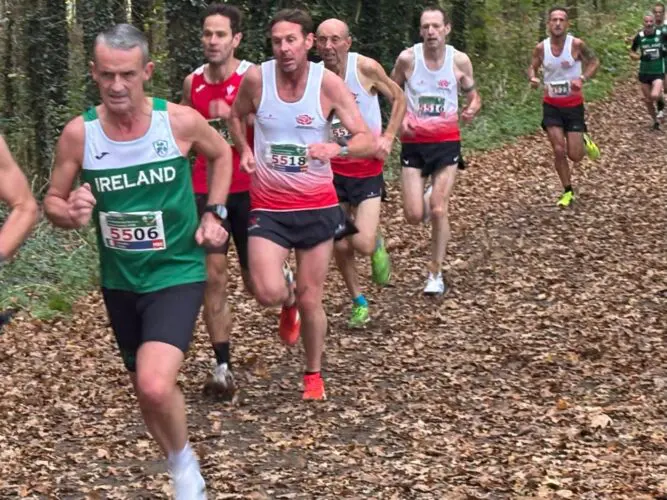
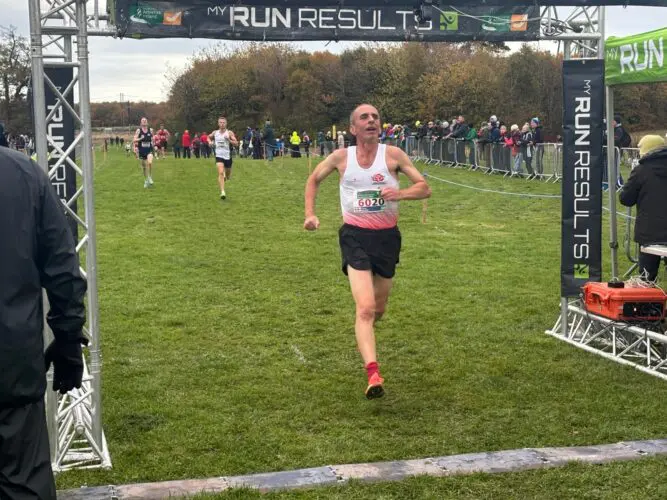
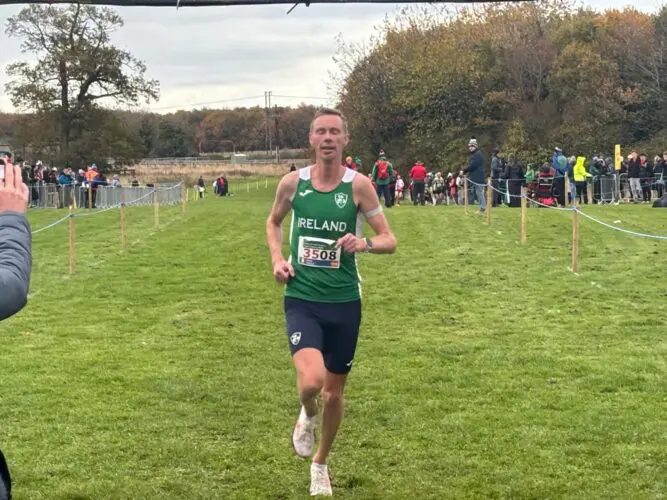
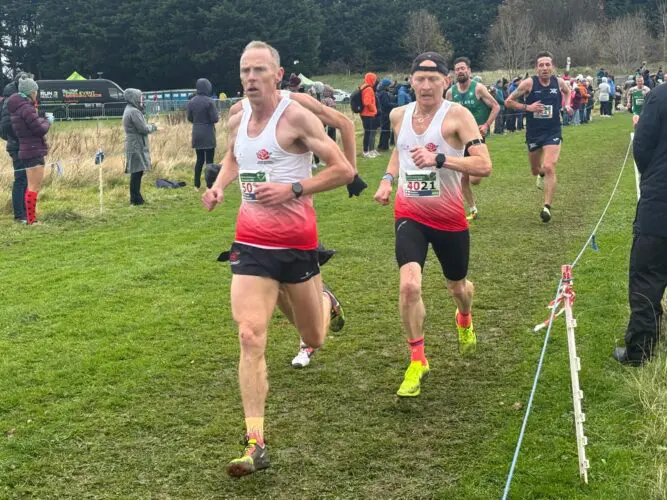
Competing at the magnificent facilities at the Sport Ireland Campus at Abbotstown, Ireland edged England in the team competition of an event which, given the strength of Britain and Ireland, many regard as consistently the top masters cross-country race in the world since the international was first run in 1987
The venue, which also hosted the 2021 European Cross Country Championships, provided a fast but deceptively tough course. Rain on the day made it slightly slippy on top, but it was still a track runner's delight compared to Leeds last year.
Defending champions England provided plenty of individual wins despite being below full strength, with outstanding runs from Lee Gratton, Jamie Arnold, Terry Booth, Bob Atkinson, Alice Braham and Clare Elms.
Scotland, too, had their moments, with decisive overall wins for Morag Millar and Fiona Matheson.
Though England won the most team golds, effectively it was Ireland's strength in the over-75s that gave them a one-point victory in each of the men's and women's sections.
Morag Millar
Race 1: Over-65s (6km)
First off was the over-65 race, which saw a clear men's win for Bob Atkinson. The reigning world over-65 duathlon champion, who now focuses more on multi-disciplines than running, should have been defending his title in Abu Dhabi the same weekend but instead chose the slightly cooler Dublin to win his fifth overall title, 26 years after he won M40 cross-country gold.
He was followed home by English champion and team-mate Peter Knight, while bronze went to last year's silver medallist Dave Warren of Wales.
Bob Atkinson leads the M65 race from Peter Knight
The depth was excellent. Ireland's M60 marathon world record-holder Tommy Hughes was fourth, multiple world track medallist Dave Clarke of Northern Ireland was 10th and 13:33.91 5000m performer and GB senior international David James 11th. With Dave Ogden completing the scoring in 12th, England won the team by two points.
Wales' Alan Davies, a former M65 winner, dominated the M70 race by more than a minute from English champion Barry Greaves. Defending champion Matt Shields was only 12th this time. Scotland, with three in the top six, took the team title.
The M75 race saw a win for Scotland's trials winner Terry Osborne ahead of four-time winner and former UK-based Martin McEvilly of Ireland. Osborne appears to have no performances listed on Power of 10.
Terry Osborne
With three in the top four, Ireland won easily as defending champion Dave Cundy of Wales finished seventh. England's fourth place here, behind Northern Ireland, would ultimately tip the balance to Ireland in the team contests.
The M80 race, which had no team event, was won at a canter by Ireland's trials winner Sean Mullin, with England's Geoff Newton replicating his second from last year.
Fiona Matheson, moving into an age group which this year has seen her on record-breaking form, dominated the W65 race to win by around 400 metres and take her ninth title. She also led Scotland to victory.
Fiona Matheson
Lindy Geyer produced the best Welsh women's performance on the day with a surprise second, well ahead of defending champion Monica Williamson and former W65 winner Sue Cordingley.
Pauline Moran took W70 gold, her sixth, by nearly a minute from defending champion Christine Kennedy. Ireland won the team contest by a point as England's three in the top five, led by bronze medallist and former winner Sue Haslam, proved insufficient.
European champion Eileen Kenny won the W75 gold by nearly three minutes, four years after her W70 title, also in Dublin. England's sole competitor Mary White won bronze and, with Ireland second to Scotland, England scored zero and lost a crucial four points to their home rivals.
W75 winner Eileen Kenny
M65: 1 R Atkinson (E) 23:30; 2 P Knight (E) 23:49; 3 D Warren (W) 23:54; 4 T Hughes (I) 24:03; 5 D Thom (S) 24:15; 6 K Griffin (I) 24:21
TEAM: 1 ENG 15; 2 IRL 17; 3 WAL 23; 4 SCO 33; 5 NIR 45
M70: 1 A Davies (W) 24:54; 2 B Greaves (E) 26:04; 3 N Ahern (I) 26:05; 4 P Thompson (S) 26:11; 5 B Urquhart (S) 26:12; 6 I Thom (S) 26:16
TEAM: 1 SCO 15; 2 ENG 18; 3 IRL 24; 4 WAL 36; 5 NIR 41
Alan Davies
M75: 1 T Osborne (S) 27:13; 2 M McEvilly (I) 27:31; 3 J Murphy (I) 27:52; 4 P Sweeney (I) 28:31; 5 B Stewart (NI) 28:31; 6 M Hammond (S) 28:49
TEAM: 1 IRL 9; 2 SCO 18; 3 NIR 26; 4 ENG 31; 5 WAL 39
M80: 1 S Mullin (I) 32:21; 2 G Newton (E) 34:49; 3 R Mullins (I) 36:20
W65: 1 F Matheson (S) 25:40; 2 L Geyer (W) 27:26; 3 M Williamson (E) 27:46; 4 S Cordingley (E) 27:49; 5 I Clements (I) 27:54; 6 J Jackson (S) 28:53
TEAM: 1 SCO 15; 2 ENG 19; 3 IRL 21; 4 WAL 27; 5 NIR 43
W70: 1 P Moran (I) 27:53; 2 C Kennedy (I) 28:49; 3 S Haslam (E) 28:57; 4 S Clarke (E) 29:01; 5 J Morgan (E) 29:33; 6 M Martin (S) 29:40
TEAM: 1 IRL 11; 2 ENG 12; 3 SCO 22
Pauline Moran wins the W70 title
W75: 1 E Kenny (I) 30:41; 2 J Craig (S) 33:32; 3 M White (E) 33:41; 4 E Evans (W) 34:05
TEAM: 1 SCO 14; 2 IRL 15
Race 2: Women W35-W60 (6km)
Last year's W35 champion Morag Millar successfully moved up to the W40s with an overwhelming victory. A week after a brilliant close third in the Scottish short course senior championships, she dominated throughout and won by 43 seconds.
There was a great battle for second overall between the other two W35 medallists from 2025, Sinead O'Connor and Katie Latham, who also both moved up to the W40s, with O'Connor, a former W35 champion, edging it.
Sinead O'Connor and Katie Latham
Such was the quality in the age group that last year's W40 winner and former European senior champion Gemma Steel defeated the W35 champion Lisa Madden but ended up outside the W40 medals in fifth.
Ireland easily won the relatively modest W35 competition, with England second, led by bronze medallist Rachael Bourne.
The W45 champion Ciara Hickey finished just ahead of W40 Steel and led Ireland to a clean sweep and overwhelming team win. Louisa Powell-Smith led the English challenge in fourth, with senior international and former BMAF winner Juliet Potter, who was debuting in the age group, sixth. Her twin sister Jane was 10th as England finished second.
Ciara Hickey ahead of Gemma Steel
The W50 saw a high-quality race between former overall champion Kirsty Longley and fellow multiple W50 UK road record-breaker Alice Braham.
Longley, who recently broke Braham's UK W50 half-marathon best, built up a big lead to halfway before her rival gradually closed the gap. On the final lap Braham, who once led home Britain's team in 20th in the junior race at the 1994 World Cross Country Championships, caught Longley. Then, showing the endurance that powered her to British bests at 10 miles (56:42) and the marathon (2:35:46) in October, she ultimately won by eight seconds.
Even without last year's defending champion Kate Rennie, England still made a clean sweep as English champion and fell specialist Helen Haigh took bronze. Overall Scottish trials winner and former UK W45 indoor record-setter Lesley Bell was fifth.
The scoring team was completed by Mary James in eighth and eight-time winner Claire Martin was a non scorer. W50 reserve Nikki Sturzaker won the overall women's open race in a time that would have placed her seventh in the international.
The W55 race saw a huge overall win for Eliosa Crawford, a former W50 runner-up. Northern Ireland's only champion on the day won by more than a minute from five-time champion Annette Kealy. In third, Rachel Cooke led England to a clear team victory, just behind the W60 winner.
Clare Elms wasn't at her best because of illness and followed her W60 rivals on the opening lap before using her 17:41 5km speed from this year to eventually open up a 68-second gap on team-mate Jackie Murdy. Former overall women's winner Niamh O'Sullivan took third.
Clare Elms (fourth from left)
Multiple world record-setter Elms thus won her third successive W60 title and her eighth individual gold and, by also leading England to team gold, won her 30th overall medal, which is believed to be an all-time best.
Surprisingly, she was the only athlete to win the same age group in both Leeds and Dublin, as the other 18 individual champions from other age groups missed out, though two athletes successfully moved up an age group.
In the six younger races, England's women got the better of the Irish overall but not enough to make up for their points deficit from the first race.
W35: 1 L Madden (I) 22:13; 2 D Grady (I) 22:38; 3 R Bourne (E) 22:39; 4 T Rogers (E) 22:46; 5 N Tierney (I) 22:46; 6 S Rynne (I) 22:56
TEAM: 1 IRL 14; 2 ENG 32; 3 NIR 40; 4 SCO 58; 5 WAL 79
W40: 1 M Miller (S) 21:07; 2 S O'Connor (I) 21:50; 3 K Latham (E) 21:55; 4 K Roche (I) 22:00; 5 G Steel (E) 22:09; 6 Y McNairn (S) 22:40; 7 R Luxton (E) 22:45; 8 A Braithwaite (E) 22:48; 9 D Tulloch (S) 22:54; 10 C O'Connor (I) 23:02
TEAM: 1 ENG 23; 2 SCO 27; 3 IRL 31; 4 WAL 67; 5 NIR 84
W45: 1 C Hickey (I) 22:07; 2 F Gettings (I) 22:27; 3 N Newcombe Pieterse (I) 22:37; 4 L Powell-Smith (E) 22:43; 5 M Kenny (I) 22:49; 6 Juliet Potter (E) 23:03
TEAM: 1 IRL 11; 2 ENG 28; 3 SCO 47; 4 NIR 67
W50 Alice Braham beats Kirsty Longley
W50: 1 A Braham (E) 22:16; 2 K Longley (E) 22:24; 3 H Haigh (E) 22:51; 4 K Costello (I) 23:17; 5 L Bell (S) 23:27; 6 A Connellan (I) 23:27; 7 K Wilton (NI) 24:10; 8 M James (E) 24:12
TEAM: 1 ENG 14; 2 IRL 32; 3 SCO 38; 4 NIR 67; 5 WAL 73
W55: 1 E Crawford (NI) 22:51; 2 A Kealy (I) 24:05; 3 R Cooke (E) 24:22; 4 M Johnston (I) 25:00; 5 S McDonald (E) 25:15; 6 T Entwistle (E) 25:19
TEAM: 1 ENG 14; 2 IRL 18; 3 NIR 22; 5 SCO 28
Eliosa Crawford
W60: 1 C Elms (E) 24:15; 2 J Murdy (E) 25:23; 3 N O'Sullivan (I) 25:34; 4 C Joliffe (E) 26:28; 5 K Byrne (I) 26:40; 6 H Shields (NI) 26:46
TEAM: 1 ENG 7; 2 IRL 17; 3 NIR 27; 4 SCO 33
England's winning W60 team of Katrina Oddy, Clare Jolliffe, Clare Elms and Jackie Murdy
Race 3: Men M35-M60 (8km)
In one of the best races since the event started in 1987, Lee Gratton narrowly defeated fellow English M40 team-mate John Beattie.
Gratton, who dominated the overall race in 2023 and 2025, ran with Beattie and M35 winner Sean Doyle of Ireland for most of the two short laps and four big laps.
Gratton had beaten Beattie by a minute in the English Championships and trials, but that was Beattie's first cross country for more than a decade. Here the England Commonwealth Games representative over 10,000m in Delhi in 2010 was fitter, liked the surface more and was much more competitive as, late on the last lap, it became a two-man race.
The pair sprinted beside each other up the slightly uphill finishing straight and, 50 metres out, Beattie edged ahead, but Gratton fought back to win by inches.
Lee Gratton beats John Beattie
Ben Robinson chased the first three solo throughout and just held on to take M35 silver, with team debutante Adam Gibson a close fourth, but Ireland won team gold.
England won the M40 team easily, though, as apart from the first two, Stephen Jackson and David Awde also made the top five.
Niall Shanahan
The M45 race was also a cracker as six seconds covered the top four. Wales' 2:14 marathoner and pre-race favourite Andrew Davies led initially but ended up fifth as Irish trials winner Niall Shanahan edged 2025 runner-up Neil Lafferty of Scotland and England's Ian Fisher, who improved on his fifth from last year. Ireland took team gold from England.
English M50 champion Jamie Arnold was just 20 seconds down on the leading M45 and that gave him gold by well over 200 metres, but Ireland, with five of the top seven led by medallists Brian McElvanna and Declan Reed, won the team contest easily.
M55 Winner Declan Toal ahead of Anthony O'Brien (5518)
Anthony O'Brien gave a good defence of his M55 title but eventually had to give way to two-time M50 champion Declan Toal, who ultimately won by 13 seconds as he moved into a new age group. Francois Rafferty, second last year, also dropped one place, like his English team-mate O'Brien. With Mark Waller fifth, England won easily.
In his third year in the M60s, 2024 champion Andrew Leach built up an early lead. However, his English team-mate Terry Booth gradually closed the gap.
Terry Booth
Last year Booth was overlooked for the M55 team but, having moved up an age group after the English Trials in September, the former Surrey county senior champion was too strong for his older team-mate on the final lap. He won by 100 metres as ultra-consistent Leach, also a former M55 champion, matched his second from 2025.
Wales' Lee Aherne took bronze. Though Ireland took fourth to sixth, Mark Cursons' eighth place proved sufficient for an England team win.
M35: 1 S Doyle (I) 25:03; 2 B Robinson (E) 25:37; 3 C McCaughey (I) 25:37; 4 A Gibson (E) 25:44; 5 K Minnock (I) 25:56; 6 R Chesser (E) 26:07; 7 G Jayasuriya (E) 26:09; 8 W Ewens (S) 26:36
TEAM: 1 IRL 15; 2 ENG 24; 3 SCO 46; 4 NIR 75
Sean Doyle
M40: 1 L Gratton (E) 24:52; 2 J Beattie (E) 24:53; 3 G Yates (S) 26:02; 4 S Jackson (E) 26:05; 5 D Awde (E) 26:06; 6 C Turner (I) 26:10; 7 G Sweeney (I) 26:21; 8 O Geoghean (I) 26:28
TEAM: 1 ENG 12; 2 IRL 30; 3 SCO 47; 4 NIR 40; 5 WAL 72
M45: 1 N Shanahan (I) 25:47; 2 N Lafferty (S) 25:49; 3 I Fisher (E) 25:49; 4 J Gahan (I) 25:53; 5 A Davies (W) 26:03; 6 E Flynn (I) 26:04; 7 J Hart (E) 26:09; 8 K Young (I) 26:24
TEAM: 1 IRL 19; 2 ENG 29; 3 SCO 46; 4 WAL 63; 5 NIR 67
M50: 1 J Arnold (E) 26:08; 2 B McElvanna (I) 26:47; 3 D Reed (I) 27:38; 4 E Coull (S) 27:47; 5 R Bartlelink (I) 27:49; 6 P Fleming (I) 27:54; 7 M Dullea (I) 27:55; 8 H Evans (W) 27:57
TEAM: 1 IRL 16; 2 ENG 32; 3 SCO 46; 4 NIR 64; 5 WAL 67
Jamie Arnold
M55: 1 D Toal (I) 27:20; 2 A O'Brien (E) 27:33; 3 F Rafferty (E) 27:42; 4 L O'Connor (I) 28:03; 5 M Waller (E) 28:06; 6 E White (NI) 28:47
TEAM: 1 ENG 10; 2 IRL 15; 3 NIR 27; 4 SCO 30; 5 WAL 51
M60: 1 T Booth (E) 28:25; 2 A Leach (E) 28:47; 3 L Aherne (W) 29:18; 4 E Murphy (I) 29:46; 5 M Counsel (I) 30:12; 6 S McCreery (I) 30:19
TEAM: 1 ENG 11; 2 IRL 15; 3 NIR 29; 4 WAL 36; 5 SCO 44
England's M60 team: Mark Cursons, Terry Booth, Andrew Leach and Richard Johnson
Open 6km
Men: 1 L Ionita (M35) 20:31; 2 D Perry (M45) 20:42; 3 M Hipwell (M35) 21:00
Women: 1 N Sturzaker (W50) 24:03; 2 J Franklin (W45) 24:06; 3 C Kilroy (W45) 24:10
Open 4.5km: 1 L Linehan (M65) 19:03; 2 T Cuddy (M65) 19:06
Foppen runs European 15km best as Matata and Ayichew win in Nijmegen
Nijmegen’s own Mike Foppen takes 32 seconds off his Dutch record, while Alex Matata falls seven seconds short of the world best.
Mike Foppen ran the fastest time by a European in a standalone 15km race when he finished fifth in 42:10 at the Garmin Zevenheuvelenloop, or Seven Hills Run, in Nijmegen on Sunday (Nov 15).
Racing in his home city, Foppen, 29, took 32 seconds off the Dutch record of 42:42 he set when finishing sixth last year. The time also beat the previous European best of 42:29, held by Belgium’s Bashir Abdi, by 19 seconds.
Sweden’s Andreas Almgren passed 15km in 41:47 on his way to a European half-marathon record of 58:06 at the World Road Running Championships in Copenhagen in September, but that was a split in a longer race.
Men's podium (Zevenheuvelenloop)
Kenya’s Alex Matata won the men’s race in 40:49, seven seconds outside the course record and world best of 40:42 set by Uganda’s Jacob Kiplimo in 2024. Matata, who won solo, was runner-up last year when Victor Kipruto beat him by one second in a sprint finish. Tanzania’s Benjamin Ratsim (41:26) and Gabriel Geay (42:04) completed the podium as the top Brit was Jake Smith with 43:09 in 12th.
In the women’s race, Ethiopia’s Asayech Ayichew won in 45:29, the second fastest time in history in a standalone 15km. Only Letesenbet Gidey’s world best of 44:20, set on the same course in 2019, is quicker.
Peruth Chemutai, Uganda’s 2020 Olympic 3000m steeplechase champion, was second in 45:56, with Ethiopia’s Lomi Muleta third in 46:44.
Maureen Koster, the European 10,000m silver medallist, was fourth in a lifetime best of 47:33, almost two minutes quicker than her previous mark, as the leading European.
It was short of Lornah Kiplagat’s European best of 46:59, set in 2007, which Britain’s Megan Keith had targeted. Keith, the European cross-country silver medallist who set a European 10km road record of 30:07 in February, went with the lead group early but dropped out just after 12km. The next best European mark, Eilish McColgan’s British record of 47:12, was also set in Nijmegen, last year.
Belgium’s Lisa Rooms, part of her country’s gold-medal team at the European Cross Country Championships, was sixth in 48:32, eight seconds ahead of team-mate Julie Voet (48:40).
Men: 15km: 1 Alex Matata KEN 40:49; 2 Benjamin Ratsim TAN 41:26; 3 Gabriel Geay TAN 42:04; 5 Mike Foppen NED 42:10
Women: 15km: 1 Asayech Ayichew ETH 45:29; 2 Peruth Chemutai UGA 45:56; 3 Lomi Muleta ETH 46:44; 4 Maureen Koster NED 47:33; 6 Lisa Rooms BEL 48:32; 7 Julie Voet BEL 48:40
Josh Kerr: "The only limits are the ones you put on yourself"
World record-holder adds to his haul of 2026 honours by lifting Scottish Athlete of the Year title.
Josh Kerr's year to remember continued on Saturday (Nov 15) when he was crowned Scottish 4J Athlete of the Year for the third time in four years.
The 29-year-old who won world indoor 3000m gold, broke the mile world record and the British 1500m record, then took the Commonwealth title in the mile in Glasgow and the 1500m crown at the World Athletics Ultimate Championship in Budapest, came out on top again at Scottish Athletics’ annual celebration.
Melanie Woods, who won double Commonwealth gold in Glasgow, was voted Para Athlete of the Year.
“The thing now with Scottish Athletics is that you have to be right at the top of what you're doing in the world to be able to even be in contention for the 4J Awards,” said Kerr, who was also Scottish athlete of the year in 2023 and 2024. “It puts a cap on an awesome end to the year. It's been a long, hard year, but I'm excited about it and looking forward to next year.”
Melanie Woods (Bobby Gavin)
Speaking to Scottish Athletics, the 2023 world 1500m champion added: “There are no limits on what Scottish athletes can achieve. Any limits are just the ones you put on yourself. If you can dream a big enough goal, and you can really believe in it and put the work in, then you're hopefully going to get as close as possible to it.
“In some instances, you might get everything that you want! As we look back, this year has been that for me. It's not always clear how much the mindset affects it, but when you train and compete for 20-odd years, sometimes it all falls together pretty well. It did for me in 2026.”
Woods also realised her ambitions in 2026, winning those Commonwealth titles in the T54 400m and 1500m – having to win the former twice after the final was re-staged.
“When I think about 2026 I reflect on going around Scotstoun Stadium on a lap of honour and seeing all the flags as well as friends and family who were there,” said Woods, who also received the Commonwealth Games special award.
“I tried to soak up the moments and I am so glad I did. I've memories there that will last for a long, long time. To be honest I dreamt of double gold. I really wanted those medals. But going out there and doing it is a whole different thing from dreaming about it.”
Scottish Athletics Awards winners
4J Scottish Athlete of the Year: Josh Kerr (Edinburgh AC)
4J Scottish Para Athlete of the Year: Melanie Woods (Red Star AC)
Masters Athlete of the Year: Rob McHarg (Kilmarnock Harriers)
U20 Athlete of the Year: Sophie Thomas (Dunfermline Track and Field)
U18 Athlete of the Year: Alistair Street (Kilbarchan AAC)
Martin Hyman Junior Hill Running award: Nancy Corrie (Harmeny AC)
George Dallas Trust Award: Stephen Mackenzie (Edinburgh AC)
Commonwealth Games Achievement Award: Melanie Woods (Red Star AC)
Performance Coach of the Year: Ross Cairns
Para Athlete Performance Coach of the Year: Steve Doig
Chasing personal bests: how the RAK Half became the epicentre of road racing
Geoffrey Kamworor won here as a rising talent in 2013. This February, after a motorbike accident and years of injury, the Kenyan returned to Al Marjan Island and ran 40 seconds quicker. His story helps explain why the world's best – and thousands of everyday runners – keep heading to the UAE for a fast half-marathon.
By the time Geoffrey Kamworor reached 14km of the 2026 Ras Al Khaimah Half Marathon, he says, he knew he was going to win. He was right. The leading pack went through 10km in 27:42, and the Kenyan pulled clear of Bahrain's Birhanu Balew and fellow Kenyan Gideon Rono at about 15km, passed in 41:25. He broke the tape in 58:14 on February 14, nine seconds ahead of Balew and 40 seconds quicker than when he first won on the same roads in 2013.
It was a victory 13 years in the making – and a hard-earned one. Kamworor, 33, is a three-time world half-marathon champion, but in 2020 a motorbike hit him from behind while he was training, fracturing his tibia and keeping him out for six months. Further injuries followed and it took him more than three years to run properly again.
“I'm just grateful to be back running without problems,” he said the day before the race.
He was not the only one to go fast. Five men broke 59:00 in all, with Balew's 58:23 an Asian record, while Rono (58:38), Jemal Mekonen (58:55) and Samwel Masai (58:59) completed the group. In the women's race, Asmarech Anley, 21, won on her half-marathon debut in 1:07:22 with no pacemaker, five seconds clear of fellow Ethiopian Melknat Wudu. Tanzania's Magdalena Shauri, who led much of the way, was third.
Geoffrey Kamworor (Rak Half)
Built for speed
The recipe is simple. Al Marjan Island is a man-made archipelago stretching into the Arabian Gulf, so the roads are at sea level, flat and closed to traffic. The course is designed with as few sharp turns and changes of elevation as possible. Tim Hutchings, the former international runner who has worked at the race for most of its history, has called the circuit “dead-flat”.
Organisers keep tinkering. Ahead of the 2024 edition, race director Peter Connerton said a revised route, drawn up with the promoters of the Dubai Marathon, was faster than any used before, with some of the sharp turns cut out. The revamp also added a 10km race for the first time.
The event has grown with it. Hutchings put the field at almost 2500 in 2018, up from a few hundred starters in the early years. A record 10,595 people took part across the 2km, 5km, 10km and half-marathon races in 2025, whereas AW reported 11,000 in 2026. AW has long billed it as a bucket-list race for road runners in search of a PB.
Cool mornings, but watch the wind
Then there is the weather. The 2026 elite races started at 6.15am in conditions of 14C, while the 2022 race, which started at 7am, was described by AW as perfect. Early starts mean runners are finished before the Gulf day warms up.
The one variable is the breeze. In 2023 a headwind and humidity ruled out record attempts, with Ethiopia's Gotytom Gebreslase saying it was “too much for the record”. Two years later the morning was an unusually cool 12C, but strong winds blunted Ejgayehu Taye's world record attempt. She had even brought her own pacemaker, yet won in 1:05:52 – exactly three minutes outside her target. “The wind was too strong,” she said afterwards. Strong winds off the Gulf also cost fast times in 2009 and 2012.
RAK Half
A history of records
The race announced itself in its first edition. In February 2007, Sammy Wanjiru, 20, won in 58:53 in a field the IAAF described as one of the strongest assembled, drawn by record prize money of $155,000. It was reported at the time as a world record but was never ratified because no EPO test was taken. Five weeks later he ran 58:33 in The Hague – and that time was ratified.
The women's record has been rewritten here three times. Mary Keitany ran 1:05:50 in 2011, Peres Jepchirchir 1:05:06 in 2017 and Ababel Yeshaneh 1:04:31 in 2020. Yeshaneh took 20 seconds off the previous mark and beat Brigid Kosgei, the marathon world record-holder, who also finished inside the old record.
Ababel Yeshaneh (Rak Half)
The 2022 edition remains the high-water mark. Jacob Kiplimo won in a course record of 57:56 after dropping his pacemaker just before 5km, passing 15km in 40:43 on the way to a 15km world best. The top six all finished inside the previous course record of 58:42. Girmawit Gebrzihair won the women's race on her half-marathon debut in a course record of 1:04:14, with Hellen Obiri a PB 1:04:22 behind in second. Britain's Eilish McColgan, sixth in 66:26, broke Paula Radcliffe's 21-year-old British record of 66:47.
Both course records still stand. Kamworor was 18 seconds shy of Kiplimo's mark in February, while Anley finished more than three minutes outside Gebrzihair's time and Taye was 1:38 away in 2025.
Ejgayehu Taye (RAK Half)
Still the fastest?
The record books have also moved on. Letesenbet Gidey ran her world record of 1:02:52 in Valencia in 2021, the same year Kiplimo ran 57:31 in Lisbon, and Ras Al Khaimah has not staged a world record since Yeshaneh's in 2020. By one measure, Valencia has the deeper fields: Watch Athletics calculated the 2022 men's top 10 at Ras Al Khaimah averaged 58:35, second only to Valencia, while the women's average of 1:04:47 was the best of any half-marathon in history.
Yet the race's pull has not weakened, and the reason is as much about the people who use it as the records. Elite runners such as Kamworor treat it as a springboard. The Kenyan told AW in February that the win gave him confidence for his London Marathon build-up and that he wants a marathon podium at the LA 2028 Olympics. Club runners enjoy the same flat roads, the same cool air and the same finish line, on the same morning.
The 20th edition takes place on January 30, 2027, and details are on the race's official website. If the weather behaves, someone may finally beat Kiplimo's 57:56 or Gebrzihair's 1:04:14.
WATCH: England Athletics and AW club of the month – Chichester Runners & AC
Through the voices of athletes, coaches and those who work behind the scenes, get exclusive insight into AW's and England Athletics' club of the month, Chichester Runners & AC.
Each person talks through their journey at Chichester Runners & AC and tells AW how much the club means to them.
Auriana Lazraq-Khlass banned for 22 months by AIU
The 2024 European silver medallist in the heptathlon received the ban after three whereabouts failures within a 12-month period.
Auriana Lazraq-Khlass, who secured the silver medal in the heptathlon at the 2024 European Athletics Championships, has been banned for 22 months by the Athletics Integrity Unit.
The 27-year-old stood on the European podium two years ago after recording a personal best of 6635 points at the Stadio Olimpico.
Lazraq-Khlass placed second behind Belgium's Nafissatou Thiam, who claimed her third consecutive European heptathlon title with a championship record of 6848 points in Rome.
The French athlete was provisionally suspended by the AIU back in March after being accused of three whereabouts failures between February and November 2025.
Auriana Lazraq-Khlass (Getty)
An independent disciplinary tribunal has now judged that while Lazraq-Khlass "did not appear to be attempting to evade testing" she had displayed both "carelessness and negligence".
Lazraq-Khlass did not argue against the first two breaches but contested the third – which ultimately resulted in the ban – stating that that when she tried to update her whereabouts for the following day, it was instead applied retrospectively to the same day.
Lazraq-Khlass, who started athletics at the age of five after being inspired by the 2004 Olympics in Athens, can return to action in January 2028 – six months before the LA Games – as her 22 month ban started on March 26 this year.
Her results since November 10 2025 have been disqualified, including her personal best of 4634 points in the pentathlon, set indoors in Aubière on February 28.
Greatness without the glare: the stars who never got their full share of the spotlight
Stripped of his Olympic titles and not named sole champion until 2022, Jim Thorpe is one of 20 athletes, past and present, whom the AW team believes are too often overlooked.
Jim Thorpe
The first native American to win Olympic gold for the United States, he finished on the top of the podium in the pentathlon and decathlon at the 1912 Games in Stockholm. However, he was stripped of his titles due to having played two seasons of semi-professional baseball before the Games, breaking the amateurism rules of the time. In 1983, the IOC restored his medals posthumously, acknowledging the challenge to his wins was filed well past the official 30-day deadline. Initially listed as a co-champion, in 2022 Thorpe was officially named as the sole winner.
Dorothy Hyman (Getty)
Dorothy Hyman
For a time, the Briton was the world’s best female sprinter. In 1963 she went unbeaten and topped the world list at 100m with two legal marks of 11.3, equalling the European record. At 200m she broke the European record with 23.2. Neither time was bettered by a British athlete for ten years. At the 1960 Olympics she won 100m silver and 200m bronze and, in 1962, was European 100m champion and Commonwealth champion over 100 and 220 yards.
Ken Matthews (Mark Shearman)
Ken Matthews
Britain’s Olympic 20km race walking champion, who broke the Games record on his way to victory in 1:29:34 in 1964, was the only one of his nation’s four gold medallists not to be awarded an MBE soon after the event. The 1962 European champion belatedly received the honour in 1977.
Wyomia Tyus
Very few people have won two successive 100m Olympic titles. Just six, in fact. Carl Lewis did it, as did Gail Devers, Shelly-Ann Fraser-Pryce, Usain Bolt and Elaine Thompson-Herah. All are household names but the first to do it, Wyomia Tyus, was not given the same acclaim. Having won Olympic 100m gold in 1964, she did so again in 1968. She set a world record 11.08 at the Games in Mexico City, running in dark shorts instead of the team-issued white to show her support for human rights. She also won 4x100m relay gold.
Meg Ritchie (Mark Shearman)
Meg Ritchie
The two-time Olympic finalist (ninth in 1980 and fifth in 1984) was the Commonwealth discus champion in 1982 and her personal best of 67.48m has stood as the British record since 1981.
Joyce Smith (Mark Shearman)
Joyce Smith
A pioneering runner, the Briton broke the 3000m world record in 1971 and also won the International Cross Country title in 1972 – the year before it became the World Cross Country Championships – as well as competing in the 1500m at the Munich Olympics. But her biggest successes came in the marathon. She was the first British woman in history to break the 2:30 barrier, winning the first London marathon in 2:29:57 in 1981. She improved that time to 2:29:43 in winning again the following year.
Smith also won the first two Tokyo international women’s marathons and competed in the first ever women’s Olympic marathon, in 1984, at the age of 46, finishing 11th.
Kathy Cook (Mark Shearman)
Kathy Cook
Considering she gathered 15 medals from major championships, at a time when doping was rife across her events, this most versatile of British sprinters arguably does not always get the credit she deserves. Her national records from 100m, 200, 300m and 400m were all long-standing and, while she was never an individual champion on the world stage (she won 400m Olympic bronze in 1984 and 200m world bronze in 1983), was a true force to be reckoned with.
Shirley Strong (Mark Shearman)
Shirley Strong
So many of the British team from the 1984 Olympics remain in the public consciousness but the 100m hurdles silver medallist from LA is often overlooked. As Commonwealth silver medallist in 1978, she upgraded that to gold in 1982 before then reaching the Olympic podium two years later.
Mark Roberts leads from Seb Coe and Dave Lewis (Mark Shearman)
Dave Lewis
The Briton is best remembered for his indoor 3000m battles with Seb Coe during the winter of 1986 that ended in a 1-1 draw. Their first clash came at the UK Championships at Cosford when Lewis, who had established himself as Britain’s No.1 cross country runner, out-kicked the Olympic 1500m champion. Coe would have his revenge six weeks later. Lewis competed in seven World Cross events in total and eventually moved to the marathon, running 2:13:49 in New York.
Tony Jarrett (Mark Shearman)
Tony Jarrett
A Commonwealth champion whose run of 13.00 in 1993 still stands as the English 110m hurdles record and who possesses a raft of major medals. However, many more of them would have been gold but for the fact that his career coincided with that of Colin Jackson.
Frankie Fredericks
The Namibian was a permanent fixture in global sprint finals and did win the world 200m title both indoors and out, but he was runner-up at three world championships and also possesses four Olympics silver medals from Barcelona 1992 and Atlanta 1996.
Kirani James and Quincy Hall (Getty)
Kirani James
The owner of gold, silver and bronze 400m medals at the Olympics and world championships was, at one stage, the reigning champion in both (in 2011 and 2012) and also won Commonwealth gold in 2014. At the age of 34, the Grenadian was still competing this year but, as ever, quietly going about his impressive business.
Christophe Lemaitre
The Frenchman was the first white athlete to officially break the 10-second barrier for 100m. He completed the European 100m/200m sprint double in 2010 and could also boast individual 200m bronze medals from both the Olympics (2016) and world championships (2011).
Matt Centrowitz (Mark Shearman)
Matthew Centrowitz
The American’s landmark performance came in winning 1500m gold at the Rio Olympics – the first American man to do so since 1908 – yet it is often dismissed by critics due it coming after a slow, tactical battle rather than a speedy shoot out. A man of strong opinions, he was also the world indoor champion in 2016, as well as winning world silver in 2013 and bronze in 2019. Though he was never personally implicated in any wrongdoing or failed tests, he was also part of the now defunct Nike Oregon Project, led by disgraced coach Alberto Salazaar. Centrowitz left the group in 2018.
Marcin Lewandowski beats Jakob Ingebrigtsen (Mark Shearman)
Marcin Lewandowski
The closest the four-time Olympian came to a global title was a 1500m silver medal at the 2018 world indoor championships, and bronze at the outdoor world championships in 2019. But he was a major contender across 800m and 1500m, winning European gold at the shorter distance in 2010. He also has European indoor titles in both events.
Sandra Elkasevic (Getty)
Sandra Elkasević (née Perković)
The most decorated female discus in history is a two-time Olympic champion, two-time world champion and seven-time European champion. Her first European gold came in 2010 and she was still on the top step of the continental podium in 2024.
Miltiadis Tentoglou (Getty)
Miltiadis Tentoglou
The Greek has won every long jump honour available to him, yet still he is a driving force in the event. Two Olympic gold medals, one world title outdoors, two outdoors and a total of seven European golds (three indoors, four outdoors) are in his trophy cabinet and just this year he equalled the national record with 8.66m.
Anita Wlodarczyk (Getty)
Anita Wlodarczyk
Her world record is now over 10 years old, she has won three Olympic gold medals, four world titles and is four-time European champion. The Pole is widely considered to be the greatest women’s hammer thrower of all-time yet is one of those field eventers who would have been lauded even more if their achievements had come in another discipline.
Sam Kendricks( Mark Shearman)
Sam Kendricks
The American looked to be taking a firm hold of the men’s pole vault and seemed to be the natural successor to Renaud Lavillenie, winning world titles in 2017 and 2019. That was until a certain Mondo Duplantis turned up. Yet still, at the age of 34, he is to be found competing for his event’s biggest honours.
Klaudia Kazimierska and Georgia Hunter Bell (Getty)
Klaudia Kazimierska
The Pole has had a breakthrough year and, though her biggest achievements didn’t come until the second half of the summer, have been received with minimal fanfare. She finished second behind Georgia Hunter Bell at the European Championships but turned the tables in the Diamond League final and also the Ultimate Championship.
Over to you
Who is your most underrated athlete of all-time? Let us know your thoughts at [email protected]
Into the wild: the history of trail running
Dave Holmes explores how trail running evolved from an ancient necessity into the world’s fastest-growing discipline.
It’s easy to imagine trail running as a modern invention – a sport born of fancy hydration vests and high-tech GPS watches. Yet running over natural terrain is one of humanity’s oldest forms of locomotion.
Long before asphalt or standard distances existed, the earth itself was our only running surface. For millennia, moving swiftly over hills and mountain passes was an essential condition of survival, messaging and trade. The story of trail running is the gradual transformation of an ancient necessity into a global athletic phenomenon.
The earliest recorded footraces away from stadium tracks were tied to functional utility. Messengers in ancient Greece and Native American runners covering vast distances relied on off-road endurance as a primary means of communication. Traversing these unpaved expanses required an intuitive understanding of the landscape, where reading the terrain was just as critical as stamina.
Swiftness in these contexts was not a matter of athletic vanity, but a vital lifeline connecting isolated communities across mountainous and forested frontiers. Where rocky ridgelines and dense woodland made horses impractical, runners got through.
As centuries passed, this practical reliance on fleet-footed couriers began to intersect with formal trials of skill. According to tradition, King Malcolm III organised a hill race up Craig Choinnich in Scotland in the 11th century to select the fastest royal messenger, an early bridge between practical duty and competitive selection.
Yet it was in 19th century Britain that off-road running made its decisive leap from necessity to sport. In Northern England and Scotland, local fairs began hosting “fell races” or “guide races”. By 1895, the Ben Nevis Race (14km) established a benchmark for Britain’s burgeoning fell running culture through a charge up Scotland’s highest peak (1345m) and back down.
Parallel traditions took root across the Atlantic and Europe. In 1905, San Francisco hosted the inaugural Dipsea Race (12km) over the rugged trails of Mount Tamalpais. In the French Pyrenees, events like the Course du Vignemale (38km) emerged in 1904, while Spain and Italy developed their own mountain racing traditions through regional alpine clubs.
While its institutional cousin, cross-country running, was rapidly formalising on manicured school fields and parkland loops, mountain racing embraced the untamed wilderness. Rather than looping synthetic courses or park turf, these trailblazers measured themselves against raw geography, pioneering a distinct off-road discipline defined by vast mountain terrain rather than standardised circuits.
What truly unified these early off-road pursuits was an appetite for self-transcendence. In the English Lake District, this spirit birthed the tradition of “fell rounds”. Inspired by 19th century climbers, Dr A.W. Wakefield and others sought to summit 2000-foot peaks within 24 hours. In 1932, a local hotelier named Bob Graham linked 42 peaks in a single day, creating the iconic Bob Graham Round, a circuit that remains a rite of passage for fell runners today. The mid-20th century saw the arrival of iconic mountain marathons. In Colorado, the Pikes Peak Marathon was founded in 1956. Notably, the race opened entries to women from its inception, leading to Arlene Pieper becoming the first official female marathon finisher in the US in 1959.
If mountain racing was defined by steep summits, the 1970s introduced the mountain ultra. In 1974, after his horse went lame prior to the 100-mile Tevis Cup ride in California, Gordy Ainsleigh tackled the rugged course from Squaw Valley to Auburn on foot. Finishing in 23 hours and 42 minutes, Ainsleigh proved the impossible. Four years later, the Western States Endurance Run was officially established as a footrace, pioneering the format, aid stations, and coveted belt buckle awards that define ultra-marathoning today.
The 1980s and 1990s brought internationalisation and structural identity. In 1984, the International Committee for Mountain Running (later the World Mountain Running Association, or WMRA) was established, staging its first World Trophy in Italy in 1985, won by English fell legend Kenny Stuart. During the 1990s, American ultra running icon Ann Trason left an indelible mark on the sport, dominating with 14 Western States victories and famously battling the Tarahumara team at the 1994 Leadville 100.
Jim Walmsley (UTMB)
Simultaneously, a technical discipline took shape in the High Alps. In 1991, Italian alpinist Marino Giacometti launched the “Skyrunning” movement. Skyrunning took athletes across glaciers and vertical kilometre climbs, showcasing stars like Italy’s Bruno Brunod and America’s Matt Carpenter, who set a Pikes Peak Marathon record of 3:16:39 in 1993 that stood for decades.
Trail running remained a niche subculture until the mid-2000s, when a storm of personalities, literature and media transformed the sport. In 2003, Catherine and Michel Poletti launched the Ultra-Trail du Mont-Blanc (UTMB, 171km) in Chamonix. Circumnavigating the Mont Blanc massif across France, Italy, and Switzerland, UTMB quickly grew into the global epicentre of ultra-running.
While alpine epics conquered dizzying mountain passes and glaciated peaks, other events also sought out the planet's most punishing environments. Founded in 1986, the Marathon des Sables in the Sahara Desert forced runners to become self-sufficient pack-mules, carrying their own food and gear across 250 kilometres of scorching dunes.
Trail Running (Getty)
A shift in athlete demographics followed. Anton Krupicka won the Leadville 100 in 2006 in minimalist footwear, bringing a countercultural philosophy to the sport. In 2008, a 20-year-old Catalan named Kilian Jornet won the UTMB, ushering in an era of dominance across both skyraces and ultras. Concurrently, Christopher McDougall’s 2009 best-selling book Born to Run brought the lore of Mexico's Tarahumara runners and the ethos of off-road endurance to millions of city dwellers seeking a visceral escape. In recent years, modern trailblazers like American Courtney Dauwalter have continued to rewrite the boundaries of human performance, most notably winning the Western States, Hardrock and the UTMB in a single calendar year in 2023.
World Athletics officially brought the sport under its global umbrella, joining forces with the WMRA and the International Trail Running Association (ITRA) to host the unified World Mountain and Trail Running Championships in Thailand in 2022. What began as a functional lifeline for ancient messengers navigating untamed frontiers has grown into a global movement. Today, trail runners are united by the same fundamental instinct that drove our ancestors: a desire to test human limits against the natural landscape.
David A. Holmes (PhD, UNSW) is a historian who specialises in the history and politics of athletics. Email: [email protected]