Talence Décastar – the foundation for greatness

Gabby Pieraccini extols the virtues of the Talence Décastar combined events meeting that has showcased “The Gods of the Stadium” for the past 50 years
One evening in September 1976, on a track lit by the beams of car headlamps in the southern suburbs of Bordeaux, an 18-year-old athlete completed a decathlon in 7905 points. The athlete was Daley Thompson, the mark would have been a world under-20 record but for the absence of electronic timing and the occasion was the first edition of what would become the renowned Talence Décastar combined events meeting.
In 2026, the meeting often referred to as “Les Dieux du Stade” – The Gods of the Stadium – is celebrating its 50th anniversary.
Over the past five decades, 13 Olympic combined events champions have competed in Talence. Every Olympic decathlon champion since 1980 has participated: Thompson, Christian Schenk, Robert Zmelik, Dan O’Brien, Erki Nool, Roman Šebrle, Brian Clay, Ashton Eaton, Damian Warner and Markus Rooth. In the heptathlon, Denise Lewis, Natalya Dobrynska and Nafi Thiam’s names are on the roll of honour.

The competition is second in status only to Götzis on the combined events circuit and shares the features which set the gold standard for athletics meetings. Athlete-centred planning and presentation, a festival-like atmosphere, and passionate fans who feel the peaks and troughs every bit as much as the athletes.
Those who had the good fortune to be in the Stadium Pierre Paul Bernard in Talence in September 2018 witnessed something close to a religious experience. Kevin Mayer was released from the purgatory in which he had been languishing since his tearful exit from the European Championships in Berlin a few months earlier and ascended to a, frankly, unholy decathlon world record of 9126 points.
Given his talent, it was inevitable that Mayer would break the world record. However, the emotional connection in Talence between the athlete, the home audience and the organisers created the perfect conditions to inspire an exceptional performance.
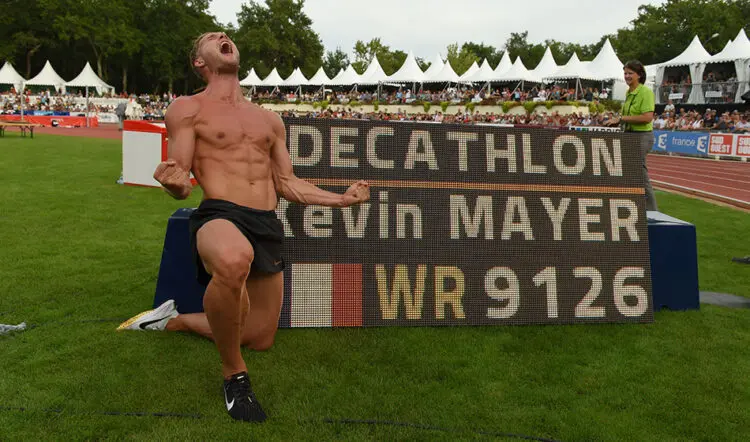
One of the first people to embrace Mayer after his feat in 2018 was Nicole Durand who, having held various pivotal roles in the meeting organisation, helped build the event into the successful format it enjoys today.
As the final preparations were being made for the 2026 celebrations, which Nicole was due to attend, word arrived that the 87-year-old had died suddenly. The imminent arrival of athletes, coaches and fans gave the Décastar family little time to grieve their loss. Instead, they incorporated a celebration of Durand’s life into the weekend. Alongside emotional tributes in the stadium, the letters “N-I-C-O-L-E” were delicately stencilled onto the edge of the long jump pit, next to the customary multi-coloured stars.
The festivities, which included a stunning drone light show by Gaz de Bordeaux, were also balanced with tributes to the firefighters of the region, who had fought the wildfires engulfing the area earlier in the year.
“Firstly, let us spare a special thought for all those who have lost everything and no longer have a home,” reflected Xavier de Cartin, Décastar Communication Manager. “Fortunately, no member of our organisation has suffered such damage. But some members of our staff had to evacuate their homes.”
“Living in Lacanau meant that we were on the border of the fire,” explained Nicolette Los, Décastar Athlete Liaison Manager. “My husband and son went to help the firefighters day and night. Those at home prepared meals and collected masks and clothing for firefighters. My mind was definitely not with the Décastar.”
The emotional connection which underpinned Mayer’s performance in 2018, and which was evident in the run-up to the 2026 edition, seems hard-wired into the event. Come September, championships have generally been and gone, and medals won and lost. A final pilgrimage to Décastar can save a season otherwise unfulfilled.

In 1992, Dan O’Brien missed out on the Barcelona Olympics after a no-height in the pole vault at the US trials. He then went to Talence and set a world record of 8891 points.
Eight years earlier, Jane Frederick similarly failed to clear a height, in the high jump, at the US trials for the 1984 Olympics in Los Angeles. Later that summer, she scored 6803 in Talence.
For the 2026 edition of Décastar, there was plenty of similar unfinished business. The 2021 and 2024 Olympic champions, Damian Warner of Canada and Markus Rooth of Norway respectively, led the ten-event field, alongside the 2025 World Indoor champion Sander Skotheim, also of Norway.

Triple Olympic champion Thiam was the main attraction for the heptathlon, alongside the Paris bronze medallist and double World Indoor champion, her fellow Belgian Noor Vidts.
Rooth had not competed in decathlon since Paris, injuring himself in training in 2025 and requiring surgery. Warner had suffered badly with the conditions at the Commonwealth Games in Glasgow, scraping 8036 points and a silver medal.
Skotheim got injured in January, missing the first half of the year and was down almost 500 points on his best when competing at the European Championships in Birmingham, where he won bronze.
Thiam and Vidts had both succumbed to injuries over the last few years, Thiam dabbling only in individual events, and Vidts returning tentatively to heptathlon in Götzis and Birmingham.
As the competition unfolded, Rooth was clearly still in the building phase of his recovery. Warner was short of his performance in Götzis, where he scored just under 8500, but significantly better than in Glasgow. The pair ended less than 30 points apart, Warner eighth in 8238 and Rooth ninth in 8209.
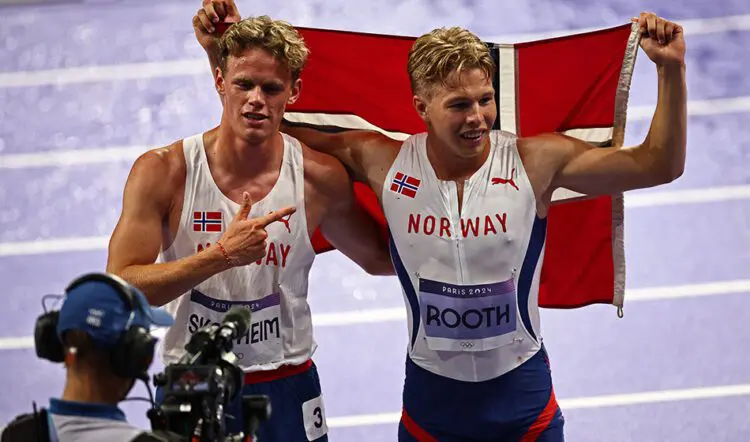
Skotheim had the best competition overall, pushed hard by Hakim McMorris of the USA. Skotheim’s decathlon profile centres on his jumps, and the 7.89m and 5.31m he delivered in the long jump and pole vault respectively in Talence are world class in decathlon. But after surgery to his foot, Skotheim was still well short of a 2.15m-plus high jump. He achieved 2.05m in Birmingham and followed that with only 2.00m in Talence.
Even with that gap in his portfolio, Skotheim – who has a decathlon PB of 8909 – scored 8630 to win the competition ahead of McMorris. The American scored a PB of 8599 points. If Skotheim can still rack up over 8600 at the end of the season while dropping 140 points from his banker event, something very special lies ahead.
Thiam and Vidts also found strong competition from a fresh face, 20-year-old Anna-Elisabeth Ehlers of Germany, who improved her heptathlon best from 5690 to 6216 when winning in Arona in June. The young German set six personal bests to score a further heptathlon lifetime best of 6374 points.
Thiam leaned heavily on her throws, with 15.10m in the shot and a 51m javelin. But the Olympic champion’s experience carried her through the competition, and she won with 6482 points, just over 100 points ahead of Ehlers. Vidts scored a season’s best of 6329 in third.
Great Britain’s Ellen Barber and Niamh Emerson participated in the competition. While Emerson withdrew after the hurdles, Barber had yet another strong meeting to round off an excellent year which included multiple lifetime bests, tenth place at the World Indoors and fourth at the Commonwealth Games. Skotheim came away from Talence with both a victory and the cushion of a qualifying
mark for the World Championships in Beijing next year. This demonstrates how Décastar can play an important tactical position in the combined events season, and the meeting also offers generous ranking points. It is classified in the GL category, as are Götzis and area championships, and is generally the final event in the World Athletics Combined Events Tour.
Although the tour needs a major overhaul, currently without either structure or coherence, winning the tour can be valuable to the victor. Rare prize money is at stake and, on occasion, a wild card entry to the following year’s global championships. The Décastar team is thoughtful about how to improve the design of the tour.
“Having a finale at the end of the season would be great, where the winner of the tour is announced by winning the ‘final’ in front of public and press, with World Athletics giving the “cheque” to the tour winner,” suggests Nicolette.
The proposition would position the Combined Events tour as something more akin to the Diamond League. A golden thread running through the season, rewarding consistency but also creating motivation to compete in a finale. It would be a step change from the current arrangements, where the tour largely exists as an artefact in a dusty corner of the World Athletics website.
As is the case for its sister meeting in Götzis, the Décastar family has decades of experience in organising world-class competition and is adored by athletes and fans alike. The foundations are already there to build a meaningful structure for the combined events season.
The car headlights that lit Daley Thompson’s teenage decathlon 50 years ago have evolved into spotlights sweeping the skies over Talence in celebration of a French athletics institution. And somewhere under one of those beams there is likely to be a future member of the “Dieux du Stade”.