Katarina Johnson-Thompson and the art of the heptathlon

As she eyes more major honours in the coming months, the two-time world champion discusses what it takes to succeed at the top level and how she has learned to “sit in the uncertainty” of sport at the highest level.
To Katarina Johnson-Thompson, there is a delight to be found in the discomfort. An artistry to be found in the agony. “I don’t know how to describe it without going on and on,” says the two-time world heptathlon champion as she discusses the intricacies of the event that has taken so much out of her but also provided priceless rewards.
It’s just very unfortunate that the interview time is running short because, when she hits her stride on this specialist subject, hearing the four-time Olympian speak makes for fascinating listening. There’s a stark reality to what’s involved in the day job – the hard work, the brutality, the endurance, the physical and mental questions that need to be answered, the huge swings in emotion to handle. Even being good at mental arithmetic helps.
On one hand it sounds like borderline insanity to think that competing in the combined events at the top level is a good idea. And yet there’s a warmth to Johnson-Thompson’s words that makes it abundantly clear just how much, deep down, she absolutely loves it.
“The best part is going through it, adding up the score and putting together a piece of work,” says the 33-year-old. “It’s almost a bit arty, seeing it come together.”
It’s fitting, then, that Johnson-Thompson’s exploits on the global stage have made her the subject of a mural or two in her home town of Liverpool in recent years. She might suffer for her art but has the track become her place of creativity, where she expresses herself most? “It must be,” she nods.
And yet the former European indoor champion sees herself only as the muse. She insists it is her coach, Aston Moore, whose vision she is realising.
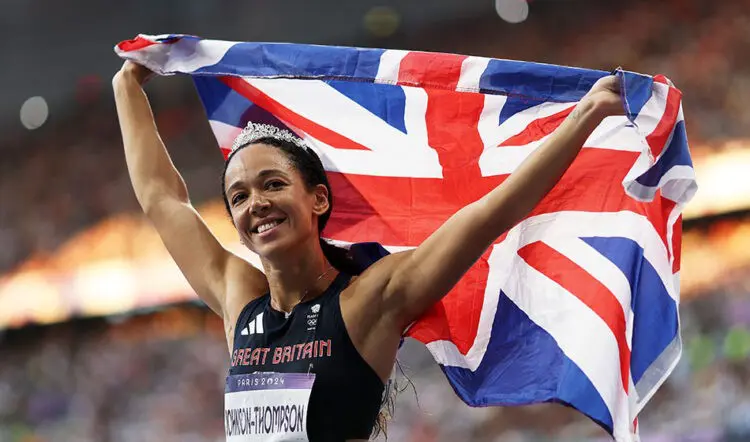
“I always think of the coaches as the artists, because they're putting together this training and [in the process] perhaps diluting one event or making another event bolder, because it's like a picture,” she adds.
“The coaches are the artists. They're putting together the training, and we're just trying to get it out and do it justice.”
From the training sessions to the competition itself, it’s a long-term project. In a world that is increasingly in a hurry, excelling at the combined events is a process that is not to be rushed. The task facing an international heptathlete is a considerable one.
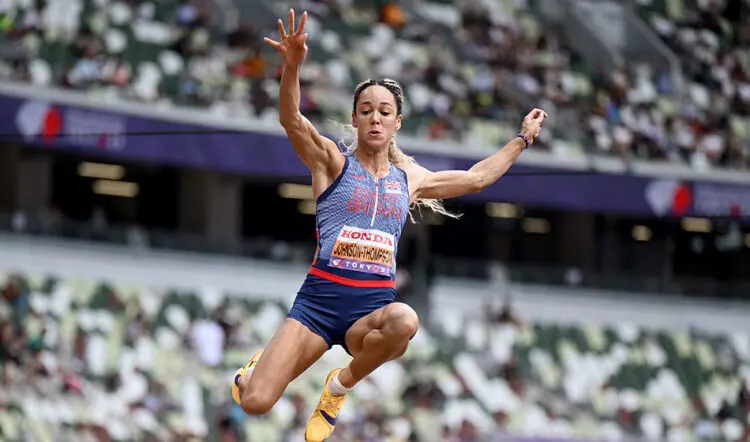
Two days of competition, the first consisting of morning appointments with the 100m hurdles and high jump, followed by the shot put and 200m in the evening. Day two begins with the long jump, followed by the javelin and the teeth-gritting finale of the 800m. So how does it feel to be confronted with all of that?
“It starts off fresh,” says Johnson-Thompson. “It's the first fresh day of the year that you've had. You've been training the whole year and you've haven’t really been tapering down for individual events [until now].

“But you feel sick with nerves on the day of the competition and you’re always on the first bus [to the stadium]. You’re up at 5am and you're trying to eat but you can’t. And, when you leave your room, you look at your bed, and you know that it's going to be hours and hours before you get back to it. You always feel like: ‘Oh, God, what's in store for today?’.
“But then, when you start, it’s incredible. It's that nervous energy before the hurdles, and then you go straight into the high jump. When you finish that morning… it’s just highs and lows. You become exhausted very quickly. The wait in between the high jump and the shot put is normally six or seven hours, and you can either talk yourself out of it or talk yourself into it in that time.”
There is certainly more than enough to occupy a competitor’s mind as they navigate their way from task to task.
“It’s the skill of moving on from disappointment, or even moving on from ‘I'm doing well’ but knowing that you've got competitors coming from all angles,” says Johnson-Thompson. “And you don't really know how to mentally add up how many points you need to be ahead of this girl, or what form she’s in.
“You learn to not look at it too much until the javelin, but you can't help but look at it overnight. You get back after the 200m and you've got to have an ice bath, you've got to recover, you've got to see the physio. You definitely have to shower, try to get some sleep and then get up the next day and do it all over again, but on tired legs this time.”
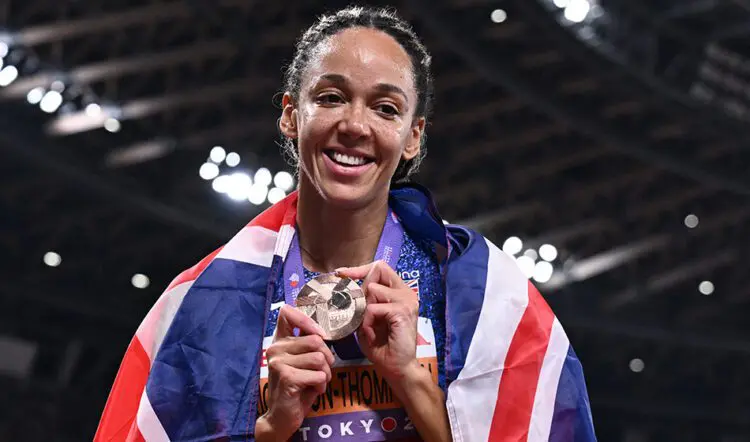
By then, though, the exhaustion is outweighed by the fact that, at this point, things are really starting to get interesting.
“That's when you really come into your own with competitiveness and you can see which people are going to be going for the medals. And it finishes on one of the hardest events, the 800m.
“The worst thing about being in medal contention is that you usually have to watch two races of the 800m before your race comes. Then you see the girls on the track and they are tired and happy and you’re so jealous of them because they’re finished.
“It [doesn’t happen] so much in a championships, but in an event like Götzis [the renowned Hypomeeting], they’ll literally be dragging the girls off the track so you can get on the start line.”
And then the gun goes.
“[With] 120m to go in the 800m is always the best part – when you can see the finish line, but you're still in it, you’re still doing it,” says Johnson-Thompson. “The worst part is directly before the hurdles [on day one] and also at the bell of the 800m.”
It seems little wonder, then, that there is such a clear camaraderie between the competitors who always complete the lap of honour together.
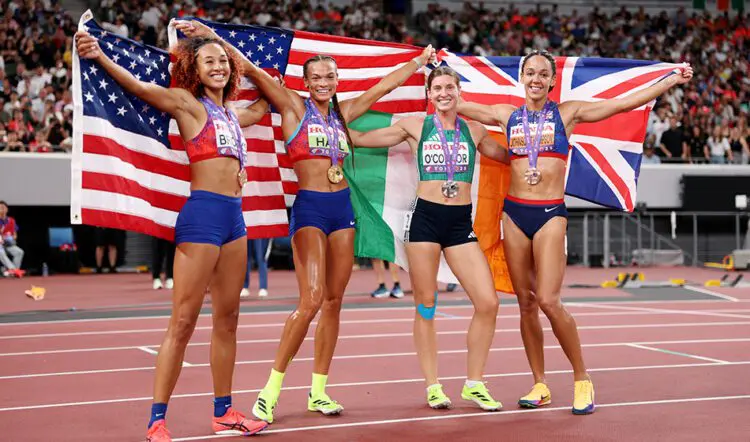
“I think it's because we've all got our strengths and weaknesses, we're all trying to put our heptathlon together and we understand how hard it is,” says Johnson-Thompson. “That's why we're all so elated at the end of it. We just want to talk to someone about it because we’re all so happy that we’ve finished! It’s really fun. I love it so much.”
It’s no bad thing that that is the case, because the diary is filling up. As we speak, the finer points of Johnson-Thompson’s competition schedule are still being confirmed, although the summer certainly isn’t a blank canvas.
She is eyeing what would be a third successive Commonwealth title in Glasgow – a feat achieved by Daley Thompson in the decathlon but something that represents uncharted territory in the women’s heptathlon. And then it will be back to Birmingham for the European Championships and a city in which she achieved the most recent of those Commonwealth successes four years ago, as well as the world indoor pentathlon title in 2018.
Neither will be an easy task but, having overcome the serious injuries, the surgeries and heartache of the past to win global gold in Budapest in 2023, Olympic silver in 2024 and then world bronze last year in Tokyo, the pressure has been removed. The outlook is entirely positive. Plus, the Alexander Stadium is familiar territory and an arena in which she has competed since first setting foot in it for “the Young Athletes League when I was 10 or 11” and the home crowds will be on hand to help.
“I remember it the old way [before it was renovated],” she says of the stadium at Perry Barr. “I vividly remember the English Schools Championships and the Young Athletes League, that used to always be the big finale competition, so it holds a lot of memories, especially from the Birmingham 2018 World Indoors and then the 2022 Commonwealth Games. I can't wait to see it filled up again. It’s a special city. It's an athletics city.”
Soon it will again be time for the early alarm calls, for the nerves to kick in and the whole combined events rollercoaster ride to be set in motion once more. It’s the very nature of elite sport that there are likely to be some bumps on the road to the championships, but Johnson-Thompson has been helped hugely by learning how to stay on more of an even keel.
“I've learned to sit in the uncertainty with injury,” she says. “I can definitely sit in that a lot easier now, whereas before it was the end of the world and a lot of panic. I feel, these days, I can just sit in that uncertainty, and that's a great skill to have.
“It’s the injuries, the results that you're not truly happy with in the lead-up to the major champs, the not being in control, which I struggled with. I still struggle with it, but I used to really struggle with it. I've just come to realise that, on championships day, I can step up and I'm always ready.
“I need to trust my coach’s programme. I need to trust myself and that I can be competitive. I need to trust that I've got experience and that has come through years and years and years of practice. It’s been a long journey but I can sit in that uncertainty now and trust that, if I'm fit, then I'll be able to put out a performance.”