A lasting impact for hurdler-turned-lawyer Richard Yates

Former 400m hurdler Richard Yates talks to Ben Bloom about the selection debacle that inspired him to go into sports law and now sees him fulfilling the role as UK Athletics’ general counsel.
They say every experience shapes an individual, often in ways one might not realise. For others, the knock-on effects are more apparent.
When Richard Yates was appointed as UK Athletics’ general counsel earlier this year, it marked something of a full-circle moment for a former international hurdler who may never have found himself in such a position without the events of the summer of 2008.
With Britain’s two leading 400m hurdlers, Dai Greene and Rhys Williams, struggling with injury that year, an opportunity emerged for a new figure to fill the hole of their absence. Yates was that man.
At the British Championships, which doubled up as the Olympic trials, he claimed his first national title in what was then a personal best of 49.50, making him the only athlete so far that season to reach the ‘B’ standard and ensuring he was eligible for selection in Beijing. A couple of weeks later, at the prestigious London Grand Prix, he lowered that mark even further to 49.06, finishing second in a top-quality field. This time, he had clocked the ‘A’ standard, although it was days after the selection cut-off deadline. Despite a public campaign for Yates’ inclusion, he was omitted from the British team, who instead opted to send no male 400m hurdlers to Beijing.
“I was 22,” says Yates. “As a young athlete, there was an argument that I could have been selected. I was never the most talented athlete so I think a lot of people saw me as someone who had broken the mould that year. It had further implications for athletes who, like me, were perhaps just outside the world class performance programme. If they did win a race and were selectable, I guess a lot of people thought they should be selected. Because I ran the ‘A’ time at Crystal Palace, and finished second in a high-standard race, that enhanced my profile as well.”
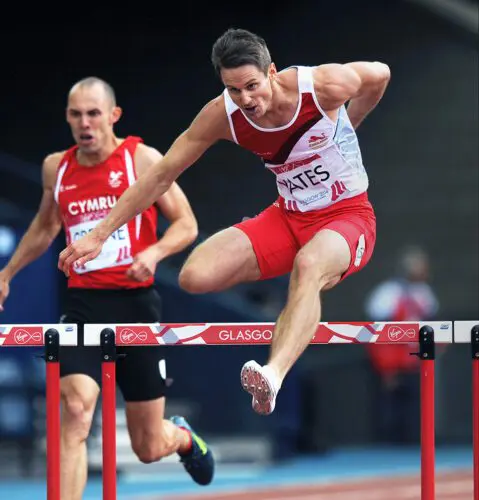
A year earlier, Yates had completed his law studies at the University of Leeds. He chose not to appeal the selectors’ verdict, suggesting: “At the time, I think I felt like I didn’t want to get in the team through a technical legal appeal avenue.”
It is a decision he admits he might have made differently if he had known then what he knows now, for that snub would go on to impact the rest of his competitive life and beyond.
“Everyone has had issues with selection, so I’m not pitching it as a sob story,” says Yates. “But it did definitely shape some of my own angles and experiences. I think there’s definitely a link with my work now because the experience shaped a lot of my interest in governance, the legal side of sport, and national governing bodies.
“I went onto the UK Athletics Athletes’ Commission as vice-chair. Obviously, I was always studying to do law – it just wasn’t entirely clear to me which angle of law I would go down, and I hadn’t necessarily put the two together at that point. But, once I got into the governance side, it seemed pretty natural to me that’s what I was going to do.”
With the benefit of hindsight, he recognises that the decision not to select him for the Beijing Olympics was something he never fully recovered from on the track. He reached two Commonwealth 400m hurdles finals, finishing fifth in 2010 and seventh in 2014. He also formed part of the England 4x400m team that won bronze at those 2010 Commonwealth Games. But he never represented his country at a global competition, having also been passed over when selectable for the 2013 World Championships.
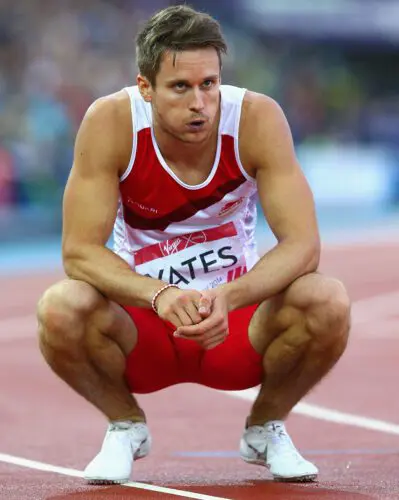
“I think I got quite a lot out of myself,” he reflects. “I don’t think I was necessarily one of the most naturally talented athletes. I trained pretty hard, stuck at it, and worked to get to the levels I got to.
“I’ve always got regret over the Olympic situation in 2008. But you can look at it a couple of ways. I was fortunate that Rhys and Dai were injured around that period. I probably wouldn’t have won the trials if they’d have been fully fit.
“But I was never able to put that issue fully to bed. I don’t know why. I was 22 and didn’t beat my personal best again. The gremlins over that, I think, hindered my ability to run a PB. I’d always run through my career with a lot of pressure, most of which was put on by myself.”
Describing himself as a “modest-slash-realistic individual”, Yates says he was firmly aware of “how good I was, but also how good I wasn’t”. Suggesting that “Commonwealths were probably my level,” he explains how finding out in late 2016 that future England squads would be smaller for that competition prompted his elite retirement at the age of 30.
After finishing second at the Manchester International in mid-August 2017, he simply decided that was that: “To do another hard season of graft and perhaps miss out on selection wasn’t really something that I felt like I wanted. It was never a planned decision – I just woke up one day and thought I wasn’t going to bust a gut doing 400m training through the winter.”
Throughout the bulk of his athletics career, Yates had worked full-time as a lawyer, inspired by that 2008 selection debacle to go into the world of sports law. He moved from private practice to serve as head of legal at the Rugby Football League because he “felt motivated by making decisions that were for the greater good of sport and would have an effect on the actual field of play”. He has also sat on appeals panels for the Football Association and Sport Resolutions, before taking up his current role at UK Athletics.
But that is not his only current connection to the sport. For five years after retiring, his exercise focus lay in triathlons, cycling events, a couple of half-marathons and regular parkruns. Then, by accident, he found himself back on the track startline again.
“When I retired I had absolutely no doubt in my mind that I’d stay retired,” he says. “I didn’t think there would be any circumstances that I’d run 400m hurdles again. It was almost a bit of a mistake that I did.
“I was helping some of the girls at Trafford [Athletics Club] with their hurdles, and the next thing I knew I was running alongside them in training. Then I was doing a race.”
After a half-decade hiatus, he began stepping out at local league meets in the late spring of 2021. It turned out he was still quick enough to qualify for the British Championships, so he seized the opportunity and reacquainted himself with lining up alongside the country’s best in Manchester. The following year, he did it again, and over the last three winters he has contested the 60m hurdles at the British Indoor Championships.
Having turned 40 this January, he was the oldest competitor in any running event at the national indoor championships in Birmingham the following month, only exceeded in age by a smattering of throwers and race walkers. His time of 8.47 did not see him advance from the heats, but he had accomplished his goal of reaching a British Championships in his fifth decade.
“I was totally there making up the numbers, but I did it and was pretty pleased with myself for getting to the startline,” he says. “When I crossed the finish line I was just pleased I’d finished in one piece. When I go to a warm-up area now for an event, I feel very old. Most of the people that were involved in the sport when I was running are coaches, administrators or officials.”
In a stroke of dark humour, he was asked to present medals to the men who made the 60m hurdles podium in Birmingham in his absence. Ever the lawyer, he is quick to point out that he was “aware of conflicts of interest, but I’m so far from the times that those top guys are doing that I don’t think anyone is suggesting I’m anywhere near the national team”.
Whether he will race at future British Championships in the years ahead is unknown. He has not run a 400m hurdles since 2023 and has no plans to return to a full lap of the track. If he can run fast enough to qualify for the 60m hurdles next year then he may well accept his place, but it is not a target he is particularly aiming for.
Masters athletics is also not something he craves, and he is instead likely to turn out a few times over 110m hurdles for Trafford in the Northern Athletics League, continuing to do what he has always loved without any pressure: “I don’t think I’ll specifically train for them, but it’s a good atmosphere – a nice sunny day at an athletics meet, you can’t really beat that.”