Sub-two: Innovations and revelations

The London Marathon brought the startling advances in footwear and nutrition into sharp focus and two people at the heart of each field explain how much of a difference they are making.
Sabastian Sawe might have crossed the finish line first, but in doing so he made two of his sponsors arguably the biggest winners at this year’s London Marathon. For Adidas and Maurten, that world record-breaking performance was not only the culmination of years of work, but also the clearest indication yet that they have truly hit on the recipe for success.
Much of the aftermath centred around the shoes – in this case the Adidas Adizero Adios Pro Evo 3 that were worn by the likes of Sawe, second-placed Yomif Kejelcha and women’s race winner Tigist Assefa. At less than 100g, was it the weight – or lack of it – that had made the difference? Or how about the latest version of the brand’s Lightstrike Pro Evo foam, designed to give the wearer maximum energy return from every step? Maybe it was the ENERGYRIM – a carbon fibre creation that surrounds the edges of the shoe’s midsole and propels the athlete forward – different from the more traditional carbon plates or rods to be found in previous iterations of super shoes?
“There's no one magic ingredient,” Valentin Perrin, Senior Development Lead of the running innovation team at Adidas, tells AW. “There are four key parts on the shoe – the upper, the midsole, the stiffening element and then the outsole – all playing an important role. But it’s not just these four ingredients, it's more about how we merge them together. We use an analogy with cooking. Because the shoe is so technical, if you touch something on it, it might impact something else, somewhere else. So it's very important how you cook the ingredients together.”
There’s a similar alchemy at play when it comes to nutrition. Around the same time that super shoes were first beginning to appear a little over a decade, so too Maurten – a nutrition company based in Sweden – was coming into being. There is a growing weight of opinion that their products have in fact been a bigger factor than the footwear in bringing marathon times down so spectacularly and it’s certainly worth noting that every men’s and women’s marathon world record since 2018 has been run by an athlete using their products.
“I’m obviously biased because of my research,” says Josh Rowe, Maurten’s Head of Technology. “But when the [super] shoes were introduced, Maurten wasn't really even a company at the time and didn't really have a voice. So even though the research was being published [around what they were doing], at the end of the day you're going up against the big marketing [power of the] shoe companies.
“The elites were aware of how important the nutrition has been compared to, say, the shoes, but I think we've always been in the background of it. With Nike’s Breaking 2 project [in 2017], it was about the shoes, and then with the Ineos 1:59 project it was [all about] a combination of the shoes, drafting and the course. Nutrition was never there. But at London 2026 it was the shoes and nutrition at the forefront.”
The creation of a “hydrogel” – which allows the athlete to absorb an increased amount of carbohydrates without suffering gastro intestinal issues – has been the major development. Rowe is a sports science graduate from Leeds Beckett University who did his masters in exercise physiology. As a marathon runner himself, he had decided to centre his PhD around “carbohydrate metabolism for optimising performance” and it was through that that he first became aware of Maurten’s work.
“I reached out to them, but because they were going through all the patent applications and things [at the time], they politely told me to get lost,” he smiles. “I was a student, asking a lot of information about the chemistry formulation, how the product worked. So I went away and created my own hydrogel and in 2019 I published this series of studies around hydrogel technology. A few companies reached out for me to join them. It only really ever made sense for me to join Maurten.”
And so it is that he finds himself at the very sharp end of the fascinating evolution of sports nutrition products that now allow athletes like Sawe to consume over 100 to 115g of carbohydrates per hour on the run – an average bowl of cooked pasta contains roughly 40g to 45g – without any stomach issues. The London success offered a brief moment for Rowe to reflect on just how far the “professionalisation of nutrition” has come. So how different did things look around a decade or so ago?
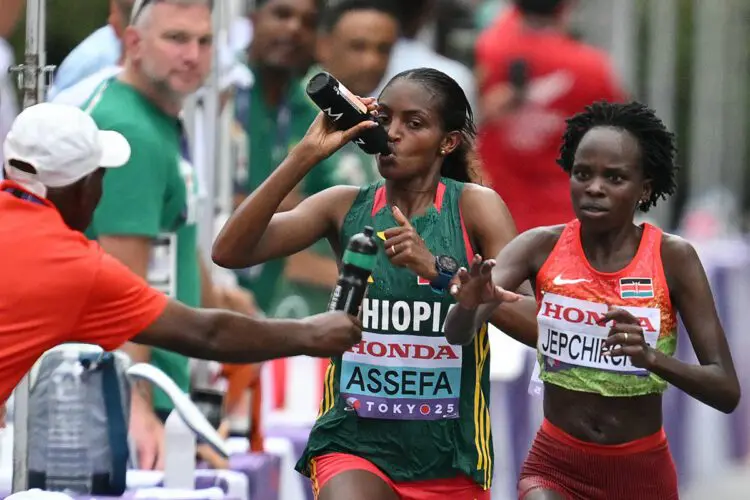
“Between 60 to 90g per hour was the recommended target intake,” he adds. “But if you spoke to most of the athletes they were getting anything from zero grams, where they would be only drinking water, to maybe 15 or 30g. If they were getting carbohydrates in, it was very minimal.
“And the issue within the research at the time was that although they were saying you could have 60 to 90g of carbohydrates per hour, it also said you shouldn't go beyond a concentration of eight per cent of a carbohydrate solution, which then meant you would have to drink considerable amounts of fluid. To get that amount of intake, you're talking close to 2.3 litres per hour to consume.
“When Maurten arrived, it was a 14 per cent solution and it was the first highly concentrated carbohydrate drink which allowed athletes to get 80g of carbohydrates in within 500m of fluid every hour. That was a game changer.
“I think nutrition just wasn't thought about as much. The handling of the drinks before a major marathon was not really an event, but now it's a crucial part of the day building up.
“What tended to happen before was that the agents or the coaches would prepare the drinks for the athletes, and they'd just say: ‘Okay, this is what you have on the course’ but the athletes wouldn't really know what it was. It could be a little bit of Lucozade, or it could be their own mixture, or it could be just water. There was no structure to it.”
But, now that there is, the difference is stark. As is the way that the world’s best approach the marathon.
“When you look at the performances that happened pre 2016 the race was about who could get to 30km and then survive the last 12km?,” adds Rowe. “When we talk about the impact nutrition has had, we’re now seeing that the athletes get faster after 30km. There's not much of a blow-up and although you can say the shoes help from an economical perspective, and a neuromuscular load perspective, nutrition is a major element because it allows the athletes to really attack the race instead.”
As he spoke with AW, Rowe was also preparing for the next of what are regular trips out to Kenya to visit Sawe’s training group. The Briton has worked with coach Claudio Berardelli for almost five years, and very closely with the world record-holder for the past three. He will be out there to “collect a lot of data on the athletes, not just around nutrition, but overall performance science”. There will also be a London debrief and a calibration of all the data from the race – all done with the focus on improvement for next time. In Sawe’s case, that next time will be the Berlin Marathon.
But, when you have managed to achieve a big leap forward, such as 1:59:30, how much harder does it become to find that improvement? How close to the ceiling are we when it comes to nutritional and footwear development?
“It's always hard to put a limit on it. I think we're getting close,” says Rowe. “I'll be surprised if we get to the point where we're recommending an athlete to be having 250g of carbohydrates per hour. But we're still optimising how we can utilise other things like sodium bicarbonate – that's been a relatively new ergogenic [performance enhancing] aid within the marathon.
“It's always been heavily used by middle distance and more anaerobic athletes so I think we’re reaching a point where we'll say: ‘From a carbohydrate standpoint, we're at the optimum range, but is there a way to start to embed these optimisations over nutritional ergogenic aids like sodium bicarbonate?’”
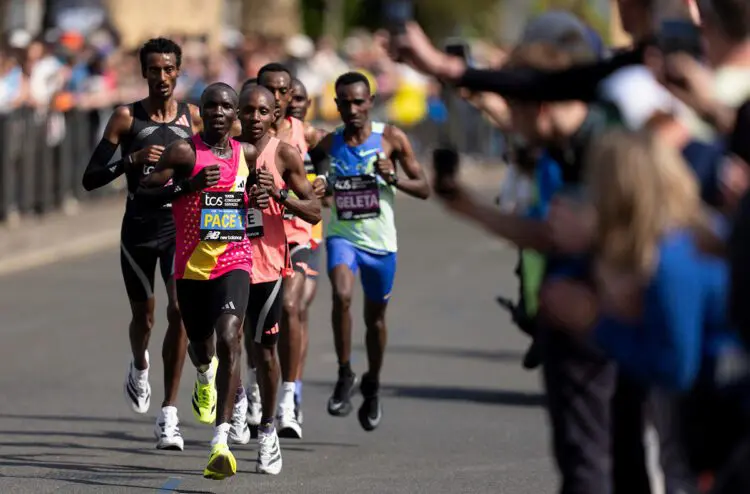
The products themselves won’t be the sole focus, though. How they are delivered is also under scrutiny. The evolution of the humble drinks bottle could be another point of difference.
“Maurten was the first company to come with the really small race bottles,” adds Rowe. “We have in development different bottles that mean the athletes don't have to use their own force to drink. Even the way athletes can collect and pick up the bottles, it's probably not the most optimal way.
“At Berlin they can get their own dedicated bottle handler and at most of the other majors that's not the case. When we do simulation work around the marathon performance, there is a bit of wasted energy around the drink stations, because the athlete has to go away from the blue line [that highlights the fastest route around the course].
“They have to waste a bit of energy and they sometimes miss [the drinks], or even if they get it then they have to get back into the pack. There's more set up in Berlin, from a race perspective, for us to run quickly, not just purely just because it's a quick course, but around the bottle handling and how the course allows the drink stations to be close.
“We have got to the point where getting enough carbohydrates in the body is not the problem any more. It's almost like: ‘How can we optimise the delivery in different ways?’ There will definitely be some innovation there.”
In the days after London, Sawe, Kejelcha and Assefa stopped off at the Adidas headquarters in Germany not only to celebrate, but to share their thoughts on the shoes with the innovation team. Does Perrin anticipate there being many changes made to this famed footwear before the autumn majors?
“I wish I could tell you, but I can’t,” he says. “Now it's a question of: ‘How do we build on that? How do we keep the momentum and integrate all the feedback we have from athletes – not just from London, but also in the upcoming months?
“There's no start and stop in terms of the project, it's continuous learning. It's super important to have feedback right after the race, integrating it into the shoe’s knowledge and then creating something in the future.”
How that future might look in another decade’s time is anyone’s guess.
This article also appears in the Sub-two special edition of AW magazine, out now