How they train: Peter Lynch

We speak to the Irishman about the work that went into breaking his own national marathon record in London.
Resplendent in Puma’s bold and vibrant colours, Peter Lynch delivered his own statement performance as he finished ninth (first European) at this year’s London Marathon in an Irish record of 2:06:08.
It was another significant breakthrough for the US-based Kilkenny City Harrier who had run 2:09:36 – a national record at the time – at the Düsseldorf Marathon in April 2025 and more recently became the first Irishman to break 60 minutes for the half marathon with 59:52 in New York in March.
“It’s class,” he told AW immediately after the race in London. “I knew based off training and the New York Half Marathon that the potential was there to definitely run fast, but for it to come off on the day was really good.”
Lynch, coached by Ireland’s former European indoor 3000m champion Alistair Cragg, joined the Puma Elite Running Team in North Carolina in July 2024 after graduating from the University of Tulsa.
He had initially been unsure of his next step, but with an interest in stepping up to the marathon, he sought advice from former Tulsa graduates Chris O’Hare (the retired British international middle-distance runner) and Patrick Dever – who was already part of the Puma team and aware of Cragg’s desire to grow the marathon group – and agreed it was worth reaching out. The decision to make contact with his fellow countryman, and in turn Cragg’s willingness to bring him into the fold, has paid off for both parties.
Lynch’s 2:17:40 marathon debut in Chicago that autumn was disappointing, but he was doing the best workouts of his life and that gave him the confidence he needed to “stick with it”. Validation came with a then half marathon PB of 61:15 in Houston in January 2025 and, off the back of his Düsseldorf Marathon performance that April, he agreed his first professional contract.
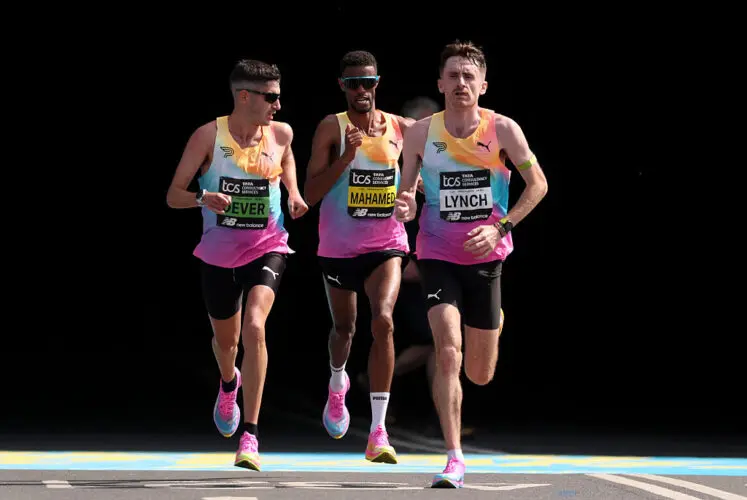
But, as Lynch approached the latter stages of the London Marathon, it was the company of his Puma team-mates rather than material items that made the difference. Unlike periods in Chicago, Düsseldorf and at the World Athletics Championships in Tokyo, this time he wasn’t alone.
“A big goal for this race was to get in the pace group and to hang on, no matter what,” says the 28-year-old, who ran with team-mates Dever and Jack Rowe for the majority of the race. “I split it up into two sections. One was to be aggressive and stay with the group until 30km – and based off training and my New York half there was no real reason why I shouldn't have been able to do that – and then for the last 10km it was just trying to pick it up if I was feeling good, or just to try and keep it together and be strong enough not to blow up.
“We hadn't really talked about London a whole lot before New York, so it wasn't like the plan was to run 2:08 pace before New York and then it changed to 2:06, but I guess after breaking 60, it was, like: ‘Okay, so it's not going to feel easy going through in 63:15 or whatever, but I’ll hopefully not implode’.”
Lynch’s focus now moves to the World Road Running Championships in September and redemption over the half marathon distance after a DNF in 2023.
For now, however, he is content in the knowledge London was a big step forward in his career as a marathon runner. “It was just a good feeling in the last 5km or so, where I kind of switched focus to trying to beat the guys that I was running with,” he says. “Any marathon I've done before I've always just been absolutely hanging on in the last 10km or dying, so to actually be in a position where I'm like: ‘Alright, I feel strong…’ I mean obviously I was in a lot of pain, a lot of things were hurting, but to feel strong and to feel like I had a move to make, that was encouraging.”
A typical training week (North Carolina, February 9-15)
The splits detailed below are from Lynch’s post-run data. Easy runs were done to feel rather than pace and his total weekly mileage (also his peak mileage for about four weeks during his London build) was 112.
Fridays are usually turnover day – “We’d normally do 300s or 400s on a gradual hill and there might be a three or four second difference, like 64 seconds going up the hill and 60 going down the hill,” says Lynch – but for this particular week coach Cragg wanted to “throw in some harder, faster reps” to prepare for New York City Half.
Sunday runs alternate between a long run for time (as in this example) and a long run workout. Gym is usually twice per week with a focus on core work and injury prevention, plus hurdle drills.
Favourite session: “Definitely long runs where there's a lot of marathon pace in there, or just a long run for time where you're out there a while then you're a bit dead afterwards. It's kind of a nice feeling you get, like a runner’s high I suppose.”
Least favourite session: “I'd probably say 5km stuff or longer reps at a really hard pace but I enjoy most of it to be honest. I definitely didn’t enjoy the faster stuff in college but I enjoy it more now because I’ve got better at it!”