Zharnel Hughes: “I want to leave a mark”

The British sprinter talks about legacy, fatherhood and adding more precious metal to his collection at the European Championships this summer
Given his profession, Zharnel Hughes is always paying attention to the ticking clock. For a sprinter who is operating in events that are decided by the tiniest of fractions, literally every moment counts.
However, he is also increasingly aware of the passing of time in his wider life. The four-time European gold medallist’s career is no longer in its infancy. He will celebrate his 31st birthday this month, while he is also father to an 18-month-old son and will head into the major championships of this summer – the Commonwealth Games and European Championships – as one of the more senior members of the England and Great Britain teams. It’s not so much that Hughes feels time is running out, more that his opportunities for further success at the highest level aren’t infinite.
“I want to leave a mark,” he says. “And when I look back at the end of my career [I want to be able] to say I really gave it my best, so I want to make these last couple of years count. I'm 30 years old now, and people are saying ‘you're getting old’. I don't feel old. I still feel I have a lot of youth in me.
“I feel like, over the years, I've been injured a lot, and that's because I feel like I'm too fast for myself in the sense that I didn’t feel as if my strength was really up there with the speed.
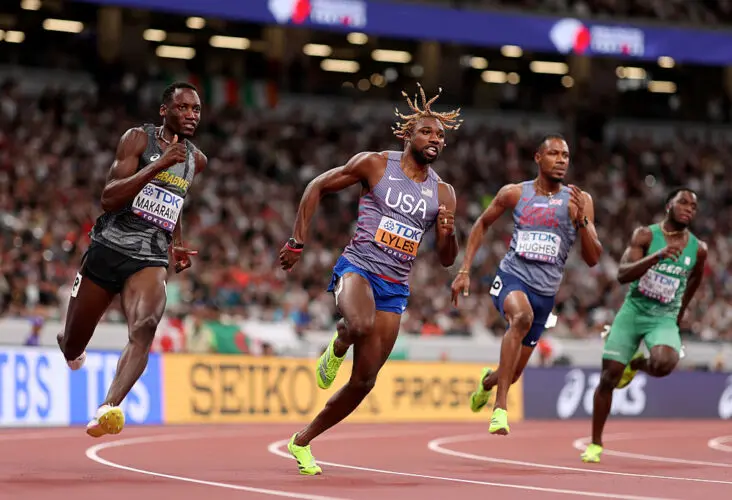
That was leading to a lot of injuries, but we have been working on a lot and I'm feeling much stronger right now.”
The man who holds the British records for 100m (9.83) and 200m (19.73), has Olympic, World, European and Commonwealth honours to his name, yet still he has lots to achieve – not just for himself but also for the little boy who will be watching his father compete in person for the first time this summer.
“My son is now becoming aware of me running, because he saw me [at the World Relays] in Botswana,” beams Hughes. “He and his mum were watching the TV – and he was like: ‘Dada, Dada, Dada!’ so he’s becoming aware of it. Any time he sees anyone running on TV, instantly his Dada is the first thing that comes to his mind. He's been a major motivation and now and again I take him to the track just to burn some energy, because he's a little toddler driving me up the wall!”
There are glimpses of some talent, too.
“He moves like a three-year-old, to be honest with you,” adds Hughes, who is coached by Usain Bolt’s mentor Glen Mills in Jamaica alongside a group that contains 100m world champion Oblique Seville. “He’s super advanced. I don't know if it's the kids these days or what, but he's incredibly smart for a one-year-old. Some things that he's doing, man, it impresses us. I feel like he's going to be talented too, because his mum taught him ‘On your marks, set, go’, and he's been doing it.
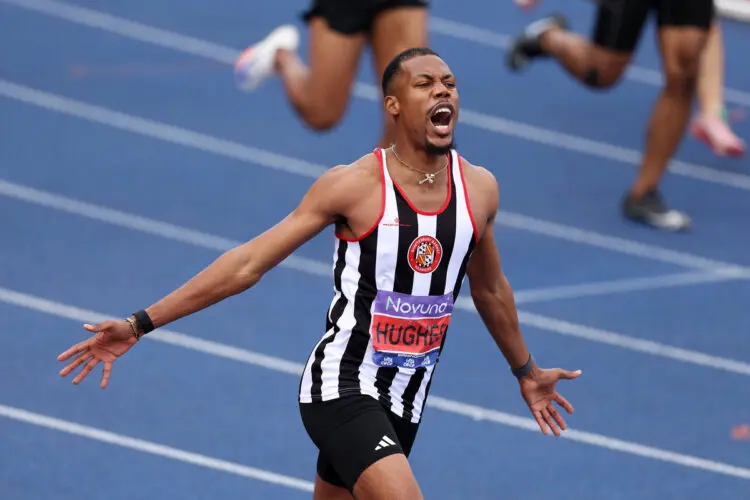
“He'll go on his mark, put his finger down, and he'll call me: ‘Dada, look!’. I’ll call ‘On your marks, set, go’ and he'll run off, and then he's looking to see if you're actually watching him run. At the end, he's looking for the clap, like: ‘Are you going to clap me?’. I won’t force him to do track and field, that's for sure, but I would love to see how fast he could run.”
Hughes admits the presence of his family unit provided great comfort last year, when all didn’t go entirely to plan on the track. Following a show of dominance at the UK Championships, where he completed the 100m/200m double, hopes had been high that he could add to his individual medal tally at the World Championships in Tokyo. Not reaching the final of the 100m and then coming fifth in the 200m, despite clocking the second-fastest legal time of his career of 19.78, was not what he had had in mind.
“I was going through some stuff that was mentally challenging me, so it was inhibiting my performances physically,” he explains. “I was in great shape, but mentally I wasn't there, and it really took a toll on my performance. Everything is heightened at that moment, so the slightest thing can trigger you.
“To me, the 200m was average. I felt as if I was in better shape than that but, because of what was going on, and my head wasn't there, it was just guts that brought me to 19.78. I won't look down on it, obviously it's a great time, but I feel as if there's more to give, and with my head being in a much better place this season, and the way I'm training right now?... Hooo!”

For the 2023 world 100m bronze medallist, an individual Olympic honour “is the only one that’s missing” but his more immediate championship concerns will take place on British shores. This month Hughes will compete over 200m at the Commonwealth Games, his first time racing in Scotland, and will head there looking to upgrade his silver medal from Birmingham four years ago. As the dust settles in Glasgow, he will then return to the Alexander Stadium to take on the best in Europe over 100m.
The European Championships have been a big part of Hughes’ international career. The man born in Anguilla first competed for Britain in 2015 and his first major title arrived three years later, when he charged to 100m European gold at Berlin’s Olympic Stadium. His winning time of 9.95, matched by Italian former Olympic champion Marcell Jacobs at the 2022 edition, remains the championship record.
“Germany's always nice to race, because the Germans love speed,” says Hughes, who also went on to win European 200m and 4x100m gold in Munich four years ago. “Being in Berlin was incredible, because you know the history behind that stadium and Usain breaking the world record there.
“I was like: ‘This is where Bolt ran, I would love to lay down my piece of history here as well, and I was able to do that. I got the European Championships 100m title there and also the championship record. To top it off with [gold in] the 4x100m, it was just spectacular. And then to bring it on over to Munich, to get the 200m title that was something we wanted to achieve. I wanted to get that as well.”
Home advantage will help with the quest this time around. Hughes vividly recalls the atmosphere created at those 2022 Commonwealth Games in Birmingham and is hoping that the crowd can create that extra dimension again.
“A lot of us are hyped about it,” he says of Birmingham 26. “I'm looking forward to being there at my best, healthy and delivering performances that I know I’m capable of. We rely heavily on the crowd participation and, once we're getting good feedback from them, it heightens our performances.”

If Hughes has his way then that crowd, including his son, should have plenty to cheer this summer. He intends to add to more achievements to that championships CV but what does he think that 22-year-old who stood on the top step of the podium in Berlin would make of what he has gone on to accomplish so far?
“I think my 2018 self would be quite proud in regards to me getting on the podium at the World Championships stage,” he says. “I really want to get on the podium at the Olympics now. That’s the one I'd love to eventually get written in the history books so that, once I’m through with the sport, I could say I've achieved at every major championship there was and I can feel proud of myself.
“But, regardless, right now I'm proud of myself. Sometimes I've had my hiccups, which can be a bit disappointing, but that's life. I try not to beat myself up too much about it. Sometimes, you prepare for the best, but you also have to expect the worst at times because that's life for you. I'm just doing my best to stay as healthy as possible, and I want to showcase to myself that I am a great – and will forever be a great – athlete.”

The fast show
Fans of the short sprints will be spoiled for choice at the beginning and end of the Birmingham 2026 European Championships schedule. The women’s 100m heats take place on the opening morning, Monday August 10, while the semi-finals and final will bring the first evening to a climax during a session that also features the finals of the women’s and men’s shot put, men’s 5000m and the Mixed 4x400m relay.
It’s the turn of the men on August 11, with the 100m heats again taking place in the morning before the medals are decided later in the day. That evening session also includes the men’s hammer, women’s 5000m, men’s long jump and women’s 100m hurdles finals.
The women’s 200m heats and semi-finals are then contested on August 12, with the final on August 13, while the men’s 200m final takes place on August 14, with the heats and semis having unfolded the day before.
The work doesn’t stop there, however, and it’s a quick turnaround for the members of the relay teams. August 15, the penultimate day of competition, will see the 4x100m relay heats unfold in the morning session, before the men’s and women’s finals bring the schedule to a close in the evening.
For the full schedule and ticket information, visit: tickets.birmingham26.com