Karsten Warholm shines as Tom Gale rises to the occasion

The opening rounds of the 400m hurdles, 3000m steeplechase and high jump, where British athlete Tom Gale reached the final, provided the highlights among the male athletes taking part on the first morning of action in Tokyo.
The 400m hurdles were well contested, with world record-holder Karsten Warholm virtually jogging home in his heat in 48.65 as Ireland's Thomas Barr followed him home in 49.02.
Qatar's world medallist Abderrahman Samba was fastest overall with a 48.38 opening heat victory just ahead of Brazil's Alison dos Santos's 48.42. American Rai Benjamin, expected to be Warholm's biggest rival for gold, won his heat in 48.60.
“It was nice to get out on the track again," said Warholm. "It’s something I've been looking forward to for a long time.
"I've been here for two weeks already, I’m starting to get bored so it was very nice to get around."
Asked if he could break his world record of 46.70 in Tokyo, he added: “Maybe someone else will do it. I’ve done my job.”
Tom Gale has competed sparingly in 2021 but he did superbly to make the high jump final on what was an otherwise disappointing morning for British male athletes.
The advertised guaranteed final qualification had been a height of 2.30m – or finishing in the top 12 – but Gale finished 13th with 2.28m and was listed at one stage as not having qualified.
He cleared 2.17m and 2.21m at the first attempt and then 2.25m at the second. However, he failed with his first two attempts at a season's best of 2.28m but managed it, just, on his final jump.

No-one wanted to go up to 2.30m to eliminate just one athlete so the judges sensibly settled for a 13-man final.
Most of the favourites will join Gale in the final, with world champion Mutaz Essa Barshim and ANA athlete Mikhail Akimenko the only two with perfect records up to 2.28m.
Ukraine's 2.40m jumper Andrii Protsenko, fourth in Rio, was probably the biggest casualty as he exited with a best of 2.25m.
Gale said: "I feel amazing. I’ve missed a significant amount of technical work, which is why today I was a little bit inconsistent and frustrated to be second and third attempt in the last two heights.
"I think I just got to the end and the image which came to my mind was one of my Dad sat in front of the TV, heart rate at like 210, and my Mum curled up in a ball watching away from the TV sat right next to him. I was like ‘I can’t let them down’.
"I’m really happy about today but, on the other side, I know going into the finals that the shape I was showing, yeah I cleared 2.28m which is a massive clearance and felt really good, [but] in the finals if I’m third attempt it’s going to be massively costly for medals.
"I believe in myself, my knee’s a bit uncomfortable so I’ll get that addressed by the physios, and if I get to 100 per cent I still believe in myself to get a medal."
While Gale excelled, it was not such a good day for London 2012 discus finalist Lawrence Okoye. The Briton had looked almost back to his very best this season after his American football sojourn, winning the European Team Championships, but he had three no-throws and did not comment after his competition.
World champion Daniel Stahl was the only athlete in either group to get the automatic qualifying mark with a 66.12m. Andrius Gudzius was next best with 65.94m.
World silver medallist Fedrick Dacres surprisingly missed out on qualifying with a best of 62.91m and was denied a top 12 place by the 6.93m throw of Jamaican team-mate Chad Wright. The qualifying distances overall were very poor, making Okoye's elimination all the more frustrating.
The steeplechase heats were the first men's action on the track and they started impressively, confirming the track at the Tokyo Olympic Stadium is very fast for distance runners.
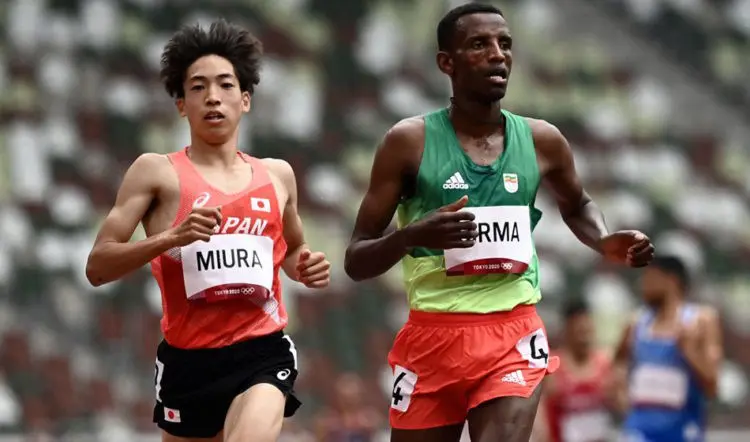
World silver medallist and world leader Lamecha Girma, a very late addition to the Ethiopian team, won heat one in 8:09.83 – easily the fastest Olympic heat in history – and was quickly followed by Japanese teenager Ryuji Miura who smashed his national record with 8:09.92. It was a six-second PB for the athlete who is still an under-20.
The second heat was not much slower and five athletes broke the previous fastest time for an Olympic heat of 8:15.11, led by Kenyan Abraham Kibiwot's 8:12.25 just ahead of Getnet Wale's 8:12.55.
The heat three runners knew a time of around 8:16 would guarantee a top five place for the final but instead they ambled round for the opening kilometres and ensured only the first three would survive. Soufiane El Bakkali won in 8:19.00 as Finn Topi Raitanen sprung a surprise to finish second in 8:19.17 as both ran the closing kilometre in 2:37.
Kenyan trials winner Leonard Bett was a casualty in the big sprint finish for places and his 8:19.62 fifth place means that, unusually, his nation will only have two finalists.
It was a disastrous qualification for the Britons. In heat one Phil Norman started encouragingly with a 2:45.2 opening kilometre but at 8:15 pace he was back in 14th. He was up to 13th at 2000m in 5:38.7 but was now eight seconds off the leader, beginning to struggle. He finished 13th in 8:46.57, with kilometres of 2:45, 2:53 and 3:08.
Zak Seddon, whose build-up was heavily disrupted by being isolated after travelling on the same plane as a passenger who tested positive for Covid, also ran similar splits. He was a leader at 1000m in 2:45.5 and tenth at 2000m in 5:35.6, just three seconds off the leader, but he lost close to half a minute in the final kilometre and finished 13th in 8:43.29. His kilometres were 2:45, 2:50 and 3:08.
Seddon was naturally disappointed with his showing but philosophical.
"It was hard, it was disappointing, it's just a shame the one race in five years you want to get right and you get wrong and you don’t show your best self on the day," he said. "I went for it, I believed I was in the shape to run well so I knew what I had to do and I’m never scared of running like that but I think it just showed that on the day I wasn’t worth what it was or some things weren’t happening.
"It's not been great and mentally it’s been hard here, there and everywhere, but in this day and age that’s what sport is and some athletes are going to get easier rides in than others but you have to deal with it – you don’t get points on the finish line for having different build-ups, you know? The numbers on the scoreboard are what counts.
"Rules are rules and if I want to show up here and run at the Games I have to abide by them. If some have to suffer for the many I suppose that’s better than everyone not having a Games."
» For the latest athletics news, events coverage and updates, check out the AW homepage and our social media channels on Twitter, Facebook and Instagram