Rain can't stop the records tumbling in Glasgow

Downpours fail to drown out the Commonwealth fireworks as Zoe Hobbs and Emmanuel Eseme fly to 100m golds, while Patterson wins brilliant high jump battle at Scotstoun.
As the start of the evening athletics session at Scotstoun Stadium approached on Tuesday (July 28), one topic of conversation dominated all others – the weather. It would become the theme of the night.
As the skies opened, outside the gates the crowds scampered for any scraps of shelter, those with tickets for the uncovered temporary stands leaving it until the very last minute to brave the Scottish summer downpour.
The person responsible for the stadium music hit an appropriate note as the sounds of Tinseltown in the Rain by eighties Glasgow band the Blue Nile drifted across the arena.
When the action began, the conditions only got worse – thunder rumbling and even the odd flash of lightning accompanying the increasingly heavy rain that caused a temporary pause in the women’s high jump final and chaos in the women’s hammer final.
At one stage, those clocking up the highest activity levels in the stadium were the squad of volunteers who were working valiantly to mop up the deluge on the jumps runway.
And yet, across the course of an eventful evening, the excess water couldn’t dampen the athletes' speed, or their ability to produce record-breaking fireworks.
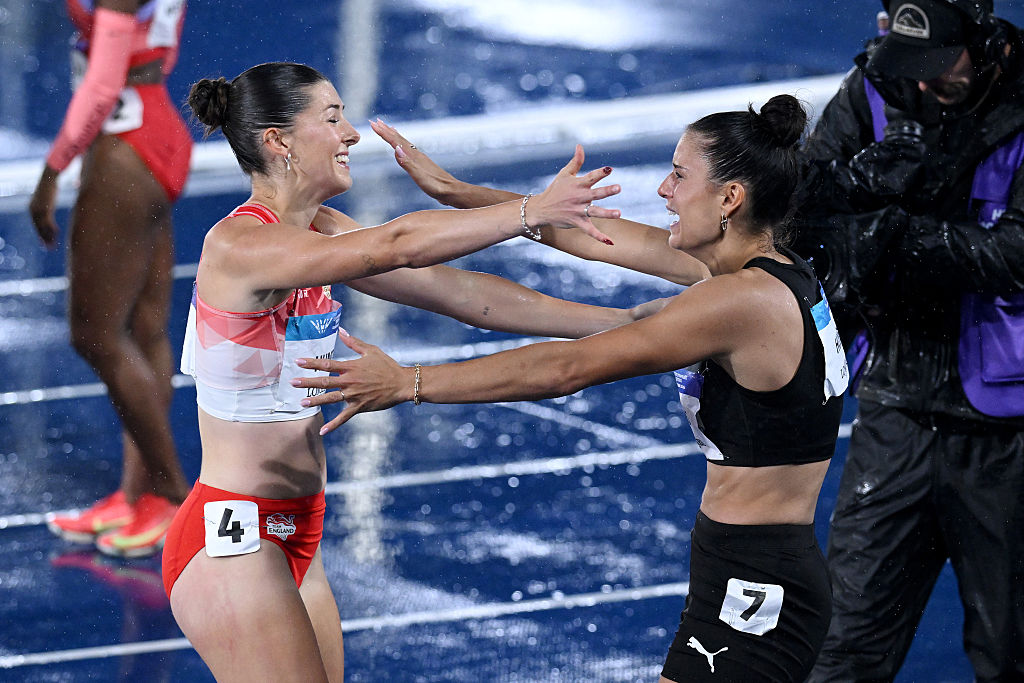
For example, in the last race of the night – the women’s 100m final – New Zealand’s Zoe Hobbs flew to an Oceania record of 10.93 (1.0) as she won Commonwealth gold. Running from lane seven, she held off England’s Amy Hunt (10.98) and, in the extremely un-Antipodean weather, Torrie Lewis produced an Australian record as she broke the 11-second barrier for the first time with 10.99. Imani Lanisquot’s resurgence continued, as the Englishwoman ran 11.02 for fourth.
The last time the Commonwealth Games were being staged, in Birmingham four years ago, Hunt was in the stands, recovering from major surgery after the quadriceps injury that had threatened her career.
But now she has added another major individual medal to a growing collection that also includes the world 200m silver she secured in Tokyo last year.
The 200m is her naturally stronger event but she has lowered her 100m personal best to 10.97 this summer and now consistently runs under the 11-second barrier. Struggling with her start in the shorter sprint at Scotstoun, Hunt had to rely on searing closing speed to bring her through – an approach that worked perfectly in the semi-finals. However, in the final, three-time Oceania champion Hobbs managed to build too big of a gap to bridge and surged to the title.
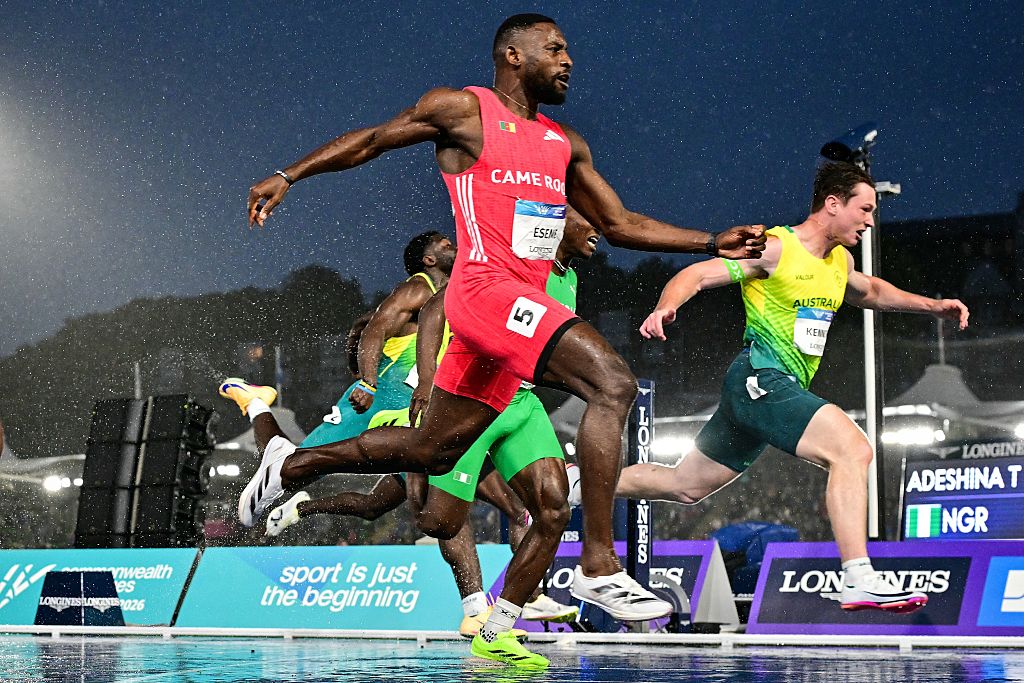
In the men’s 100m final, Emmanuel Eseme left it late but got his timing just right. Having clocked a national record of 9.89 in the semi-finals, the man from Cameroon charged through to pip Australia’s Lachie Kennedy on the line, lowering his national mark and breaking the Games record into the bargain with 9.83 (1.3). The previous record had been Ato Boldon’s 9.88 from 1998.
For a brief moment, Kennedy thought he’d won it, but he could console himself not only with a silver medal but an Oceania record of 9.85, while Nigerian pre-race favourite Kayinsola Ajayi had to settle for bronze despite clocking 9.90 and Welshman Jeremiah Azu was fifth in 10.03.
The semi-finals had been eventful, and fast, with Eseme clocking that 9.89 and Kennedy a then PB of 9.94 - the same time logged by Ajayi. But the main headline was defending champion Ferdinand Omanyala falling by the wayside, the Kenyan only able to finish sixth in his semi-final with 10.19. Linford Christie remains the last man to win back-to-back 100m Commonwealth titles.
And so it was that Eseme stepped through the open door. The 32-year-old is a former amateur football goalkeeper but has not looked back since switching to athletics at the age of 24. He has not lost his links entirely with his first sport, however, as he is based in Portugal and trains as a member of the multi-sport club Sporting CP in Lisbon that is best known for its football team.
“After the semi-finals I just said to myself: ‘You may not be the best starter. They may let you go in the first 50 metres, but just keep it, don't rush anything’,” said Eseme. “‘Execute your race’. Somehow at the end I know I'm going to catch them.”
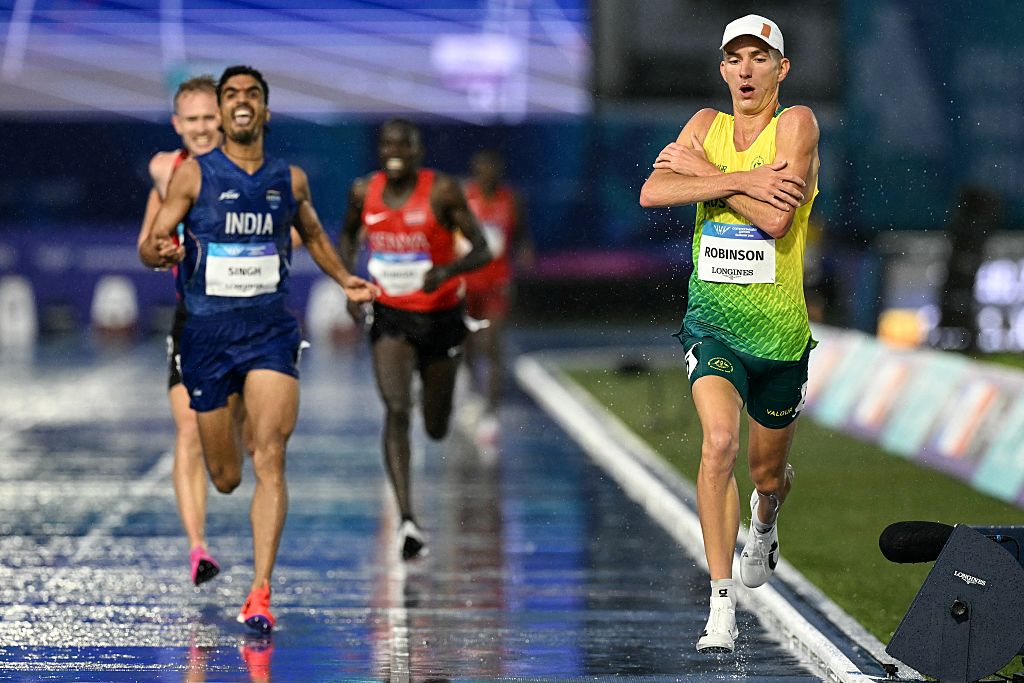
As with the women’s event the previous evening, the men’s 10,000m title was taken in spectacular style by an Australian athlete whose fine late charge carried them to gold. It was Ky Robinson who followed the example that had been set by his fellow countrywoman and now fellow Commonwealth champion Rose Davies, winning what became a four-way shootout for the medals with 200m to go.
With Australian distance running great Steve Moneghetti watching on, last year’s world indoor 3000m bronze medallist summoned a closing kick that saw him pull away off the final bend to hit the line in 27:48.93 ahead of India’s Gulveer Singh (27:49.78), while the British 5000m champion David Mullarkey put the Isle of Man on the podium with his run of 27:50.28, holding off Kenyan Edwin Kurgat (27:50.98).
Scott Beattie of England was fifth with 27:54.50 while Scotland’s Andrew Butchart, who had placed himself at the heart of proceedings before fading in the second half, was 13th in 28:16.75.
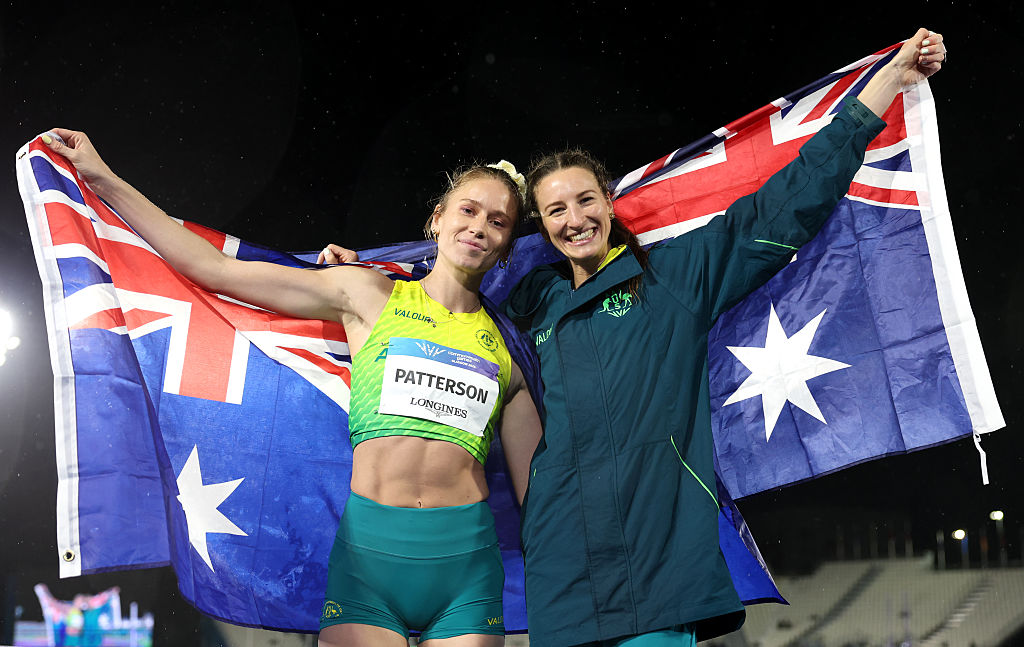
When the rain finally did relent enough for the women's high jump to resume, it resulted in a brilliant climax to the competition. Eleanor Patterson won what became an all-Australian battle against world champion Nicola Olyslagers with a Games record-equalling clearance of 1.96m.
Fully 12 years on from winning her first Commonwealth gold, also in Glasgow, Patterson added a second with her final attempt at 1.96m, then made three – albeit unsuccessful – attempts at clearing 2.00m.
Patterson had produced the cleaner card, going over first time at 1.87m, 1.90m and 1.93m – but, with Olyslagers also clearing that higher mark at her first attempt it took the contest into that showdown.
Nigeria’s Temitope Adeshina took bronze thanks to a third-time clearance of 1.90m, while British record-holder Morgan Lake wasn’t able to clear her opening height of 1.82m in the difficult conditions.
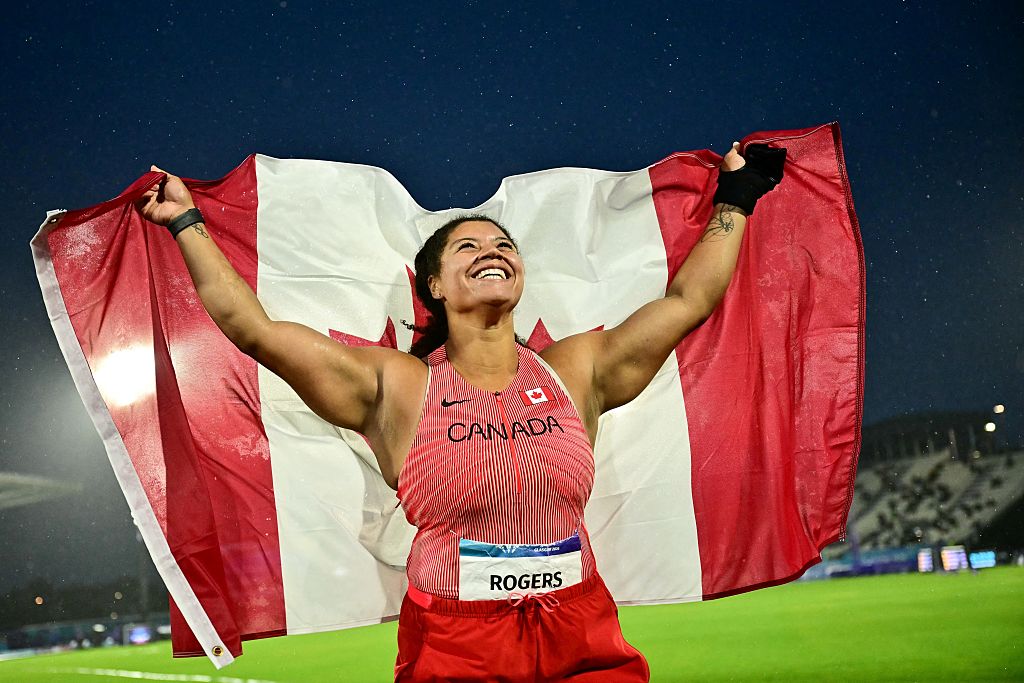
In the women’s hammer, Canada’s Camryn Rogers won her third consecutive Commonwealth title with a Games record of 74.91m, with New Zealand’s Lauren Bruce getting closest to the reigning Olympic and world champion with a best throw of 69.82m. Bronze went to Australia’s Lara Roberts with 68.05m while England’s Charlotte Payne, who managed to produce the first legal throw of the night as the competitors struggled to spin their way through the puddles, was fourth with 67.34m.
It was far from easy for the finalists in the T20 men’s long jump, either, with Malaysia’s
Abdul Latif Romly winning with a leap of 7.17m, Canada’s Noah Vucsics taking silver with 6.66m and another medal going to Malaysia via Eljoe Gotuoh’s 6.51m.
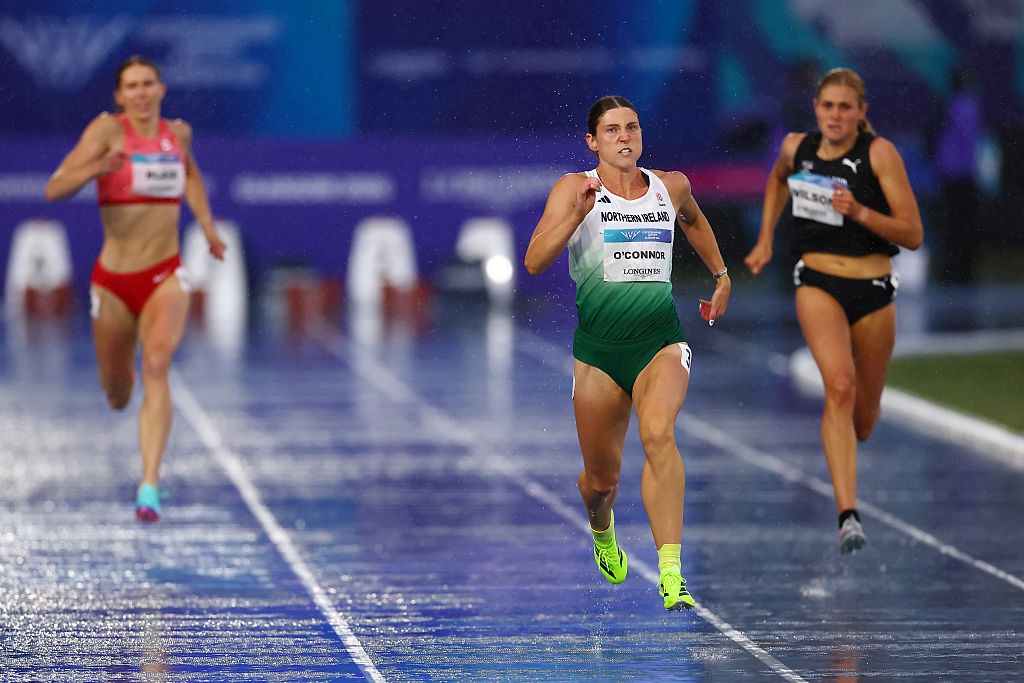
Northern Ireland’s Kate O’Connor, meanwhile put herself in pole position to win the first major title of her career at the end of day one of the women’s heptathlon.
The world silver medallist, who was also second at the 2022 Commonwealth Games, recovered from what she referred to as a “shocker” in the shot put, storming home in the 200m to log a tally of 3731 points after four events.
An intriguing battle developed between her and England’s Jade O’Dowda, who sits second in 3682, with Mia Scerri of Australia completing the top three with 3560.
The 2018 Commonwealth bronze medallist Niamh Emerson, a late call-up to the England team after the withdrawal of defending champion Katarina Johnson-Thompson, is making the most of her opportunity and is right in medal contention on 3554.
Third after the 100m hurdles (13.54) and then first following a high jump clearance of 1.82m, O’Connor was overtaken by O’Dowda in the treacherous throwing conditions for the shot put as the English athlete reached 13.28m to O’Connor’s 12.85m. But last year’s world indoor bronze medallist was fastest overall in the half lap thanks to her run of 24.14 to win the opening race, with O’Dowda clocking a time of 24.93 in heat two that saw her lose ground.
“I messed up that shot so badly,” said O’Connor. “I just couldn't deal with the rain, and I've not thrown that short in a long, long time. I threw further off the standing throw, to be honest.
“The more I speak about it, the more annoyed I get at myself, so I've just got to park that because I can't change it. I went out and I did myself proud in the 200m. I think I'm capable of running much faster but, in weather like that, with only 10 minutes to warm up, freezing cold conditions and lashing rain, I think I did a good job.”
Full results here