Why the London Marathon is the greatest in the world

Experiencing London's vibrant streets and unrivalled atmosphere, which showcased the British capital at its very best, was a joy to behold.
Life is like a marathon. It is full of ups and downs that take your breath away. There will inevitably be peaks and troughs and a mix of emotions. You can feel unstoppable at one point and then, at other moments, question yourself, having to fight through what seems like never-ending pain.
Until this past Sunday these were stories and anecdotes to me, passed down by generations before and friends who have taken on 26.2 miles more recently. From world record-holders to club runners, each person spoke about their relationship with the marathon in such depth and clarity.
Given the most miles I had run before February was 13.1 – at the 2022 Royal Parks Half Marathon – the marathon seemed like a distant dream and a goal that initially appeared out of reach.
I ran around 10km to 15km every week last year but it wasn't targeted. I only downloaded Strava in December and bought my first Garmin watch in January. To say I needed to be like a sponge in assimilating as much information as possible would be an understatement.
So in November I sat down for a coffee with Amrit Ghatora, who is an Abbott World Marathon Major six star finisher, to explain I felt I needed help to get to the start line of the London Marathon itself. My abiding memory of Royal Parks four years ago was ending the race with a searing pain in my right hip, that made the last 10km pretty uncomfortable. I didn't want to replicate that situation a third of the way through London.
In the subsequent years after Royal Parks, I improved my fitness to the extent where I ran 2:32.45 for 800m during the media race at last year's World Athletics Championships in Tokyo. That mark in September was set in 32C heat and showed some progress in my speed endurance. The fact that it was one of the very few occasions I'd ran on a track since school highlighted the work I needed to put in for the marathon.
So I signed up for Tracksmith's '100 days to London' programme, led by Amrit, with an emphasis on community cohesion and fulfilling small goals every week. The consistency of track sessions in the week and long runs every Sunday was exactly what I needed, and I never looked back.
Having made the cardinal sin of starting training in carbon shoes – specifically the Puma Fast-R Nitro Elite 2 – I was forced to see a physio in January and, due to my overeagerness and naivety, sustained fat pad inflammation in both knees.
To look back at those early long runs now is surreal. On February 1 I took part in a 14-mile session, which started out in Canary Wharf and ended in Marylebone, weaving its way through Poplar and Limehouse – the latter end of the London Marathon course.
Every subsequent weekend turned into my longest ever run, with one mile added to each session. Combined with the track sessions and strength and conditioning in the gym, I noticed vast improvements to my fitness pretty quickly.
One session comes to mind. On February 22 I was part of the group that covered 16 miles across Hampstead Heath, which included almost 1000 feet of elevation. It was also the first time I had practiced with multiple gels (Maurten became the ultimate choice for London). Those rugged muddy hills gave me enormous angst beforehand but, even though it took my legs two days to recover, it turned out to be one of the most important sessions of the entire programme.
During this long process, I was keen to improve my speed-work in the shorter distances. I got my 5km and 10km bests down to 21:47 and 44:27 respectively, before then reducing my half marathon mark from 2:01 at Royal Parks to 1:41:35 (averaging 7:36 minutes per mile) at the Bath Half Marathon.
View this post on Instagram
That gave me a lot of confidence, not only in trusting the process but realising that a sub-four-hour-marathon – viewed as a benchmark for any runner – was possible in London.
In the immediate build-up to London, preparations felt pretty good. The speed in the legs kept improving in track sessions and I was averaging 6:30 minutes per mile for a 5x1200m session, with 90 seconds rest between each rep.
Then, a fortnight before the big day, the pain in my throat, which was nothing more than a nuisance for a few weeks, worsened, with even eating becoming an issue. I quickly realised that this wasn't something I could ignore and immediately saw an emergency doctor.
Within three seconds she took a look at my throat and stated "you've got pretty bad tonsillitis". In one sense I was relieved that the cause had been found, but I would be lying if I said I wasn't concerned about the quick turnaround to get fit. I received a week's worth of antibiotics, leaving three full days before London to rebuild the energy I lost because of the medication.
In a way it was a blessing in disguise because it forced me to stop during the taper. I didn't quite know what my energy levels would be like on race day, but I was sure my legs would be rested.
This didn't calm any nerves though, which were always going to be high in the few days preceding London. It was a similar feeling to preparing for a big exam at school, where you just had to trust the revision undertaken over the previous months.
Pacing was always going to be key and I intended to go out around 8:20 minutes per mile until Tower Bridge, with the hope of going more quickly in the second half of the race. That belief came from a quick 4x4km session – with 1km off between them – within my 20-miler in Victoria Park, where I produced 7:40 minute miles in the last 4km.
I arrived in Blackheath both confident and worried. I kept saying to myself 'trust the process', with the realisation that I was about to push my body through something it had never experienced before. After dropping my see-through bag off into one of the many lorries that deliver them to the finish line, I made my way down to the starting pen and waited for 'wave 10' to be announced.
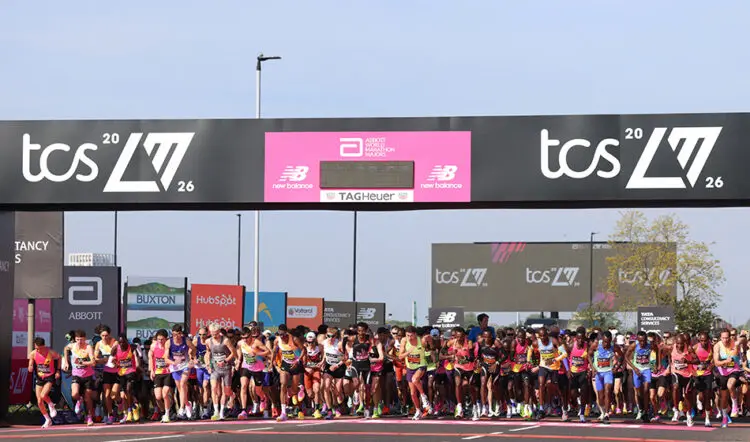
Wearing a fluorescent green t-shirt, black shorts and the New Balance FuelCell SC Elite v5 shoes, I soon entered the pen, and within five minutes was escorted to the start line. Expecting a '5,4,3,2,1 go', I was initially surprised it was a rolling start, but given the amount of people involved it wasn't a shock.
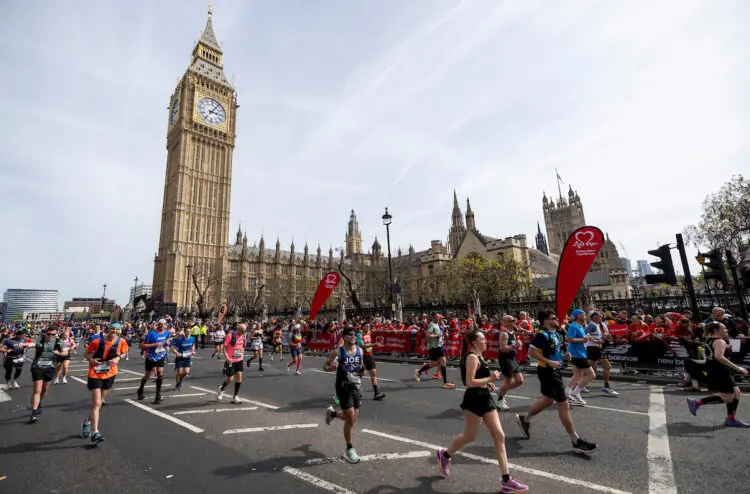
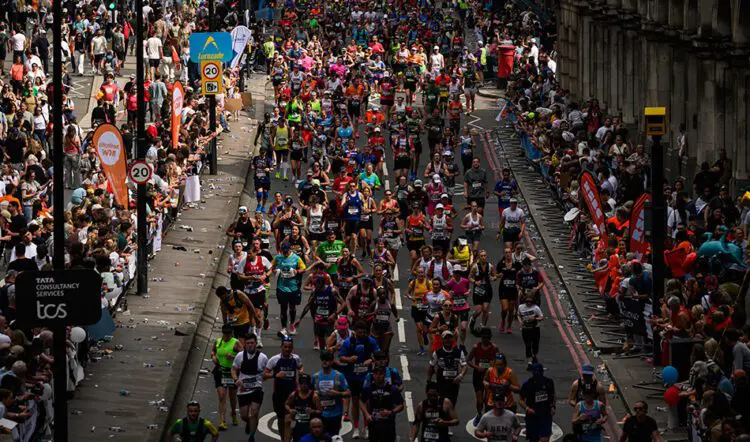
Then we were off. I soon got into a rhythm of 8:30 for every mile and just kept ticking through each of them. The size of the crowds, especially with people decorating their houses to support the runners, took me aback. I've covered four London Marathons but you never get to go down to the start line, so this was all rather new to me.
The first time I went "oh wow" – there were many occasions when this happened on the course – was on approach to Cutty Sark. The noise was deafening and people were lined 10-15 rows deep. It was that loud that if you had a conversation with someone next to you, it would have been difficult.
I chose not to wear airpods, as I wanted to take in the atmosphere, with this being my first marathon. It was the best decision I made on the day. There were moments where the support was that great, such as on Tower Bridge, where it was difficult not to get emotional. I was thinking to myself "is this really happening?"
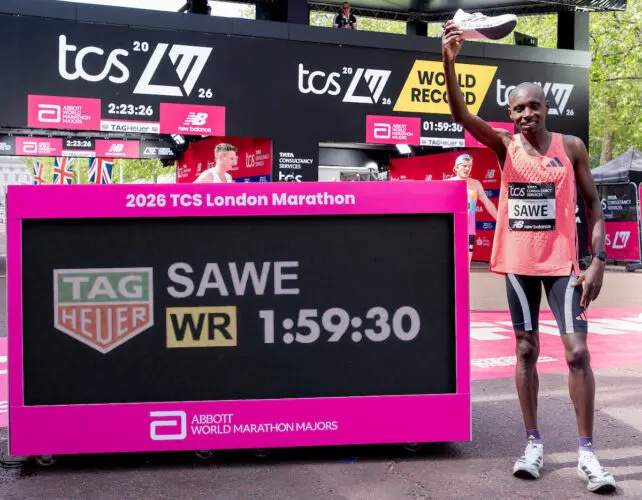
As if the inspiration of the crowds wasn't enough, I received a notification just before Tower Bridge that stated Sabastian Sawe and Yomif Kejelcha had both broken the two-hour barrier with 1:59:30 and 1:59:41 respectively. A loud "oh my god" left my mouth at that point.
I went through half-way in 1:53:21 – the aim was around the 1:50 mark – and felt pretty comfortable. The pacing was consistent and I approached the Isle of Dogs with an assurance I could keep this up for a while.
Seeing my family and friends around Canary Wharf provided another boost, as did the gels. I took six overall – each containing 40g of carbohydrates – with two being caffeine ones. They thankfully settled in my stomach pretty well, which I had hoped would help get me through the last six miles relatively comfortably.
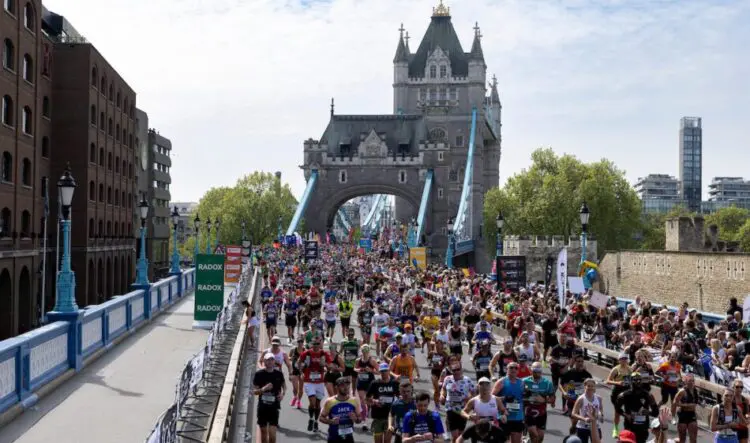
I was soon in for a shock. The term 'hitting the wall' is synonymous with marathon running and, more precisely, it is when the body suffers from severe glycogen depletion. That's because the muscles run out of stored carbohydrate fuel, leading to sudden fatigue, heavy legs and potential dizziness.
Throughout the last six miles I experienced all three of those symptoms. The first time I knew my body wasn't right was around Limehouse, when my left knee seized up. Within five minutes I suffered from cramp in my left groin and left calf, which I couldn't 'shake off' all the way down Embankment.
The crowds, as so many others tell you, definitely helped get me through that section of the course. Giving up never crossed my mind. I was raising money for Great Ormond Street Hospital, which had helped my family in times of need, and told my Nan, who passed away just a few days before last year's edition, that I intended to run it next year. Those two factors kept me going.
Even though Embankment felt like the longest stretch of road in my life, I staggered through both it and Westminster in around 9:30 per mile. I was already starting to get emotional as I approached Buckingham Palace, and that was before Geoff Wightman, Kath Merry, Kris Temple and Rosie Tinbergen called me home in the final 200 metres. I also saw my boss Wendy Sly and Eamonn Martin, the last British man to win the London Marathon back in 1993 (2:10:50), cheering me on.
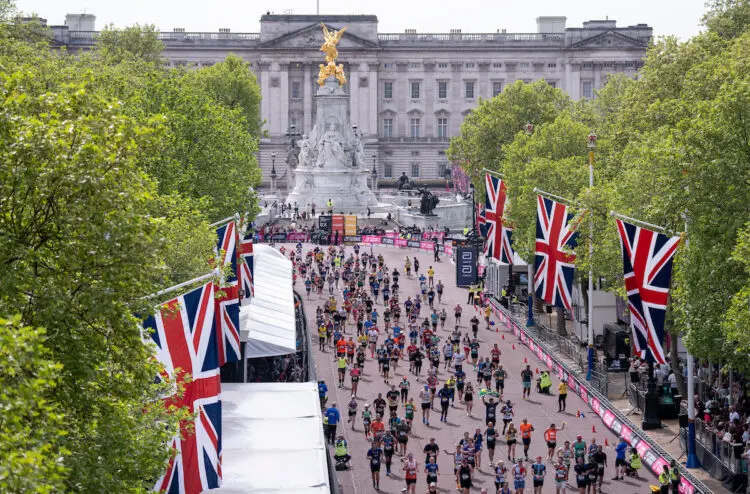
As I crossed the line I raised two hands into the air, in honour of my Nan, and looked at my phone and watch. The official time? 3:54:30. I initially thought I had missed out on breaking the four-hour mark but actually achieved it in my first ever marathon. The emotion soon took hold and I was watery eyed when receiving the medal.
A few days on and the size, grandeur and scale of the event is difficult to comprehend. I will take away so many memories from London but the abiding one is that the marathon showed the city at its best. The London Marathon set a world record of 59,830 finishers, surpassing the 59,226 set at last year's New York City Marathon.
To be just a tiny part of that was a privilege. The phrase "no human is limited" cannot be more aptly associated to the first ever 'sub-two-hour-marathon'. I am sure that Sawe and Kejelcha will now open the door to others in the future. But that phrase can also be linked to every person who crossed the finish line, each with their own journey.
There is a purity to running that makes it irresistible to take part in and irresistible to watch. So expect more than 1.1 million people – the figure that applied for this year – to be higher for 2027, when the total is released next week. This 'running boom' has no signs of plateauing anytime soon. Now I've experienced running London as well as covering it, I can see why.