Werro, Hodgkinson, Broeders-Bol: the 800m rivalry set to define a generation

The women’s 800m final in Birmingham not only provided a major highlight of the European Championships but also an early sign of things to come. We look at the rivalry that looks set to run and run.
“Every year, there’s always someone,” said Keely Hodgkinson. “Someone makes an appearance.” She is not wrong. From Athing Mu of the USA to Kenyans Mary Moraa and Lilian Odira – even training partner Georgia Hunter Bell – the queue of athletes forming to mount a more than formidable opposition has been a long one. The Olympic champion has not had it easy in her career thus far and, in 2026, more have been added to the list.
Hodgkinson was speaking in the immediate aftermath of the women’s 800m final at the European Championships – a race that had well and truly lived up to the hype.
No event in Birmingham had been written about, spoken about or speculated over more than that one, with three women in particular firmly in the spotlight. Would Hodgkinson win her third European 800m title in a row in front of a home crowd? Would Audrey Werro manage to keep the momentum of her extraordinary summer rolling? Or would Femke Broeders-Bol, whose 800m career is still in its infancy, throw the most impressive of curve balls by surging to gold?
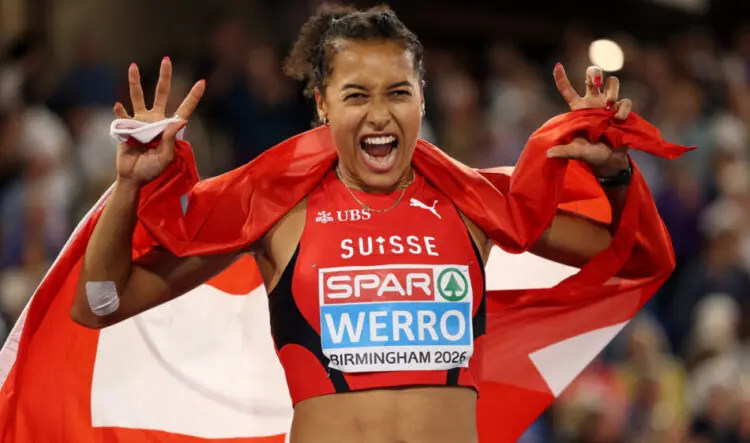
Coming off the final bend of the race, all three outcomes were still entirely possible but it was Werro, showing no ill-effects of the nasty and painful-looking fall she had suffered at the semi-final stage, who stayed strong to hold off Hodgkinson’s push for the line as Broeders-Bol’s challenge faded in the closing straight.
With the roars of the crowd still hanging in the air, it was immediately clear we had just witnessed the first installment of a rivalry that has the potential to run and run. If athletics is built on head-to-head contests then here were the foundations of something significant.
It didn’t take long for comparisons to start being drawn with the era of Coe, Cram and Ovett – and it felt entirely apt.
Werro, Hodgkinson and Broeders-Bol are all athletes who like to race and, seemingly, like to race each other. At the time of writing, they were about to do battle again at the Zurich Diamond League and by the time you read this Jarmila Kratochvilova’s world record of 1:53.28 may well already have fallen.
Should all three come through that meeting unscathed, then they might well produce one of the highlights of the inaugural Ultimate Championship in Budapest later this month. But, regardless of what happens over the remainder of this year, Birmingham showed that the women’s 800m is going to be front and centre for the foreseeable future.
The lion roars
This has been a breakthrough year for Werro. The European U23 champion had been marked out as one to watch but, having finished a distant second to Hodgkinson at the world indoor championships in March, no-one had expected her to start the outdoor season in Stockholm in quite such spectacular fashion.
At the Olympic stadium in the Swedish capital on June 7, just as she had done in Torun, Hodgkinson moved into the lead with around 300m to go and made the charge for home.
What raised eyebrows, however, was that the Swiss didn’t go away this time and managed to produce the kind of finishing speed that not only saw her catch up with, but overtake, her opponent. Werro became the first woman in 43 years to run under 1:54 and then did it again in Paris soon afterwards to prove it was no fluke.
In the European final, her strength was to the fore again as she opted to hit the front and fend off her challengers. Not for the first time this season, she roared like a lion in celebration.
“When I was a child my dad used to tell me that I have to be a lion and that I don’t have to be shy during the race,” she explained. “I used to be really shy and I would let the other athletes go ahead.”
Before the final she had admitted that being the favourite was something she was getting used to. “It’s a bit different from other championships because I was never the best, the favourite athlete and now it’s a little bit more pressure,” said Werro. “But I think I can take this pressure and use it as a positive thing. It has also given me a lot of confidence because I know that I can run fast.”
After the drama of that semi-final fall, she seized that second chance.
Hodgkinson’s new target
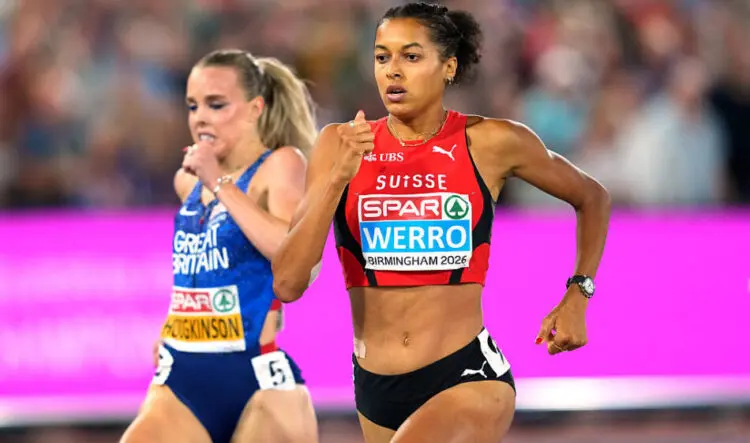
After the European final, Hodgkinson insisted that: “It doesn’t sting because I was beaten by a great athlete. I think I put together a pretty good race. I don’t think I did anything wrong.”
She didn’t, but this defeat wasn’t part of the plan. During the indoor season, everything she touched turned to gold. Her 400m personal best was lowered, closely followed by the arrival of the 800m world indoor record and the world indoor title in quick succession.
Her springtime performances were so dominant and her form so good that conversation quickly turned towards beating Kratochvilova’s outdoor mark and the London Diamond League on July 18 earmarked as the perfect place to do it.
Elite sport has a knack for upsetting the best-laid plans, however, and a withdrawal from the 400m final at the British Championships due to a “twinge” was not in the script. Neither was the fall during training that left Hodgkinson with very bad cuts to her knees and rather scuppered the plan for fireworks in Eugene, where she came second to world champion Odira. There was victory to celebrate in London, but it was solid rather than truly spectacular.
All of that followed the Stockholm race that got the world talking but, as her coach Trevor Painter points out, there’s nothing the 24-year-old loves more than having someone in her sights.
“What drove Keely on in the early stages is those neck and neck races with Athing Mu,” he told AW’s Legends Series in July. “There was the World Championships in 2022. There were seven hundredths between them and the year after there was Athing, Mary Moraa and Keely again – all within a fraction of each other.
“It’s what gets her out of bed in the morning, to be that winner and to try and win those races. So it was strange that the path was open for Keely. Indoors, nobody touched her and everyone’s saying: ‘Oh, you’re going to get this world record, no problem’. But now Audrey’s stepped up. She’s been on the radar for years and we’ve known about her. We’ve always said she was going to be good. I think this year she’s just finished university so it’s her first year as a full-time athlete and that’s why we’ve had this growth. So it’s great to have people to focus on and to ignite that passion in the morning before you go and put your spikes on.”
“I back myself completely. Everyone’s got different strengths and weaknesses, and it’s all about each of us figuring out how to run our best 800m and then doing it against each other; that is the hard part, and you just hope it goes your way on the day. But that makes it really exciting. I think the crowd really enjoyed it. Everyone was talking about it, and I’m just happy to be able to be a part of it.”
Femke ahead of schedule
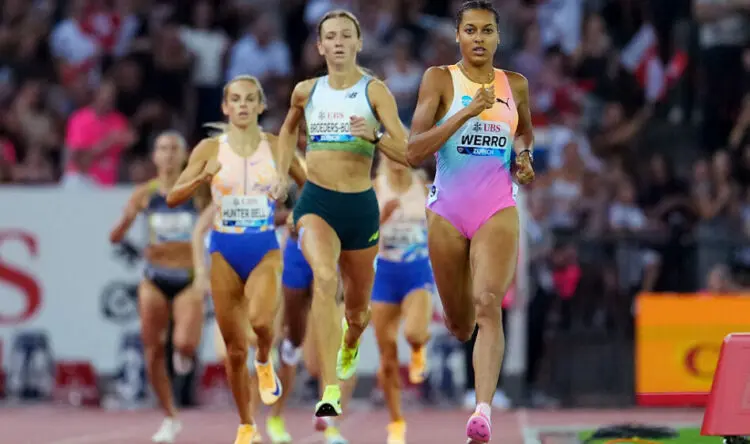
Few athletes could pull off the kind of switch that Broeders-Bol is in the early stages of making. But the reigning 400m hurdles world champion is not your average athlete. Her performance in coming third in Birmingham equalled the Dutch record of 1:55.54 held by former Olympic champion Ellen van Langen – a mark she then lowered at the Lausanne Diamond League.
Guided by coach Laurent Meuwly, the move wasn’t made on some kind of whim and, with every performance over 800m, there is progress.
“This journey has gone better than I expected in the first year,” she said in Birmingham. “I was strong throughout the competition, so it’s a good step. I think I can do more, want more, and dream more.”
Speaking to AW earlier this year, Meuwly had outlined: “I have information that shows me it's realistic for Femke to be one of the best 800m runners in the world in the coming three years and to battle for the gold medal in Los Angeles [at the Olympics]. “I would not propose this kind of change to an athlete of this calibre without having a certain amount of guarantee that it’s going to be successful.
“Some things are a bit subjective of course – her stride, her relaxation, the way she can keep her form even when she's in the last part of the race – but a lot is also objective; for example she holds the 500m indoor world record (1:05.63). If she’d just have jogged another 100m she would probably also have the 600m indoor record. The plan is to be competitive in 2026, to be in the final or top five in 2027, and to be medal competitive in 2028. I don’t think it’s an unrealistic plan.”