Double the fun for Georgia Hunter Bell

The Commonwealth and European gold medallist talks about making fast progress, learning how to win, keeping a healthy perspective and aiming for success in both the 800m and 1500m.
It’s in the quiet moments, as the competitors gather in the depths of the stadium before being called on to the track, when Georgia Hunter Bell grants herself the opportunity to reflect.
“When we're going through the tunnel and we can't see anyone yet – and everyone's silent in their own thoughts – I always think about just how far I've come and how lucky I am to be here,” she says, before quickly adding: “And how much work has gone into it, as well. It's obviously not just luck.”
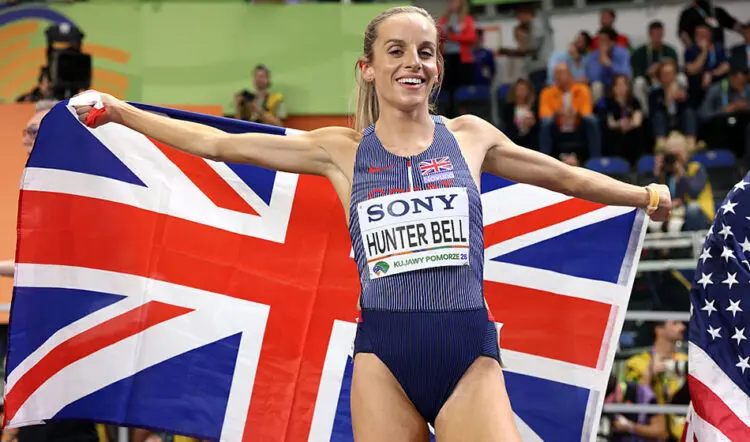
There certainly hasn’t been any element of fortune about the 32-year-old’s performances in 2026. She has convincingly won every championship final she has contested this year – and there have been a few. First came the maiden international title of her career, in the women’s 1500m final at the World Indoor Championships in March, then the time trial of a second consecutive British 800m title in June before the tactical masterclasses that landed her 800m Commonwealth gold in Glasgow in July and European 1500m success in Birmingham last month.
Hunter Bell’s work isn’t done, either. As well as the Diamond League appointments in her diary and a date with the first Athlos event to be staged in London, World Athletics’ new venture – the Ultimate Championships – awaits this month. Regardless of what happens in any of those, this has already been a truly golden year.
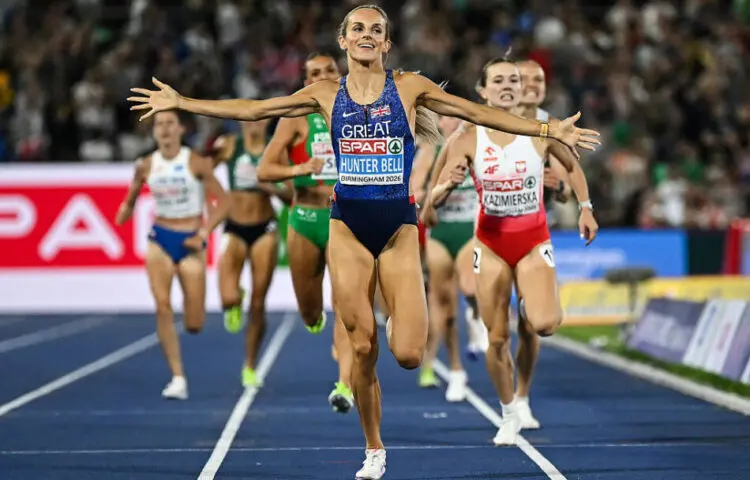
It would represent a remarkable achievement under any circumstances, but it becomes all the more impressive when you consider that it was only a little over two years ago that Hunter Bell decided to leave her job in cyber security behind and go all in on being a full-time athlete. She is no novice runner, but had stepped away from the sport back when she was 23, disillusioned and having fallen out of love with it when the rigours of the NCAA system in America brought injury and unhappiness.
The story of what would happen a few years later is well-known but it bears repeating. Hunter Bell gradually began to start running again and, in March of 2022, reminded herself of her potential when she clocked a parkrun time of 16:14. A few months later, she began working with her old coach Trevor Painter and his wife Jenny Meadows.
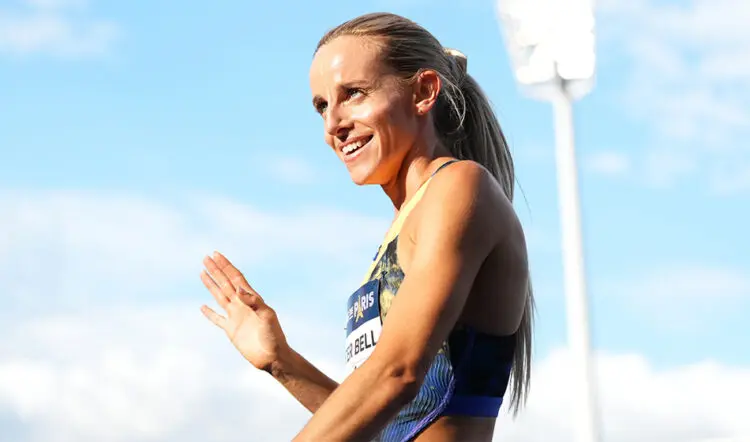
It did not take long for her to make serious progress and it was at the world indoor championships in Glasgow in March of 2024, when she finished just outside of the medals, that the call was made to bet on herself and turn fully professional. Olympic bronze and European silver over 1500m arrived that summer, then a world indoor 1500m silver and world 800m silver last year. This year, the road has been paved with gold.
Hunter Bell has moved from being an outside bet to an outright champion and the main feature of those medal-winning runs has been the level of control she has exerted over her opposition. Whenever a threat has been posed or an attack made, she has covered it and defended with grace and poise, gliding her way to the top spot on the podium with gear changes that have been imperceptible yet deadly.
“I feel like I've learned a lot, and I’m definitely still learning a lot – about positioning, about pacing,” she says. “The times are great, but so much of it is that tactical element and the racing IQ. I feel like I'm really developing that, which I'm really happy with.
“The rhythm [to the 800m] is very different from the 1500m rhythm. I got really comfortable knowing what four-minute pace for the 1500m was over the past two years, and now I'm starting to get comfortable with understanding what 1:57, 1:58 pace feels like [for 800m] so it's an ongoing learning process.
“I came straight from Glasgow to [a training camp in Portugal before the European Championships] and, at my first track session, Trev said: ‘Let's try and go for four-minute pace’, so that's coming through 200m in about 32 seconds. I set off and thought I was going really slowly, and then I came through in 29 seconds, so I was way off the pace. It is quite weird to work out the balance of the two and it does take a few sessions to get back into it, and that's why I think it's really impressive when people are able to switch at championships – if they double, they haven't wrapped up one event before they go to the other. I think that is really tricky, but I am developing that, and my hope is to double at championships in the future, so I need to get used to it.”
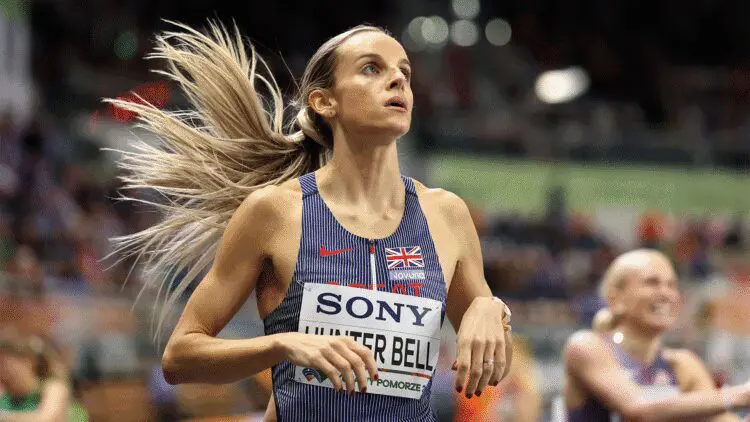
Which leads to an obvious question: does that mean a double is on the cards for the LA Olympics? The schedule allows it, while Kelly Holmes was 34 when she famously won 800m and 1500m gold in Athens and Hunter Bell will be the same age when the 2028 Games roll around.
An instructive conversation between the two, however, has made Hunter Bell all the more eager for the timetable of next summer’s world championships in Beijing to be published and to ascertain if a dress rehearsal opportunity is going to present itself.
“At the Olympics, the schedule does allow for it, but I would definitely want to try it before then,” she says. “When I spoke with Kelly Holmes last year, when I was asking her advice about whether I should double at the world championships, she was really helpful and gave very direct feedback, which I really appreciated.
“One of the things she said is that the schedule definitely accommodates it and it’s a fantastic schedule, to be honest, with days off. But she said: ‘You have never done an 800m at a championships before. You need to know you can do one before you try and do two’. She also said that she had doubled many times before she got to the Olympics. So I take that on board and the world schedule for 2027 isn't out yet but, if it does accommodate for that, I think I would need to test it there before I go to the Olympics and try to do it.”
In the meantime, Hunter Bell will continue to work on both distances, so how does she approach or view each of them?
“With the 800m, for a lap you’re okay and then it turns into a one-lap race where you really are red-lining,” she says. “Very quickly you can go from feeling good and then feeling pretty bad. But you have to have top-end speed. You have to be able to get out very hard and finish very hard, but you also have to navigate traffic – I think that's one of the things that is crazy about all of us being in eight lanes, and then we merge when we're all running super fast.
“It is physical. It's almost impossible to not make contact with another person in some way. Then [it’s a case of] navigating that to stay calm, to still be able to respond. But it is a race where you can go to the front and hold it the entire way if you're strong enough, which is not the case in the 1500m. I don't think anyone really runs a 1500m like that any more. It is incredibly difficult to gun to tape that event, so that one is a lot more tactical. That one [involves] a lot more people changing positions. Timing is everything. Positioning is important, but it's slightly less important than the 800m. They have similarities. You need to have both speed and endurance, you need to be able to navigate the traffic and you need to make good tactical decisions, but I think that the 1500m is harder.
“It can be painful, but if someone does something, you're just like: ‘Oh, here we go. I’ve got to make a decision right now. What am I gonna do?’. And it's fun to see what the end result will be, knowing that you're going in as prepared as you can be, but also having no clue of who's going to do what. It's interesting versus [events like] the sprints, where you get from A to B as quickly as you can in a straight line. They're thrilling in a different way, and I feel like this has just so much more jeopardy.”
Is there a creativity to it, too? Hunter Bell nods.
“I think that's one of the things that has been nice over the past year and where I have hopefully cemented my worth in the event,” she says. “I've gained a few medals now across both, so I'm able to try different things, try racing in different ways, which I think can be the scariest bit at the beginning.
“While you're trying to win, while you're trying to get medals or titles, you might play it safe, and maybe be a bit more reserved. But then, once you have that confidence behind you, you can try different things. It has been really fun this season, trying to win all of those races in different ways.”
But the best part, says Hunter Bell, is unleashing the finishing kick when you know you are at the top of your game. That sweet moment when the after burners are engaged to leave the opposition trailing.
“I'm not going to lie. It's really, really fun,” she grins. “We practice it a lot in training and, in the race, it's just really fun knowing that you have that extra gear on that home straight. It's honestly one of the most fun things about racing when you realise you're going to win, but doing a big move at the end and feeling the momentum of the race and the crowd go with you. It's just such a fun feeling.”
The word fun crops up repeatedly in our conversation and it’s clear Hunter Bell is relishing every moment of this second chance, being guided so ably by Painter and Meadows. Having the opportunity to race against the likes of her training partner Keely Hodgkinson, Audrey Werro, Femke Broeders-Bol, Faith Kipyegon or Jessica Hull is not something she is taking for granted. It’s not something she could have envisaged happening almost a decade ago, either.
“I feel sorry when I look back and think about the Georgia that quit when she was 23, had graduated, was just really disillusioned with running and not happy,” she says. “But it was also the years prior when it was kind of accepting – or so I thought – that I had messed up this talent that I had and the opportunity that running would give me.
“Those were just bad times for me personally, and I was pretty unhappy, so when people say: ‘Are you doing this for the younger version of yourself?’, they think about the little kid version of themselves and how cool it is. But I think more of the young adult version of myself who was really, really struggling and has found a way back despite the odds and is living this dream.
“I find that quite motivating because it shows me that I am very resilient and, if I was able to go through all of that, then I have everything I need to be able to do well in the races when I step on the start line.”
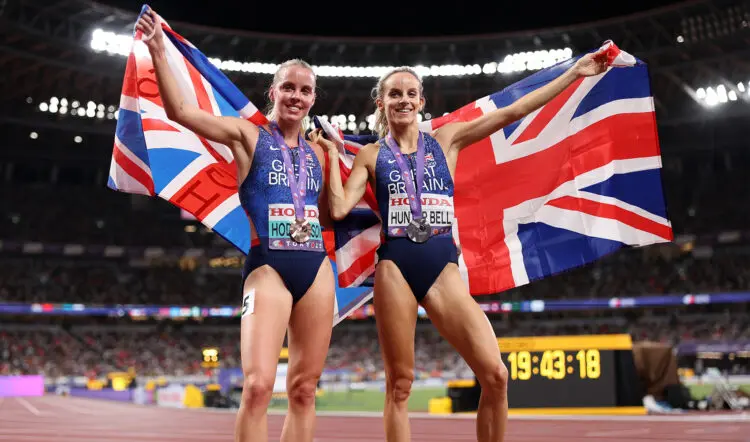
Whether by accident or design, it means Hunter Bell has become an example, a role model for those who have faced similar challenges. What would her advice be to anyone who has hit the same wall that she did previously?
“You need to get back to the love,” she says. “I really needed that time off because it wasn't working for me, and I was not enjoying racing. I felt completely numb, and I just didn't care what I was doing. I had no nerves on the start line, no nerves in the race. I needed to step away.
“So for anyone who is really struggling and feels like they need a break, that's okay, and you just need to find your way to be excited about what you're doing again. For me, that was getting back into running in a different way.
“I wasn't doing track races. I was doing longer runs, I was doing parkruns, I was doing triathlons and duathlons, and that brought the spark back. And then I made my way back. Now I just love running so much. Even if I retired tomorrow, I would continue to run. It wouldn't be something that I look at and think ‘I'm glad that's over’. I do really just love what running has given me and how it makes me feel before we even get to the competitive side of racing. So I would just say: ‘Find your way to get back to the love of it’.”
And who knows where that might lead? For Hunter Bell it has taken her to those big moments and the world’s great arenas where she now gathers with the world’s elite, takes a deep breath and retakes the steps that have brought her to that point. Is she able to describe just how far she has exceeded her own expectations?
“That's the thing – there were no expectations,” she says. “I obviously didn't think that when I did the comeback 5000m in Battersea Park as my first race back on the track in five years that it would end with me being a European champion, Commonwealth champion, a world indoor champion, an Olympic medallist and all these things.
“That wasn't the expectation or the goal. It was really fun having no pressure for those initial years, and just completely blowing the doors off to see what was possible. I do think nothing will be easier than that year of 2024 where it was just unbelievable momentum and I had no pressure. That was the easiest I think that competitive running would ever come to me.
“But now it's such a fun place to be at because it's a new challenge. It's a challenge of seeing what I can do with the pressure, with the expectation, and now with those goals for myself that I didn't have previously. Now I'm like: ‘Okay, this is what you need to aim for next, and this is what we should be trying to do’. It’s just the evolution of being an athlete, I guess.”
Hunter Bell’s international honours board
2026: World Indoor Championships 1500m gold, European Championships 1500m gold, Commonwealth Games 800m gold.
2025: World Championships 800m silver; World Indoor Championships 1500m silver
2024: Olympic Games 1500m bronze; European Championships 1500m silver