Into the wild: the history of trail running

Dave Holmes explores how trail running evolved from an ancient necessity into the world’s fastest-growing discipline.
It’s easy to imagine trail running as a modern invention – a sport born of fancy hydration vests and high-tech GPS watches. Yet running over natural terrain is one of humanity’s oldest forms of locomotion.
Long before asphalt or standard distances existed, the earth itself was our only running surface. For millennia, moving swiftly over hills and mountain passes was an essential condition of survival, messaging and trade. The story of trail running is the gradual transformation of an ancient necessity into a global athletic phenomenon.
The earliest recorded footraces away from stadium tracks were tied to functional utility. Messengers in ancient Greece and Native American runners covering vast distances relied on off-road endurance as a primary means of communication. Traversing these unpaved expanses required an intuitive understanding of the landscape, where reading the terrain was just as critical as stamina.
Swiftness in these contexts was not a matter of athletic vanity, but a vital lifeline connecting isolated communities across mountainous and forested frontiers. Where rocky ridgelines and dense woodland made horses impractical, runners got through.
As centuries passed, this practical reliance on fleet-footed couriers began to intersect with formal trials of skill. According to tradition, King Malcolm III organised a hill race up Craig Choinnich in Scotland in the 11th century to select the fastest royal messenger, an early bridge between practical duty and competitive selection.
Yet it was in 19th century Britain that off-road running made its decisive leap from necessity to sport. In Northern England and Scotland, local fairs began hosting “fell races” or “guide races”. By 1895, the Ben Nevis Race (14km) established a benchmark for Britain’s burgeoning fell running culture through a charge up Scotland’s highest peak (1345m) and back down.
Parallel traditions took root across the Atlantic and Europe. In 1905, San Francisco hosted the inaugural Dipsea Race (12km) over the rugged trails of Mount Tamalpais. In the French Pyrenees, events like the Course du Vignemale (38km) emerged in 1904, while Spain and Italy developed their own mountain racing traditions through regional alpine clubs.
While its institutional cousin, cross-country running, was rapidly formalising on manicured school fields and parkland loops, mountain racing embraced the untamed wilderness. Rather than looping synthetic courses or park turf, these trailblazers measured themselves against raw geography, pioneering a distinct off-road discipline defined by vast mountain terrain rather than standardised circuits.
What truly unified these early off-road pursuits was an appetite for self-transcendence. In the English Lake District, this spirit birthed the tradition of “fell rounds”. Inspired by 19th century climbers, Dr A.W. Wakefield and others sought to summit 2000-foot peaks within 24 hours. In 1932, a local hotelier named Bob Graham linked 42 peaks in a single day, creating the iconic Bob Graham Round, a circuit that remains a rite of passage for fell runners today. The mid-20th century saw the arrival of iconic mountain marathons. In Colorado, the Pikes Peak Marathon was founded in 1956. Notably, the race opened entries to women from its inception, leading to Arlene Pieper becoming the first official female marathon finisher in the US in 1959.
If mountain racing was defined by steep summits, the 1970s introduced the mountain ultra. In 1974, after his horse went lame prior to the 100-mile Tevis Cup ride in California, Gordy Ainsleigh tackled the rugged course from Squaw Valley to Auburn on foot. Finishing in 23 hours and 42 minutes, Ainsleigh proved the impossible. Four years later, the Western States Endurance Run was officially established as a footrace, pioneering the format, aid stations, and coveted belt buckle awards that define ultra-marathoning today.
The 1980s and 1990s brought internationalisation and structural identity. In 1984, the International Committee for Mountain Running (later the World Mountain Running Association, or WMRA) was established, staging its first World Trophy in Italy in 1985, won by English fell legend Kenny Stuart. During the 1990s, American ultra running icon Ann Trason left an indelible mark on the sport, dominating with 14 Western States victories and famously battling the Tarahumara team at the 1994 Leadville 100.

Simultaneously, a technical discipline took shape in the High Alps. In 1991, Italian alpinist Marino Giacometti launched the “Skyrunning” movement. Skyrunning took athletes across glaciers and vertical kilometre climbs, showcasing stars like Italy’s Bruno Brunod and America’s Matt Carpenter, who set a Pikes Peak Marathon record of 3:16:39 in 1993 that stood for decades.
Trail running remained a niche subculture until the mid-2000s, when a storm of personalities, literature and media transformed the sport. In 2003, Catherine and Michel Poletti launched the Ultra-Trail du Mont-Blanc (UTMB, 171km) in Chamonix. Circumnavigating the Mont Blanc massif across France, Italy, and Switzerland, UTMB quickly grew into the global epicentre of ultra-running.
While alpine epics conquered dizzying mountain passes and glaciated peaks, other events also sought out the planet's most punishing environments. Founded in 1986, the Marathon des Sables in the Sahara Desert forced runners to become self-sufficient pack-mules, carrying their own food and gear across 250 kilometres of scorching dunes.
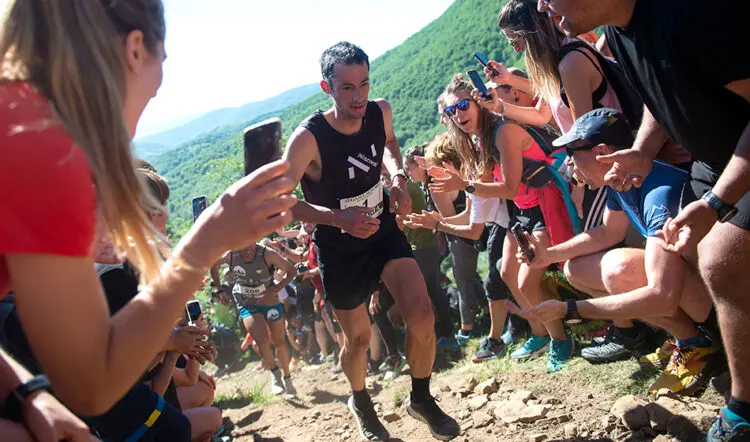
A shift in athlete demographics followed. Anton Krupicka won the Leadville 100 in 2006 in minimalist footwear, bringing a countercultural philosophy to the sport. In 2008, a 20-year-old Catalan named Kilian Jornet won the UTMB, ushering in an era of dominance across both skyraces and ultras. Concurrently, Christopher McDougall’s 2009 best-selling book Born to Run brought the lore of Mexico's Tarahumara runners and the ethos of off-road endurance to millions of city dwellers seeking a visceral escape. In recent years, modern trailblazers like American Courtney Dauwalter have continued to rewrite the boundaries of human performance, most notably winning the Western States, Hardrock and the UTMB in a single calendar year in 2023.
World Athletics officially brought the sport under its global umbrella, joining forces with the WMRA and the International Trail Running Association (ITRA) to host the unified World Mountain and Trail Running Championships in Thailand in 2022. What began as a functional lifeline for ancient messengers navigating untamed frontiers has grown into a global movement. Today, trail runners are united by the same fundamental instinct that drove our ancestors: a desire to test human limits against the natural landscape.
David A. Holmes (PhD, UNSW) is a historian who specialises in the history and politics of athletics. Email: [email protected]