Mary Rand's finest moment

Looking back, I didn't realise that I had natural ability – I was just doing what I loved. The press followed me everywhere. That was kind of tough but somehow I was able to handle it without it interfering with my training.
At the Rome Olympics in 1960, there were four of us that didn't do that well when we had been supposed to do really well. The headlines coming back to England were “flop, flop, flop” but I didn't really get that discouraged.
I got married, I had a little girl, and she was two years old when I went to Tokyo. I feel that having my daughter was, at that time, the biggest event in my life. I wanted to be a stay-at-home mum. If my husband at the time had said: “I want you to be at home, I don't want you to do this,” I probably wouldn't have done it.
Tokyo 1964 was probably the best ever Games. It was amazing. The Japanese just did such a fantastic job. My event was on the first day an it was hail stoning. We got up in the morning, and I thought “oh, my gosh” but you have to think to yourself “all the other competitors are going to have to deal with this”.
My coach, John Le Masurier, didn't say much. He just said go out there and give it your all. I'm sure he was nervous but, at the same time, all through that year, I'd done very well.
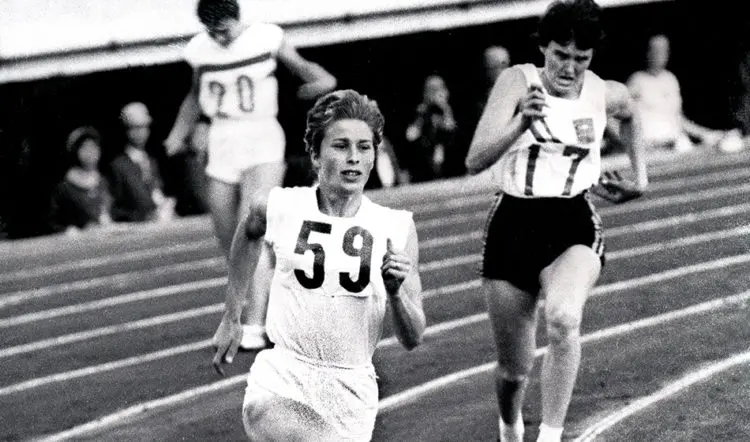
When I went out, there was always the press thinking, “Mary is going to flop again” because of four years before. But I didn't think like that. I was in the present and I was very fit. Fortunately, I went out there and I qualified on my first jump so I was able to come right back and rest that afternoon.
I was grateful to qualify but you go out there in the final and, of course, everybody is rushing to get their run-ups. They’ve got the tape measures and you have to make sure you have your correct marker. Your mind is thinking about all those things, about the other athletes. I just thought “I've got a chance”.
When we had the final, it was still pretty overcast – and the track was very soggy. The 800m was going on. I remember vividly having to wait until the runners went past because there was so much noise in the stadium. I would just wait so I didn't have that disruption and then I took my jumps.
I didn't know until many years afterwards that I was jumping against the wind – and that five of my jumps beat the Olympic record.
Irena Kirszenstein – who went on to win seven Olympic medals and was a phenomenal athlete – was right behind me jumping and I had to wait for her and a couple of the Germans in the last round. At that point, I didn't even know I've got the world record. I didn't know whether or not I was able to hold on to it because the others were really great athletes. They could have pulled one out of the bag really. So I was on tenterhooks for a while. I couldn't believe it when I found out that I'd won.
I was so grateful for my coach because he'd been there all the way through it and he finally got the recognition that I felt he should have had. I was so thrilled for my parents, too, because four years before that they had sat and done an interview and they were all thinking I was going to win in Rome. Of course, everything went wrong and so four years later my dad was still alive and he got to see me win a gold medal. It was like the icing on the cake.
I never thought I'd end up with a set of medals – gold, silver and bronze in Tokyo. I was competing against Irena Press in the pentathlon. The Soviets were like men. I felt sorry for them because I honestly don't think they would have known they were probably given hormones or other things.
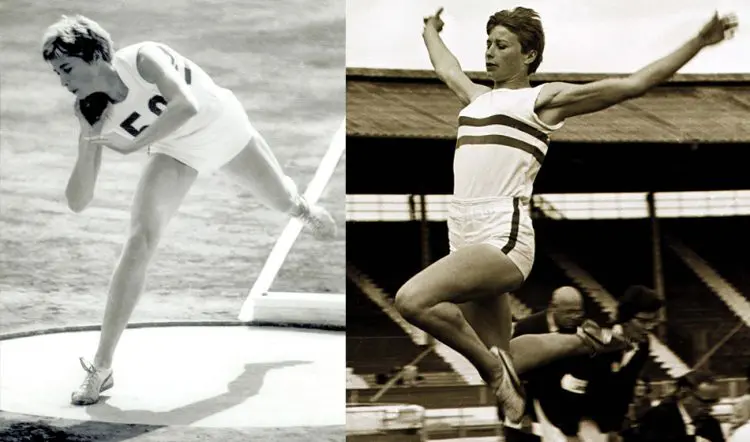
Ann Packer's husband, Robbie Brightwell, always said to me, “you really got two gold medals”. But I actually liked the Press sisters. I'd competed with them many times. I went on small meets, and we became really good friends. We couldn't understand each other much because of the language. But I think there was a respect, and I never felt resentment.
After Tokyo, I did a few meets, but I just didn't have it and I think then it’s time that you have to say to yourself “hey, you did this, it's time to pack it in”. Because I was struggling, I just didn't have the desire or I didn't want to train as hard, plus I was married and had a little girl and I felt that I'd had my time – that it was time to be a mother and take care of my family.
I moved to America but Jean Pickering said to me, ‘Mary, you're part of history. And you're the first woman to win a gold medal for Great Britain. Your medals belong in England.’ They probably would have been in a drawer or something. My niece Mary still lives in Somerset and she was the go-between in having them on display at Millfield School, where I went. They’re behind glass and it says what I did. I hope that it's an inspiration to other athletes.
Mary Rand
Born: February 10. 1940
Achievements:
1966: British Empire and Commonwealth Games long jump gold
1964: Olympics long jump gold, pentathlon silver; 4x100m bronze
1962: European Championships long jump bronze; 4x100m bronze
1958: British Empire and Commonwealth Games long jump silver
» New year special offer – get your first issue of AW magazine for just £1!