Femke Broeders-Bol: “I’m not afraid to fail”

One of the greatest hurdlers in history has taken a huge leap by switching to the 800m and will be part of arguably the most highly anticipated event at Birmingham 2026.
“I think she's also able to perform over 800m,” said Laurent Meuwly, speaking to AW at the end of 2023. The Swiss coach was discussing his Dutch star pupil, Femke Broeders-Bol, who had been voted International Female Athlete of the Year in the magazine’s annual awards following a summer in which she had become the 400m hurdles world champion.
To do that, under Meuwly’s guidance she had effectively re-learned an event at which she was already exceptionally good – by switching to a stride pattern that would maximise her strengths and bring greater speed. It wasn’t just her performances over the barriers that had caught the eye, though.
Earlier in the year, she had taken down Jarmila Kratochvilova’s world indoor 400m record that had stood for 41 years, clocking 49.26 to win the Dutch indoor title (a mark she lowered to 49.17 at the World Indoor Championships 12 months later). During that 2023 indoor season, in Boston, she also recorded a world indoor best of 1:05.63 for 500m.
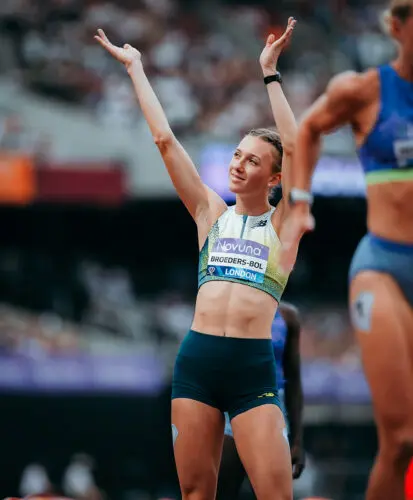
“She showed in Boston that she has this efficiency, and she's pretty good in all the endurance sessions because of it,” added Meuwly. “I can imagine [the 800m] might also be an option.”
Fast forward to August 2026 and that option has been taken. The 400m hurdles has been left behind, the 26-year-old who has a combined tally of 11 European Championships gold medals indoors and outdoors, now stands on the brink of her first championships as a two-lap competitor and, once again, she has shown herself to be more than willing to learn new skills.
That is brave enough in itself but even more courageous when you consider that Broeders-Bol could barely have picked a more difficult time to enter the world of women’s 800m running. It has been an event at the centre of a rapid evolution in recent years, but there has been a noticeable gear change in 2026.
Audrey Werro of Switzerland has become the third-fastest woman in history, running 1:53.98 in Stockholm and then 1:53.80 in Paris. Reigning European and Olympic champion Keely Hodgkinson, meanwhile – who beat Werro to the world indoor title in March – took her own British record down to 1:54.33 in Sweden and has made no secret of her pursuit of the world record of 1:53.28, albeit injuries have hampered that mission thus far.
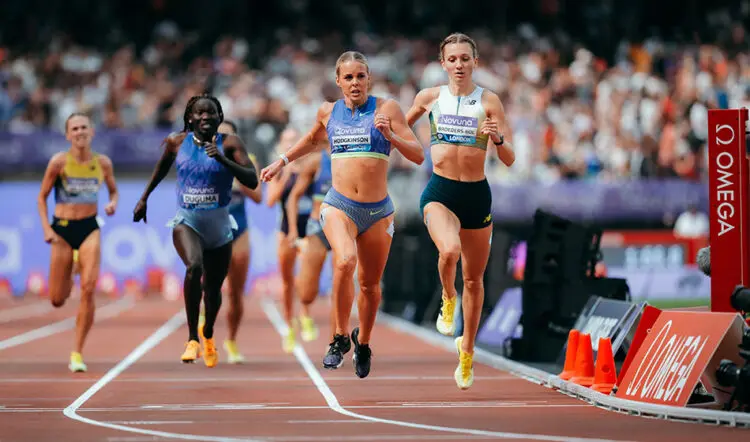
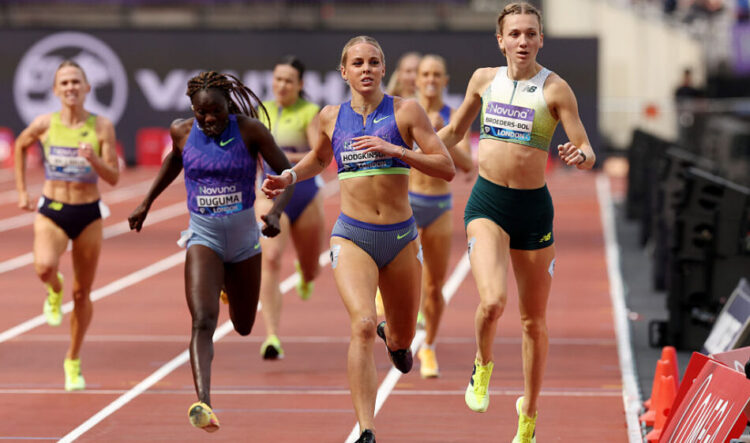
Broeders-Bol will come up against both in one of the most hotly anticipated events at the European Championships in Birmingham and has shown herself to be a fast learner. After a first serious attempt at 800m indoors, running 1:59.07 in February, she had injury struggles of her own but, this summer, has already lowered her best to the 1:55.60 she produced in coming second to Werro in the French capital at the end of June. She also finished closely behind Hodgkinson at last month’s London Athletics Meet.
Femke, how are you coping with this new person, the 800m runner, that you've become?
I think it fits me well. I'm really enjoying it. I really enjoy the training and how it's going.
What's the toughest thing you've had to get your head around?
The mindset change. I was a good endurance 400m runner, and speed was not my strong part, and now at the 800m, I'm a very speedy 800m runner and my endurance needs a lot of work. This was a big mindset change.
You ran 1:59 in Metz but you picked up a serious injury and had to take a month out. Now you've had five outdoor races, it's really developing. What do you feel your potential is?
It’s quite crazy for me, actually. I didn't expect the times to be this fast already. I knew it was a big change, I knew it would be very different. I needed to learn the event, I needed to learn to race, and so far the races have been executed quite like my coach wanted. The results have been way better than I even expected.
I think it's really cool that I'm in an era where there are such good 800m athletes, like Keely, Audrey and also Georgia [Hunter Bell]. The level is so high, but I'm not at that level yet, so I'm just enjoying my own bubble. With the 800m, I enjoy being new. I feel a bit like a young athlete discovering everything, not really being afraid to fail because what do you have to lose at this point? For now I'm just enjoying not knowing what my potential is. I think it's fun.
How would you compare the 400m hurdles and 800m – the degree of mental toughness needed, the discomfort, the pain you have to go through in that last 200m?
It's hard to compare, but I think it's just a different kind of pain and I’ve had to get used to this different kind of pain. With the 400m hurdles, at one point you hit a wall and you just know your speed is going to go down, down, down, down and you can see the finish line. With the 800m, the wall isn’t as high, but the wall starts a lot earlier. So for me now, around 500m, I start to think: ‘I'm really starting to get a bit tired’, but it's a pain you can push through for a lot longer while, with the 400m and 400m hurdles, you can try to push through it but at one point you can see the lactic taking over. It's just completely different. But, at the end of the day, you have to have some sort of sense of liking pushing through that pain, or almost liking the pain, if you want to be a 400m or an 800m runner.
What have you enjoyed most about the process of taking on a new event? Has it given a freshness to your career?
For sure. Of course, in training a lot of things are different from before and I really like that I didn't go in the same way I [would usually go] every year. This is a huge change, and I really like that I can discover myself in a new way. I'm a bit of an older athlete but, like I said, I really feel a bit like a young athlete, seeing, “Where are my boundaries? How is this going to be?”.
In a lot of sessions, I go completely into the unknown, having no clue how tough it will be or how fun it will be. This is a part I really enjoy – I get to challenge myself in new ways, get to develop myself in new ways, and really become a different athlete.
People will look at the world record and go, "Kratochvilova was a 400m runner who ran 47.99” and you've run a 47.9 relay leg, as well as sub 50 seconds for 400m many times. You bring that speed and speed endurance to 800m that actually nobody else in the 800m group does at the moment – they're not breaking 50. After another two or three winters of hard training and strength work, a lot of people will put two and two together. Does Laurent Meuwly make you keep your feet on the ground, or does he say: ‘Femke, you can break the world record one day’?
I think, if it was that easy, a lot more 400m runners would have changed towards the 800m. He will always keep my feet on the ground. I think he does know, especially now going into a new event, I tend to underestimate myself a bit more often than I would overestimate myself. So I think he tries to balance this a bit for me. But he also knows he can give me pressure if he says things like that, and it wouldn't work because we always work in goals.
We work in small goals towards a big one. We need to be realistic, need to see where we are at now, what we can improve and, if one day it will be realistic, he will talk to me about it. But we just are seeing how it is right now, the next goals, the next things we want to improve and I think that's the best way.
What are your expectations for the European Championships in Birmingham?
That's a tough one for me. I hear from everyone that competing in the 800m at a championships is different to racing 800m at Diamond Leagues. I've watched a lot of races to see how people do it, but I'm used to doing the 400m hurdles. You go in, you know your shape, you know if you can chill a bit at some hurdles or not, if you can save some energy, and you know that, if you do what you can do, you usually make it to the next round.
But, with the middle distances, you can see favourites going out in the heats or in the semis because they make tactical errors so I think for me it will be a big learning curve at the Europeans.
Of course I hope to get into the final, then give it my best and see what it brings me but I'm mostly just very curious how a championship 800m will be, how I will feel after the 800s going into the 4x400s because I also still have the 4x400s. I'm mostly really excited and curious to start this part of my 800m journey because it's one you cannot really practice until you are at the tournament, so it will be fun.
The 400m hurdles is a very technical event and there's a lot to think about whereas the 800m is straightforward running, gun to tape. Have you done anything to accommodate that extra headspace because you're not having to worry about a stride pattern, you're just wondering about how the race is going to go? Have you become a student of the event, for example? Have you looked at tapes of great 800m races and studied them?
Yes, for sure. We're lucky that the Diamond League puts one video of all the races of the season online, so you can easily watch a lot of them back. But I think this was very important.
It's completely different but the same thing is that you have some rhythm in there. With the 400m hurdles, you have rhythm and in the 800m too. You do have some distractions in the 400m hurdles but, on the 400m flat, there was no distraction. You were running in your lane.
In the 800m, you have people around you but I really try to watch a lot of things so you can see how people also respond in certain situations because I think, by seeing them, you automatically visualise them a bit, and if you ever come in contact with [those scenarios], you have already run it once in your head.
But there has also been a lot of talking about it. I spoke with Ellen van Langen, our 800m Olympic champion from the Netherlands, and also Bram Som, another great 800m runner. I just really try to learn and, at the same time, I know I need to experience certain things because I would see the break and I would be like: "How is this person now in front?” and now, while running it, you can feel how it feels to be with people. But, yes, I enjoy watching a lot of races and learning from them.
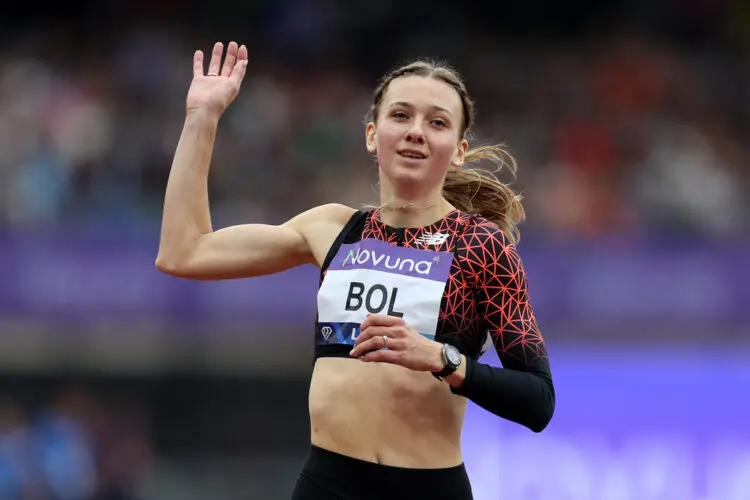
Running in lanes, you can't influence what other runners are doing and you can't interact with them, whereas in the 800m you absolutely do. You've got to think about your positioning, covering moves and so on. Is the main challenge for you the fact that you're having to get used to running with bodies around you?
Yes and I think running with them, but also getting ready for it, is completely different. I really like my plan A to work. That’s how I work and, for the 400m hurdles, I would write my plan exactly with the coach – “this is how we want to execute the race”. It didn't matter what others would do – I needed to stick in my own head in my own lane. With the 800m, I can have a great plan but, if three people have a different plan, I cannot execute that plan.
It’s very different for me that I don't have control about it. For the 400m hurdles you always had control about your own race.
But now, if this person wants something else, the problem is in your lane, and you need to figure out how to do it. So this is something I really need to learn – that I will have plan A-Z, and sometimes I have to do plan Z, and it doesn't mean I will have a bad race. But mentally it's a really big switch.
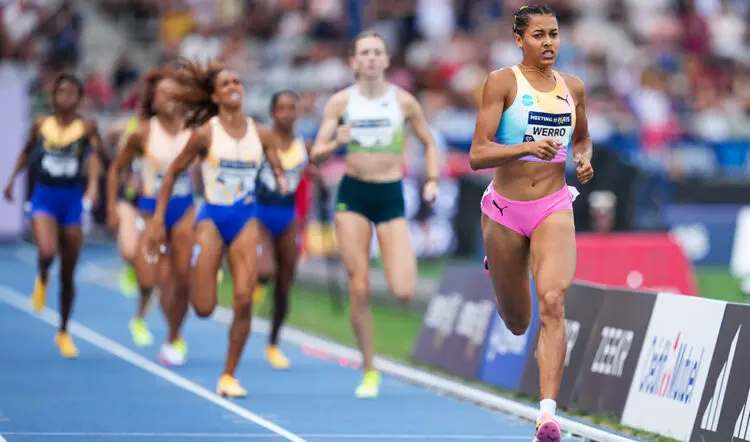
Have you spent time looking at Audrey's races and Keely's races, studied the way they run and their strengths and weaknesses?
I've studied them. I haven't seen it in [terms of] “these are their strengths, these are their weaknesses”, but more in how they race, because they both race differently. I also look at [former Olympic champion] Athing Mu, for example and how she races because everyone is their own athlete and has different qualities. And I think it's really interesting to see this in the 800m – that there are so many people and then, in the end, like at a world final, they are just put together and need to figure out how someone is going to win the race. There’s so much you can learn from watching, and not just the best, but also the people maybe more in the middle who have to fight for their spot because this is something I'm really not used to and something I will also need to learn. It's really cool to watch.
Femke Broeders-Bol’s 800m story so far
February 8 – 1:59.07, Metz (indoors)
June 16 – 1:57.13, Ostrava
June 21 – 1:57.41, Hengelo
June 28 – 1:55.60, Paris
July 18 – 1:56.46, London