Ben Dhiman: scaling new heights as UTMB men's winner in 2026

After failing to finish twice and then coming second last year, Ben Dhiman got to taste UTMB victory this time around. The former footballer who found his calling on long-distance hiking trails explains how he did it.
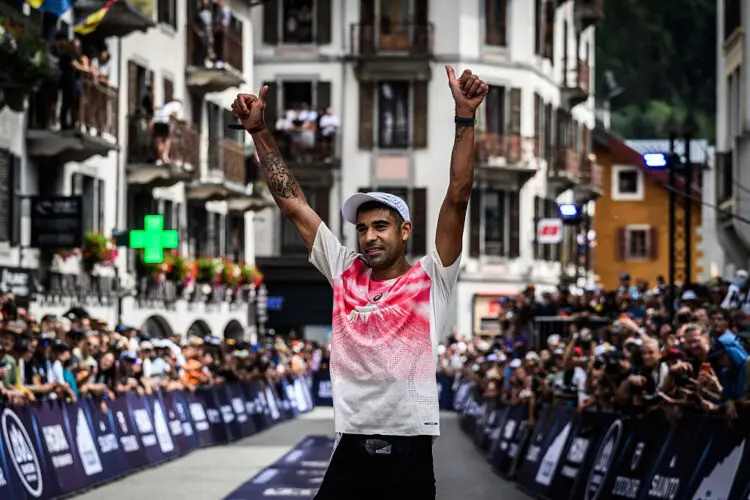
Ben Dhiman had fallen hard, with just 10km to go. After more than 18 hours of racing across the Mont Blanc massif, with a lead of more than half an hour and the finish line in Chamonix within reach, his legs finally gave up on him. Yet he managed to summon a final effort to get up, kept moving forward and crossed the line in 18 hours 16 minutes and 29 seconds – the fastest time ever recorded at the Ultra-Trail du Mont-Blanc and enough to make him, at the third time of asking, the winner.
It had been a long time coming. Dhiman failed to finish the UTMB in 2023 and 2024 but then managed to produce a breakthrough when finishing runner-up to British athlete Tom Evans. For most athletes, a podium finish at the world's most famous trail race would be the pinnacle of a career. Not for Dhiman.
“It's been a hell of a process to go from somebody who just wanted to win with open ambition to somebody who really knows how to get it done,” he says, after becoming only the second American to win the UTMB after Jim Walmsley in 2023.
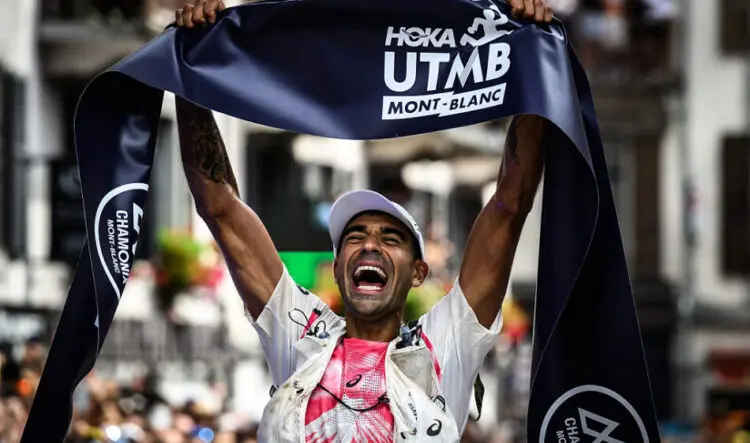
The 34-year-old’s route to UTMB glory has been anything but conventional. Born Ben Singh Dhiman and raised in Cincinnati, Ohio – his father's family from Punjab in India, his mother white American – he grew up, in his words, “very American”, his father keen to assimilate fully into life in the US. Sporting-wise his background was in football rather than running: he played through college as a right-winger. “My real strength was my fitness on the field,” he remembers. “It was obvious in our fitness tests and everything. I already had a pretty good speed background.”
It was in his 20s that the switch towards the mountains began, when Dhiman started “thru-hiking” – long, self-sufficient treks such as the Continental Divide Trail, carrying everything he needed for weeks at a time. That experience, he believes, gave him an unusual combination of traits that few of his rivals share. "Most of the hikers I know are actually slow and then a lot of the real fast guys just aren't super durable over long stuff," he says. "I seem to have a good blend of both."
He now lives in the French Pyrenees with his wife and their three children and has become fluent enough in the local language that, in the aftermath of his win, French media outlets fought for his time as much as anyone from the host country. The heart of Dhiman's success is an unusually deliberate, self-coached training system that he has refined over several years – one built around low-intensity volume rather than the kind of speedwork more familiar to track and road athletes.
"I'm a self-coached athlete," he tells AW. "This is my system that I've been developing for several years now. I run different iterations of it every year."
The decision to coach himself, he admits, comes as much from temperament as necessity. “I suppose it arrived because I'm a very stubborn person, first of all – I also have some problems with authority. But it also arose out of necessity, because when I was starting out in the sport, getting a coach wasn't really a feasible option for me. I needed to keep it simple and minimalist. Then I found I really enjoyed the creative process of doing it.”
His year is built around a distinct winter block. From December through to most of March, Dhiman trains roughly 100 hours a month, according to data from his Amazfit Cheetah 2 Ultra sports watch – 107 hours in January alone this year, followed by 95 and 105 hours in February and March. Surprisingly little of it is running. The bulk is ski mountaineering, supplemented by around six hours of running a week and time on the bike.
“You can't run 30 hours a week – you'll destroy your body!” he says. "But the aerobic system still needs a huge amount of stimulus to improve, because the idea is to become such an efficient machine that you can hold UTMB pace. You have to find non-impact sports to do that."
As spring arrives, the balance shifts towards trail running, building through three overlapping blocks: one before an April tune-up race, one before a second race at the end of June and then a final block building towards UTMB itself in late August. Running hours climb steadily through that progression – from 12-14 hours a week in the first block, up to 16-18 in the second and finally 20-24-plus in the UTMB-specific phase. “The idea is it's all centred around running durability,” he says, “becoming a stronger athlete who resists fatigue the most possible.”
According to Amazfit's Training Balance feature, more than 20 per cent of Dhiman's overall preparation this year consisted of strength work, with endurance training making up the remaining 80 per cent. A typical July week, deep in his final training block, included roughly 12,000m of elevation gain: long mountain runs of five to six hours, hilly gravel sessions of two to three hours, easy flat running, uphill treadmill work and up to two strength sessions.
That emphasis on volume over intensity is, Dhiman argues, the only honest way to prepare for a race like UTMB. “If I do higher intensity, shorter hours, I will become sharper. I will run a faster 10km, faster over 50km, faster over 100km,” he says. “But then I will not go faster over 100 miles. This year was all about going faster over 100 miles.”
Central to that is training the body – and mind – to function deep into extreme fatigue, something Dhiman regards as the defining challenge of the race itself. “It changes your perception of reality,” he says. “It makes everything difficult. That's why you have to train under high, prolonged loads, repeatedly, so that you become accustomed to making decisions and maintaining efficient movement despite mounting fatigue.”
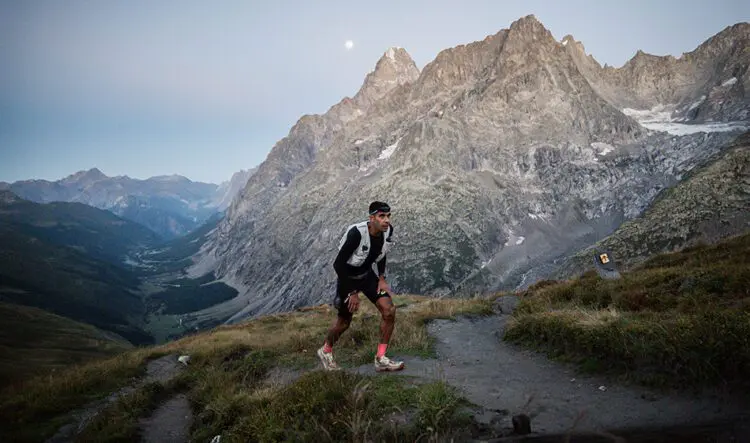
One of his final hard sessions before this year's taper captured the essence of this: a 75.17km run from Chamonix to Courmayeur, along a significant stretch of the eventual race route, accumulating 4519m of climbing in 8 hours 18 minutes, at an average heart rate of just 134 beats per minute – evidence of an aerobic engine built to stay efficient deep into a long day in the mountains.
Data plays a central role in how Dhiman refines that engine, not least because he is both athlete and coach. “Sometimes after sessions I've got to put on the coaching hat,” he says. “I've got to go into the data and dig into it and try to figure out where there's still room to improve.”
Much of that comes down to analysing how his heart rate responds across different phases of a long run and how his climbing speed holds up towards the end of a session. "How do you go after 12 hours?” he explains. “It’s impossible to replicate that directly in training. What we can see is a cumulative load over the week and then adding some spicier stuff at the end of that to see how the body actually reacts."
Mileage matters too, though less than the hours themselves. "Hours are probably most important when we're talking about UTMB," he says. "However, I'm still very hard-lined about distance – it's also a measure of how much impact you're taking on in a week."
Between hours, distance, and weekly climbing and descent totals, he says, "they're all super important and part of the algorithm."
Perhaps the most striking part of Dhiman's story, though, is what hasn't happened: he has not been seriously injured in five years. “I'm not like everybody else,” he says. “I think, first, because I'm smart about what I can and can't do, and I always bring the load up pretty gradually.”
He also credits his physical build. "I'm pretty big compared to a lot of the other athletes, and I think that extra body mass gives me a bit more resilience, perhaps."
He adds: “Consistency is king. The guys who stay uninjured, who stay on the path and keep putting the work together, are the ones who rise to the top eventually. The biggest setback a runner can have is getting injured, so that has to be fundamental to the training programme.”
Dhiman has strong views on the level of performances in the UTMB as well. He wrote somewhat controversially on Substack post-race: “We’ve been living in the stone age of performance over the 100-mile distance. We run in fear of the distance: slow starts, conservative downhills…We anticipate blowing up, but we don’t know where that limit is. As the leaders detonate old times, the top 10 follows.”
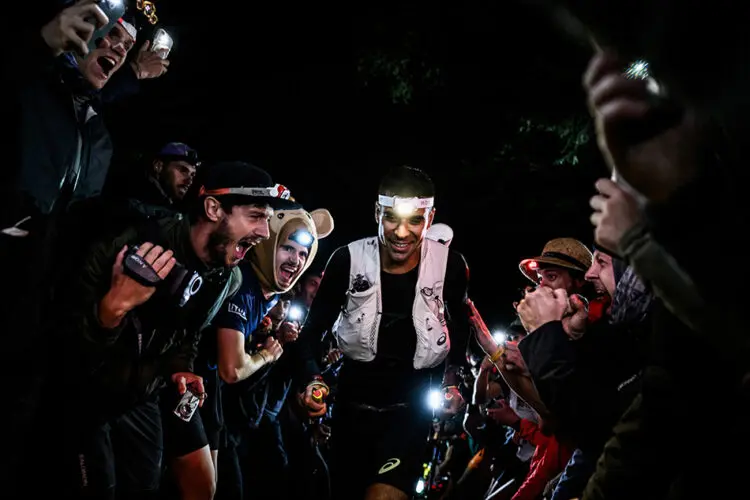
His consistency was tested to the limit on race day itself. After a start delayed by thunderstorms and with the route itself shortened due to the conditions, Dhiman ran within the lead group early before moving clear after the 40km mark – with roughly three-quarters of the 168km, 9686m-climbing route still to run. His Amazfit data shows his heart rate spiking above 170bpm four times during the opening eight hours, close to his 185bpm maximum, each time on a long climb – the most demanding of which took him from 800m above sea level to over 2500m.
From there, the race became a masterclass in sustained, metronomic effort. His lead grew from around 19 minutes at 80km, to 22 minutes at 104km, to 28 minutes at 127km, before stretching past half an hour by Vallorcine, some 20km from the finish. His average pace across the entire race was 6:27 per kilometre; adjusted for the route's brutal climbing, his effective grade-adjusted pace, as recorded by his watch, was 4:51 per kilometre. By the time he crossed the line in Chamonix, his Cheetah 2 Ultra recorded 9911 calories burned – roughly three days' worth of energy for an average adult man, spent in a single push around one mountain.
Asked whether he might one day pass his methods on to others, Dhiman doesn't hesitate. “Totally,” he says, “I'd be into it.” For now, though, there remains unfinished business of his own – a system still being refined, one long winter of skis and low heart rates at a time, in pursuit of whatever comes next after becoming, officially, the fastest man ever to run round Mont Blanc.