How they train: Andreas Almgren

Katy Barden speaks to the world half-marathon and European 10,000m champion about how he is preparing for to make his marathon debut in New York.
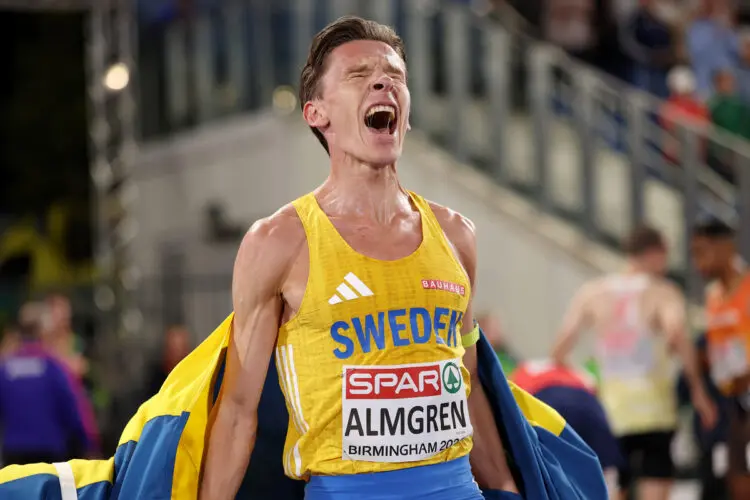
Sweden’s Andreas Almgren shattered his European half marathon record with 58:06 (previously 58:41) to win the world half marathon title in Copenhagen in September. Outkicking Kenya’s long-time leader Nicholas Kipkorir in the final 300m, it was yet another exceptional display from the world 10,000m bronze medallist who had delivered a dominant, championship record-breaking performance of 27:23.44 to take 10,000m gold at the 2026 European Athletics Championships in Birmingham earlier in the summer.
“I felt extremely strong in the last few kilometres,” he said after winning his first global title. “I did not only have one or two gears left; I had three or four – I felt like my opponents could try whatever they wanted but I was not going to let this gold medal go.”
The Stockholm-based 31-year-old, who also holds European records in the 5000m (12:44.27) and road 10km (26:45), will make his much-anticipated marathon debut in New York City on November 1, the first significant step in his long-term plan to transition fully to 26.2 miles after the 2028 LA Olympics.
“I think it's good to see how I react to a marathon block and what things I need to change in order to really perform,” he says.
The prospect is intriguing. As a teenager Almgren was a rising star in the 800m with a best of 1:45.59. He was a bronze medallist at the 2014 World Under-20 Championships and finished fourth at the 2015 European Indoor Championships. By his own admission, he had no intention of stepping up in distance until injuries – alongside the influence of his friend and team-mate Kalle Berglund – forced him to reconsider his training approach.
It's a well-documented story; the pair went to the same training camps as the Ingebrigtsen brothers who operated on a “more controlled, high-mileage kind of set-up” and they had seen the success that Norway was having with that method. Berglund committed to change and subsequently made it to the 800m final at the 2019 World Championships in Doha. Almgren followed suit: “I ran a national record in my first race back and I was like: ‘Okay, this works for me.’”
Since then, while his training has adapted – more prehab workouts, the addition of strides and sprints and a gradual increase in mileage in base training, for example – the philosophy remains the same. Almgren has written his own programme in recent years and his coach Urban Aruhn, who has worked with him since 2012, acts more as a “support person”.
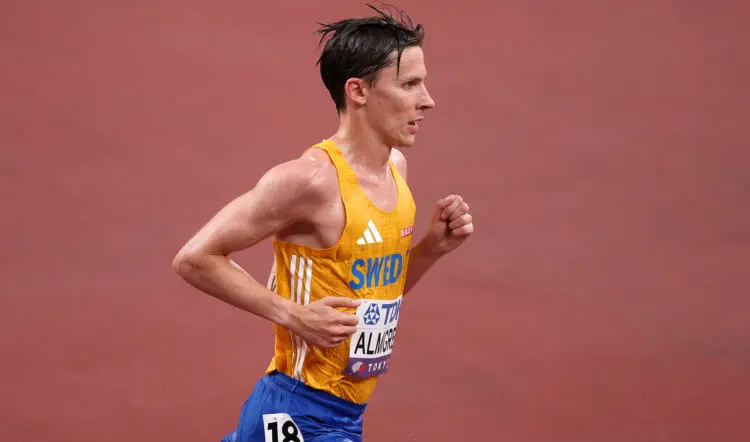
“I kind of want him to challenge my plan,” says Almgren. “I really need to be able to explain it and argue for it – why I think it's good – so he’s like a devil's advocate, because I think if I can't defend it properly, I haven't thought it through well enough. I think one of the main things that he needs to do is to make sure that I don't do too much.”
Almgren’s decision to debut in New York, based on his goal to race for position rather than time, was made almost 12 months ago. It had always been an option, but it was only when he joined his friend at the race last year – experiencing the atmosphere, observing logistics and listening to race day instructions – that he knew for sure. “That was basically the same day I started to plan for it,” he admits. “It’s something that I visualise in every workout right now.”
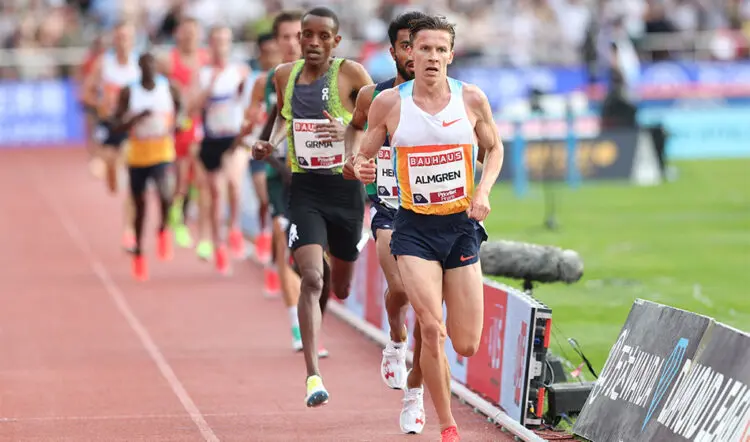
A typical training week (Aug 31-Sept 6 – build toward New York City Marathon)
Almgren has been based at altitude in Flagstaff, USA, since the World Road Running Championships in Copenhagen and will remain there until the New York City Marathon.
He considers his marathon block in two parts; the first leading up to the world half during which he was “building quite high mileage” (approximately 230km/140 miles per week) and doing long, hard runs at aerobic rather than anaerobic threshold in order to build pure base fitness. Following the world half he moved into a more specific training block with an increase in marathon-paced, harder long runs.
“I think, mileage-wise, I'm already there,” he says. “The bottleneck is going to be the durability of running fast when you've already run fast for, like, one-and-a-half hours.”
Favourite session
“I like doing 12 x 1km on the track at an aerobic threshold [during base training], so aiming for around three in lactates. You just get into a good flow when you feel you're fast and strong, so I kind of like that.”

Least favourite session
“If I want to perform at my best in a 5km I feel like I need to do one or two workouts when I really go for it – and when you're not really used to that type of training, those are really tough. It could be like 3 x 2km at 5km pace or something like that.”