Asafa Powell and the never-ending quest for speed

Jamaican sprinter talks about moving into coaching, paying tribute to his late mentor and what the current crop of top sprinters need to do to get faster.
When Asafa Powell officially retired from sprinting, on his 40th birthday in 2022, he sought to create a little bit of distance between himself and his former life. “I wanted some time for myself and to spend some time with my family,” he says, before adding with a grin: “And enjoying my hobby – cars.” Fast cars, to be precise. The Jamaican former 100m world record-holder’s obsession with speed runs deep.
But he hasn’t been able to stay away from sport for long. “Coaching keeps calling my name,” he admits and the primary reason why he is sitting down to chat with AW via video call from Jamaica is to discuss the announcement that he is now working as a high performance sprint consultant, coaching athletes, teams and federations around the world.
Coaching is not unknown territory for him. There have been “some one-off sessions, some private sessions with a few people” already but now the time feels right to fully take the plunge in the pursuit of helping others get faster. “It's something I love doing and I'm pretty good at it,” he says.

But there is something else, something very personal, about this new chapter in Powell’s life, too. Stephen Francis, his long-time coach and co-founder of MVP (Maximising Velocity & Power) Track & Field Club, died in July at the age of 64 and, as his former pupil says: “I think it's me paying tribute to him and wanting his legacy to live on. That also contributes to why I'm so determined to make this work.”
Under Francis’ guidance, Powell became a sprinting machine known as “The Sub-10 King” and ran 100m in under 10 seconds 97 times during his long career. His explosive starts and sprinting technique are often cited as the blueprint to follow for success in athletics’ blue riband event and now he is aiming to marry his top-level competitive experience with the knowledge he gleaned from Francis down the years.
“He had a unique way of coaching,” says Powell of his mentor. “His way of explaining things, of simplifying things…he knew how to let me understand what he wanted. I'm going to follow his philosophies, his principles. His way of coaching.
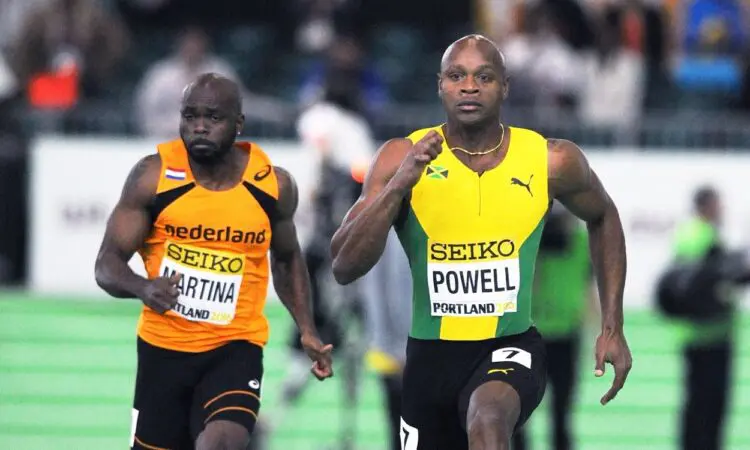
“He believed that you have to come to near death when you're training. You have to push yourself way past your expectations. He wanted to push the boundaries and push the limits to near impossible – to see what a human could achieve. He never got the chance to experience actual competition – he didn’t know what it felt like – so he learned from research, experiments. You can say I was an experiment in a sense.”
It’s too soon for Powell to have honed a rounded coaching philosophy of his own. A self-confessed visual learner, perhaps his biggest challenge will be working out how to get his message across for an activity where the devil is very much in the detail. He has already learned one key lesson, though.
“I realised that not everyone is Asafa Powell,” laughs the two-time 100m bronze world medallist. “Everyone has a different way of learning. Everyone has a unique technique. I want to try and coach people to run like me, as close to my technique as possible, because I'm considered to be one of the most sound and technical sprinters out there. But I have to understand that not everybody does the same thing.
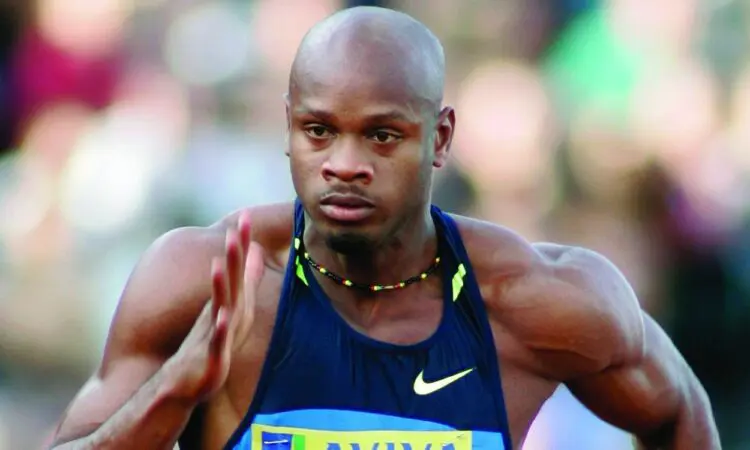
“I remember Noah Lyles said he studied my technique over and over, but he had to come to the realisation that he won't ever run exactly the way that I ran. He had to take bits and pieces from my technique, add his own thing to it and perfect it.”
Since going public on his coaching ambitions, Powell has quickly become a man in demand. It didn’t take long for the phone to start ringing and he’s keen to branch outside of athletics, too.
“They're always talking about speed when it comes to football, when it comes to American football, even basketball, tennis, rugby,” he says. “Every sport has something to do with speed and if you can get faster in any of these sports, you're untouchable.”
But, ask him which of the current crop of elite sprinters he would most like to work with, and his eyes light up. Lyles’ name comes to the fore once again.
The American might be the reigning Olympic 100m champion but the short sprint has long been viewed as his weaker event. His top-end speed is without question but it’s getting out of the blocks that Powell feels is holding the 200m world champion back from true greatness.
“If I could get Noah to get out of the starting blocks, even just a little bit with the other guys…I mean, the sky's the limit,” he says. “We don't know what he can [really] do because he is getting out behind everyone but coming back, passing people that are running 9.7.
If I could work with him on that first 30 metres then I think there would be some madness on the track.”
The men’s sprinting scene looks very different to when Powell locked horns with the likes of Yohan Blake, Tyson Gay, Justin Gatlin and, of course, Usain Bolt. But while technological advancements have helped to bring a variety of previously untouchable records in athletics within reach, or even seen them broken, the 100m and 200m marks set by Bolt (9.58 and 19.19) in 2009 don’t look like coming under genuine threat any time soon. The world record-holder stated last year that he thinks that comes down to his generation simply being more talented than the competitors of today. Powell has his own theories.
“It's a different era,” he says. “It's not that the athletes aren’t running fast. They're getting fast times, but they're not getting the fast times that they really, really want. I think there's just too much technology involved and they're trying too much.
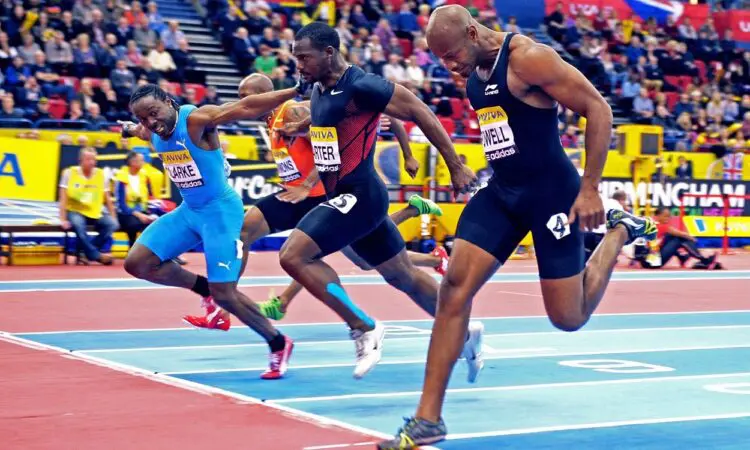
“We were beasts out there on the track. It's a time I wouldn't give up for anything else. When you had myself, Usain, Tyson, Justin… I don't know when something like that is going to come back but it was a different time. Maybe if we’d had that technology back in the day we would have run slower or maybe we would have run faster. I don't know what would have happened but I think they're chasing. They're using too much technology to try and chase fast times.”
Does that mean the competitors need to relax a little more and, essentially, let the performances come to them instead?
“Let's put it this way – the most consistent athlete now is Noah,” says Powell. “Everyone else is very inconsistent. So maybe if they stop chasing fast times and all that stuff we'd have more consistency. Some run 9.8 today but tomorrow they run 10.0. Some would run 9.7 today but tomorrow they're running 10.1. You don't know who is going to come out on top on a given day and you don't know if they're going to run fast or slow. So maybe if they cut back a little more on chasing the fast times and focus more on the athletes we'll get more consistency.”
Creating consistency was an art that Powell managed to perfect during his career.
“I put [the 100m] in layers,” he says. “I put myself in a zone where I would be listening for the gun and then, after getting out of the blocks, that's when I’d start to think: ‘Drive all the way, stay low to 40m’ and then when I got to 40m I’d tell myself to relax. I talked myself through it, so I could always run the same race. That was my strategy.”
Competing at the same time as Bolt made individual prizes all the more difficult to come by, though Powell does have one Olympic gold and two word titles in the 4x100m. It was also his mark, of 9.74, that Bolt broke to set the first world 100m record of his career back in 2008.
Powell had set that global standard in Rieti one year previously and went faster still with the quickest run of his life, clocking 9.72 in Lausanne following a frustrating time at the Beijing Olympics, where he finished fifth. So which of his many races stand out in his mind as he flicks back through the mental archives?
“The 9.72 race, I knew I was going to run fast, but not 9.72 fast,” he says. “That race was well put together. I was very disappointed about the Olympic Games because I knew I was in great shape and the race didn't end the way I wanted it to, so it was kind of a comeback race for me and that was one of those races where I was very confident.
“I was very calm, very relaxed and I wasn't thinking about the outcome. I wasn't thinking about breaking records. It wasn't until after that race I started thinking about breaking records. That race still stands out but my 9.74… to this day I still kick myself for stopping at 70m. I stopped at 70m and I ran 9.74 so I was like: ‘What if I continued [to drive] on through to the finish line?’.”
It’s a question that will remain unanswered but there are plenty of other things to occupy Powell’s mind now. Francis, who also helped the likes of Shelly-Ann Fraser-Pryce and Shericka Jackson to great success, won’t be far from his thoughts as he continues his coaching journey. He says he would gladly help if MVP need him but also says: “Coach has left a really good legacy. I think they're in good hands.”
He is also pleased to see the most recent developments in track and field, with the advent of events like the Ultimate Championship helping to bring more money to the sport’s stars.
“It's not charity. It's our job,” says Powell. “We work just as hard, if not harder, than other sports. So I think they should be compensated, and what is going on in sport now is huge for the athletes. It's not big money compared to the other sports, but it's something.”
He adds: “Track and field doesn't get the recognition it deserves. I think that needs to change, and it can change.”
With his new role, he might find himself being able to help do just that.