Steve Ovett's race history - part two

Talbot Games, Crystal Palace, June 27
1st 3:35.3
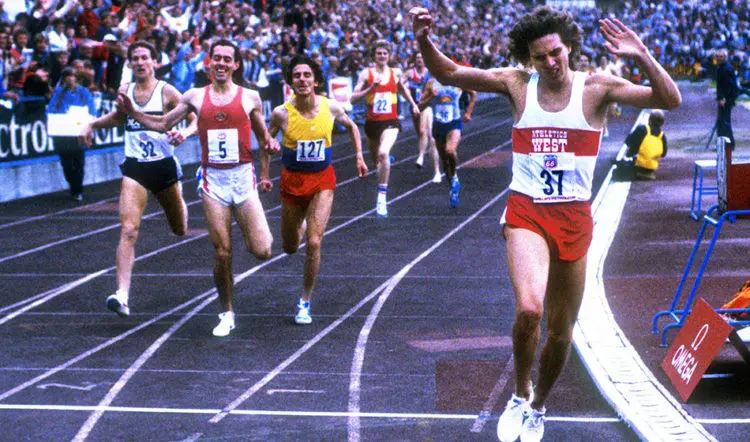
After a slow start to Olympic year, he made a world record attempt here and was on schedule at 800m in 1:53.4 but a slow third lap led by David Warren meant he just settled for victory as he was chased home by Cram’s world teenage record (3:35.6). The latter proved less successful in his assessment. “Ovett doesn’t seem to have that little bit of zip he had in the past.”
Oslo Mile, July 1
1st 3:48.8 (World record/PB) (3:32.7 1500)
Less than a hour after he had set a world 1000m record, Coe lost his mile record to his fellow Brit. Dave Warren got to halfway in 1:53.5 with Ovett going ahead uncharacteristically early with 600m left. He passed three quarters in an unprecedented 2:51.0, over two seconds up on Coe’s time. He was only marginally ahead versus Coe at 1500m though (3:32.7) but he held his form to nip Coe’s time (3:49.0) by a few tenths. Steve Cram was a distant second (3:53.8) which sealed his Olympic spot.
Oslo 1500m, July 15
1st 3:32.1 (equals world record/PB)
After effectively missing equalling the record in Brussels in 1979 (3:32.11) by a hundredth of a second as times then got rounded up, here he just about did enough (3:32.09) to get a share of Coe’s 3:32.1 record, in his last major pre Olympic run. After a slow 57.8 first lap, Steve Scott, who was missing the Olympics because of the US boycott, and keen to make a point to the Brit, blasted a vicious 55.8 second lap. He was still ahead at 1200m but as Thomas Wessinghage went to take over 200m out, Ovett kicked away with an incredible blast of speed in a world record pace run.
He seemed to ease off a little in the straight and waved to the crowd but he still equalled the record. Wessinghage, who was second in 3:33.16 and who moved to sixth all time, said: “Never have I seen running like that. To run at uneven pace, to fool around and play to the crowd and equal a world record. A year ago I felt we were starting to run closer to Steve. I sensed he was human after all. Now I know I was wrong.”
Olympic 800m/1500m, Moscow, July 26/August 1 1980
1st 1:45.4 and 3rd 3:39.0 (3:36.8 heat)
World record-holder Seb Coe was a clear favourite for the 800m but the slighter Briton ran a terrible tactical race. Ovett’s race was far from flawless as he managed to barge his way out of trouble a few times on the first lap in a manner that many thought was lucky to survive disqualification. However, he ran a brilliant second lap, following the bursts of first Dave Warren and then Nikolay Kirov. He hit the straight in second but easily passed the Russian to win by around four metres. He covered the last 200m in around 24.9 and last lap in 50.5 as Coe’s late burst nabbed second (1:45.85).
For the 1500m, Ovett was favourite but found it hard to motivate himself and was not helped by running history’s fastest ever first round heat of 3:36.8 to maintain his unbeaten record. In the final at the second attempt, Coe (3:38.40) ran a perfect race, following Jurgen Straub’s burst 700m out (54.2 third lap) and kicking a 52.2 last 400m of his own. Ovett was close to the pair 100m out but failed to even get past Straub (3:38.80), who he had always easily beaten in the past.
IAC/Coca-Cola 5000m, August 8
2nd 13:27.9
The only Olympic 800m champion who would ever choose to run a 5000m in his homecoming race in front of a capacity crowd welcoming Britain’s Olympic heroes. He suffered an embarrassing loss but only because of complacency and carelessness and a 13:27 5000m with the after effects of flu, still warrants a special mention.
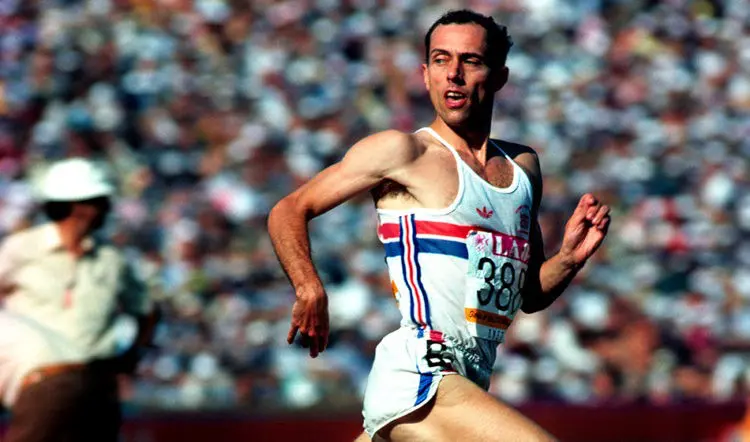
The race on YouTube is headlined 'arrogance personified' and has had seven million views. Ovett looked like he was jogging most of the race and he sprinted into the lead 100 metres out and waved to the crowd. John Treacy, the two-time world cross country champion, sprinted up to his shoulder and the Briton went three metres clear again but he again eased before the line and held his arms aloft only for the Irishman to sprint and dip under his raised right arm and both shared the 13:27.9 time though Treacy got the verdict by a few hundredths.
Van Damme Brussels Mile, August 22
1st 3:51.6
A week after a failed 1500m attempt at Lausanne (3:35.4) went the same way - too fast a start (1:53.1 at halfway) and then left alone with 600 metres plus to go and he eased in a second up on a tied Walker and Scott (3:52.7).
IAAF Golden Mile, Crystal Palace, August 25
1st 3:52.84
One of the best fields ever assembled for a mile was a tactical affair with Ovett doing just enough for a victory with a 26.3 last 200m but he cut it fine, winning by just 0.08 of a second from Scott (3:52.92) with former record-holders Walker third (3:53.19) and Bayi seventh (3:55.35) and future setter Cram in eighth (3:55.71).
Koblenz 1500m, August 27
1st 3:31.36
It had seemed Ovett might be tiring after a packed racing schedule following a gruelling Olympics and some less than impressive results. Not so. Before the race the world’s fastest 1500s in tenths of a second were 3:32.1: Coe (32.03) and Ovett (32.09), 3:32.2: Ovett (32.11) Bayi (32.16) and Coe (32.19). This was all cleared up in Germany. Garry Cook led through 800m in 1:53.00 and Wessinghage led at 1200 in 2:50.69 and was still ahead in the straight and though Ovett passed him and ran a 40.6 last 300m and 53.9 last 400 and smashed the world record, he only won by two metres from the German doctor (3:31.58) while little-known Harald Hudak (3:31.96) also bettered the old mark with a four second PB.
AAA Championships Mile, Crystal Palace September 6
1st 4:04.4
The runners in the centenary Championships set a pace more akin to a century earlier (3:12 at the bell) and Ovett with a 37.5 last 300m won from Walker (4:04.7).
UK Championships 1500m, Antrim Forum, May 25
1st 3:42.80
Made a late decision to run and support the event and won comfortably ahead of former Olympic finalist Frank Clement (3:44.10).
Bislett Games Mile, Oslo, June 26
2nd 3:39.53
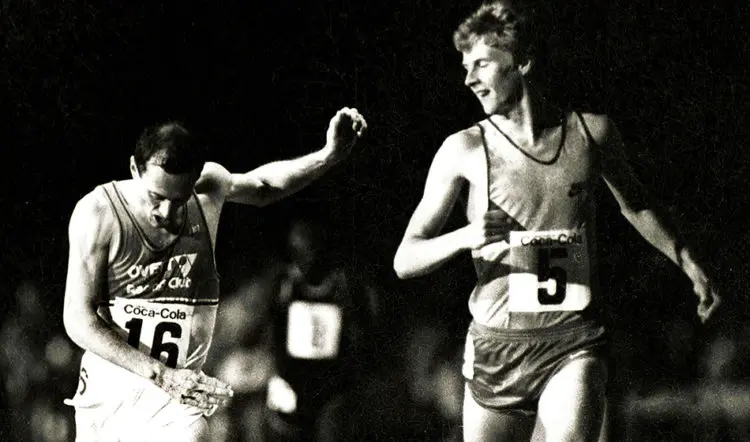
Everyone ignored the pace making efforts of Tom Byers (1:54.83 at 800m) who was almost 10 seconds clear at the bell and decided to keep going. Though Ovett ran a 24.5 last 200m and 52.3 final circuit he fell a few metres short of Byers (3:39.01) and narrowly beat Scott (3:39.58) (pictured below).
European Cup Semi Final 1500m, Helsinki, July 4
1st 3:46.47
Helping Britain win their first ever semi final he won a poor quality race in modest time with a 53.7 last lap from Markku Laine (3:47.13).
Milan 1500m, July 8
1st 3:31.95
A day after Coe (at Stockholm) had run 3:31.95 - not helped by 52.43 and 1:49.18 splits by pacemaker Robinson - incredibly Ovett matched him exactly to the hundredth of a second though he had been almost four seconds slower at 1200m. His last 300m was a superb 39.85 and he beat Walker (3:35.60) by well over three seconds.
Oslo Dream Mile, July 11
1st 3:49.25
Shortly after Coe had a set world 1000m record of 2:12.18, Ovett won the greatest mile race in history in terms of depth as the first seven broke 3:51, a time that would have been a world record just six years earlier. The pace was never quite on world record tempo and Ovett surged clear 200m out as he ran a 55.8 last lap to run the third fastest time in history and he was followed home by Jose Luis Gonzalez (3:49.67) and Scott’s US record (3:49.68).
Lausanne Mile, July 14
1st 3:49.66
Three days later he went close again and at this stage had four of history’s six fastest miles. Bob Benn took him through in his fastest ever 800m split of 1:51.7. The plan was for Wessinghage to take over but it was too fast for him so Ovett had to lead the third lap and though he reached the bell in record time (2:50.4), he was unable to kick and struggled home with a 59.3 last circuit after passing 1500m in 3:33.34 as Gonzalez was second again (3:50.87).
Budapest 1500m, July 29
1st 3:31.57
After Benn had run a strong first two laps (1:54.2), Walker took over and run a fast 56.5 third lap. Ovett hesitated to go by and when he did he run strongly to the line but he missed his record by 0.21 of a second but did run history’s second fastest time and won easily from Omar Khalifa (3:34.96). He now owned five of the fastest nine 1500s in history.
Koblenz Mile, August 26
1st 3:48.40 (world record/PB)
After a 1500m win in cold and windy conditions in Fana (3:34.63), a calf injury kept him out of the AAA and the European Cup Final and Coe had taken his mile record back in Zurich (3:48.53). A week later the promoter agreed to add a mile to this meeting though Scott and Wessinghage refused to change events and ran the 1500m instead. Bob Benn led most of the first half but James Robinson took over and led through halfway in just over 1:54 and most of the third lap before Ovett was ahead at the bell in 2:51.5. He ran a strong last lap but it was close as he took just 0.13 of a second off Coe’s mark. Craig Masback was a distant second in 3:54.14. The record lasted just two days as Coe then ran 3:47.33 in Brussels.
World Cup 1500m, Rome, September 5
1st 3:34.77
Representing the winning Europe team, a 53.6 last lap was enough to comfortably defeat Walker (3:35.49) and Beyer (3:35.58) and he broke Herb Elliott’s 21-year-old track record set in winning the 1960 Olympics (3:35.6).
Rieti Mile, September 9
2nd 3:50.23
Sydney Maree, who was only fifth in Rome, managed to repel the challenge of a very tired Ovett halfway along the straight and win in 3:48.83 as the Briton had to contend himself with the greatest ever season of 1500m and mile races.
IAC/Coca Cola 2 miles, Crystal Palace, September 11
1st 8:25.52
Returned to winning ways out sprinting a very subdued Coghlan with a 27.0 last 200m as the Irishman seemed to make little effort to produce his usual finishing kick after Cram had led much of the race. Ovett ended the season with three slow wins in Australia in October to complete a 24 race track season.
Bislett Games 3000m Oslo, June 26
2nd 7:43.87
A week after it was announced that Coe and Ovett would meet in a series of races in 1982, the latter collided with some church railings that punctured a muscle in his right knee that necessitated an operation and a long struggle to regain fitness. His first race back went well when he was a few metres back on 1980 Olympic runner-up Suleiman Nyambui (7:43.12).
Oslo 2000m, July 7
1st 4:57.71 (UK record)
Even more encouragingly, he broke his own British record and went fourth all-time as he beat Wessinghage (4:58.42).
Citizen Games 3000m, Crystal Palace, July 17
10th 7:48.07
This race should have been the first of Coe and Ovett’s series of races but Coe withdrew and Ovett faded on the second half but this was still the best quality 3000m race in history won in a European record 7:32.79 by David Moorcroft from Maree (7:33.37).
BAAB Golden Jubilee Games, 1500m Crystal Palace, August 7
1st 3:38.48
This was Ovett’s sole completed 1500m of the year and he world ranked 40th after being top the previous two years and second the three years before that and he won from Geoff Turnbull (3:39.98).
Viareggio 800m, August 11
2nd 1:46.08
A close second to European 400m hurdles champion Harald Schmid (1:45.90) in his fastest 800m since winning Olympic gold proved to be his last race of the season as he pulled a hamstring shortly afterwards.
Worthing 10, April 10
1st 50:34
Made a late decision to run and won by a minute from Dave Fudge.
10km road race, Oslo, April 24
2nd 28:55
Finished second to defending champion and future British 10.,000m record-holder Eamonn Martin(28:37) and ahead of Olympic 10,000m silver medallist Kaarlo Maaninka.
Southern Championships 1500m, Copthall, June 18
1st 3:46.45
Dropped out of 800m final after 1:50.39 heat but won 1500m from World Championships 5000m representative Dave Clarke (3:47.15)
Tarmac Edinburgh Games 1000m, June 26
5th 2:23.81
After Turnbull fell early on, Ovett had to jump over him and then he stopped to check if he was alright and he lost 30 metres. He closed with a 26 second last 200m moving from ninth to fifth, just under two seconds down on winner Peter Elliott (2:21.92).
Bislett Games, Oslo 1500m, June 28
1st 3:33.81
Had his best run since 1981 when he out-sprinted Gonzalez (3:33.93) who had beaten Coe a few weeks earlier in Paris with a 55.6 last lap though he was lucky not to be disqualified after moving out from being boxed and causing Jose Abascal to fall.
Talbot International Games 1000m, Crystal Palace, July 15
1st 2:17.26
Ran a 52.9 last 400m to comfortably gain revenge on Elliott (2:17.65).
AAA Championships 800m, Crystal Palace, July 24
DNF (1:46.29 heat)
After a promisingly fast heat, cramp caused him to drop out of the final which cost him a chance to run 800m at the World Championships. William Wuyke won the final in 1:45.44.
Rank Xerox 1000m, Gateshead, July 31
1st 2:19:08
In his final Helsinki warm up race, Ovett produced a 52.4 last lap to hold off former world No.1 at 800m Don Paige (2:19.29), who was to run 1:44.29 later in season when winning at Rieti.
IAAF World Championships 1500m, Helsinki, August 14
4th 3:42.34 (3:36.26 semi)
Ovett ran the fastest last lap of anyone at 51.9 but an appalling tactical race cost him a medal. “The worst of my life,” he said as he got boxed and had to come from too far back. Cram (3:41.59), running a perfect tactical race, won from Scott (3:41.87) and Said Aouita (3:42.02).
Oslo Mile, August 23
1st 3:50.49
Five days before Maree would take his world 1500m record with a 3:31.24 in Cologne, he thrashed the inconsistent South African in the mile winning by almost three seconds as his rival ran 3:53.41.
Brussels 800m, August 26
2nd 1:45.25
Ran his fastest 800m for four years though was too far back at the bell as he lost by a few metres to World silver medallist Rob Druppers (1:44.90) but he beat fourth-placer Elliott (1:45.32) which meant it was now over 10 years since he last lost a 800m to a Briton.
Koblenz 1500m, August 31
2nd 3:32.95
Hopes to regain his record were dashed by a terrible first lap of 58.47 by the pacemaker Pat Scammell. A fast second lap of 55.98 followed and then a slow third lap so Ovett chose to settle for a 54 last lap and clear win over Walker (3:33.84).
Rieti 1500m, September 4
1st 3:30.77 (world record)
On the notoriously fast Italian track, he set his third world 1500m record – a feat only previously achieved by Gunder Hagg in the 1940s as he took just under half a second off Sydney Maree’s mark of 3:31.24. David Mack set a perfect pace of 54.17 and 1:51.67 before Ovett took over by 1200m (2:49.14) as looking strong throughout he achieved a 55 last lap and 41.63 last 300m well clear of Pierre Deleze (3:34.55).
IAC/Coca-Cola Mile, Crystal Palace, September 9
2nd 3:52.71
Five days after setting a world record he was happy to take on the world champion Cram in one of the great domestic clashes of all-time (pictured below). It was the latter who controlled the final lap with a long acceleration and Ovett was not quite able to get past his younger rival (3:52.56) despite a 53.4 last lap as a 17,000 crowd rose to their feet.
Koblenz 25km, October 18 (28 years old)
9th 1:27:39
His longest ever race.
Phoenix 7.5km, Brighton, November 20 (28 years old)
1st 21:01
Beat former clubmate Pete Standing (21:05) and future top agent Kim McDonald (21:26). AW contributor Martin Duff was eighth and future leading coach Jon Bigg 18th.
Rank Xerox 10km, Battersea, December 4 (28 years old)
4th 28:16 (PB)
Showed his speed endurance was at a good level as he held on to the leaders for 8km before having to let the leading three go who were headed by Steve Harris’s 27:56.
Mallusk, 8km Cross-Country, Belfast, January 7
1st 24:36
Not at full fitness, left it until the last 400m and won by two seconds from Ireland’s Richard O’Flynn.
Sydney 1500m, March 11
2nd 3:35.3
As part of winter preparation, he went to Australia and this was his best race and he was pleased with his time though he was unable to challenge Mike Hillardt (3:34.2).
Paris Road Mile, April 28
1st 3:56.2
Confirmed good form by beating the two top Spaniards - Gonzalez (3:56.8) and Abascal (3:57.4) with Maree seventh.
Loughborough 800m, June 17
1st 1:47.00
Returning from a bout of bronchitis and a pulled hamstring, ran a 52 last lap to beat a number of Britain’s best two lappers including Rob Harrison and Ikem Billy (both 1:47.47).
Belfast 800m, June 19
1st 1:46.15
This win with a 26.10 last 200m over Billy (1:46.36), who pushed him hard down the straight, was sufficient for the Olympic champion to rest on his laurels and not contest the AAA event and he was selected for the 800m at the Olympics to defend his title.
Oslo 1500, June 28
1st 3:34.50
Showed he is returning to form as he led the last 500m and withheld the challenge of Gonzalez (3:34.61) yet again.
Lausanne 1500m, July 10
1st 3:38.43
A slow win over Chuck Aragon (3:38.80) confirmed his kick was still in good working order.
Edinburgh 1500m, July 17
1st 3:36.90
He delighted a 15,000 crowd with an easy win over world steeplechase medallist Colin Reitz (3:38.86).
Larvik 800m, July 18
3rd 1:46.41
His final pre-Olympic race went less well as probably not helped by racing the day before and then travelling to Norway all day he suffered his first defeat to a fellow Briton over 800m for 11 years (1973 Commonwealth Games Trials). Billy (1:46.11), who was not in the Olympic team, but ran 1:44.65 in Oslo a few days later, was a clear winner.
Olympic 800m and 1500m, Los Angeles, August 3/11
8th 1:52.28 (1:44.81 sf) & DNF (3:36.55 sf)
His first three 800m races of 1:46.66, 1:45.72 and 1:44.81 were much better than his three in Moscow of 1:48.39, 1:46.55 and 1:45.50. However he was suffering from a bronchial and viral heart infection and dehydration and the three fast heats took their toll and he was a tailed off last in his third Olympic 800m final.
Joaquim Cruz (who Ovett was chasing home in all three rounds) won in 1:43.00 from Coe’s 1:43.64. Even after hospitalisation he battled through to the 1500m final but pulled out on the last lap while he was close to a medal position. Coe won in an Olympic record 3:32.53 from Cram (3:33.40).
Viareggio 7km, April 8
1st 20:07.3
Resumed training in December, and his return was as a late replacement for Steve Jones, he defeated future world steeplechase champion Francesco Panetta (20:09.2).
Watford Open 3000m, May 27
1st 7:57.9
In his first track race since his Olympic DNF, ran solo in the rain to win by 40 seconds but kicked in a 25 last 200m.
Southern Championships 1500m, June 14
1st heat 3:38.51
Ran the heat (which was nearly a hour late at 9.20pm) solo with a 55.0 first lap and won by 13 seconds but as he did not get home until 1.30am, he controversially chose not to contest the final which was being filmed by ITV. Gary Staines won the final in 3:42.89.
England v USA 3000m, Birmingham, June 21
1st 3000m 7:55.95
His return to international competition saw another victory as a 27.2 last 200m and 55.7 last 400m saw off Dave Lewis (7:57.03) and US 1500m champion Jim Spivey (7:58.40).
Ulster Games Mile, Belfast, June 24
1st 3:56.34
Burst clear of the pack 250m out to defeat Marcus O’Sullivan (3:56.74) and Frank O’Mara (3:58.51) who would both win World Indoor golds in 1987.
UK v France v Czechoslovakia 1500m, Gateshead, June 29
2nd 3:50.83
Despite a 52 last 400m, was unable to get past Commonwealth 800m bronze medallist Chris McGeorge (3:50.50) who beat him for the first time.
Stockholm Grand Prix 1500m, July 2
2nd 3:37.74
Boxed at the bell, he was unable to challenge winner Scott (3:37.30) but he did out sprint Gonzales (3:37.95).
GB v GDR 3000m, Birmingham, July 7
1st 7:49.83
It was a staged dead heat between him and team-mate Dave Lewis and not flat out but Ovett was declare the official winner as they stayed just ahead of Frank Heine (7:50.03).
Dairy Crest Edinburgh Games Mile, July 23
1st 3:55.01
Led throughout a 55.4 last lap and produced a 26.2 last 200m to see off his predecessor as world record-holder Maree (3:55.27) with former Olympic champion Walker fifth.
Laapeenranta 1500m, July 30
2nd 3:37.91
Was surprisingly easily beaten by Khalifa (3:36.89).
McVities Challenge 3000m, Crystal Palace, August 26
1st 8:29.18
Produced a 26.2 last 200m to easily beat 1984 AAA 5000m champion Ray Flynn (8:31.01).
Brussels, Grand Prix August 30
9th 3:39.01
Dropped out injured two days earlier while challenging winner Jose Abascal in Koblenz (3:32.17), and wrongly tried again here and still suffering, jogged in at the back as Abascal won again (3:32.86).
Peugeot Talbot Westminster Road Mile, September 15
1st 3:56.1
After a underwhelming track season, had his best race of the year as he out-sprinted Cram (3:57.7), who had set three stunning world records during the year and a field including Boit (3:58.4), Maree (3:58.9), who had broken 3:30 for 1500m earlier in the month and Walker (3:58.9).
Fifth Avenue Road Mile, New York, September 28
3rd 3:53.36
O’Mara (3:52.28) won the sprint a second up on Ovett, who failed to match his Westminster effort.
Ukiah Road Mile, October 5
1st 3:55.13
He gained his revenge by half a second over O’Mara (3:55.68) with Peter Elliott fifth.
San Francisco 1200m uphill road, October 12
2nd 3:48.7
Though he beat Scott by 10 and O’Mara by 20 seconds, he was a long way down on Elliott (3:43.3).
Kodak 10km (inc AAA Championships), Battersea Park, April 5
11th 28:42
In his first race for six months was pleased with his seasonal debut but he was some way down on winner Harris (27:58) who beat him as the last time they met on this course.
Gijon Road Mile, May 3
1st 4:20.7
Finished just ahead of Deleze (4:20.8).
Gaymers Race Series 8km, Oxford, May 10
1st 22:24
Probably his best ever road race as he won the televised event with a late sprint ahead of Paul Davies-Hale (22:25) and Dave Clarke (22:32).
Seville 2000m, May 24
1st 5:01.47
In stifling heat produced a 53.3 last circuit but still only narrowly beat Deleze (5:01.52) but was comfortably clear of Olympic bronze medallist Abascal (5:02.20).
Zaragoza 3000m, May 29
1st 7:55.37
A big kick in the last 200m easily saw off home favourite Gonzalez (7:57.08).
Lappeenranta 3000m, June 22
1st 7:51.43
Controversially staying clear of the AAA Championships, but still seeking 5000m selection for the Commonwealths, he easily out-sprinted Scott (7:52.43) and Maree (7:55.94).
Dale Farm Ulster Games 5000m, Belfast, June 30
1st 13:20.06 (PB)
Ovett had not run a 5000m for six years and some rivals were less than happy that an England Games place had been left open for him when he had avoided domestic opposition. However, he rubber stamped his selection by being paced through a mile in 4:10, by which point he was then out well on his own but he was caught by Mark Nenow at the bell but easily oukicked the American (13:21.33) with a big PB.
Cork Mile, July 8
1st 3:52.99
Showed he still had speed at shorter events as he ran away from O’Sullivan (3:53.55) and Maree (3:53.57) on the last lap.
Nice 3000m, July 15
DNF
Challenging for the win and a time in the 7:41-7:42 range, felt a glute twinge and wary of the Commonwealths, pulled out on the final bend in a race won by Vincent Rousseau (7:42.15).
Paris 1500m, July 22
1st 3:34.50
Showed no sign of his injury from the week before and gained revenge on Hillardt (3:34.68), who had beaten him in Australia two years earlier.
Commonwealth Games 5000m, Edinburgh, July 31
1st 13:24.11
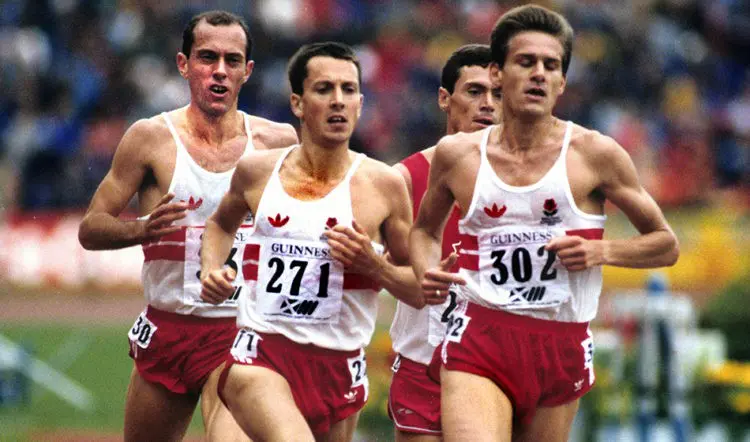
Making his Commonwealth debut, 12 years after being disappointed he had been overlooked for 800m selection, he won comfortably. The battle for gold (pictured below) proved an all-English affair with Tim Hutchings’ 60.13 lap around 3000m being the major move but Ovett covered that and a 57.3 last lap of his own pulled him well clear of Jack Buckner (13:25.87) and Hutchings (13:26.84), who would go on to finish first and third respectively in fast times at the Europeans the following month.
Koblenz 1500m, August 6
1st 3:33.78
Within a week of his gold medal run, ran his fastest 1500m time since his world record three years earlier and it was a world leading time. Hit the bell in 2:35 and looked on for a really fast time but his leg was hurting and he lost concentration and eased home with a 58 last circuit half a second ahead of future world champion Abid Bile (3:34.33) with Scott third.
European Championships 5000m, Stuttgart, August 31
DNF (13:31.24 heat)
Unwell he was not able to challenge on a hot day and with a fast pace and dropped out at 3000m as his conquered team-mates from Edinburgh - Jack Buckner (1st 13:10.15) and Tim Hutchings (3rd 13:12.88) enjoyed their greatest races.
1987 onwards
That was not the end of his good performances but he failed to match the level of his performances at Edinburgh and Koblenz thereafter.
A 7:44.83 3000 win in Belfast was his best run in 1987 where he finished 10th in the World Championships 5000m in a slow run race that should have suited him.
A 3:36.90 1500m was his best run in 1988 and 3:37.40 1500m in 1989.
In 1990 he failed to get through the AAA heats while a 8:07.28 3000m in May 1991 is his final track entry on Power of 10, in a race where he out-sprinted Paul Davies-Hale.
» Photography by Mark Shearman
» See part one of Ovett’s career history through the 1970s here
» For more on the latest athletics news, athletics events coverage and athletics updates, check out the AW homepage and our social media channels on Twitter, Facebook and Instagram