How they train: Sarah Tait

We talk to the Scottish 3000m steeplechase record-holder about a breakthrough year, dealing with injury and adjusting to life as part of her first professional team with On.
Last year, Sarah Tait was enjoying the summer of her life. Every time she ran, something impressive happened. Whether it was breaking Eilish McColgan’s 12-year-old Scottish 3000m steeplechase record, winning silver at the European Team Championships on her senior international debut, doing likewise at the UK Championships or qualifying for her first appearance at a World Championships, major progress was being made.
“Basically, at every race going into the World Championships, I'd run a PB,” the 25-year-old says. “I started the season with a PB [9:37.62], and then I ended up running 9:18.66 [come August]. I was really riding the high, and I was really excited to see what I could do against the best in the world. Unfortunately, it didn't end up going to plan. The ending was a shame, but it won't take away from what a special season that was.”
The “ending” of which Tait speaks was a fall in her heat at the Olympic stadium in Tokyo – a painful landing in the water jump that caused substantial damage. “You've got three main ligaments [in your ankle],” says the 25-year-old, who was the first beneficiary of McColgan’s Giving Back To Track initiative. “I ruptured one and tore the other two. I had some bone bruising as well.
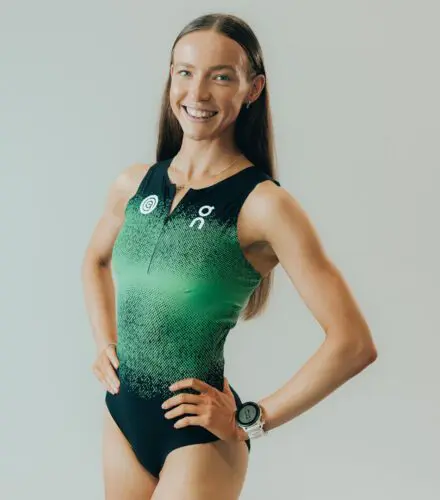
“I don't think I could ever have imagined how hard it would be to come back from. I ended up having close to six months of basically no running. I'm definitely not cut out to be a triathlete! I spent way too much time on the bike, the elliptical trainer and swimming. It's been much, much longer than I think anybody would have expected.”
But the start of the year hasn’t been all doom and gloom for the former West Virginia University student, who was fourth in the 2025 NCAA final. In January she signed her first professional contract, joining the On Athletics Club Oceania team, based in Melbourne and coached by Australian four-time Olympian Craig Mottram. Since February, Tait has been in Australia and working to get fully back on track. Happily, she is almost there.
“It's very different to what I'm used to,” she admits. “The hardest part has been the fact that I've joined the team injured and not fully been able to join in with everything. We're getting there. I still spend quite a lot of time cross training when they're out doing their easy miles.
“But the main difference really has been that they train three sessions a week. I did that growing up at Lasswade with my coaches, Kirk and Linda Smith, but then in America it was two big sessions a week.
“I'm really excited, because I've done a lot of the aerobic building over the last two years [in America] and, though they do a lot of that here, too, they do a little more of the intensity as well. I think that that will be a good change for me.
“Craig fully took over towards the start of the year and then, once I came over, we quite literally hit the ground running and we've just been progressing every week. Every week's been different, but building closer and closer and closer to what a normal training volume would look like for me.”
Motivation is not in short supply, with a home Commonwealth Games and European Championships to aim for.
“The only thing that's been keeping me going is the thought of competing at two home Games,” says Tait. “I grew up competing at Scotstoun Stadium as a wee girl and just the thought of being able to stand there in the Scottish uniform with a home crowd, friends and family there… I don't think anything could beat that. My number one priority this season is to try and get on both of those teams.”
When she can expect to start racing again remains unclear for the moment but much of the confidence built up last year remains. Lizzie Bird’s British record of 9:04:35 is a target that she and British champion Elise Thorner are eyeing, while Tait admits that the LA Olympics have crossed her mind, too.
“I want to see how good I can get,” she adds. “If that takes me to the Olympics, then that would be amazing. Seeing what Lizzie Bird and Aimee Pratt did – the two of them were just taking chunks out of the British record and I don't see any reason why Elise and I can't be doing the same over the next few years.”
Typical training week
(Recent training week during recovery)
With these final stages of her injury recovery, Tait admits: “My training really does change every week at the moment.” Currently running around 80km per week, the aim is to replace more of her cross training sessions with running and take that weekly total up to 100km-110km. Eventually, she will add a third session to her week.
“It would be Monday, Wednesday, Friday for the session days and then the long run is generally Saturday or Sunday, depending on how you're feeling off the back of the Friday workout. I’m in the gym twice a week, too, which is new for me.”
Two of those sessions will focus on threshold running, while the third will be “a variation of race pace speedwork”, such as “8x800m, with some 300s as well”. As the season approaches, that switches to two more VO2 Max focused sessions and one threshold.
Monday: (am) 7 x 1km (60 seconds recovery); (pm) cross training, 30 minutes elliptical or bike
Tuesday: (am) one hour elliptical; (pm) gym session
Wednesday: (am) 14km run ("4:20-5:00/km pace depending on how I'm feeling”); (pm) 30 minutes elliptical
Thursday: (am) track session. “It will be VO2 Max focused. We only find out what it is when we get to the track,” says Tait.
Friday: (am) cross training; (pm) gym session
Saturday: (am) Long run, up to 20km, “usually in 4:10-4:30/km range”.
Sunday: (am) 12km run; (pm) 30 minutes cross training
Favourite session:
“Anything a wee bit longer. I like doing Fartlek sessions, like Mona Fartlek or 3, 4, 5, 4, 3, 2, 1, with float recoveries. Or I do love a treadmill workout. People think I'm absolutely crazy but anything like five by four minutes cut down on the treadmill… You just put it at a pace, and you have to run that pace. It's so simple.”
Least favourite session:
“Any sort of hill reps. They really get me. On the track, I’ve done 16 x 500m before – and that's a lot further than a 400m rep, I'll tell you!”