The English patient

Cathal Dennehy talks to the Irishman whose summer of 800m success has been a long time in the making.
Back in 2020, Mark English got chatting to one of his rivals, Adam Kszczot, about training for the 800m. The Pole – a five-time global medallist and six-time European champion – passed on some useful advice.
“He said the 800m is all about getting to 600m feeling good,” recalls the Irishman. “That’s what I tried to work on over the last while.”
English had already won three European medals at that point – two indoors, one outdoors – but had yet to win a gold or make a global final. He won another European bronze in 2022, but fell short at the semi-final stage at the 2023 World Championships, 2024 Olympics and 2025 World Championships.
The latter was the hardest blow of all, with English drawn alongside Olympic medallists Djamel Sedjati and Marco Arop in the first semi-final, which went out in a controlled 52 seconds, meaning only the top two were likely to qualify. He finished third.
Minutes later, he watched from the 'hot seat' as his national record was broken by Irish team-mate Cian McPhillips’ semi-final winning run, the times behind him ensuring English's elimination.
At the time, it felt like it might have been his final chance to make a global final, but English, now 33, came back for more in 2026. He broke his Irish indoor 800m record twice, the latter a 1:44.23 in Ostrava, but at the World Indoors in Torun he struck for home a touch too soon in his semi-final and faded to fourth in the home straight – another near-miss.
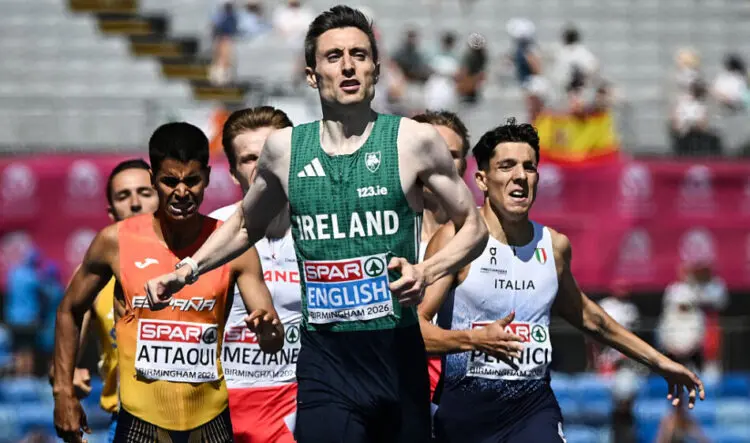
However, what followed was, by some distance, the best outdoor season of English's career. He won the Diamond League in Shaoxing, clocking 1:43.85, and lowered his personal best to 1:42.97 to finish second at the London Diamond League.
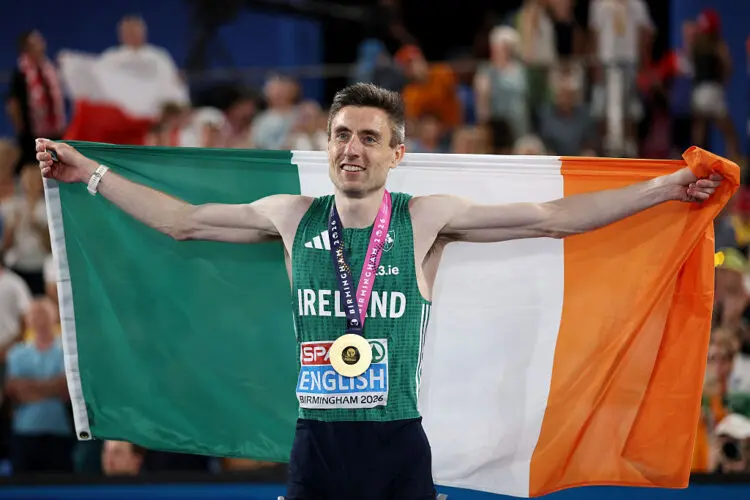
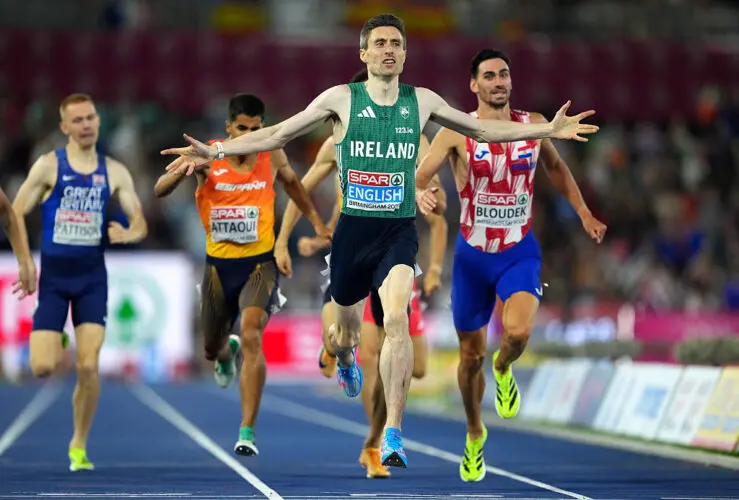
Then, at the European Championships in Birmingham in August, he finally achieved something that had long seemed destined for an athlete of his calibre – kicking to gold in the 800m, his task made slightly easier by the withdrawal of chief rival Max Burgin shortly before the race.
English's coach, Justin Rinaldi, had urged him to hold his fire in that final, to wait until the closing 100m before going for his final gear. That's exactly what he did, accelerating impressively as he turned into the straight, taking a dominant win in 1:45.26.
That gold meant the world to him.
"We get into the sport to break records and win races," he says. "I won so many races when I was younger, but to finally do it at European level, it's an emotional experience.
"I think you saw that when I crossed the line. I couldn't really put it into words. I knew I couldn’t finish my career without a title."
His work wasn't done, however. The morning after his medal ceremony, English left Birmingham at 6am to fly to Spain, putting in another block of altitude training in Sierra Nevada. Conscious of the Achilles soreness that had bothered him for part of the year, and the need to choose his battles at the age of 33, he chose to bypass the Diamond League Final in Brussels and head straight for the World Ultimate Championship in Budapest.
"At my age, you don’t want to be running every race, every week, so you have to just be careful,” he says.
The plan worked, with English winning his semi-final in 1:43.74, then finishing sixth in his first global senior final in another PB, 1:42.78.
The 800m is not typically an event that sees athletes flourish in their 30s. After all, the average age in the last Olympic final was just 24. So how is English running better than ever now, at 33, an age when many of his peers are retired or in regression?
There are multiple reasons. For one, English has been a full-time athlete for the past three years, having spent the previous decade first qualifying and then working as a doctor at various hospitals around Ireland. For most of his 20s, compromises had to be made with both the quantity and quality of training.
“When you’re trying to train twice a day [and work] it can get quite taxing and I’m looking back wondering how I ever managed to do it,” he says. He has upped his training volume significantly over the past two years, now doing close to double what he used to.
It's an area many previous coaches – from Nic Bideau to Steve Magness to Feidhlim Kelly – had also identified for improvement, but English had long known that his strength was his speed, and he was sometimes wary of taking an edge off that by doing higher volume.
Training under Rinaldi since the autumn of 2024, with his medical career now on hold, the big difference is that he now has the time, and energy, to take on a heavier training load.
An example: a few hours after setting an Irish record of 1:43.92 to win in Hengelo last year, and after giving his stomach some time to digest his dinner, English laced up his shoes and set off running around the streets late that night, getting cheers from well-oiled locals outside bars as he churned out a post-race workout of 10 x 3 minutes, finishing near midnight. It's the kind of thing he just wouldn't have been doing early in his career.
Now that he's running his best ever, is there anything he might do differently if he could go back 10 years?
“I would have ramped up the mileage more, gradually, over the years,” he says. “I would have gone away altitude training a lot, but it’s hard to do those things when you’re working or studying, as I was for the last 10 years.
"You’re doing night shifts so it’s not possible to train [properly] and, the way the 800m has gone, you’re just training twice a day, every day. There’s insane depth in this, so it’s difficult.”
Only in the last two years has English consistently incorporated altitude training, and he's noticed clear benefits. He has also tweaked his strength and conditioning programme, working recently with Martina McCarthy in Dublin, who was an Olympian for Ireland in Sydney 2000.
“In the 800m, you need to get all these things right," says English. "And you can’t neglect what makes you good in the first place, which for me is my speed."
It has been a key weapon ever since his teenage years.
A native of Donegal, English was a prodigious junior: a talent that had Irish athletics aficionados reaching for comparisons to Eamonn Coghlan or Sonia O'Sullivan during his schooldays.
He won gold at the European Youth Olympic Trials in 2010 and, in 2012, he finished fifth in a top-quality world U20 final, also lowering his PB to 1:45.77 that summer. His longevity and consistency in the years since have been simply remarkable.
It’s now 13 years since English made his senior championship debut and 12 years since he won his first major medal – a bronze at the 2014 Europeans. He has accrued a total of 28 senior caps for Ireland, six medals, and his gold in Birmingham meant he surpassed Sonia O’Sullivan as the Irish athlete with the most podium finishes at European level.
How much longer will he go on?
In Budapest, English was non-committal about 2027, saying he'd consider his future during his end-of-season break, but there was a subtle indication he'll carry on.
“As years go, this has been my best year," he said. "So you have to take stock of that."
Over the years, he's had his share of injuries and big-stage disappointments, enough to ensure that he enjoyed the good times when they arrived this year.
"At 33, I don’t take it for granted," he says. "There’s plenty of things that could happen. I could get injured, life could come up, you don’t know what can happen."
For the time being, there's no need to look to the future, with English preferring to enjoy the present, reflecting on the best season of his career, which was many, many years in the making.
"To be in those races, running those times, finishing in those places, it’s a real privilege," he says.