Sub-two: The marathon story so far

Picking out the big milestones on the way to a record-breaking landmark.
1967: The first big leap under 2:10
Derek Clayton shocked the sport by running 2:09:36 in Fukuoka, smashing previous expectations and taking almost two-and-a-half minutes off the previous world record. It was one of the first signs that huge barriers in the marathon could fall dramatically, not just incrementally.
1998–2003: Professionalisation accelerates times
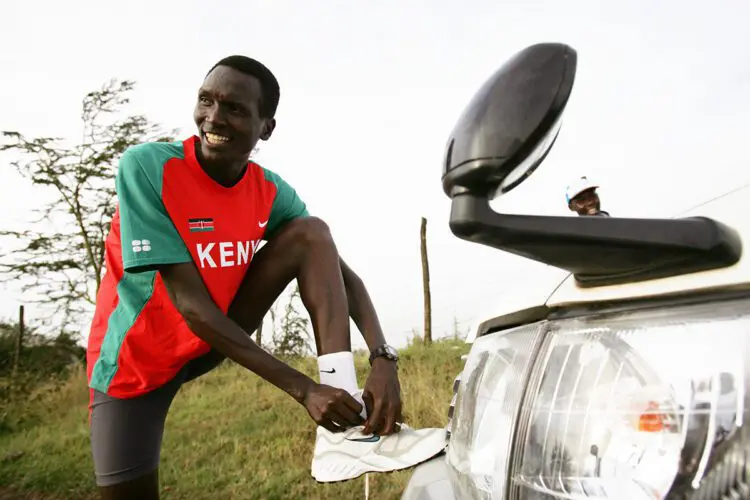
Marks by Ronaldo da Costa, Khalid Khannouchi and Paul Tergat pushed the record down to 2:04:55. Prize money, pacing and course design began to play a much bigger role.
2007–2008: Gebrselassie redefines possibility
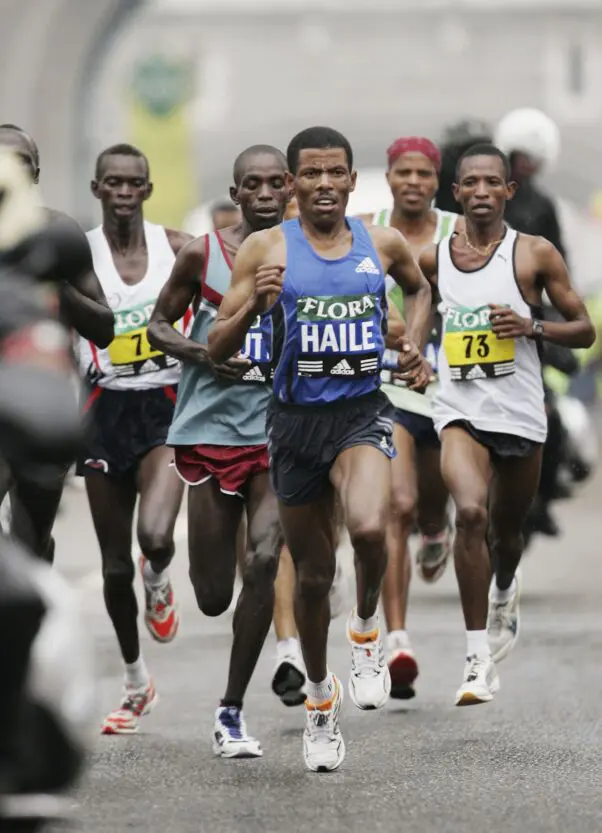
Despite struggling on his early attempts at the marathon in London, Haile Gebrselassie broke the world record twice in Berlin, dipping under 2:04 for the first time. His dominance made people seriously ask whether 2:00 might one day be within reach.
2011–2014: The Berlin conveyor belt
A string of records on the roads of Germany by Patrick Makau, Wilson Kipsang and Dennis Kimetto took the mark to 2:02:57. Progress was steady, but sub-two still seemed distant.
2014: The Sub-2hr Project
Sports scientist Yannis Pitsiladis at the University of Brighton headed up a team charged with taking runners closer to the two-hour barrier. A team of experts in genetics, nutrition, biomechanics and physiology were assembled to figure out how to shave more time off the marathon record.
2016: Nike launches the moonshot
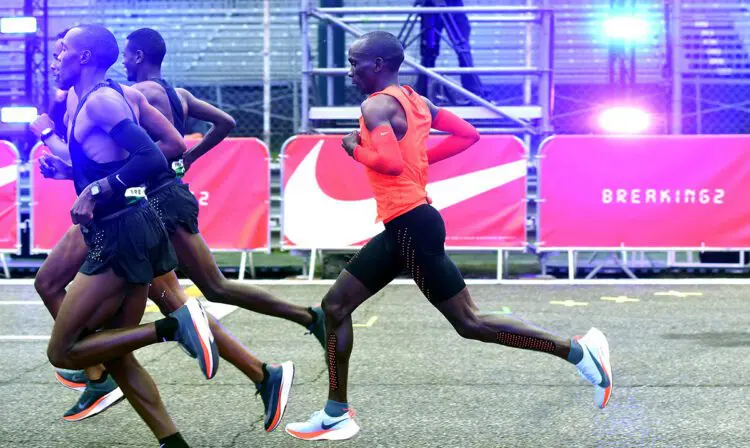
Nike publicly announced the Breaking2 project, aiming to run a marathon in under two hours. It marked a shift from organic progress to a deliberately engineered attempt at history.
2017: Breaking2 in Monza
At the Autodromo Nazionale Monza, Eliud Kipchoge ran 2:00:25 in a controlled time trial. Though not eligible for a record, it proved the barrier was no longer theoretical. If he had run just one second per mile quicker, the Kenyan would have dipped inside two hours.
2018: Kipchoge’s Berlin masterclass
Eliud Kipchoge’s official 2:01:39 world record in Berlin was widely seen as the greatest legitimate marathon ever run. It brought the sport to within striking distance of two hours under race conditions.
2019: INEOS 1:59 Challenge
At Hauptallee in Vienna, Kipchoge ran 1:59:41 to become the first man to run a marathon inside two hours. With rotating pacers, Nike super shoes, smooth, flat roads and perfect weather conditions, the psychological barrier was finally broken – even if unofficially. Not everyone approved with the manufactured nature of the attempt, though.
2020–2022: Shoes, science and marginal gains
Advances in footwear technology and race execution helped push times lower across the board. Kipchoge’s 2:01:09 in Berlin showed that even official racing was inching closer to the barrier.
2023: Kiptum changes the trajectory
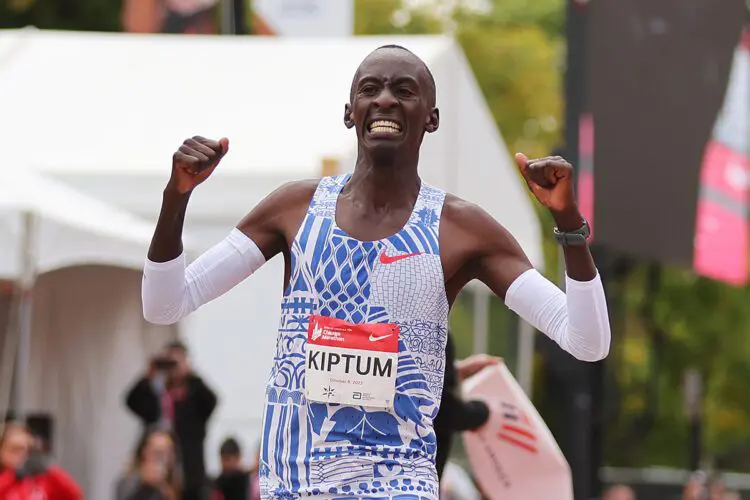
Kelvin Kiptum ran 2:00:35 in Chicago, the fastest official marathon ever at the time. Crucially, he did it with an aggressive second half, suggesting it was on a matter of time until
sub two was achieved in an official race.
2026: The barrier finally falls
Sabastian Sawe clocked 1:59:30 at the London Marathon, making history. Decades of incremental progress, innovation and belief culminated in the first official sub-two-hour marathon.
The men’s marathon world record progression
2:55:18 John Hayes (USA), London 1908
2:52:45 Robert Fowler (USA), Yonkers 1909
2:48:52 James Clark (USA), New York 1909
2:46:04 Albert Raines (USA,) New York 1909
2:42:31 Henry Barrett (GBR), London 1909
2:40:34 Thure Johansson (SWE), Stockholm 1909
2:38:18 Harry Green (GBR), London 1913
2:36:06 Alexis Ahlgren (SWE), London 1913
2:32:25 Hannes Kolehmainen (FIN), Antwerp 1920
2:30:57 Harry Payne (GBR), London 1929
2:26:44 Yasuo Ikenaka (JPN), Tokyo 1935
2:26:42 Sohn Kee Chung (KOR), Tokyo 1935
2:20:42 Jim Peters (GBR), London 1952
2:18:40 Jim Peters (GBR), Chiswick 1953
2:18:34 Jim Peters (GBR), Turku 1953
2:17:39 Jim Peters (GBR), Chiswick 1954
2:15:17 Sergey Popov (URS), Stockholm 1958
2:15:16 Abebe Bikila (ETH), Tokyo 1964
2:15:15 Toru Terasawa (JNR), Beppu 1963
2:14:28 Buddy Edelen (USA), Fukuoka 1963
2:13:55 Basil Heatley (GBR), Chiswick 1964
2:12:11 Abebe Bikila (ETH), Tokyo 1964
2:12:00 Morio Shigematsu (JPN), Chiswick 1965
2:09:36 Derek Clayton (AUS), Fukuoka 1967
2:08:18 Robert de Castella (AUS), Fukuoka 1981
2:08:05 Steve Jones (GBR), Chicago 1984
2:07:12 Carlos Lopes (POR), Rotterdam 1985
2:06:50 Belayneh Dinsamo (ETH), Rotterdam 1988
2:06:05 Ronaldo da Costa (BRA), Berlin 1998
2:05:42 Khalid Khannouchi (USA), Chicago 1999
2:05:38 Khalid Khannouchi (USA), London 2002
2:04:55 Paul Tergat (KEN), Berlin 2003
2:04:26 Haile Gebrselassie (ETH), Berlin 2007
2:03:59 Haile Gebrselassie (ETH), Berlin 2008
2:03:38 Patrick Makau (KEN), Berlin 2011
2:03:23 Wilson Kipsang (KEN), Berlin 2013
2:02:57 Dennis Kimetto (KEN), Berlin 2014
2:01:39 Eliud Kipchoge (KEN), Berlin 2018
2:01:09 Eliud Kipchoge (KEN), Berlin 2022
2:00:35 Kelvin Kiptum (KEN), Chicago 2023
1:59:30 Sabastian Sawe (KEN), London 2026
This article also appears in the Sub-two special edition of AW magazine, out now