Sub-two: "It's not every day you meet an athlete like Sabastian"

Claudio Berardelli, who is guiding the career of marathon world record-holder, talks about his coaching philosophy and the lessons he is learning from Sawe the "outlier".
Italian coach Claudio Berardelli heads up 2 Running Club in Kapsabet, Kenya, and is best known for guiding Sabastian Sawe to the marathon world record of 1:59:30. A sports science graduate from the University of Milan, Berardelli initially worked with Kenyan athletes who were in Italy to prepare for races in Europe. Based in Kenya since 2004, his training group – in addition to Sawe – now includes 2025 New York Marathon winner Benson Kipruto, Olympic and world 800m champion Emmanuel Wanyonyi and former London Marathon winner Amos Kipruto.
How did you first get into coaching?
I had a group of friends at university and we were very passionate about endurance. One of them, Vincenzo Lancini, eventually became a physiotherapist. He is now the physiotherapist of my group, but at that time he was employed as a coach by Rosa Associati and he asked me if I wanted to become a sort of assistant.
I was still a student at the university, so for the first couple of years I mostly took work with Kenyan athletes based for long periods in Italy. I can’t say I was coaching, but I was learning. I had no clue about athletics. I was not a runner myself – I’d been a cyclist up to junior level so I didn’t know much about running, honestly speaking.
In January 2004 I had my first trip to Kenya, and what was supposed to be a one-week trip became a 22-year trip. You never finish learning here. You keep seeing situations on top of situations, so it might look the same, but it's never the same, because when you deal with individuals, it's always very different. It has not always been easy and I’ve had to face different challenges, including the different culture where I have had to adjust and compromise.
When did you start 2 Running Club and what was the meaning behind the name?
I left the Rosa group in 2015. At first I was willing to have a sabbatical year to reflect a bit on the first part of my African life, but then quite a big group of athletes asked me to continue supporting them. From there, I founded 2 Running Club in 2016.
The initial idea was that I wanted to show the athletes something different, that it wasn’t just about winning. As a provocation I told them: “To be a champion is much more than just to be a number one – you can be a champion in your attitude, in your mentality, even when you lose”. So, we called it 2.
Probably the main thing that changed is that I was on my own. I was free to make my own mistakes, to rectify them, and to explore a little bit more. It wasn't as easy as I'm narrating, you can imagine all the politics, but I'm happy about how things are going.
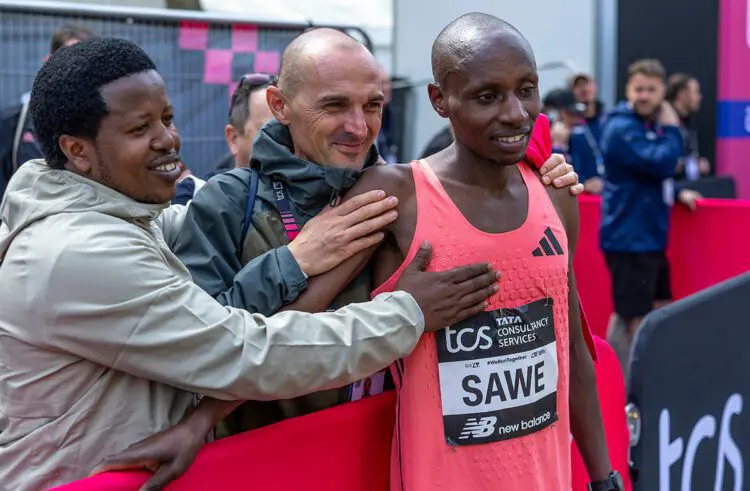
How did you first link up with Sabastian?
Sabastian came to me as a matter of coincidence. He had almost given up on the possibility of becoming professional but then his uncle [Olympian Abraham Chepkirwok, Ugandan 800m record holder with 1:43.72], who is the neighbour of my assistant coach Abel Kiprop Mutai [London 2012 Olympic steeplechase bronze medallist], asked if Abel could help Sabastian because he was a bit frustrated that no-one was giving him a chance. My initial reaction was: “Okay, just because it is you asking, Abel – bring the boy and we’ll see what he can do”.
I didn't know much about Sabastian but he had tried to become professional after he left school and he had joined different groups. He's a very quiet boy, very humble, so he probably wasn’t so aggressive to really ask someone: “Give me an opportunity, I want this, I want that”.
I met Sabastian right after Covid. Initially, he started training with my track group and he did cross-country and a bit of track, but then I noticed he was okay in doing longer stuff and I moved him to the marathon group. In January 2022 he ran his first road race at the Seville Half Marathon. He was supposed to be pacing but he won it in a course record of 59:02 and I was like: “Wow, this guy is a good one.”
What do you think makes Sabastian special?
Seville was a key moment for me to understand that I was dealing not with an ordinary runner, but an extraordinary athlete. From there things evolved pretty quickly and Sabastian gained confidence in his potential, in his capabilities, and in training.
I mean, I've coached – and I'm coaching – athletes who have been some of the best in the world in the marathon, but Sabastian is an outlier. What he's able to do, what he's able to handle, the way he does it.
He seems to be always in control, not only in training, but also in his life. Even tactically when he competes, it's like he always knows what he has to do. To be honest, I'm still in the process of fully understanding who this guy is, because he’s really unique. I described him like someone who has all the ingredients to be an extraordinary athlete, but probably the key aspect is how he takes all the ingredients and puts them together.
I've known athletes over the years who were super talented, capable of doing incredible things, but they were not able to put the pieces together, so they could easily get lost here and there for different reasons. It’s an ongoing process, together with the help of experts, to discover more about Sabastian and for us to learn from him, because it’s not every day that you meet an athlete like him.
What do you think needs to happen for him to run even quicker, sub-1:59?
That’s a very interesting point because, after all, Sabastian has only run four marathons. First, in terms of long-term adaptations, time will still help Sabastian to evolve physiologically and biomechanically.
Even from a training perspective I think we still have quite a margin. There are some things we have gradually introduced, but we haven't fully developed. For example, strength and conditioning, which is a key aspect when it comes to durability. Andy Jones did a lot of stuff with Eliud [Kipchoge] and I read as much as I can from him.
Across Sabastian’s four marathons there was definitely a natural progression in terms of volume and intensity and I believe there is still margin in terms of intensity and density. There is no doubt that we are still at the beginning of a journey.
There is a balance, of course, because more is not always better. There is a Spanish author I really like, Manuel Sola Arjona, who wrote a book The Nature of Training: Complexity Science Applied to Endurance Performance. He explains that as human beings we have a very complex system, and we have to be very careful in changing one aspect or moving things, because we might generate more side-effects than benefits.
We had a bit of a setback in December 2025 with an injury, so from mid/end-January we decided [based on what we had seen in previous seasons] that he probably had margin in his training capacity, so we took a bit of a risk to increase the volume and to start going up with the intensity. His body started to respond very well and at the end of the preparation for London we had a feeling that something very, very good was in his body, but of course, we did not go to London with the idea of running a sub-two.
An interesting thing that Sabastian told me was that when the pacemakers finished their job and he took control, his watch was showing splits of 2:50mins/kilometre, and he was feeling very comfortable, very stable, so he was trying to increase the pace a little bit, like he was discovering what he could do and going towards the 2:45s. He never realised, actually, that he
was running a world record or even a sub-two until the final stretch when he saw the clock at the finish.
Who has been your greatest coaching influence?
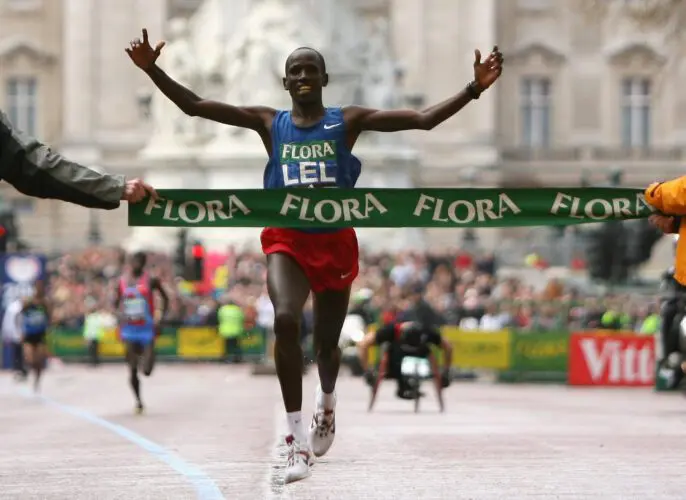
I can't really identify one single person, but observation guides my coaching philosophy and I would say that the athletes I work with have been my mentors. For example, at the beginning of my journey, I was in theory the coach of [three-time London Marathon winner, two-time New York City Marathon winner] Martin Lel , but I always say Martin was my coach to become a coach. It was him coaching me more than me coaching him.
I started to learn from any opportunity I could, so from books, scientific papers, courses and that's what I still do to keep myself up-to-date. With the internet and whatever, you can get in touch with whoever you want, but I also like to interact with people and to have proper discussions.
Of course, I had people that, directly or indirectly, would show me how to be and also how not to be. You learn in many different ways. There was the Italian school – Dr. Rosa, Renato Canova, Lucio Gigliotti – but I also did courses with ALTIS, and I mentioned on social media recently Brad Stulberg, an author I also like to read.
Coaching is multi-disciplinary, you need to pick a little bit from everywhere, and maybe you never become really expert in one specific topic but you need to know a little bit of everything, which sometimes is a bit challenging.
What do you think are the key characteristics of a good coach?
Empathy is very important. As much as we try to learn and to understand about coaching, I think, in my opinion, that when I don't establish a deep, genuine relationship with each of my athletes, I can't give my best.
A coach should have the courage to have a double CV – a good one with all the good performances, but also a bad one with situations they’ve maybe not been able to handle properly or athletes that they haven’t been able to help to perform at their best.
And sometimes you have to be courageous and honest enough to say to an athlete: “I'm not a good coach for you, you must look for another coach”, because you cannot waste their time.
What is the most valuable lesson that you've learned so far as a coach?
Remember that the athlete is at the centre of the project. As coaches, we have a tendency to sometimes put ourselves at the centre of the project without even realising it, but we are
not. It's always the athlete. The athlete drives, and we are sitting next to him, giving him a little bit of direction.
I don't feel that I am a coach, but I'm doing the job of a coach. I often suffer from imposter syndrome, to be honest, especially coaching athletes like Sabastian. I thought I had seen more or less everything in 22 years here in Kenya, and then all of a sudden, this guy is showing me really the impossible. And then you question yourself: “How much have I really contributed in what he has done?” I see being a coach as the ultimate achievement. I hope that one day I will feel like I actually am a coach.
This article also appears in the Sub-two special edition of AW magazine, out now