Patrick Dever looks to make his mark in the London Marathon

US-based Preston Harrier talks about the latest in a long line of battles with Emile Cairess, raising his game and the thrill of making his London Marathon debut.
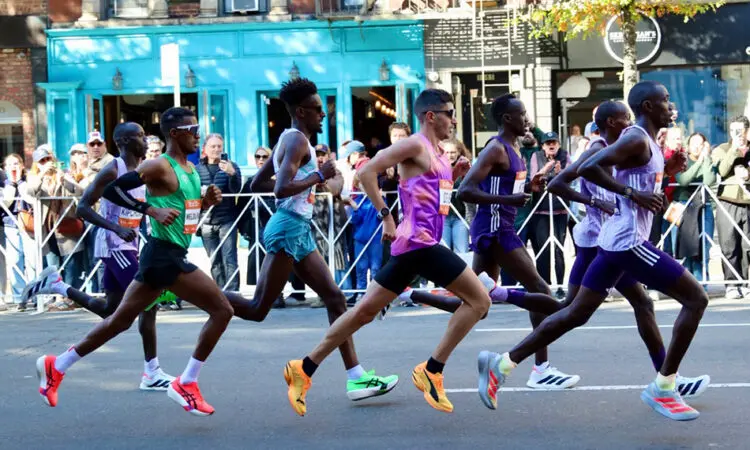
After his 2:08:58 marathon debut in New York last November, Patrick Dever is looking forward to running faster – and making an impact on British soil – in the TCS London Marathon on April 26.
“I’m so excited about doing London,” he says. “I’ve heard so many good things about it. I always watched it growing up and even just talking to my friends who live in London or who have done it or spectated, it sounds like such an incredible race to be a part of.
“It was insane to me at the New York Marathon how loud the crowd was and I’m sure London will be the same or louder. My family, who live mainly in Leyland, Lancashire, don’t get to see me race too often so it’ll be nice to have them there.”
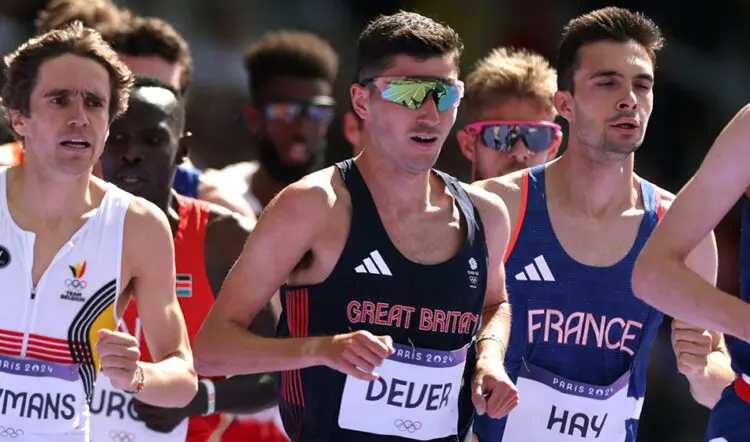
Dever, 29, finished sixth in the Mini London Marathon in 2012 and then fifth in 2013 representing the North West of England. But since those early teenage years with Preston Harriers he went on to run for Loughborough and then the University of Tulsa in the United States, where he won the NCAA 10,000m title. He has also won British titles at 5000m and 10,000m, competed in the Paris Olympics in 2024 and has run 27:08.81 for 10,000m.
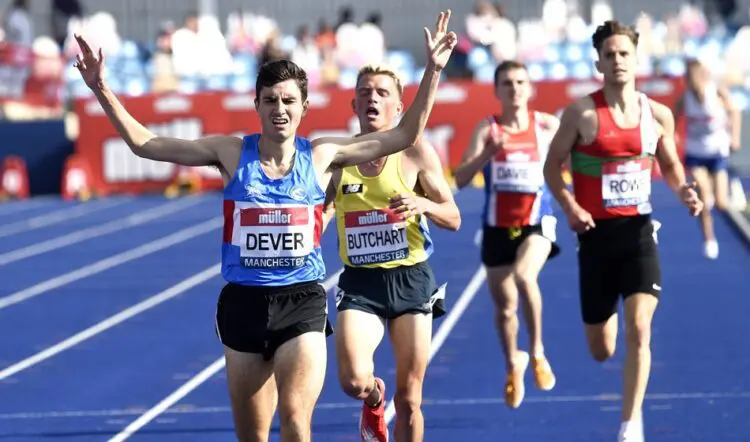
The London Marathon will also be a good opportunity for him to renew his long-time rivalry with Emile Cairess (note, since this interview took place, Cairess has withdrawn from London). The Yorkshireman is just over a year older than Dever and moved up to the marathon earlier, clocking 2:06:46 in London two years ago before finishing a fine fourth in the Olympics.
Over the years the pair have enjoyed a particularly close rivalry. At the British Universities 5000m at Bedford in 2017, for example, Dever beat Cairess by less than a tenth of a second although the pair finished half a second behind Ellis Cross. Then, in the same summer, Cairess pipped Dever by 17 hundredths of a second in a British Milers’ Club 5000m in Manchester, whereas at a Trafford 10km Dever beat Cairess by five seconds.
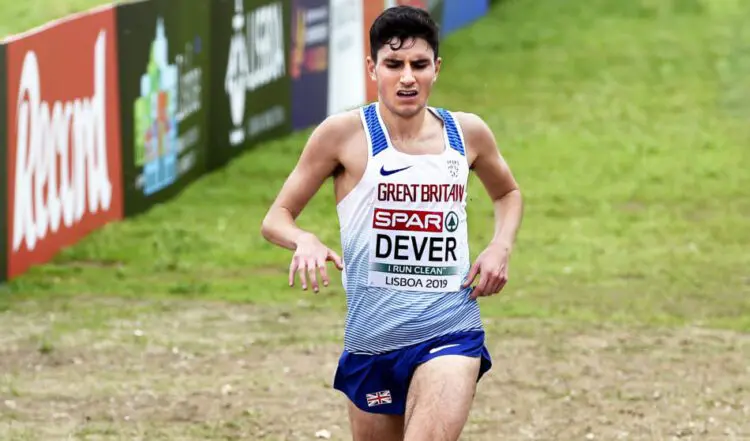
Some of their toughest races have come in cross country as well. At the European Cross Country Championships in Tilburg in 2018, Dever finished fifth and Cairess eighth, with just two seconds separating the duo.
Most memorably of all, the 2019 British Universities Cross Country Championships saw the pair separated by just one tenth of a second, although organisers admitted it was technically one thousandth, after half an hour of rugged racing on the south coast of Devon.

“If I see Emile at races I try to take the time to speak to him and ask how things are going,” says Dever. “I really like him and the way he goes about his training and races. It’s been great watching how he’s done in the last few years.”
Both athletes have progressed a lot from those student days of seven years ago when they fought it out with faces daubed with the colours of their respective universities.
“One hundred per cent,” Dever agrees when asked how much stronger he is today. “The level I’m able to train at now consistently is way higher than what I was able to do back then. The quality of sessions I do now and am able to come back from quickly are head and shoulders above what I was able to do just three or four years ago.
“I’ve really found a sweet spot with my training. I know how hard to push on the easy days in order to make my main workouts count. I’ve still got a lot to learn about the marathon and pushing up my volume but I’m really confident that I’ve come on a lot in the past few years.”
He adds: “A big part is to take breaks regularly and to let the training and racing make their adaptations. After New York I did a really good job of taking a nice break and since then everything else has gone really smoothly.”
Dever is chatting to AW from his altitude training base in Albuquerque, New Mexico. The Puma athlete has already done his first run of the day and is relaxing on the porch outside his apartment wearing sunglasses to shield his eyes from the bright sunshine.
Friends often call him “Paddy” but he doesn’t mind Patrick, either. His father is apparently a stickler for his surname being pronounced properly, though. Over the years many have mistakenly said “Deever” whereas instead it should rhyme with “never”.

He is part of the Puma elite running team and is coached by Alistair and Amy Cragg with a group that includes fellow British distance runner Jack Rowe. A few days earlier a number of the squad raced at the NYC Half and Dever excelled with a 59:56 PB to place sixth.
“Psychologically to get under the one-hour mark was good,” he says. “I knew it was a matter of time before I got under that mark but wasn’t sure it’d happen in New York as it’s quite a challenging course.”
It was his first race since the New York City Marathon five months earlier, too, where he placed fourth behind three Kenyans, Benson Kipruto, Alex Mutiso and Albert Korir, the latter of whom was suspended in January after testing positive for drugs and has since been banned from the sport for five years.
On New York, he says: “I’ve kind of parked it a little and have been trying not to think about it too much. During the build-up to London I didn’t want to be complacent. Just because one’s gone well it doesn’t mean they will all go well. I’m really trying to keep improving in training. London is completely different as well as there’s more of a time aspect.”
On the NYC Half last month, he says: “When I finished I was definitely completely gassed although I could have run it a bit smarter at the beginning. I was probably a bit too ‘engaged’ from the get-go. In the marathon I was mentally really switched off early in the race but in the half-marathon I was too engaged or hyper aware of every surge early on in the half-marathon as I was worried about people breaking away. I’ll take this forward into the London Marathon hopefully.”
Dever seems quietly confident ahead of London. He will stay in Albuquerque until just over a week before the race and then head down to North Carolina for a few days before coming across to Britain. “Most of the work will be done up here and then I’ll come down to hopefully reap the benefits,” he says.
“The marathon is such a long way and you can think your training has gone really well but something might happen in the race that throws you off a bit,” he says. “All you can do is make the training as good as possible and learn what you can to feel as good as possible on the day, such as fuelling in the final few days and on the day itself.”
He adds: “There will always be that element of the unknown, though, which is what I guess gives you those nerves.”
Cairess has been talking about breaking Mo Farah’s British record of 2:05:11, which was set in Chicago in 2018. Given Dever’s history of being neck and neck with the former, in addition to his fine debut in New York, surely this makes him believe he can match whatever his fellow Brit does?
“Definitely,” he says. “Through the age groups we were doing much less training than we are now. But I feel there’s no reason why I can’t get up to those levels in the marathon.
“I’ve just been spending a little longer on the shorter distances and I feel I have more room to grow over distances like the half-marathon and 10,000m. Whether it’s now or 2027 or 2028, I feel I have tonnes more growth to make over the marathon distance.”