The making of a record-breaker: Dina Asher-Smith's remarkable medal haul

At the European Championships, Dina Asher-Smith became the most decorated British athlete in history. Statistician Mark Butler looks examines a career that, so far, has produced a tally of 28 medals and counting.
One of many heartwarming moments at the European Championships came after Britain’s mixed relay victory on the final night. Infield presenter Iwan Thomas interviewed Dina Asher-Smith, introducing her as the nation’s most bemedalled athlete. The crowd rightly responded with one of the loudest cheers I’d heard all week.
It was a statistic I’d been hoping to see ever since the Paris Olympics when Dina stood on her 25th podium at a major international championship. That tied a record set by Colin Jackson 22 years earlier. In Birmingham Dina’s total went up to a record of 28. There may well be more medals to come for her, but it could take an athlete from a future generation to better that figure even as it is now.
Her name first came to my attention in 2011, when she reached the 200m final at the European Youth Olympic Festival in Trabzon. She was disqualified from that race for false starting, something she’s never done since. Amends were swiftly made at the Commonwealth Youth Games on the Isle of Man at the end of that summer. Her major championship medal count started with golds in the 200m and the relay, a quartet which included another current A-lister, Jazmin Sawyers.
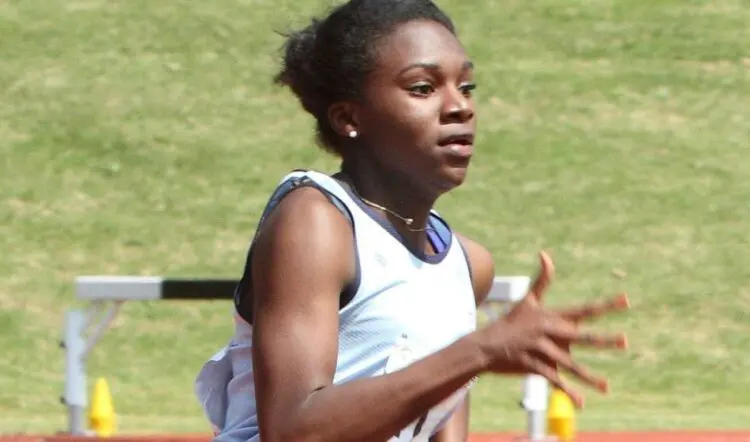
The following year, British women’s sprinting was at something of a low point, though Dina’s progress continued with seventh place at the World Junior Championships 200m, one spot ahead of Shericka Jackson. Three weeks later she was a kit carrier during “Super Saturday” at the London Olympics. Britain had failed to qualify a women’s 4x100m team then, but the rebuild started the following year, and Dina was part of it.
After taking two golds at the European Junior Championships in Rieti, she led off Britain’s 4x100m team at the Moscow World Championships. They finished a creditable fourth but later word came through of France’s disqualification. Britain had the bronze and Dina, at 17 years and 257 days, replaced Mark Richardson as the country’s youngest-ever World Championship medallist.

I confess to a particular interest in women’s sprinting. At the height of my own lowly running career, I found myself approaching times set by some of Britain’s leading women. I would see races of the great Sonia Lannaman or Kathy Cook or Joslyn Hoyte-Smith, then take their times as targets. Those numbers remain etched on my brain. Even now if I see 22:58 on a digital clock, I think not of bedtime, but of Sonia’s wonderful run in Cwmbrân on May 18, 1980. In 2009, I tried and failed to persuade then chief executive Niels de Vos to have UK Athletics commemorate the fact that Cook’s British records at both 200m and 400m had stood for 25 years apiece. After all, 22.10 and 49.43 were always exceptional times which would win big championship medals, even now. It took world beaters to finally break them. Christine Ohuruogu was one, Dina would be the other.
When she clocked wind-resisted marks of 11.49 and 23.08 in a youth league fixture at Norwich in April 2014, we knew she’d wintered well. She won the world junior 100m title that summer and broke the British junior 200m record to reach the European final in Zurich. Dina failed to finish that race because of a hamstring pull, but the British women’s sprint renaissance continued without her. The nation’s 4x100m quartet won in 42.24 to break a national record that had stood for 34 years.
It was in 2015, her first year as a senior, that the Asher-Smith era began in earnest. She equalled Jeanette Kwakye’s national 60m mark for European indoor silver. She cut Montell Douglas’s 100m record to 11.02 in Hengelo, then 10.99 in London. At the World Championships in Beijing, she was a stride away from a 200m medal in clocking 22.07. Cook’s 1984 mark was finally beaten, and then a first global relay medal was collected, with more to come in Rio 2016 and London 2017. Earlier in 2016 in Amsterdam, she became the first British woman to win a European 200m title. The following year, she’d recovered from a broken foot to place a fighting fourth in the world 200m final.
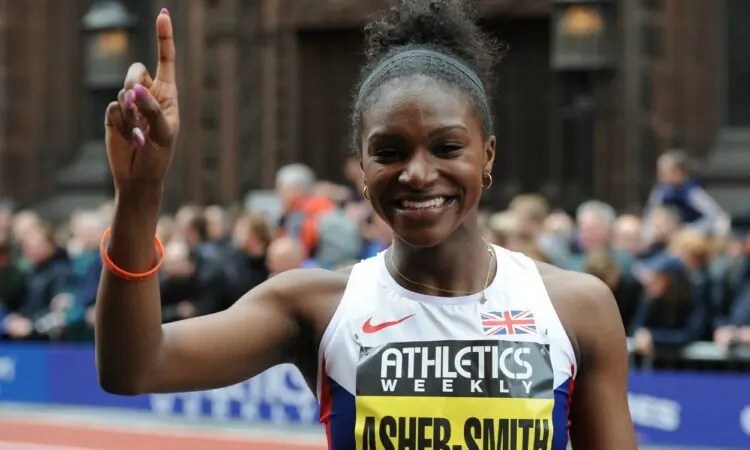
At the 2018 Gold Coast Commonwealth Games at Gold Coast, Dina did well to claim a 200m bronze and then help England snatch relay gold from a Jamaican team which was anchored by Elaine Thompson-Herah. But it was in Berlin, in August, when Dina climbed to a new level. She was the first Briton to achieve a sprint double at the European championship, in times (10.84/21.89) which only she has since bettered or even approached among British women. A sprint relay gold followed.
Three more medals followed at the 2019 World Championships in Doha. Contesting her first senior championship 100m, she lost only to Shelley-Ann Fraser-Pryce and snipped her national record to 10.83. Then came gold in the 200m in 21.88, the first senior global title by a British woman sprinter since Eileen Edwards won the 250m at the 1926 Women’s World Games in Gothenburg. Silver in the 4x100m relay rounded off the greatest season ever by a British woman sprinter.
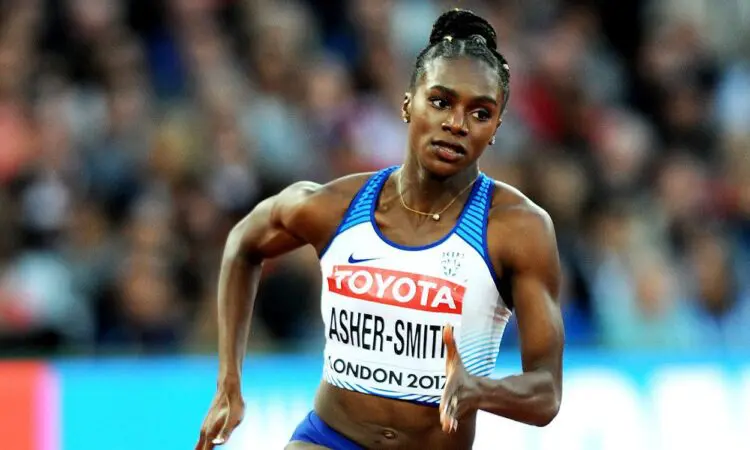
The momentum created by that 2019 world title evaporated when the coronavirus pandemic unfolded. Dina trained through 2020 and appeared ready to carry on where she left off in Tokyo 2021. In order to get there she was obliged to contest the British trials at the chilly, exposed and generally unsuitable Manchester Regional Arena. She clocked a snappy 10.91 100m in her semi, but also, it transpired, picked up a hamstring niggle. This became evident when she was eliminated in the 100m semis at the Olympics.
She tearfully scratched from the 200m to save her fitness for the relay and that sacrifice paid off, with a British record of 41.55 in the heats and another bronze in the final.
In my judgement too much was asked of all the athletes in 2022, with the World Championships, Commonwealth Games and European Championships held in quick succession. Dina acquitted herself wonderfully at the first of these fixtures in Eugene, placing fourth in the 100m and third at 200m.
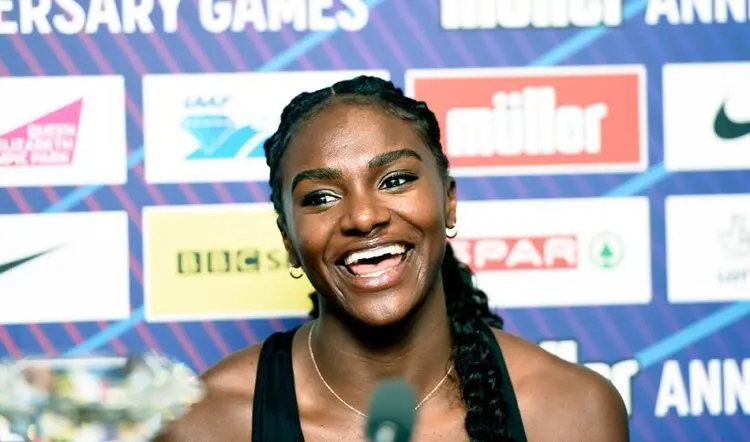
She skipped the Birmingham Commonwealths but returned to defend her three European titles in Munich. Disaster struck when she cramped up in the 100m after a decent start. Then she was outsmuscled by Mujinga Kambundji in the 200m. As Dina waited to run the anchor in the relay, Britain’s first exchange failed. She had gone from three golds in 2018 to a solitary silver.
By now the medal count was 22. Just one below Cook’s revered British women’s record total of 23 across 1977-1986. There were none at all at the world championships in Budapest in 2023 or Tokyo in 2025, though she fought her way into the 100m and 200m finals on both occasions.
She regained her European 100m and relay titles in June 2024, but the Paris Olympics were bittersweet. Dina missed a medal by a whisker in the 200m, then led Britain off to a great start in the relay. The Americans were under threat, but with wobbly British changeovers to and from leg three, it was not to be. Instead, Dina’s 25th medal was a silver jubilee silver.
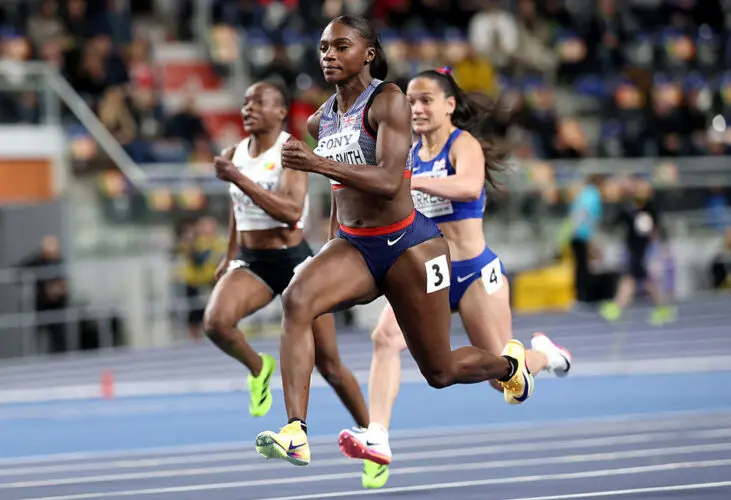
Indoors at Toruń 2026 she maintained her record of never failing to reach an individual World Championship final, equalling her British 60m record in the process. But there was no medal in that final, or the 4x400m, where she unexpectedly appeared with an excellent 51.29 split.
So her medal total was 25 before that battling 200m bronze in Birmingham 2026, followed by two relay golds in which Dina clearly “won” her legs. Whatever happens next, I believe the career of Geraldina Rachel Asher-Smith will be regarded with the same special affection we have for those of her preceding podium icons Colin Ray Jackson and Kathryn Jane Smallwood-Cook.
Vital Statistics
Born: December 4, 1995.
Personal bests:
60m: 7.03i (2023 & 2026)
100m: 10.83 (2019 & 2022)
150m straight: 16.70 (2017)
200m: 21.88 (2019)
300m: 36.77i (2024)
400m: 52.13 (2025)
400m relay split: 51.2 (2024) & 51.29i (2026)
Medals:
GOLD (15)
2011 Commonwealth Youth Games 200m and 4x100m relay
2013 European Junior Championships 200m and 4x100m relay
2014 World Junior Championships 100m
2016 European Championships 200m
2018 Commonwealth Games 4x100m relay; European Championships 100m, 200m and 4x100m relay
2019 World Championships 200m
2024 European Championships 100m and 4x100m relay
2026 European Championships 4x100m relay and mixed 4x100m relay
SILVER (7)
2015 European Indoor Championships 60m
2016 European Championships 4x100m relay
2017 World Championships 4x100m relay
2019 World Championships 100m and 4x100m relay
2022 European Championships 200m
2024 Olympic Games 4x100m relay
BRONZE (6)
2013 World Championships 4x100m relay
2016 Olympic Games 4x100m relay
2018 Commonwealth Games 200m
2021 Olympic Games 4x100m relay
2022 World Championships 200m
2026 European Championships 200m