My greatest race: Mark Rowland

Steeplechaser looks back on the Olympic final in Seoul in 1988 where he won bronze with a British record of 8:07.96 – a mark that still stands today.
It was my coach Alan Storey and my agent Kim McDonald who came with the idea of me switching to the steeplechase heading into the 1987 season. I wanted to be Steve Ovett. I thought maybe I'd have to move to 5000m but Alan knew I probably wouldn’t be the world class 1500m runner I’d have loved to have been.
I went to Portsmouth for a development day and I met John Miller, who was a 400m hurdles coach. Every Thursday evening, I'd go down to Portsmouth and learn how to hurdle and do technical drills. I also coached myself. A lot of the stuff that I ended up doing then is what formulated who I am now as a coach. We adapted. We changed. I really wanted to get my hurdles right.
My water jumping was terrible. My ankle used to swell up, which ended up being a nightmare. I was trying to take videos of my jumping and hurdling and we broke it down. These days it’s easy to do with a mobile phone but, back then, it was a completely new field. Everyone was telling me it looked okay but I was knackered so I knew it wasn’t.
I worked out, on one freeze frame, what I was doing wrong. It was just little things. I did a little hurdling work with David Hemery, too, and all the little pieces came together.
I did core work every morning and I’d hurdle after every track session. I'd always do 100m run overs, over hurdles, just to build up hurdle endurance, because I wasn't a natural steeplechaser. I needed to learn that. I became obsessive. I wanted to prove the people who’d said I couldn’t do it wrong.
I’m a working-class lad. I'm not an academic. I'm not a smart guy. I just worked hard. I only did eight steeples before the Seoul Olympics. At the 1987 world trials, I hit the barrier and got a haematoma with blood clots and was out for two weeks. But I was completely bought in.
Having two young kids, family, drive, hunger – I was motivated to earn a living and put food on the table for the kids. But, fundamentally, I wanted to be successful, to be the best. It was just the penny dropping in 1987 that I could be good at this despite the criticism.
I didn't think I was that gifted, so I had to be better. I’m a butcher's son but I cut out red meat. I wouldn't advise that to anybody, but I did it. At that time, it was thought: “There’s more fat there.” I wanted to do everything, anything that I could do to be the best I could be. I wasn't a Coe, Ovett or Cram. I trained with those guys but I had to be meticulous in all the other areas.
I did all the physical and mental preparation, instilling confidence and belief. I ended up doing some tapes for relaxation, calming myself down. My nature is always to be worried about the environment but I learned I can't control anyone else, or control the weather. I can control me, now.
Headed to Seoul, I'd run 8:07 in a time trial at the holding camp. I didn’t know how much faster I could go but, by that point, I wanted to win. It was all about winning. The Italian Francesco Panetta was the world champion, so he was a big player. I knew there were always three Kenyans, so I had to do something good.
We anticipated the hardest thing was going to be the heat, and running the semi rather than the final. Semi-finals were harder because they're slower. I was better running quickly because there was more efficiency.
I went to the medical centre in the village to get quite loose. I’d never had a massage in my life, but I needed to get loosened out after the heat frightened me. Then you keep focused. You stand on the line and just ignore everybody. For the final I was really in the moment, in the zone.
I knew it was going to be quick. I just needed to keep them in touch. You never know what pace it will be run in, but I would have probably ignored that anyway. The one thing you don’t want to do is to hit the hurdle and I skimmed the very first one. It woke me up because I didn't want to over-hurdle. That tuned me in. It might have been a blessing in disguise.
Then there was a critical moment when the Kenyans started to go with 1000m left. That's a critical moment when it went down. Panetta had died back but some of the East Germans had come back, and they started to get to the front.
I remember, with about 800m to go, thinking: “It’s on here, just stay with them.” Alan had told me: “Just don't start sprinting and stick with as many as you can.”
I couldn't do anything down the back straight. I was looking back, seeing a blur of blue vests. I thought: “Don't look back.” I was in third and I couldn't do anything about it. I’d come fourth at the world and European indoors in 1987. That had killed me because I put it on the line there.
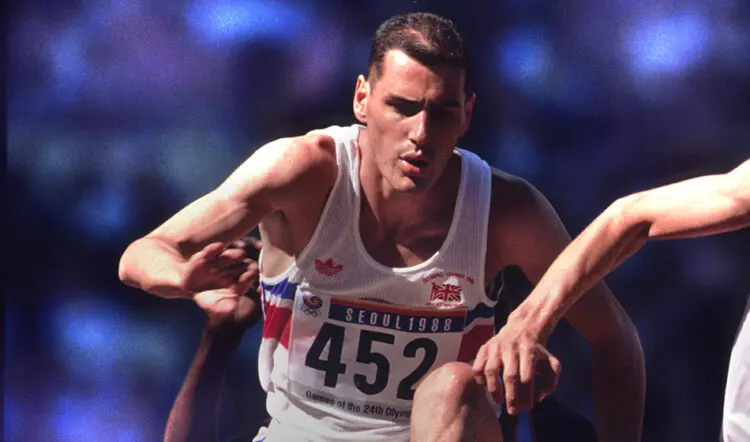
Peter hurdled the water jump, and then I went in and I was pretty good. I felt myself closing a bit more. I just attacked every hurdle. It went into slow motion over the last 300m. I attacked the last one, I got over, and it was just there – the finish line.
I’m not disappointed that no-one has broken my British record since then. But, now, I’d love to coach someone to break it.
Mark Rowland is head coach of the Edinburgh University Endurance Programme
As told to Mark Woods