Kate O'Connor: "I'm hoping I can make it hard for everybody"

The newly-crowned Commonwealth heptathlon champion is full of confidence as she approaches her first European Championships in Birmingham.
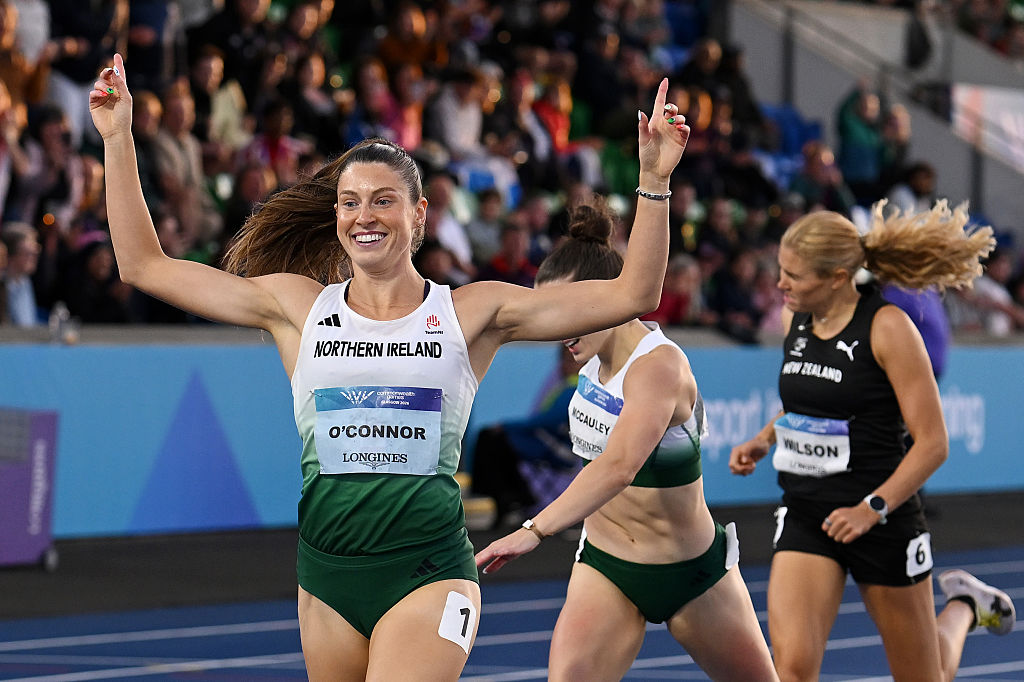
There was a moment, with the sun setting on a blustery Wednesday evening in Glasgow, when Kate O’Connor stepped into the light. The final discipline of the women’s heptathlon – the 800m – was coming to its conclusion and, after two days of hard toil and battling the elements, it was time to have a little fun.
Coming off the final bend, the 25-year-old was sitting third in the race but out she moved and cruised past her opponents. With Commonwealth gold secured – the first to be won by a Northern Irish competitor in athletics for 40 years – here was an opportunity to soak in the moment and enjoy the first major title of her career.
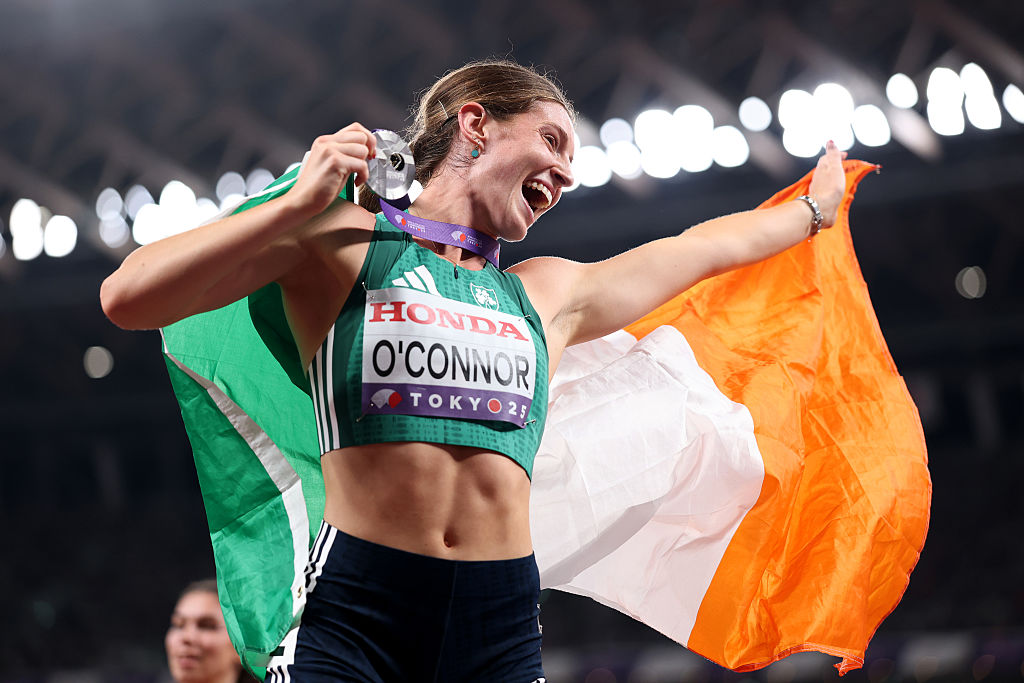
Over the past 18 months, there had been medal success for O’Connor to celebrate. Last year represented a major breakthrough, with European indoor bronze, then world silver medals both indoors all coming her way.
There was also a world indoor bronze in March, but a knee issue meant that Scotstoun was her first heptathlon of the year, so to produce a winning score of 6569 points in Scottish weather that was testing, to say the least, was sweet.
Sweeter still was the fact that one of O’Connor’s heroes – former Olympic champion Dame Mary Peters and the last Northern Irishwoman to win a combined events Commonwealth title – was in the stands to see her doing it.
“It's pretty surreal to be put in the same sentence as her because to me she is one of the icons of multi events,” says O’Connor. “To be compared or to be put in the same sentence [as her] is something that I'm still trying to come to terms with in my own head.”
It’s not the only thing that the Birmingham 2022 Commonwealth silver medallist has been processing. Coached by her father Michael, she has established herself as a real force on the global scene and will now head back to the Alexander Stadium, and her first outdoor European Championships, as one of the athletes to watch when the competition gets going on August 14.
“I've always been quite a mentally strong person, and I cope very well under pressure, but now that maybe other people are starting to notice that and say that about me, it makes it a little bit more difficult to then actually deal with the pressure and be able to still execute,” she says. “That's what people now are expecting me to do because that's what I do, apparently.
“Sometimes, I'm standing on the high jump runway and I'm like: ‘Oh god, everyone's actually expecting me now to get over this’, so that can be tough. But it's part and parcel of it, isn't it? The top athletes are the ones that are able to navigate the pressure and deal with it. It's definitely not easy, but it's part of it.”
The best way to cope, she says, is to compile some hard evidence in training for back-up. O’Connor’s week typically involves four “full work days” of training that start at 9am and finish at 5pm. The two “shorter” days: “Aren't that short. They're five hours, but they're a little easier and lighter on the body.
“Whenever you do solid training blocks behind the scenes, and you know that that's going well, it makes dealing with the pressures a little bit easier because I'm not turning up to championships hoping for anything – I'm just trying to execute what I do day in, day out.
“I'm not looking for anything special. I'm just looking to do what I do every day back at home. That's something that definitely helps me a lot. What I do in training is what I'll do in competition, and I definitely find some relief in that.”
O’Connor will be calling on that body of evidence for Birmingham, where she is all too aware that the standard of competition will be incredibly high. Switzerland’s Annik Kälin has produced the two highest heptathlon scores in 2026, while Dutch athletes Emma Oosterwegel and Sofie Dokter are also in form. Then there’s Katarina Johnson-Thompson, who will have the home support behind her, albeit the British two-time world champion withdrew from the Commonwealth Games due to an injury concern.
Regardless of what happens, a new European champion will be crowned following the withdrawal of 2024 gold medallist and three-time Olympic champion Nafi Thiam. O’Connor wasn’t at those championships in Rome, choosing instead to focus fully on qualifying for the Paris Olympics. She also missed Munich 2022, through injury, so is relishing the opportunity to engage in continental competition.
“It will be a fun experience doing the European champs for the first time,” she says. “It's going to be very stiff competition, but the plan was to come [to Glasgow], shake off the rust and show myself that I'm in good shape. To score almost 6600 points in weather like that and in the cool is something to be really proud of. It gives me a lot of hope for what I can do in the next couple weeks.”
That score, the second-highest of her career and achieved despite the biblical rain that resulted in O’Connor throwing well below par in the shot put, undoubtedly sent out a message.
“I've never been in a competition where a medal's been easy to win,” she adds. “I'm hoping that I'll be able to go out and make it hard for everybody, just like they're going to hope that they can go out and make it hard for me. That's the fun part.”
To hear O’Connor just talk through the toll that an elite heptathlon can take sounds exhausting in itself, but it does give some insight into the scale of the task faced by the athletes who choose to put themselves in the arena.
“It's obviously extremely physically fatiguing, but it's probably more the mental fatigue that is the really tough part,” she says. “It all starts the day before the heptathlon even begins, because the nerves start, and you know you've got two huge days of competition coming up, and maybe you don't sleep that well before the comp starts.
“Then you have to deal with your emotions being all over the place on day one – whether that's highs or whether that's lows – as well as maybe having a lot of caffeine in your system by the time the night time rolls around. And then you’ve got to try to sleep.
“You wake up on day two and you're sore, and then you've got to try and do it all over again. The mental fatigue for me really rolls in before the 800m because I know that I'm going to ask my body to do something that's really difficult and it doesn't want to do.
“You can almost feel everything shutting down, but that's when you have to find that inner strength to stand on the line and do the job that you're setting out to do.”
It was unusual, then, for O’Connor to feel the way she did when that 800m rolled around in Glasgow.
“I used to be an 800m runner when I was a kid, so it was like going back to that and running a tactical race, which I hadn't run in a long time because in the multi-events you just go as fast as you can for as long as you can and just hold on.
“With 200m to go, I was like: ‘Gosh, I feel really fresh right now’. Even up the home straight I was just being springy and bounding along, which was really fun. I was genuinely enjoying myself and listening to the commentator.
“It fills me with confidence because I crossed the line and I felt like, if I had to go for another 150m, I probably could have. So I think that I'm in really good physical shape. I didn't need to show everything, but I showed enough.”
Birmingham 2026 tickets are still available here