Weightman reaping rewards from a year of disruption

Laura Weightman has achieved a great deal in a very short space of time this year.
Her truncated racing season began on August 14 when she burst into action at the Monaco Diamond League meeting and promptly ran 14:35.44 for 5000m to move to second on the all-time UK rankings.
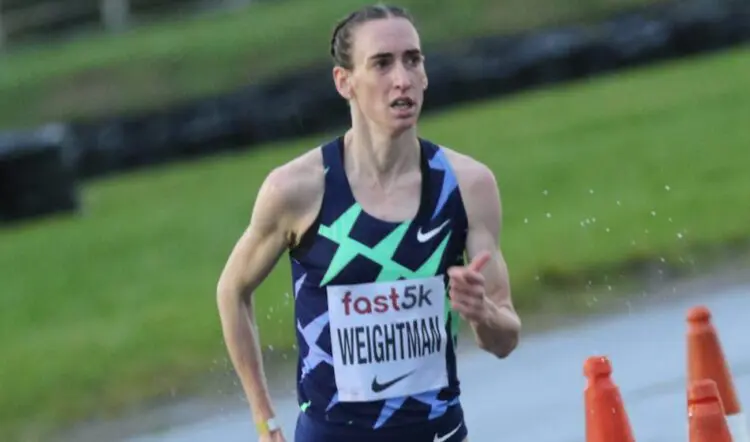
It finished on a motor racing track earlier this week as she found a gear which none of her opponents possessed to speed to victory at the fast5k in 15:10, putting her third on the UK all-time lists.
In between those impressive bookends, the 29-year-old also came perilously close to her 3000m PB of 8:26.31 in Doha, as well as winning the British 1500m title and lowering her PB for the distance to 4:00.09 in Berlin.
It has been an eventful couple of months in which every opportunity to race has been seized.
“I think it’s going to take a little bit of time for what I have achieved this summer to sink in,” says Weightman, who will be on 10,000m pacing duties in Hengelo on October 10.
“The 14:35 5000m PB is probably one of the highlights and I think the manner in which I ran that – competing with Hellen Obiri, one of the best athletes in the world ever over 5000m (was great).
“Then backing that up with just missing four minutes for 1500m and nearly equalling my 3000m PB – I don’t think I could have really asked for much more this year and I’m really proud that I’ve taken as many race opportunities as I have and just put myself out there, challenged myself and not been afraid.
“I think that’s probably as a result of having a stress-free summer in the sense of just viewing this as a year to have fun and push my limits. I think it’s definitely given me a new-found confidence and belief going into Tokyo next year about what I can actually achieve and not limiting myself.”
"It’s definitely given me a new-found confidence and belief going into Tokyo next year about what I can actually achieve and not limiting myself" - Laura Weightman
Weightman is coached by Steve Cram and the former middle distance powerhouse has been delighted to see his student not only continue her athletics education but also gain such impressive pass marks in 2020.
“It’s part of the trajectory she’s been on for the past couple of years,” he says. “After Rio we took the decision that the 5000m was where we’d be going in this Olympic cycle and she’s done brilliantly. Each year she’s been layering in terms of training and getting to know the event.
“The other thing – and it took me a little bit of time to convince her this would happen – but her other events have still been very, very good.
“It’s been interesting to see athletes who have kind of grasped the situation that we’ve been in. I think for distance athletes it hasn’t been difficult and I understand that but changing your mindset and getting your head around the idea that ‘I don’t know when I’m racing, I don’t know if I am racing’ but train and train and train.
“Particularly through May, June, July we knew she was getting in really good shape and started trying to make as many plans as we could. I’m so grateful to a lot of the meet organisers who took some big risks to put meetings on.”
When those chances to race were confirmed, Weightman was able to head to the track with that aforementioned sense of freedom. Was it that case that having a more carefree approach helped to broaden her horizons?
“Almost subconsciously,” says the two-time European and Commonwealth medallist. “I said to Steve back in April that I was going to take this as a mental down year. I’m 29 now and I’ve been competing at major championships since 2012, which is quite a long time to go back-to-back championships every single year. I said to Steve to take this summer as one to have fun, push the boundaries and let’s see what we could do.
“Having that mental down year hasn’t meant that I haven’t trained really hard, I’ve just taken the pressure off the championships and let myself have fun and go into races, really pushing myself to see what we can achieve.
‘Those results on the track have suggested that some of the things we’ve tried in training and done differently are definitely paying off.”
There has been no choice but to do things differently in 2020. The lessons learned, however, could well bring long-lasting benefits.
“It’s actually been the case of giving the athletes the confidence that you don’t have to go altitude training, you don’t have to see your physio every three days, you don’t have to have access to a track all the time,” says Cram. “I’m saying this for distance athletes, of course.
“I’ve always tried to say to Laura ‘don’t rely on things’. Running the 1500m or 5000m is actually pretty simple. What covid did was bring everything back to that straightforward level and some of the things which athletes have got used to relying on – which are nice things to have – if you don’t have them then it doesn’t mean you still can’t perform well.
“For instance, we took a conscious decision even when things were opening up not to go altitude training in Font Romeu and Saint Moritz.
“As a coach you are looking ahead and planning and I was thinking ‘what if there’s an Olympics but we can’t travel (beforehand) and we might have to go to Tokyo three or four weeks beforehand and there could be various restrictions?’.
“So for her to be able to go and run these times without some of these things that hopefully we’ll have back next year just gives her extra confidence.”
"I’ve always tried to say to Laura ‘don’t rely on things’. Running the 1500m or 5000m is actually pretty simple" - Steve Cram
He adds: “Not all athletes, I guess, would respond in that way. She has and it’s been brilliant. From a coaching perspective it’s hopefully helped me to reinforce some of the things we’ve talked about over the last few years.
“Going around the circuit, I’ve heard similar things from athletes and coaches as well, which is good. It’s been a learning exercise and I think for a lot of the athletes who’ve come through it it will stand them in really good stead going forward.”
Weightman fully agrees.
“It has shown us that you don’t have to stick to Plan A, you have to be a lot more flexible,” she adds. “I think it might be a tough winter ahead and with travel restrictions we might not be able to get out to our usual winter training camp locations so I think that why in part we’ve had this later summer season and not rested too soon, because I didn’t want to be in a position where I was in great shape come December/January but have no races.
“Pushing it back, mirroring what happened last year with the Doha World Championships, hopefully in the spring more road races will pop up that we can get into before the track season begins.
“I think going for so long without physio and the usual treatments you might have and not quite knowing when you’re going to be racing, it does give you that time and you got to really learn ‘what does your body need? What can it cope with?’ and what training gets you ready to race.
“I’ve definitely learned a lot of lessons, especially in the real lockdown period when we couldn’t have a lot of access to things, it definitely made me realise what worked and some of the things that didn’t work.
“I do benefit from doing a lot of that kind of base work and I think that’s one thing we can take forwards for next year, knowing how to get me in the best 5000m shape.”
(Lead photo by Chris Cooper)
» Read more from Euan Crumley's interview with Laura Weightman on the AW website here
» For more on the latest athletics news, athletics events coverage and athletics updates, check out the AW homepage and our social media channels on Twitter, Facebook and Instagram