How Naomi Metzger found her way back to the runway

Naomi Metzger talks to Ben Bloom about being an artist, becoming a technology influencer, finding creative ways to fund her sporting career and giving the triple jump another shot.
Just as the 2025 indoor season was getting under way, Naomi Metzger returned from a winter training camp in South Africa and decided to pause her athletics career. Successive major injuries to her knee and quadriceps – both of which required surgery – had taken their toll. Although she had returned to claim her 11th British triple jump title the previous summer, the mental scars ran deeper.
“The fear was so great that I didn’t even want to go to a track,” explains the Commonwealth bronze medallist. “I was getting panic attacks. It’s scary to come back to triple jumping when you’ve been hurt from doing it twice.”
Prioritising her mental health, she halted her sporting aspirations and instead “became a normal human being”. Out went track training and a precise eating regime, in came whatever irregular gym classes she felt like doing and the opportunity to explore other sides of her identity.
Metzger, 28, has always been something of a polymath. A politics and quantitative methods graduate, she dabbled in comedy when at university and long enjoyed documenting different aspects of her life on social media.

“Compared to my athlete friends, whose whole life and everything always revolved around getting Olympic gold – and that’s their one and only goal – I’ve always had so many different goals,” she says. “Olympic gold is just one of them.”
With time on her hands in athletics’ absence, a decision dating back to 2021 set her on a path of exploration last year. It was in the wake of the Covid pandemic that she was dropped by her Adidas sponsor, forcing her to find a way to make some quick money to continue funding her athletics career.
Scrolling through social media, she discovered NFTs, or non-fungible tokens, which are digital assets bought and sold online, often tied to artwork or collectibles.
As a keen artist – another of her multitude of interests – Metzger began drawing some illustrations on her iPad, and uploaded them onto the digital blockchain database. She called the 200 or so unique designs AfroChicks, proudly showcasing black women and their hairstyles. The first few sold for around £20, with others later going for closer to £100.
Most of the income went towards her own career, but she also donated some of the proceeds to the Lloyd Cowan Bursary, supporting younger athletes making their way in the sport.
“I ended up making enough to cover my training camps for that year,” she says. “I was super happy that I’d found a different way to fund my athletics.”
With her interest piqued by the success of those NFTs, she decided to fill last year’s athletics hole by delving further into the world of technology. In 2024, she had spoken at the House of Commons about the value of cryptocurrency and blockchain technology. Now, seeking to demystify an often confusing world, she began making explainer videos to describe technological matters in simple but compelling ways. When the videos generated traction, companies began contacting her directly and asking her to create some for their specific products. “I didn’t think I could get paid for making videos about this type of thing,” she says.
She was asked to attend a technology conference in Colorado and make videos while there. Then she was invited to speak at the Christie’s Art + Tech Summit in New York alongside various leading industry figures. Suddenly, athletics had given way to an unexpected second career as a technology influencer.
There were times, she admits, when she considered never returning to athletics. “But there was always something in the back of my mind saying I don’t want to have any regrets,” she says. “When I was 20, I jumped 14.15m from behind the board. I really don’t want to end my career without having reached my potential, because anybody who had seen me then would have thought I had so much potential. So I really just wanted to give it another shot and get back into it.”
Having been coached by Aston Moore for the previous three years, she sought new pastures last autumn and joined Aaron Gadson, who coaches his wife, Dominican Olympic champion Thea LaFond. Since then, she has travelled to their American base for regular catch-ups, while conducting most of her training solo in her home town of Manchester.
A first competition in close to two years saw her jump 12.37m at the end of April, a distance she surpassed as a 16-year-old. But, given all that had come before it, there was far more at stake than a number on a board.
“It was literally just to get the fear away and dust the cobwebs off,” she explains. “I wasn’t going full pelt and giving it everything. The aim was literally just to jump again – that was it. Of course I was disappointed with the distance because I’ve still got a competitive side in me, but I was also so relieved. It was just a really nice moment to be back on the track again.”

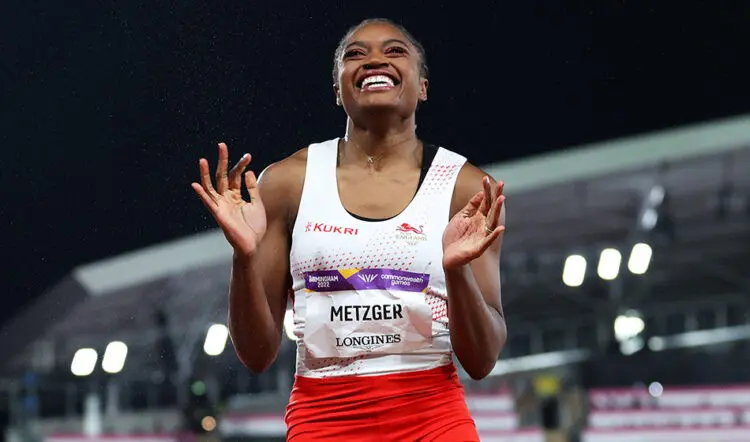
It was in 2022 that Metzger had truly ascended to triple jump’s global elite, qualifying for her debut World Championships, and then putting the disappointment of failing to make the final there by winning Commonwealth bronze in Birmingham. A fortnight later she came within 4cm of another personal best when narrowly missing the European podium.
Her short-lived 2024 return after double surgery to her right leg prompted a switch in take-off leg to the left. It is an alteration she has stuck with now, mirroring triple jumping great Christian Taylor, who won two Olympic titles off his right leg having earlier become world champion off his left.
“It definitely was difficult, and it still is,” she says. “Sometimes I have to do a little dance before I start jumping, almost to remember what leg I need to go off and which leg is going to hit the board first. It’s still something I’m getting used to.

“It’s almost like learning to drive on the other side of the road. Over time you can kind of get used to it. Christian Taylor showed it’s definitely possible to get back up to your best jumping off both legs. It just takes a bit of time and work.”
Her overall athletics ambitions centre on making an Olympic debut at Los Angeles 2028, while short-term goals are more fluid. “I just want to see what happens,” she says. “I’m not putting too much pressure on myself. This year it’s just building it brick by brick. First, it’s about confidence and then trying to get the distances further and further. I’ve started from quite a low point, so I’m hoping I can keep building and get back to where I was or even better. Training with the Olympic champion is definitely motivating me so much more.”
Triple jump is only one area of focus, though. Delving into her budding passion for everything technological, Metzger has spent recent months developing her own digital coaching app called Gymbot, which uses Artificial Intelligence to analyse different weight lifts.
“I train remotely and I’m always a bit slanted when I do exercises,” she explains. “I think I’m nice and upright, and straight, but actually I’m a bit bent, and my coach would normally tell me to straighten up.
“So I got on my computer and started typing away with Claude [AI assistant]. I did it for eight hours straight trying to make this app to look at my squatting technique and tell me how my form was, looking at the speed, the depth of range and where my body is.”

After further developments, the app will soon be publicly available, and the hope is that it will generate some income. But even if not, it is all part of a wider journey to become self-sufficient, regardless of whether athletics sponsors come back on board or not.
“I like the idea of my finances and my athletics career being in my own control,” she says. “It’s opened my eyes to the possibilities of thinking outside the box when it comes to funding yourself as an athlete or coming up with side-hustles that involve tech.”
So what do people in her two vastly distinct orbits think of her multi-tasking? “The tech people think the athletics is really cool,” she says. “And the athletics people just have no idea what I’m talking about half the time!
“But some athletes – especially those that are unfunded – have been really interested in learning more about making videos for these tech companies, or even just learning about crypto.”
Ultimately, it is working for her. “2022 was my busiest year of combining things and it was my best athletics season, so it proved to myself that I don’t need to be full time, grinding and doing nothing else,” she says. “For me, it just works that I do other things as well. So getting dropped by Adidas ended up being a blessing in disguise.”