Capital gains and memories of the 1970 Commonwealth Games

We look at when “the Friendly Games” came to Edinburgh, and two athletes by the name of Stewart stood out in front of the besotted Scottish crowd.
The 1970 British Commonwealth Games in Edinburgh involved a number of firsts. It was the first time that the championships had been staged in Scotland, the first time that the opening ceremony was broadcast on colour TV and the first time that the Queen came to watch in person and present medals. This was also the first Commonwealth Games to use metric measurements instead of imperial and electronic photo-finish technology.
It had all been a long time coming, given that Edinburgh had tried to secure the Games since 1936 and the city made the most of the opportunity. Over the course of the nine days of competition, as the public embraced the spectacle, it became known as “the Friendly Games” – a moniker that stuck for subsequent editions – and it was at the brand new Meadowbank Stadium, built at a cost of £2.8 million, where some of the most unforgettable performances were produced.
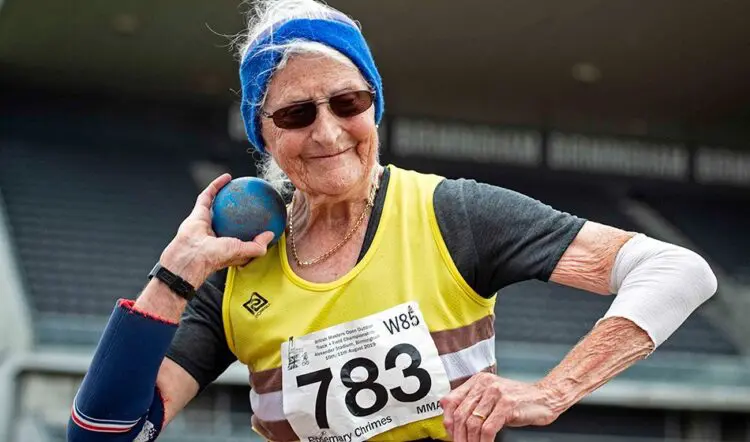
The tone was set for the home nation on the opening day of major track and field competition, July 18, by what represented another first. No female Scottish athlete had ever won a Commonwealth gold medal (in Edinburgh there were 23 athletics events for men and 13 for women) but Rosemary Payne changed all of that, her second-round throw giving her victory in the discus by over three metres. It was the second medal of the day for her family to celebrate, given that her husband Howard had also won the hammer competition for England just a couple of hours earlier. Edinburgh University graduate Rosemary, now 93, remarkably continued to compete into her late eighties under her new married name of Chrimes and held a number of masters records.
Hers would not be the only Scottish victory of that fateful day back in 1970, though. In fact, what followed was one of the most famous performances in Scottish athletics history. Ron Clarke, Australia’s Olympic bronze medallist and serial world record-breaker (he broke 17 in all, with 12 of those coming during a 44-day European tour in 1965), was the overwhelming favourite to take 10,000m gold. His most likely challenger was the British record-holder, England’s Dick Taylor, but few expected any outcome other than Clarke – three times a Commonwealth silver medallist – coming out on top in the last major championships of an illustrious career. A dental technician by the name of Lachie Stewart had other ideas.
“I remember seeing him in the Games Village in Edinburgh in the lead-up to our race,” recalled the Scot of his Australian rival. “I didn’t speak to him – I didn’t think I was worthy! It’s not that Ron was aloof but he definitely had an aura, a bit like that of a film star. Everyone admired him because of everything he’d achieved. He just kept piling up all those records.”

Clarke looked strong entering the closing stages of the race as he and Taylor matched each other stride for stride at the front, with Stewart shielded and keeping watch in third. With around half a lap to go, the Australian made his move and the Englishman hesitated for a moment. Stewart pounced, pressing the accelerator in pursuit.
"What a wonderful crowd... what a wonderful reception they're giving me," Clarke had thought as the spectators roared their approval. It was only when he heard Stewart’s approaching footsteps that he realised who the support was actually for.
“Going into the last bend I knew I would win,” recalled Stewart, who died in May of last year at the age of 81. “I was strong and had never been beaten in the last 100 yards in any race.”
The object of the crowd’s affection kicked and promptly pulled away, hitting the line in a then Games record and Scottish native best of 28:11.8. No sooner had he finished than a huge teddy bear, Scotland’s unofficial mascot called “Dunky Dick”, was thrust into his arms but the first person he sought out was Clarke.
“I’m really sorry to have done this to you because you were my idol,” he told the silver medallist. Taylor finished third.
The name of Stewart proved to be a prominent one on the track in Edinburgh that summer. Lachie returned for the 5000m final, along with Taylor and Clarke, but two other members of the Scottish team stood out to bring the championships to a glorious finale.
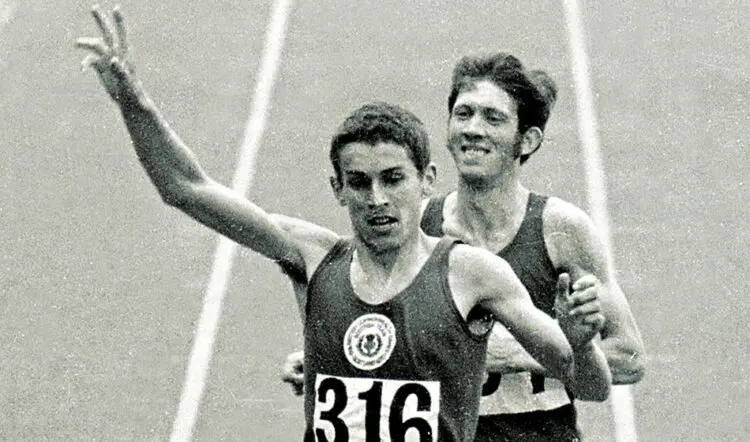
Ian Stewart (no relation) struck gold and led home a Scottish one-two with Ian McCafferty in what proved to be one of the greatest 5000m races in history. No fewer than nine of the first 11 had won or would go on to win Commonwealth medals and the first two went second and third in the world all-time rankings.
The race started slowly before Taylor burst ahead, with only Stewart, McCafferty, England’s Allan Rushmer, Olympic 1500m champion Kip Keino, Clarke and Kenyan John Ng’eno able to withstand the ferocious pace.
The fourth kilometre slowed before McCafferty picked it up and then Stewart went ahead with 600m to run, accelerating through to the bell and pursued by Keino – who had successfully defended his 1500m title in Edinburgh but defied death threats to contest the 5000m – as well as McCafferty.
The Kenyan tried to get past along the back straight, but he faded and could do nothing to stop the Scottish pair. Stewart clocked a then European record of 13:22.85 – only world record-holder Clarke had ever run faster with 13:16.6 – with McCafferty second in 13:23.4. Keino jogged home in third.
"With 800m to go, McCafferty took off and I went with him and Keino went with us,” recalled Stewart. “I was glad someone else went as I was thinking about it. I took off on the bend and thought if I could keep Keino under pressure until 150m to the tape I could get him, which is why I took off so early. At the bell I was shifting, getting faster all the time. He tried to get round me with 200m to go and I fought him off on the bend. I put my head down in the straight. There was no doubt I was going to win."
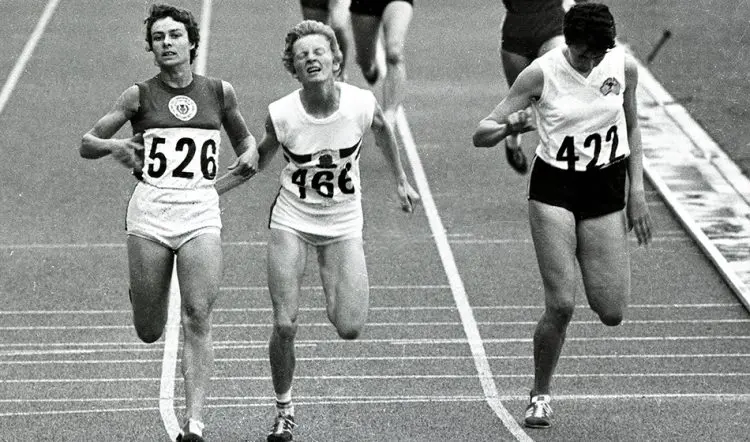
There had been more Scottish success earlier in the day in the women’s 800m final, a race decided by the tightest of margins as one tenth of a second covered the top three. Rosemary Stirling, whose grandson Sam Ruthe is already breaking age group middle distance records, won from England’s Pat Lowe, both given the same time of 2:06.2.
In between all of that, there were sprint doubles from Jamaica’s Don Quarrie and Raelene Boyle of Australia, English marathoner Ron Hill produced a world-class 2:09:28 victory, while his team-mate David Hemery took his second sprint hurdles gold. There was a long jump win for Wales’ Lynn Davies, pentathlon and shot put success for Northern Ireland’s Mary Peters and a 400m world record of 51.02 by the 17-year-old Londoner, Marilyn Neufville, competing for Jamaica.
Scotland finished with four gold medals, two silver (Jim Alder in the marathon adding to McCafferty’s 5000m) and two bronze medals (Moira Walls in the high jump and Bill Sutherland in the 20 miles road walk).
“It was quite an occasion for us all,” Stewart told The Scotsman. “We won the 5000m and the 10,000m and I think if you’d said that before the Games everyone would have looked at you and laughed.
"Having the Scotland crowd behind you in a place like Edinburgh was phenomenal, a crowd like that could be worth 10 metres, and it could be 10 metres you win by. I remember crossing the line and turning round and asking Ian [McCafferty] ‘where did you finish?’ and he said ‘second’.
"I thought it was Kip Keino chasing me down the home straight because I never looked behind at all. I could hear he was coming at me and of course the crowd was going absolutely nuts and the noise was phenomenal.
“For Scotland, for us to have one and two and the second and third-fastest times in the world at that time, I was quite shocked when I saw the time. It was a fantastic thing to do in Scotland, one of those special moments.”