How Cooper Lutkenhaus is taking on the world

Teenage 800m star talks about staying humble, doing his homework, the advantages of sibling rivalry and being touted for greatness.
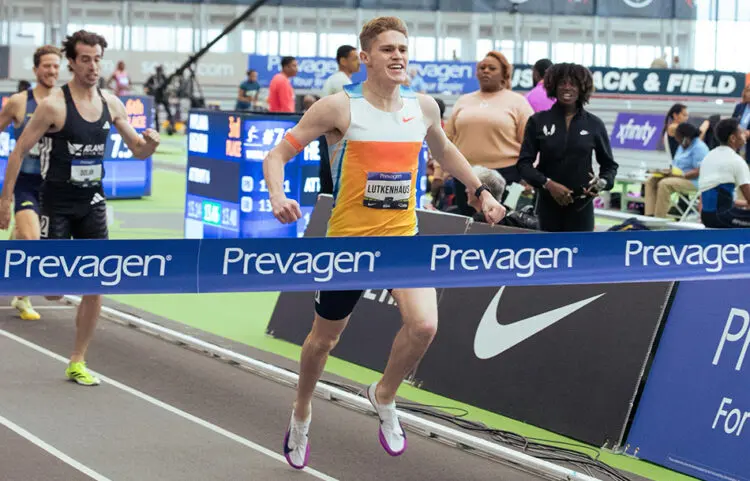
If Cooper Lutkenhaus has spent the past few weeks being revered as exceptional by the athletics community following his 800m world indoor title, then the opposite has been true when it comes to how life has been since flying back from Toruń to Texas. “It feels like it goes back to normal pretty quick,” he smiles.
We are speaking via video call on a Saturday afternoon, almost a week after he had become, at 17, the youngest winner of any event at a world championships, indoors or out, with an assurance and authority beyond his very tender years. He is still in recovery mode, so there is some cross training to be done later in the day, but the first thing on his list is “to do some errands for my mom”.
For someone who is making extraordinary progress, it’s striking – and refreshing – how ordinary the other parts of his life appear to be. As any parent of teenagers might acknowledge, perhaps the most remarkable thing about his day is that he was up at 7am.
At Northwest High School in his home town of Justin, there were pats on the back when he walked through the doors but there was no fanfare. The minimum of fuss was made.
“I feel like a lot of them think it's kind of normal now,” says Lutkenhaus. “In my freshman year of high school, when I won a State title, they were like: ‘Oh man, that's crazy’. And then, in my sophomore year, I did it again, and they were like: ‘Oh, okay’. When I ran the 1:42 in Eugene, that one was pretty crazy for a lot of people in my school, but now it's more: ‘Okay, you won. Good job’.
“A lot of high schoolers don't exactly know how impressive a World Indoor title is. Most of them didn't know indoor track was a thing. [There has] been great support, but a lot of people expect it now.”
The expectations of the wider world were certainly raised with that “1:42” Lutkenhaus mentions. On August 3 of last year, in the final of the men’s 800m at the US Championships, the then 16-year-old not only finished on the shoulder of Donavan Brazier in second place, but in a time of 1:42:27 that broke world under-18 record and secured him a place on the team for the World Championships.
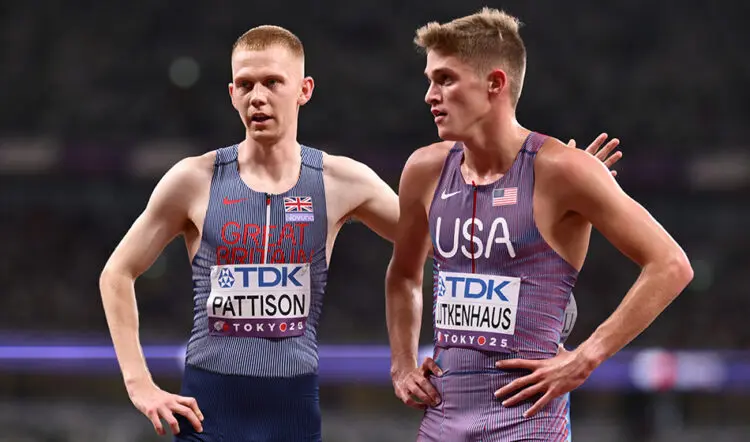
There was bedlam after that performance as the interview requests poured in and the attention ramped up, especially with Lutkenhaus’ decision to then promptly sign a professional contract with Nike. It all caught up with him in Tokyo, when he looked tired, out of sorts and didn’t make it past the heats, but the whole experience of 2025 has proved to be incredibly valuable.
“A lot of growth has happened ever since the USAs and Tokyo last year,” he says. “I think the most important thing is we're a lot more confident, especially on the racing side. We're not afraid to stick our nose up in any race, no matter who's in it.
“I enjoy the pressure of it. When I ran the 1:42 at the USAs, there was no pressure on me and then, when I came to the World Indoors, I feel that a lot of people, before the first round had even happened, it was like: ‘Oh, he's going to win’. I feel that I can thrive really well off whichever way it goes.”
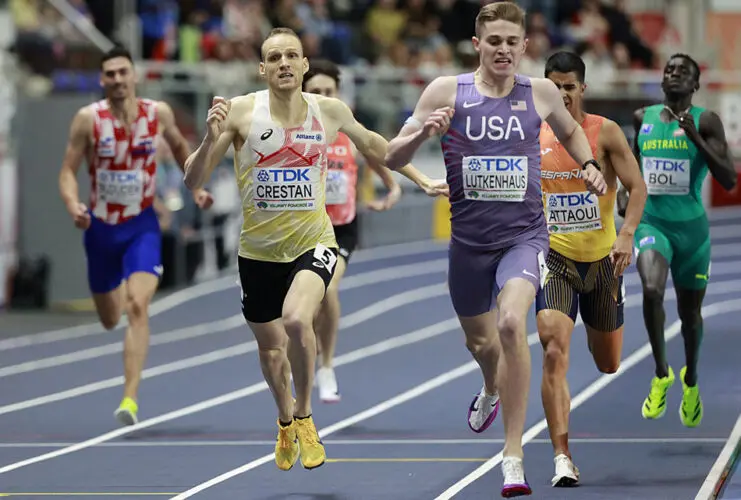
And thrive he did. In Toruń, the plan he had hatched with coach Chris Capeau worked perfectly. Lutkenhaus followed Eliott Crestan through 400m in 51.91 but moved into the lead soon after and was too strong for the Belgian as he came home in 1:44.24, with Crestan clocking 1:44.38 and Mohamed Attaoui of Spain third with 1:44.66.
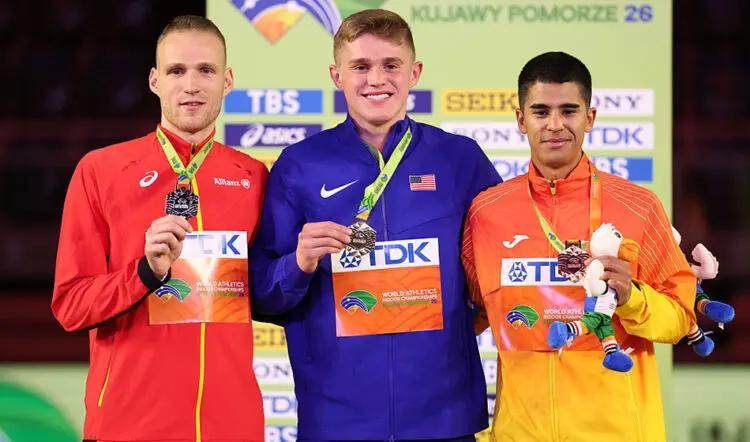
“Every time I think of the race, I think of the move I made at 300m to take the lead,” says the American who only turned 17 in December. “When me and my coach were talking, we wanted to make a defining move somewhere in the race. That could have been at 200m but I wanted to go a little bit earlier, just to surprise the field, and I feel like I did that pretty well. Maybe if I had waited until 200m I would have had to run outside a little bit more, and that's not what we were trying to achieve, so I went with 300m out and just felt really confident.
“I feel stronger aerobically than I did last summer and I think my speed is also about the same as last year, so that's really exciting to know I have a lot of extra speed that I didn't have this time last year. We'll see what we can do in this outdoor season.”
It should be an eventful summer. While it looks unlikely that Lutkenhaus will target the World U20 Championships in August, he will return to Europe to make his Diamond League debut in Stockholm on June 7 before heading back to Hayward Field in Eugene for the Prefontaine Classic at the beginning of July.
The reigning US indoor champion is bristling with anticipation at the thought of being involved in the series. A keen student of history, he has certainly been doing his homework.
“I've watched so many Diamond Leagues, especially during school, when I should be working,” he says. “I love to watch the Diamond League races. If you had asked me maybe three years ago, I probably wouldn't even have known what the Diamond League was. I was pretty new to the sport and knowing the professional side of things.
“But if you asked me last year, I could tell you where everybody was at a certain week, what they'd run in a certain Diamond League. My sports IQ has grown a lot in the past two years now and I'm really excited to get over to Europe. I feel like Europe has the best fans when it comes to track and field. They love it, and they love to see fast times. It’s going to be fast.”
Lutkenhaus, it seems, has always had speed. When the topic of conversation turns to his first brushes with track and field and how he started in the sport, he says: “When I was six years old, I believe I ran a mile on the grass in maybe 6:30 so nothing fast.” A pause. “Actually, maybe for a six-year-old it is!”
Sport has been an ever-present in his life. His father George, now Athletic Director at Cooper’s school, was also an accomplished runner, as was his mother Tricia. And then there are his older brothers. Andrew is also a middle distance runner and competes with the University of Tulsa, while George Jr swam for Adams State University in Colorado. But, growing up in Texas, where American football rules the sporting roost, things could have been very different.
“There are a lot of photos of me and my two older brothers playing in the front or back yard with little plastic helmets on with a football,” smiles Cooper. “Seeing the photos makes me smile, just realising that we've always been involved and love sports.
“I've always been a big fan of American football and that's always what I wanted to do but then the running side kind of came into play with my dad being a high school track coach and cross country coach.
“When I was younger, I would go to their practices but it's not normally something I would enjoy doing, because I would have to sit there until they were done with the workout. But I loved competing when I was running, so I think that's where the love for the sport grew.”
He adds: “Having two older brothers is a big part of my success. I've always been competitive with them. I've always wanted to win. I don't like the feeling of losing. That was really prominent in middle school, whenever I did all sports, man, losing was not my thing.
“During middle school, when we had basketball season, we weren't exactly the best team, but we were all really aggressive just because we wanted to win. There was just no skill in the court. Whenever we lost, I'd be pretty upset, just always angry and pretty mad at myself that ‘I could have done more’, and then that's just grown. Ever since I've stepped into the professional scene… I don't want to lose, and obviously everyone's going to lose – even the greats do – but right now I'm just trying to enjoy it and to put myself in all the races.”
Does that mean he sets high expectations for himself? “I do, yes, but I don't set unrealistic expectations – I set ones that I know I can achieve.”
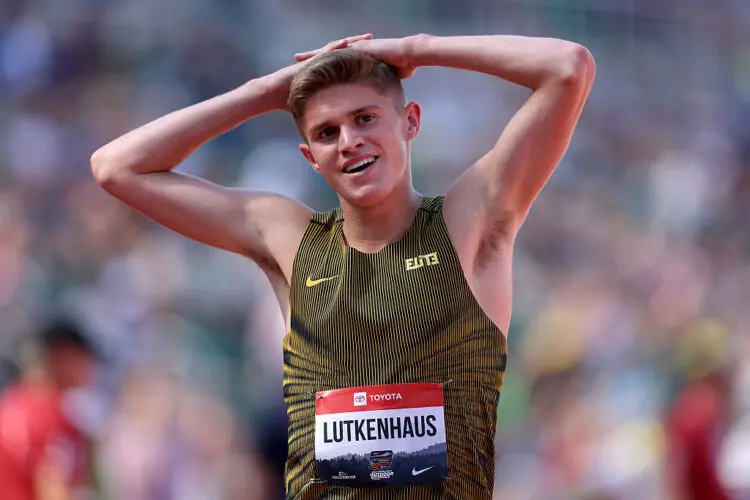
After that World Indoor final, Lutkenhaus himself was mentioned in the same breath as one of the very best there has ever been. “I think he can be the future [David] Rudisha,” said Crestan, likening him to the two-time Olympic champion and current world record-holder. The teenager has pored over the Kenyan’s unforgettable run of 1:40.91 from London 2012 “probably my favourite race of all time”, so how does he feel to be the subject of such comparisons?
“It's crazy. I don't really try to look too deep into it, just because a lot can happen in this sport. It’s pretty brutal, you just never know what's going to happen the next time you race or the next run you have so just focus on every run. It’s always fun to get to be able to do that. And then every race is always exciting. It's always a good time to get out there and race the best guys in the world.”
It isn’t only Rudisha that Lutkenhaus holds in the highest esteem, however. As he speaks of the moment when he realised he might be really good at this, the name of a current British international who also made a big impression as a teenager crops up.
“I would have to say my freshman year of high school,” says Lutkenhaus of his breakthrough moment. “I ran 1:47 and it was just off Max Burgin's age 15 world record [1:47.50]. And then getting to watch him in the [Paris] Olympic final, I was like: ‘Oh, maybe I could do that’. Watching what Max has done in the past couple of years has been really exciting and when I was watching the Tokyo [World Championships] final, since there were no Americans in it, I was definitely rooting for him, just because being close to the record that he had when he was 15 was really, really cool.”
Before the arrival of summer, though, it’s more training and more school work. Lutkenhaus has a little over a year left of his high school career and, though that Nike contract has changed the process slightly, he is still planning to go to college. The aim is to maintain as much normality as possible and to enjoy more moments like the very American celebration of his world indoor success – a midnight meal in McDonald’s along with his parents.
“It was the only place that was open,” he says. “We couldn't get out of the stadium for a little over four hours after the race happened, with the [medal] ceremony and all the other stuff.
And we actually waited for maybe an hour just because that's where every athlete was. But, when we started eating, it was pretty quiet, just enjoying the meal and just thinking about what had happened. It was definitely one of my favorite moments.”
A race of four parts – Cooper’s view of the 800m
“It hurts, that's for sure! I guess the way I've always looked at the race is by breaking it down into four 200s. The first 200m is always just about getting out and putting yourself in solid position, and then that second 200m going into 400m is always if you need to make a move up or two. That's what I did during this indoor season – from 200m to 400m is maybe where I make a little change, if that's leading or just moving up a spot. Then the third 200m is, I feel, where the men get separated from the boys. That’s when you start to feel it and you start feeling the lactic acid maybe kick in a little bit.
“But I feel like, if I'm close enough with 200m to go, I know I have a chance. I feel like I've proved that a couple times this year now and last year, but the last 200m is probably one of the most important parts of the race. Who can get to the line first?
“The third 200m is what I've improved the most. In my freshman and sophomore years of high school, I would lag off the pace a little bit from 400m to 600m [perhaps] because I was leading the race and I just started slowing down because there wasn’t really anybody behind me. Or in my freshman year was like: ‘Oh, we're just going to wait until the last 200m, this part of the race doesn't matter’. At least that’s what I used to think: ‘If you just get to the last 200m then you can beat anybody, right?’
“Nowadays, that's not how that works. It's just 800m of sprinting now. A part that I would want to improve on is the last 200m and closing a little bit faster. Everyone's closing in what feels like 24, 25 [seconds] now, and I've done that a couple times, but I’ll always see if I can get a little bit faster.”