Glory in the chaos at the 1986 Commonwealth Games

Edinburgh in 1986 was the Commonwealth Games that almost failed to happen, weighed down by an impending financial catastrophe that threatened its cancellation and then by an African-led boycott that stripped the event of so many of its likely stars. Yet amid the behind the scenes shenanigans, there were still moments to remember on and off the athletics track, writes Mark Woods.
“It'll be a bit of a surreal thing but I won't get nervous,” Liz McColgan forecast, perhaps naively, during the weeks and days leading up to the 1986 Commonwealth Games in Edinburgh, taking place barely two marathons away in distance from her birthplace to the north in Dundee.
“But I remember standing outside Meadowbank Stadium after we were all told we had to go to the opening ceremony. It's the only opening ceremony I've ever been to, because I never went back to another one. We were all told to be dressed in our uniforms and we're still standing there as Scotland were the last ones to go into the stadium.”
Then just 18, four days away from the storming run to gold in the women’s 10,000m that announced the Scot as a new and potent force in distance running, the ceremonial lap of the track in Edinburgh lives vividly in her memory, four decades on.
“As soon as the pipes started playing, every hair on the back of my neck just stood up,” she reveals. “And it just completely went from this sort of: ‘Oh, it's in Edinburgh, I've been here lots of times’ to being a very, very big moment for me.”
Just getting the event safely to the start line in one piece held a huge significance for the organisers, too. The threat of a ruinous staging of these Commonwealths loomed large before, during and after due to twin pressures represented by an inept supervision of its finances and the tidal wave of withdrawals among African, Asian and Caribbean nations due to Prime Minister Margaret Thatcher’s refusal to impose strict economic and sporting sanctions on the apartheid regime in South Africa.
The latter shredded the field, with 32 of the 59 teams eventually opting to join a boycott sparked when Nigeria and Ghana withdrew and others followed during a fortnight-long domino effect. Eight teams even checked into the athletes village before discovering they were being summoned home. Bermuda teased by marching in the opening parade before their participants became among almost 1500 entrants withdrawn from the expected field.
It only added to an already overwhelming sense of chaos. A lack of money in the bank almost obliterated the Games completely with an initial £10 million budget (like Glasgow 2026, funded without government help) spiralling out of control and threatening to bankrupt its host city.
Cancellation and humiliation were genuine possibilities when a self-proclaimed white knight came riding to the rescue, barely a month before kick-off. Robert Maxwell, owner of the Daily Mirror and Daily Record newspapers, burst on to the scene vowing to address the “chronic mismanagement” that had bedevilled the build-up and was promptly handed the responsibility of pulling this event back from the brink.
One of the most controversial businessmen of his era, he was a Jewish-Czech son of an impoverished farmer whose mother had died in a Nazi concentration camp during World War II. Largely self-educated, he constructed a vast empire, controlling the world's largest scientific and educational publisher, and even owning both Luton Town and Derby County football clubs before an audacious bid for Manchester United came up short.
Despite serving six years as a Member of Parliament, he was never well-regarded enough to become part of the Establishment. However an immense ego and larger-than-life personality perhaps persuaded him to prise control of the Games from Edinburgh’s council and move it into the hands of his inner circle, famously claiming credit for the Games survival when presenting Queen Elizabeth II with a commemorative coin set as a memento.
There was no doubt that Maxwell lit a fire under an organising committee that had done little to land commercial sponsorship deals or attract widespread interest. That he talked a good game was certainly good for the Games.
“86 per cent of the British people say that these Games should go ahead regardless of how many absent friends we have – and we hope we won’t have too many,” he said on the eve of its start. “And go ahead they will, and they will be a great success.
“I have this morning checked with the divisional heads and directors – people who have spent years in preparing this event – and I am happy to tell you that from the ceremonial to the village we’ve already had the first compliments about the quality of the food – all preparations are well in hand. The Friendly Games will start, they will be efficiently handled and they will be very successful.”
Despite a seeming ambivalence to much of the actual sport, his presence was never more evident than when the cameras and microphones were around. “I was invited up one day to the VIP area and he was there,” McColgan recounts. “It was a brief hello but no conversation. I got this special bottle of whisky. It had a gold medal with ‘Edinburgh 1986’ on it, and that's probably about the only memory that I've got of him.”
Without Maxwell’s involvement, who knows if the Commonwealth Games would have fallen into disrepair and ceased long before their eventual – and successful – return to Scotland in 2014, and again this month?
“Once the Games started, all of that negative stuff went out the window,” McColgan acknowledges. “They delivered a very good Games with the circumstances and the short time that they had to adjust everything. And the athletes didn't feel that.”
Yet a man who would later drown when falling overboard from his yacht – just as his own business affairs began to unravel with hundreds of millions ultimately found missing from the pensions of his employees – did very little under the surface to right the ship with losses for Edinburgh 1986 recorded eventually at £4.3 million and the creditors and the city left counting the bill.
Still, the return on that investment included other happier memories, such the then-Liz Lynch’s surge to victory by over ten seconds from New Zealand’s Anne Audain, with Wales’ Angela Tooby in bronze. It was the hosts’ only win on the athletics field where England topped the table with 48 medals, including 18 golds, and Canada just pipping Australia for second.
Some big names shone throughout the women’s events. Kirsty Wade commanded a middle-distance double for Wales. A young Sally Gunnell enjoyed her own breakthrough by landing the 100m hurdles title. Australia’s Debbie Flintoff rehearsed for her subsequent Olympic supremacy in the 400m hurdles while also winning the flat 400m. And Tessa Sanderson overcame Fatima Whitbread by over a metre in a ferociously-contested javelin duel between the two greats of the time.
“Shell-shocked,” responded Whitbread when asked for her analysis. “Paralysed. I simply cannot believe what has just happened.”
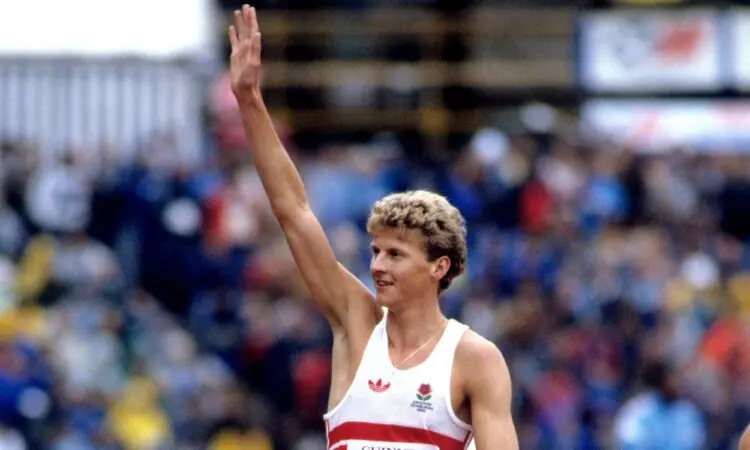
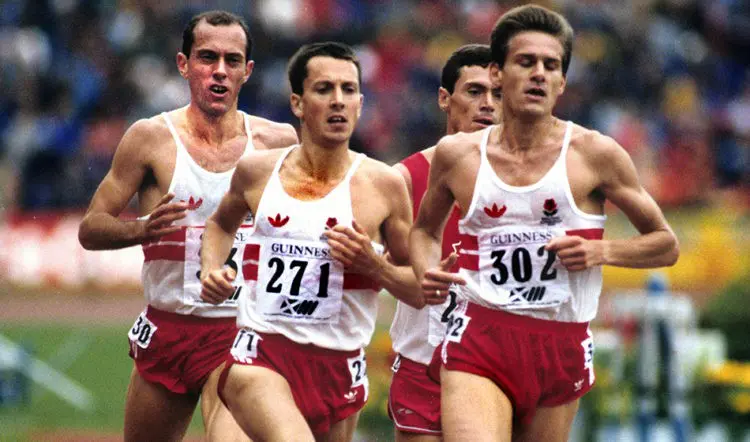
On the men’s side, Steve Cram capitalised on Seb Coe’s withdrawal due to illness to match Wade with an 800m/1500m double, while Steve Ovett produced a late-career flourish in the 5000m to prevail in a classic battle with fellow Englishmen Jack Buckner and Tim Hutchings. “If I had not run well today, a lot of people would have written me off,” Ovett said.
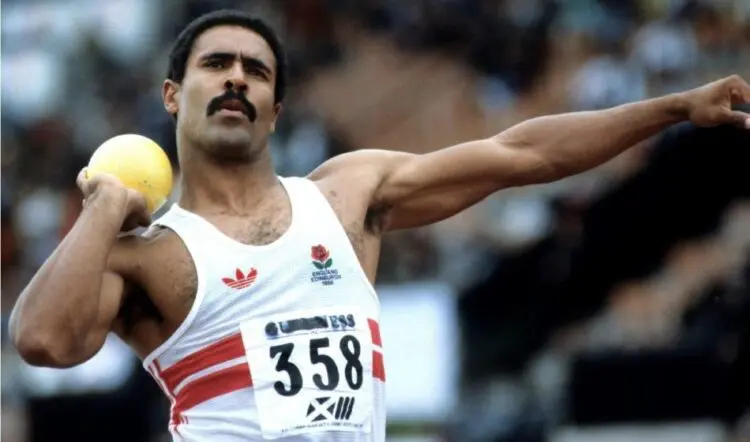
The irrepressible Daley Thompson completed a hat-trick of Commonwealth decathlon titles, Roger Black held up his own hand as a future star by taking the 400m and Olympic champion Mark McKoy repeated his 110m hurdles success from four years earlier in Brisbane.
His fellow Canadian Ben Johnson brushed off the challenge of Linford Christie by clocking 10.07 seconds in the 100m final. One of three medals he collected in Edinburgh, it was the final international championships that remains valid on his CV, pre-dating the slew of medals and records wiped from the books following his doping disgrace at the 1988 Olympics in Seoul.
Meadowbank, these days reduced to a poor imitation of its pomp, was never better as the track and field action sizzled in often cold and windy conditions. “They actually extended the seating so there was more people in,” McColgan notes. “The stadium was transformed. It looked magnificent. It was just so sad that they ended up knocking so much of it down.
“But Meadowbank always was a massively meaningful venue for me. I remember being 12 and my first time going to the East District Championships. I thought it was bigger than 400m, because it was such a massive stadium compared to what I was running on at the cinder tracks in Dundee. It was iconic.”
Two of her fellow runners had bet her £75 that she would break down in tears at the medal ceremony. She lost the wager. In the stands, others felt the emotion and elation, too. “It was the first race that my Mum and Dad had actually come and watched,” she remembers.
“My dad used to have this stupid thing about being superstitious, that if he watched me run I'd lose. I think it was just some excuse, I don't know. But it was the first time he actually came and actually watched me racing.”
In fact, he reverted to his tradition mid-race and walked outside. “My uncle went out and hauled him back in and said: ‘Martin, you’ve got to come in, you’ve got to watch, she’s going to win it’. So he came back in, and he actually did see the last three laps.”
Famously, the tables were turned four years ago in Birmingham, when another McColgan produced the standout moment of a Commonwealth Games, this time on English soil when eldest daughter Eilish captured the 10,000m title for the family once again.
“It kind of made me feel what my mum and dad had experienced,” Liz concedes. “It was a really good sort of flip of the coin to actually see from their point of view, from a parent's point of view, of your child being successful.
“So that was a really special moment, and I’m thankful that I got to get that … when not only was I there as her coach but that was me watching my daughter. From a parent's point of view, it was pretty amazing.”
Hairs standing on the back of her neck, lapping up the big moments, just as Edinburgh offered amid the chaos all those years before.