From the Quayside to Birmingham: the school races that predicted Britain’s European team

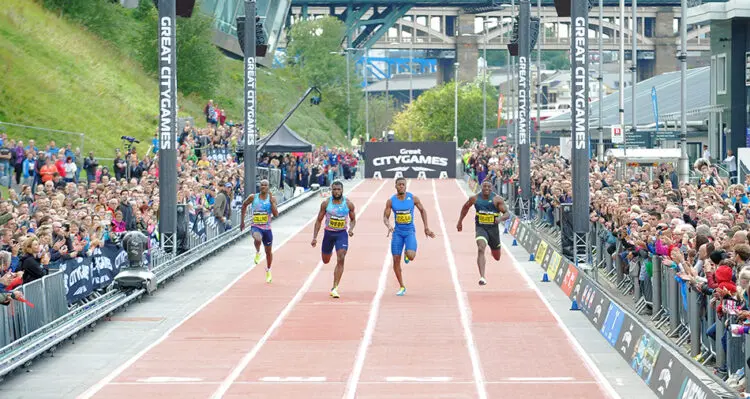
Nine years ago, Amy Hunt, Kristal Ama-Awuah, Romell Glave and Charlie Dobson raced over 150 metres on a temporary track beside the Tyne. They are among 10 athletes from that Great North CityGames programme now selected for the European Championships in Birmingham.
On Saturday September 9, 2017, four teenage sprinters stepped on to the temporary Great North CityGames track at NewcastleGateshead Quayside.
The setting was spectacular, but the occasion was relatively modest. These were not senior international finals or televised championship medal races. They were the English Schools “A” 150m events, staged early in a programme that would later feature world champions, Olympic medallists and some of the biggest names in British athletics.
In the girls’ race, 15-year-old Amy Hunt won in 17.31, finishing almost six tenths of a second ahead of Kristal Awuah, in 17.90.
Minutes later, Romell Glave won the boys’ race in 15.70. Behind him, in second place with 16.03, was a red-haired 17-year-old from Colchester named Charlie Dobson.
Nine years on, all four are preparing to represent Great Britain and Northern Ireland at the European Athletics Championships in Birmingham from August 10-16.
Hunt has been selected for the individual 100m and 200m. Glave will contest the men’s 100m, Dobson the 400m and Ama-Awuah is part of the women’s 4×100m relay squad.
They are not the only connections hidden in that old CityGames results sheet.
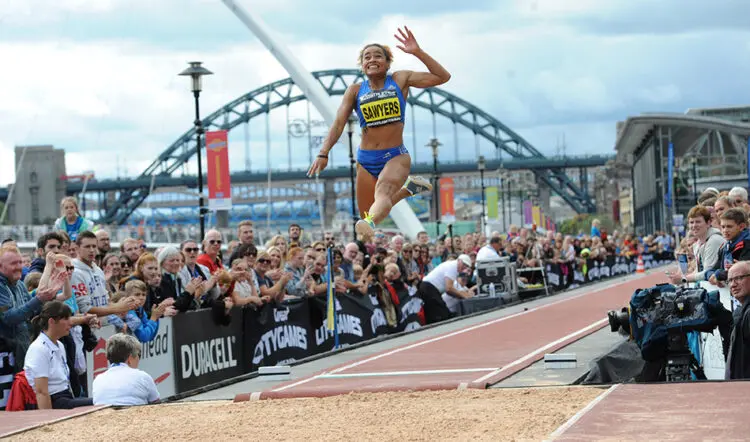
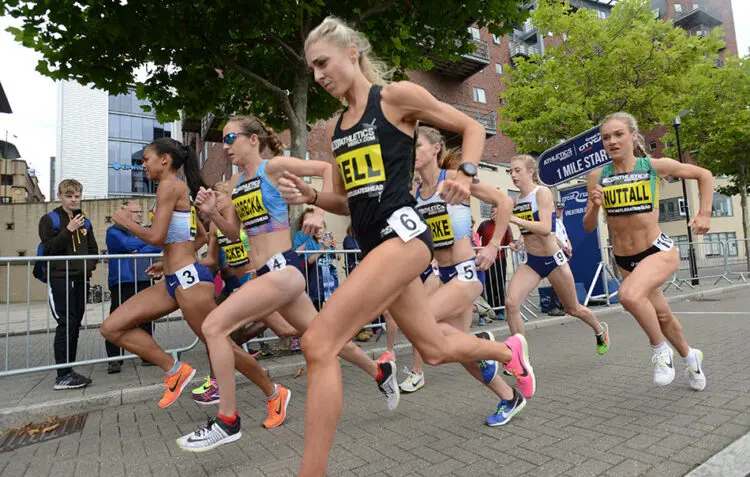
Dina Asher-Smith, Nethaneel Mitchell-Blake and Jazmin Sawyers competed in the senior sprints and long jump. Jemma Reekie, Katie Snowden and Hannah Nuttall finished one after another in the women’s road mile.
In total, 10 members of the Birmingham 2026 team competed at the 2017 Great North CityGames.

Hunt’s journey from prodigy to global medallist
Of the four teenagers in the school races, Hunt has made the most dramatic journey to the top of the senior sport.
Her CityGames victory came two years before she announced herself internationally. In June 2019, aged 17, she ran 22.42 for 200m in Mannheim, setting what was then a world under-18 best and a British under-20 record. Weeks later, she won both the 200m and 4×100m titles at the European Under-20 Championships.
At the Paris Olympics in 2024, Hunt ran the third leg as Great Britain took silver in the women’s 4×100m, the country’s best Olympic result in the event since 1956. In Tokyo the following year, she claimed individual world 200m silver in 22.14, fulfilling the promise first shown during her age-group career.
Hunt has raised her level again in 2026. She broke 11 seconds for the first time with 10.97 and retained the British 100m title at Alexander Stadium, beating Asher-Smith in 11.01.
She will return to the same Birmingham track for the Europeans as a global medallist, national champion and contender in both individual sprints.
The contrast with the Quayside could hardly be greater. Yet that school race already contained one of the qualities that has shaped Hunt’s senior career: an ability to separate herself decisively from the field.
Ama-Awuah’s junior medals and senior resurgence
Ama-Awuah’s second place behind Hunt should not be overlooked.
Less than a year after their Quayside meeting, she won Britain’s first medal of the 2018 World Under-20 Championships, taking 100m bronze in Tampere in 11.37. She later helped the British 4×100m team secure another bronze at the same championships.
Her career since has included European Under-23 and European Team Championships medals, although injuries and interruptions have prevented a smooth progression into the senior international ranks.
The 2026 season has brought renewed momentum. Ama-Awuah placed third in the 200m at the British Championships and then lowered her personal best to 22.57 in July. Her Birmingham selection places her back in a major senior team as part of Britain’s 4×100m squad.
At the 2017 CityGames she was listed simply as Kristal Awuah, the runner-up in a school sprint. In Birmingham, she will arrive with two world junior medals and the possibility of contributing to a British relay team that enters the championships as the defending European champion.
Glave’s long route to a first British title
Glave’s development has followed a different path again.
He represented Jamaica during the early part of his senior career before becoming eligible to compete for Great Britain in 2023. His first major senior championship in a British vest brought an immediate return: 100m bronze at the 2024 European Championships in Rome, where he ran 10.06 behind Olympic champion Marcell Jacobs and Chituru Ali.
In 2026, Glave won his first British 100m title at Alexander Stadium. He clocked 9.98 to defeat a field containing Zharnel Hughes, Louie Hinchliffe and Jeremiah Azu, describing the victory as the product of finally believing fully in his ability.
He has since lowered his personal best to 9.97.
The Birmingham crowd will see a European medallist and one of the continent’s leading sprinters.
Dobson finds his event
Dobson did not remain behind for long. At the 2018 World Under-20 Championships, less than a year after finishing second to Glave, he won silver in the 200m. Britain achieved a memorable one-two as Jona Efoloko took gold and Dobson followed in 20.57.
His eventual breakthrough at senior level came over twice that distance.
Dobson took European 400m silver in Rome in 2024, running a personal best of 44.38 and missing gold only because Belgium’s Alexander Doom produced a championship record. Later that summer, he helped Britain win Olympic 4×400m bronze in Paris, where the quartet set a European record of 2:55.83.
He has since lowered his individual best to 44.14 and returns to the European Championships as one of Britain’s leading medal opportunities in the one-lap event.
The teenager who chased Glave down the Quayside straight has therefore travelled from the 150m to the 200m and ultimately to the 400m, collecting global relay medals and a major individual silver along the way.
Nine years after finishing first and second in NewcastleGateshead, Glave and Dobson will compete at the same home championship, but in different events and with very different sporting stories behind them.
Asher-Smith and Mitchell-Blake light up the Quayside
The senior 150m races contained two more future Birmingham selections.
Asher-Smith won the women’s event in 16.70, three tenths ahead of Bianca Williams. Her victory was particularly significant because she had broken a bone in her foot earlier that year and only returned in time to finish fourth in the 200m at the London World Championships.
Asher-Smith won the European 100m and 200m titles in 2018 before becoming Britain’s first woman to win a global outdoor sprint title, taking the world 200m crown in Doha in 2019 with a national record of 21.88. She also won 100m silver in 10.83 and helped Britain to 4×100m silver at the same championships.
She added Olympic 4×100m silver in Paris and reclaimed the European 100m title in Rome in 2024. Birmingham gives her the opportunity to defend that continental crown on home soil, with entries in both the 100m and 200m.
Mitchell-Blake arrived at the 2017 CityGames with a world title already to his name. Less than a month earlier, he had anchored Britain to a famous 4×100m victory at the London World Championships.
His first competitive 150m ended in the narrowest of defeats. American Ameer Webb won in 15.24, with Mitchell-Blake only two hundredths behind in 15.26. Former world 100m champion Kim Collins was also in the race.
Mitchell-Blake has remained a central figure in British relay teams ever since. His achievements include world 4×100m silver in 2019, two European titles and Olympic bronze in Paris in 2024.
In Birmingham, however, he is selected for the individual 200m, almost a decade after contesting the unconventional distance between his two principal sprint events beside the Tyne.
Three jumpers, one distance
The women’s long jump produced one of the most unusual results of the afternoon.
Lorraine Ugen, Estonia’s Ksenija Balta and Sawyers all jumped 6.46m. They were separated through countback, with Ugen awarded victory, Balta second and Sawyers third.
Sawyers was already an Olympic finalist and European silver medallist by 2017, but some of her greatest achievements were still ahead.
She added European outdoor bronze in Munich in 2022 before producing the defining performance of her career at the 2023 European Indoor Championships. Sitting outside the medals in Istanbul, she jumped exactly 7.00m in the fifth round to win gold, set a British indoor record and claim her first senior title.
Then, a few days ago in Glasgow, she won Commonwealth gold with a best leap of 6.93m.
Poised to compete in Birmingham, her journey back to a major championships adds another layer to a results sheet already filled with stories of persistence as well as early promise.
The road mile’s remarkable seventh, eighth and ninth
The 2017 women’s road mile was won by Melissa Courtney, now Courtney-Bryant, in 4:33.83.
Further down the result, three young British runners finished consecutively:
Jemma Reekie was seventh in 4:42.11, Katie Snowden eighth in 4:43.25 and Hannah Nuttall ninth in 4:44.59.
Reekie went on to win the 800m and 1500m double at the 2019 European Under-23 Championships. She finished an agonising fourth in the Olympic 800m final in Tokyo before securing her first global senior medal on home soil at the 2024 World Indoor Championships in Glasgow, where she took 800m silver. She will contest the same distance in Birmingham.
Snowden has developed into one of Britain’s most consistent championship middle-distance runners. She reached the 1500m final at the 2023 World Championships, finishing eighth, and set a personal best of 3:56.72 during the competition. She is selected for the Birmingham 1500m alongside Georgia Hunter Bell and Laura Muir.
Nuttall has progressed from that 4:44 Quayside mile to become a world-class 5000m runner. She lowered her personal best to 14:39.48 in London in 2025 before finishing eighth in the 5000m at her first senior World Championships later that year. In 2026 she has run 8:26.48 for 3000m and enters Birmingham ranked among Europe’s strongest distance runners.
The seventh, eighth and ninth finishers in one road mile have therefore become an Olympic finalist, a world 1500m finalist and a world 5000m finalist.
The next generation
On the same day, 6,500 Junior and Mini Great North Run participants also took part in their own race on the Quayside. Children aged from three to 16 completed part of their courses on the same temporary track used by the international athletes and future European Championship selections.
The Junior & Mini Great North Run celebrates its 40th staging this year, with over 200,000 children taking part since the inaugural event in 1986.