1966 and all that - a memorable history

1966 will be best remembered by British sports fans for England winning the football World Cup final at Wembley but it was a year that also included a European Athletics Championships and Commonwealth Games.
I recently came across the World Sports International Athletics Annual 1967 which reviews the 1966 season and it includes some fascinating information which shows just how much athletics has changed over the last 54 years.
Curiously, there were women’s world lists and all-time rankings, and women’s results from the European Championships and Commonwealths, but also a list of all national records and national championships, only for men!
That women were not considered equal back then was further illustrated by that year’s European Championships, with there being no events over 800m (for example no 1500m, 5000m, 10,000m, steeplechase and marathon) and no 400m hurdles, pole vault, triple jump, hammer and 4x400m relay.
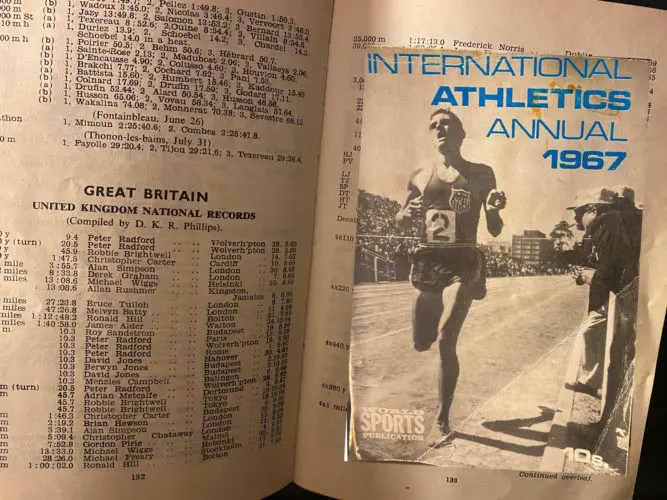
The list of British record-holders is a very interesting snapshot of the state of British athletics at that time.
The men's 100m record was a modest 10.3 - there were no electronic times then! And it was shared eight ways.
Roy Sanderson set the first time in 1956 before Olympic medallist Peter Radford equalled it in 1958 and also ran it twice in 1960.
David Jones also equalled it in 1961 and 1963 and his namesake Berwyn gathered a share in 1963. Then, finally, Menzies Campbell - the future leader of the Liberal Democrats - equalled it in 1966.
The 200m was more straightforward as it was Radford’s 20.5 from 1960 which was set at the same meeting in Wolverhampton where he also set the 100 yard and 220 yards records.
There was also a share at 400m. Future commentator Adrian Metcalfe ran 45.7 as a junior in 1961 and then Robbie Brightwell equalled it in both the 1964 Tokyo Olympic semi-final and final.
Chris Carter held the 800m (1:46.3) and 880 yards (1:57.5) records, with the metric mark coming when he finished a very close fourth in the European Championships. Carter has been involved in the sport now for 70 years, having become a top administrator and official when he retired and his son Richard became a national junior winner.
Alan Simpson, second in the Commonwealth mile in 1966, held the 1500m (3:39.1) and mile (3:55.7) marks.
Gordon Pirie owned the 3000m mark with a 10-year-old run of 7:52.8, which was a world record at the time and was still eighth all-time in the world. It was not the oldest individual British track mark as Chris Chataway had a more modest 5:09.4 for 2000m.
Mike Wiggs had the 5000m record with 13:33.0, which at the end of 1966 ranked him sixth all-time, and he had a share of the three miles with 13:08.6 alongside Allan Rushmer’s Commonwealth bronze medal-winning run in Kingston behind the great Kip Keino and Ron Clarke and narrowly ahead of future Olympic champion Naftali Temu. Both Wiggs and Rushmer were in the all-time top 10.
Mike Freary set the 10,000m mark of 28:26.0 in 1966, and the father of AW shoe guru Paul ranked eighth all-time on the world at this stage.
Bruce Tulloh held the six-mile record with a similar sort of time of 27:23.8 which ranked him sixth all-time based on his run in that year’s AAA Championships at White City.
The steeplechase record of 8:32.4 was Maurice Herriott’s Olympic silver medal-winning run in Tokyo.
The 400m hurdles record was also set in winning a silver medal in Tokyo by John Cooper (50.1). In two years that record would fall two whole seconds to David Hemery’s Olympic winning effort in Mexico.
The 440 yards hurdles record was shared by Cooper and John Sherwood, who in 1968 would win Olympic bronze behind Hemery.
In 1966 Hemery did have a half-share of the 110m and 120 yards hurdles record of 13.9 with Mike Parker.
The lesser 220 yards straight hurdle record belonged to Peter Hildreth’s 23.3 from 1955. Hildreth went on to become the Sunday Telegraph’s athletics correspondent for over 30 years.
In the field pre-Fosbury Flop, Gordon Miller held the high jump mark with 2.08m and another event which would dramatically improve was the pole vault where future Commonwealth champion Mike Bull owned the record with a 4.72m from his Kingston silver medal effort.
The Olympic, European and Commonwealth long jump champion Lynn Davies was obviously far closer to the heights and his 8.18m in Bloemfontein ranked third all-time behind Ralph Boston and Igor Ter-Ovanesyan’s world records.
Fred Alsop owned the triple jump record and that (16.46m) came from his Olympic fourth place.
The shot was also a world-class mark with Arthur Rowe’s 19.56m from five years earlier still in the all-time top 12.
Not quite at the same level were the discus marks of Roy Hollingsworth of 56.71m set in 1963 and Michael Ellis's hammer mark of 64.95m in 1959.
John Fitzsimons, who held the javelin mark of 79.78m, can at least point to a title won as that mark came when he won the Commonwealth Games in Kingston though the mark only ranked 27th in the 1966 world lists.
Clive Longe won the silver medal for Wales in the 1966 Commonwealth Games decathlon but his latest British record came in Budapest with a score of 7160 points. The years of Daley Thompson were over a decade away.
In longer events, Basil Heatley’s 2:13:55 (then a world record) was listed as the British best while there were also world-class track records at 10 miles (Mel Batty's 47:26.8), 15 miles (Ron Hill's 72:48.2) and 20 miles (Jim Alder's 1:40:58).
Hill is also down for the 20,000m (60:02.0) and one-hour mark (19,990m), though curiously in the list of other noteworthy performances, Freary had slightly better marks in the same event at Bolton of 59:59.0 and 20,004m.
The two main relay marks of 39.6 and 3:01.6 were both set in Tokyo, with the latter mark much the better as it was set when securing the silver medal run with a key last leg from Brightwell.
The oldest listed mark was the very rarely-run 4x1500m as the 15:27.2 which included Pirie in the quartet was set in 1953.
» For more on the latest athletics news, athletics events coverage and athletics updates, check out the AW homepage and our social media channels on Twitter, Facebook and Instagram