When three kings came to Tyneside

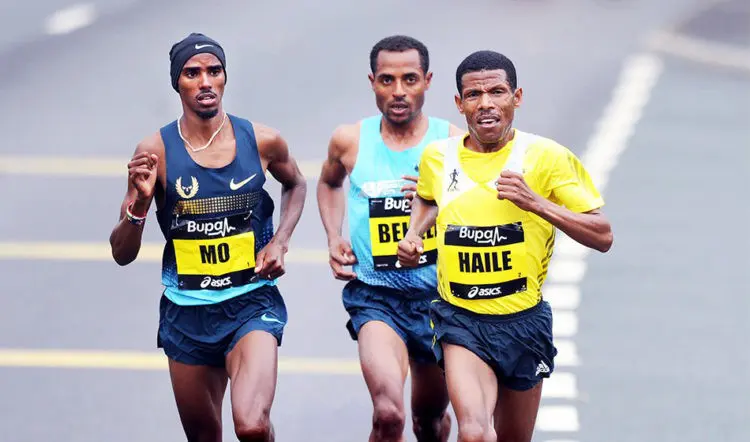
In 2013, three of the greatest distance runners in history met on the roads between Newcastle and South Shields. The result was a tactical contest, a remarkable comeback and one of the closest finishes the Great North Run has witnessed.
For a few tantalising seconds on the South Shields seafront, Mo Farah looked as if he might pull it off.
The Briton was closing rapidly on Kenenisa Bekele, eating into a lead which had appeared decisive only moments earlier. With the finish line approaching, Farah moved almost on to the Ethiopian’s shoulder. The home crowd sensed a famous victory and the noise rose accordingly.
But Bekele had one final response.
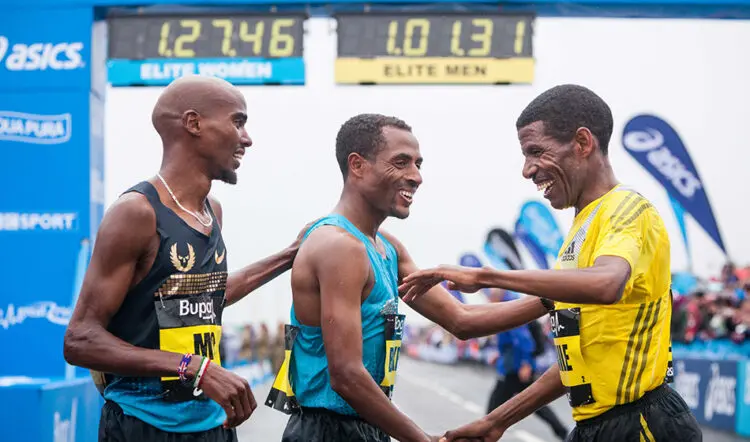
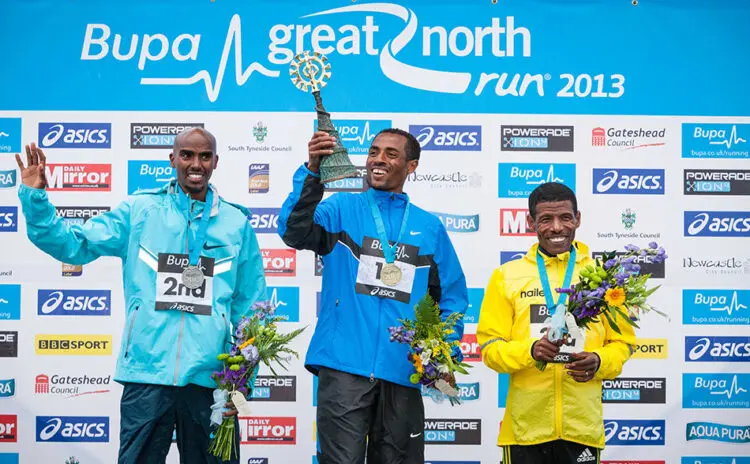
Finding just enough speed to resist Farah’s charge, he crossed the line in 60:09. Farah followed one second later, with Haile Gebrselassie third in 60:41. It was the conclusion to a contest which had promised much and, unlike so many heavily promoted showdowns, delivered.
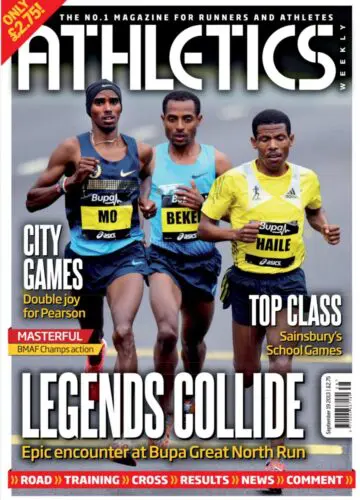
The 2013 Great North Run did not just bring together three famous names. It placed three distinct generations of distance-running greatness alongside one another on the same start line.
Gebrselassie was the elder statesman, a transformative figure whose track career had helped redefine what was possible over 5000m and 10,000m before he moved on to record-breaking performances on the road.
Bekele had succeeded his compatriot as the dominant track distance runner of his era. Yet, after a prolonged period of injury problems, his appearance on Tyneside also carried an element of uncertainty. The race would be his debut at the half-marathon distance.
Then there was Farah, the reigning force in global distance running. He arrived as Britain’s double Olympic champion and had won the 5000m and 10,000m titles at the World Championships in Moscow only weeks earlier. Bekele and Gebrselassie represented the sport’s recent past, but Farah was very much its present.
It was a field which seemed more at home in an imagined championship final than on a point-to-point road race in the North East of England.
The setting added to the occasion. The Great North Run’s journey from Newcastle to South Shields has always offered a distinctive combination of mass participation and elite racing. It can place Olympic champions at the front of the same event as tens of thousands of club runners, charity fundraisers and first-time half-marathoners.
In 2013, however, attention was fixed firmly on the leading trio.
A slow-burning contest
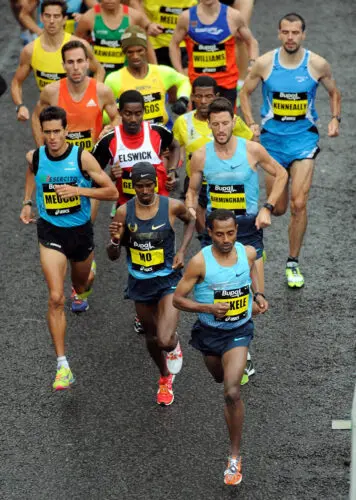
Despite the quality of the field, the opening half of the race was more controlled than explosive.
Gebrselassie took much of the responsibility at the front, with Farah close by. The trio reached 10km in 28:58, at which point Bekele was running a few metres behind his two rivals.
On appearances, it was the first sign of weakness.
Bekele had endured more than three years of injury disruption and this was unfamiliar territory. Perhaps the pace, the distance or the undulations were beginning to expose a vulnerability. With Farah and Gebrselassie together up front, the gap suggested that the debutant might be in difficulty.
In fact, it was a calculated gamble.
After the race, Bekele explained that he had deliberately allowed the gap to open because he wanted his rivals to increase the pace. With all three running together, he felt the race was not moving quickly enough: “I wanted the race to become faster and I did not see this happening while we were all together. So I dropped back, hoping that they would try to increase the pace.”
It worked, in fact Farah later said he had told Gebrselassie that the gap was not large enough. By 13km, Bekele was back alongside them. What had looked like a struggling runner losing contact was actually an athlete assessing his opponents and attempting to manipulate the shape of the race.
That tactical detail is one of the reasons why the contest has endured in the memory. This was not simply three champions running against the clock. Each was watching, waiting and testing the others.
Gebrselassie was doing much of the work. Farah, renowned for his finishing speed on the track, appeared content to stay in contention. Bekele, meanwhile, was preparing to make his move before the contest could become a straightforward sprint.
Bekele makes his move
The decisive attack came on the steep downhill section shortly before 20km.
Bekele accelerated suddenly and created immediate separation. Gebrselassie was unable to respond, while Farah found himself around 15 metres behind as the runners approached the closing stages.
The timing was significant. Waiting until the final straight would have played to one of Farah’s greatest strengths. By attacking earlier, and using a fast downhill section to build momentum, Bekele forced the Briton into a sustained pursuit rather than a short finishing duel.
For a time, it appeared to have settled the race.
Then Farah began to close.
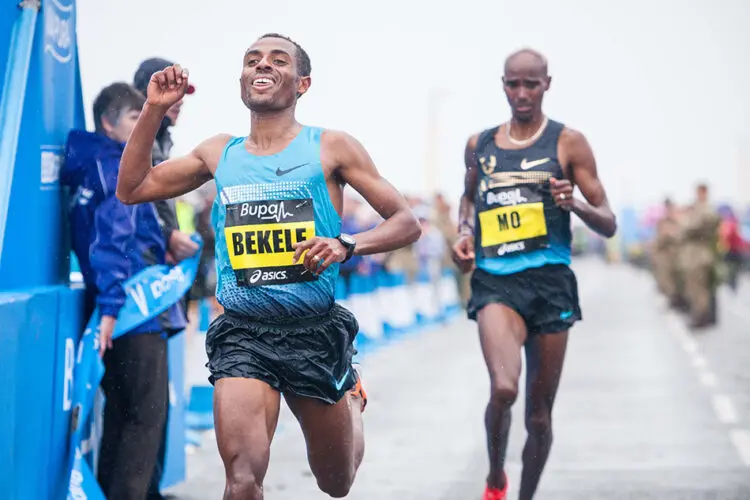
Inside the final 400 metres, the gap narrowed dramatically. Bekele repeatedly checked over his shoulder as the red, white and blue figure behind him grew larger. With 100 metres remaining, Farah was only a step or two away.
The finish offered a compelling clash of racing instincts. Farah had built his championship success around an ability to remain composed before unleashing a devastating final lap. Bekele, by contrast, had tried to remove that weapon by striking first.
The Ethiopian’s move had established the winning margin, even if almost all of it disappeared before the line.
Bekele prevailed in 60:09, with Farah clocking 60:10. Gebrselassie, unable to stay with the decisive acceleration but still producing a high-level performance, completed the celebrated podium in 60:41.
A victory with wider significance
For Bekele, the result carried meaning beyond a single victory.
“It was an amazing race for me,” he said afterwards, pointing to the long period in which injury had interrupted his career. He also indicated that a marathon debut would be his next major target, a move that duly followed.
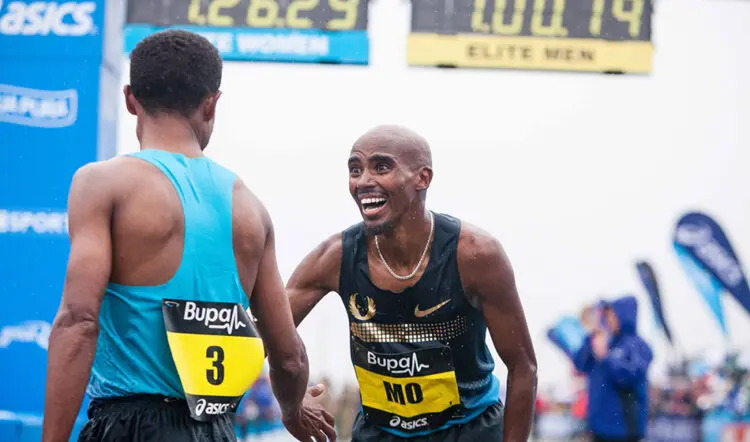
Farah was understandably disappointed to lose in front of a home crowd, but he placed the result in context. His priority that year had been the World Championships and his specific half-marathon preparation had only begun after Moscow. He also acknowledged the quality of the athlete who had beaten him.
The defeat would become the starting point of Farah’s own Great North Run story rather than its conclusion.
He returned in 2014 and secured the title he had narrowly missed, becoming the first British men’s winner since 1985. He went on to claim six consecutive victories between 2014 and 2019. When Athletics Weekly reported his fifth win in 2018, the race against Bekele and Gebrselassie was still the natural reference point for his Great North Run career.
The event also became the setting for his final serious competitive appearance in 2023, bringing his relationship with the race full circle.
Jeptoo defeats Defar
There was another exceptional race that day, too. Priscah Jeptoo defeated Meseret Defar and Tirunesh Dibaba in 65:45, finishing only five seconds outside Paula Radcliffe’s course record.
That women’s result underlined the remarkable depth of the occasion. The elite fields contained an extraordinary concentration of Olympic and world champions, while both races produced performances worthy of the billing.
For the men, though, the lasting image is of three giants heading towards South Shields together before one final, breathless test of speed and nerve.
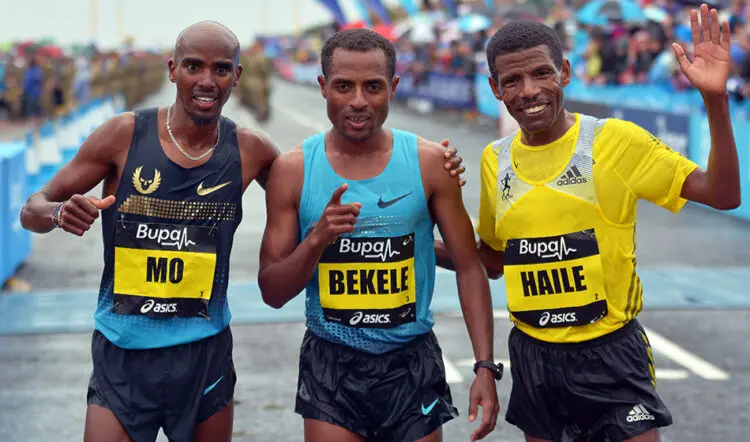
Gebrselassie had helped create the modern era of distance running. Bekele had taken it forward. Farah had become its new championship king.
On one wet and windy morning on Tyneside, their careers converged. For 13.1 miles, athletics supporters did not have to debate how the generations compared. The three men settled it on the road.
And, when the finish line arrived, only one second separated the winner from the man who would go on to dominate the race.