After Birmingham, Budapest: Why the Ultimate Championship Could Redefine How the Season Ends

The World Ultimate Championship will take place in Budapest in just over two months.
For years, September has meant the same thing for athletics fans: a gradual quietening. The Diamond League Final wraps up, the season dissolves, and the sport essentially goes dark until the following spring. Budapest is about to change that.
The inaugural World Athletics Ultimate Championship lands on 11-13 September 2026 at the National Athletics Centre, the same arena that delivered some of the sport's most electric moments at the 2023 World Championships.
The Road to the Ultimate tracker has been open all season. Fans have been watching it, refreshing it, debating it on forums and social threads every time a Diamond League result drops or a world ranking shifts. Who has locked in their spot. Who is on the bubble. Who needs a big September to get there.
Interest now extends beyond traditional athletics audiences. Sports betting operators are tracking qualification battles, with results, ranking changes, and championship qualification creating new betting opportunities. Interest has also grown among users of non-GamStop betting sites, many of which are known for offering broader international athletics coverage, extensive pre-event and live betting markets, and competitive odds.
As a result, the Road to the Ultimate has transformed what was once a relatively quiet period into months of meaningful competition, giving fans and bettors more reasons to stay engaged as athletes fight for a place in Budapest.
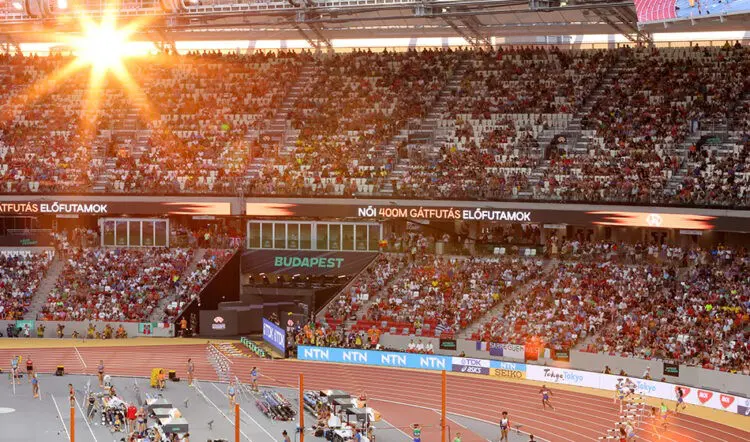
What the Sport Has Been Missing
The problem with even-numbered years has always been structural. The World Athletics Championships runs on an odd-year cycle, which means years like 2026 sit in the gap between major global titles. The Diamond League provided the competitive framework, but it could never fill the void. Fans knew it. Athletes knew it. The end of the season felt like a parking lot.
What the Ultimate Championship does is flip that logic. Rather than closing a season that has already peaked, it gives the season something to build toward. Every Diamond League appearance, every ranking point, every performance from September 2025 onward has fed directly into qualification. By the time September 11 arrives, the field in Budapest will be the most credentialed collection of athletes the sport can assemble outside an Olympic year.
World Athletics CEO Jon Ridgeon put it plainly: the previous end-of-season experiments had very little at stake, and fans could tell. This is different. Olympic champions and world champions competing against each other in finals-only sessions, for a record $10 million prize purse, with $150,000 going to each winner. That is not a Diamond League afterthought. That is a season finale.
How It Works
Each of the three evenings runs under three hours, packed almost entirely with finals. On the track, select events run through a brutal semi-final filter, eight athletes in, top four through. The 1500m, 5000m and relays go straight to finals. In the field, eight athletes get one shot to settle the argument.
The 28-event programme covers the sprint trebles for both men and women, the middle-distance events, hurdles, pole vault, high jump, long jump, javelin, women's triple jump, men's hammer, and mixed 4x100m and 4x400m relays. That last one is a genuine first, a mixed 4x100m relay that has never featured at any global championship before.
Events that did not make the cut, the steeplechase, 10,000m, shot put and discus, generated debate when the programme was announced. Critics were right to push back. The omissions narrow the scope and leave some of the sport's most important disciplines without a seat at the table. That conversation will run alongside every session in Budapest, and rightly so.

The Names That Matter
A total of 26 athletes are already confirmed as automatic qualifiers by virtue of their Olympic titles. The rest of the field is filling in through world ranking positions. The list reads like a who's who of the post-Paris athletics landscape: Noah Lyles in the sprints, Faith Kipyegon in the 1500m, Jakob Ingebrigtsen in the 5000m, Mondo Duplantis in the pole vault, Emmanuel Wanyonyi in the 800m.
For British fans, the name that matters most is Keely Hodgkinson. She arrives in Budapest already confirmed as Olympic champion in the 800m, but the storyline is considerably more complicated than that. The 2023 World Championships in that very same arena is where she finished second, a result that sharpened ambition rather than satisfied it. She has since won Olympic gold in Paris, set an indoor world record in February, and broken her own British outdoor record in Stockholm this June. She arrives in the form of her life. And she still might not win.
Audrey Werro beat her in Stockholm in June. Lilian Odira is the reigning world champion. Femke Bol, arguably the most versatile athlete in the world, is reportedly exploring the 800m this season.
Four athletes with genuine claims to the event, one of the most volatile two-lap races in a generation, in an arena where Hodgkinson has unfinished business. That is the 800m women's final in September. It is worth planning your Thursday evening around.
Why This One Feels Different
End-of-season events have come and gone. The World Athletics Final, the Continental Cup, various Diamond League showpieces, all failed to stick because the competitive stakes were never high enough to hold attention past the summer championships.
Budapest is built differently. The qualification pathway means every top athlete had reason to perform across the entire season to earn their place. The prize money means every race has real consequences. The format means there is no room to save yourself for another day.
The sport has long had the talent to fill a genuine season finale. What it lacked was the event. For the first time, September has somewhere to go.