Meet the coach: Stuart McMillan

The renowned sprints mentor talks about what it takes to be fast and why it’s so important to make an athlete believe.
Stuart McMillan is a Canadian coach who has worked with professional and amateur athletes in a variety of sports including football, American football, bobsleigh, speed skating and track and field. He is widely considered to be one of the most knowledgeable and sought after speed experts in the world.
McMillan, a physical education graduate with a passion for art and English literature, has coached over 70 Olympians – including over 40 medallists – at 10 Olympic Games. He has worked with national governing bodies in six countries, including in the UK where he was based at Lee Valley from 2010-2013 and worked with athletes including Dwain Chambers, Marlon Devonish and Christian Malcolm. Since 2013 he has been based in Phoenix, Arizona where he is CEO of ALTIS, an elite training environment for athletes and a global leader of education in sport performance.
How did you first get into coaching?
My dad was a really good footballer – he's Scottish, and I grew up in Scotland and England before we moved to Canada in 1981 – and he started coaching in England. When we moved to Canada he became a coaching coordinator of a big club and a few years later, when I was 14, I started coaching the under-11s team.
I was still playing football at the time myself and I played to a decent level. When I finished playing football, I was 22 or 23, I’d been coaching the entire time so I knew enough about how people got better at things. I had a few friends who were sprinters, and they said: “You're a really fast footballer, you should try sprinting.” So, I tried that, and I was rubbish. I found out that I was a pretty fast footballer, but not a fast sprinter.
But I also knew enough about coaching that I thought: “Maybe I'm not getting fast because the coaching isn't very good”, so in the second year of doing the sprints, I started coaching myself. I was able to talk a few of my friends into training with me. I didn't get any faster, but they did, so that was it for me. I ran sprints for about a year-and-a-half and said: “That's enough”. I liked the coaching part of it, so I just got more into that.
At the same time, they were starting a strength and conditioning group at the University of Calgary where I went to school. I was really interested in speed and power and strength, so I was like: “Let me get involved in that.” A few colleagues and I started the University of Calgary strength and conditioning group. We started providing strength and conditioning services to all of the different university sports teams and it just went from there.
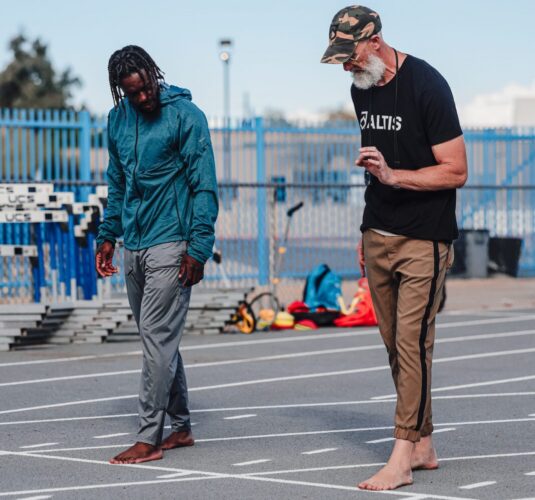
What is your coaching philosophy?
I don't think it's ever set in stone. I think it's always iterative. There are two things when I talk about philosophy: there's a coaching philosophy, and there's a training philosophy.
Your training philosophy is what guides the training process and, for me, that’s quality over quantity. You have to earn the right to do more. Whether “more” is more intensity or more load, you have to earn that; you have to make sure that you can do things well first and foremost, so that's primary.
I really value the quality of movement and I feel like we over-emphasise quantity at the expense of quality. We start playing sport because we fall in love with the quality of it, not quantity.
From a coaching perspective, I see coaching as being a partnership, not a dictatorship. It's important to me that I work with and help to guide athletes who are wanting to be a big part of the process. I'm not really that interested in telling athletes what to do.
I really like to be challenged and I think true challenge comes at the tip of the spear when you're working at the highest level you can possibly work. That’s a partnership.
I also look at health and performance as being the same thing, and they just exist on a continuum. I take a massive systems approach to it and specifically a complex systems approach where it's not just about the training. It's also about the recovery from the training. It's the fuelling for the training. It's the mental resilience that's required to do the training and the competition. And then also understanding how the ’off’ track components of your life impact the sport. So those five things make up a health and performance system, and we talk a lot to the athletes about why it’s much more important to have balance around all of these five component parts rather than to really try to optimise any single component part.
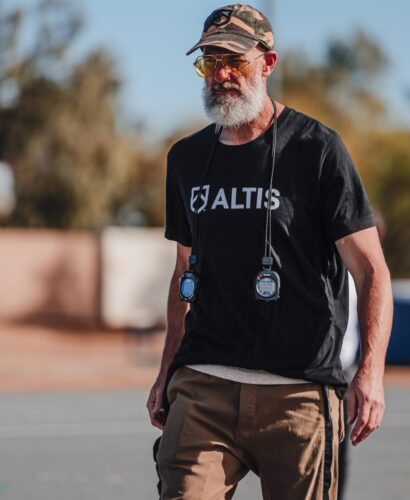
Who has been your greatest coaching influence?
My dad was my first mentor. I saw how he operated, not just as a father, but also as a coach. I’d copy what he was doing, what he was saying. My first and really primary coaching mentor as an adult has been Dan Pfaff. I met Dan for the first time in 1994/1995, and he's been my primary mentor since then.
I learned so much, especially through the 90s and the 2000s, through peer mentors. We had a very enriching educational environment in Calgary where it was the start of the professionalisation of strength and conditioning coaching in Canada. It was just an incredible place to learn. And then coaching in different sports with different ages and at different levels for going on over 30 years. For me that's where you learn the most.
What is/are the key component(s) of a good sprinter?
A high degree of co-ordination. That's what it boils down to, because if you look at the eight finalists in any World Championships or any Olympic Games, you've got eight very different people, often very different heights, very different weights, very different limb lengths. They produce forces in very different ways. They have extremely different step lengths and step frequencies, and different ground contact and flight times. You’ve got the eight fastest people on the planet running really, really fast in very different ways.
Now, what is the commonality between all of them? They're all incredibly coordinated. That’s the only thing. They apply different forces at different rates, in slightly different directions, in very different ways. Usain Bolt was very long on the ground relative to a guy like Christian Coleman or Su Bingtian.
So, it's very different and I like to think that it's a coordination game. Our job is not only to maximise the magnitude of the force, the rate of the force, the technique, the orientation of the force, but how you do all that together, that speaks to the quality of the movement and how coordinated that movement is from step to step to step to step. That’s a really difficult thing to manage, so if there’s one single thing, that’s primary for me.
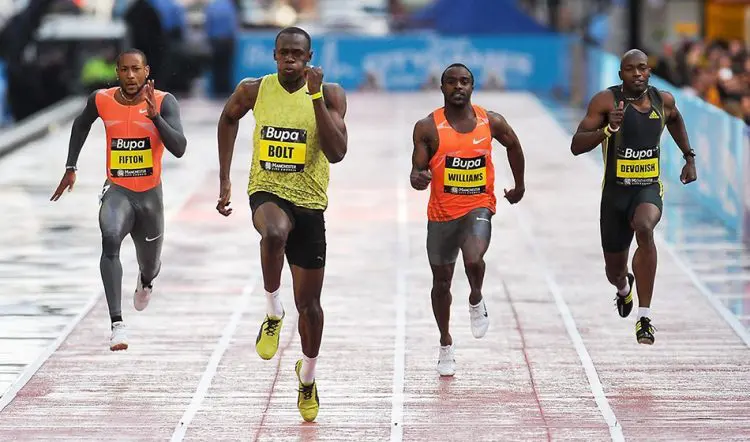
Why is it important for athletes across every running discipline to learn a good sprinting technique?
Every event now comes down to a sprint, doesn't it? I mean, sometimes even the marathon does. When's the last middle-distance event that you saw that didn't come down to a sprint?
The thing with that is the sprinting pattern is different from the typical pattern of most middle-distance runners. With most middle-distance runners, it's more propulsive, so they hit and they roll, and they push off, whereas in sprinting it’s much more active contact, there’s a much higher eccentric strength capacity.
It’s how well they bounce, how well they co-ordinate the timing of the impact between the foot and the ground, and that's incredibly difficult to train. It is the differentiator between the fastest sprinters in the world, and the ones that are just a little bit slower. It's also the differentiator between a Cole Hocker and a Josh Kerr, and those who are two or three seconds behind them who don't have the ability to co-ordinate that impact with the ground as well.
It is literally the hardest thing in training to get better at. We can all build better capacity, you can get stronger, you can get faster, you can put more volume in your training, you can build different capacity and so on. What's harder to get better at is the one which is the primary differentiator between the elites, and that's how well they coordinate the impact with the ground. It's everything.
What would you say are the key characteristics of a good coach?
Curiosity is primary. If you're curious, most of the rest of the important things come along with it. You've got to be curious about learning, about teaching, about understanding more about the athlete. Curious about understanding more about what goes into health and performance, other than just what you do on the track for two hours per day. Curiosity is everything for me.
Do you think the UK is doing as well as it could in terms of coach education?
It’s gone massively downhill since we all left. Part of that has been budgetary constraints, obviously, but the biggest part is, if coach education is important to you, you have to find ways in which you can invest in it and I don't think the investment anywhere near matches what the necessity of it is.
Athlete development and coach development have to happen in parallel. That was why there was such a big investment in coach development while we were all there. It was never just about the athlete.
I just don't think there's any sort of real joined-up thinking around what coach education actually is, and what you're trying to do. Like, what is the purpose?
And, by the way, that's not just in the UK, that's worldwide. I think they do a lot better in New Zealand and Australia – and I think there's a reason why New Zealand and Australia typically punch above their weight per capita in many of these sports – but in the UK, especially in athletics, I think it's really poor.
What is the most valuable lesson that you've learned over the years?
Stay curious, and instil maximum belief in the athlete, in what they are doing, in their system, in their coach, in themselves. You will never, ever see a champion athlete who doesn't believe in that. It's why Usain Bolt, for example, has eight Olympic gold medals. Even though his coach objectively doesn't know everything, he was able to instil this magical belief in Usain that was just above and beyond everything. It's a belief game, and I think if you start with that heuristic – that your job is to instil belief – that changes everything you do and how you do it.
Then you understand that communication is really important, that your relationship with the athlete is really important. All of those things then come to the forefront, rather than just thinking it's a biomechanics game, or a physiology game. Obviously that's part of it, those are component parts within the system, but all of it needs to lead to the athlete having 100 per cent belief in themselves when they stand on the line. That's it. That's the game.