How they train: Issy Boffey

We talk to the British indoor champion whose big breakthrough in January has opened up a whole new world of opportunity.
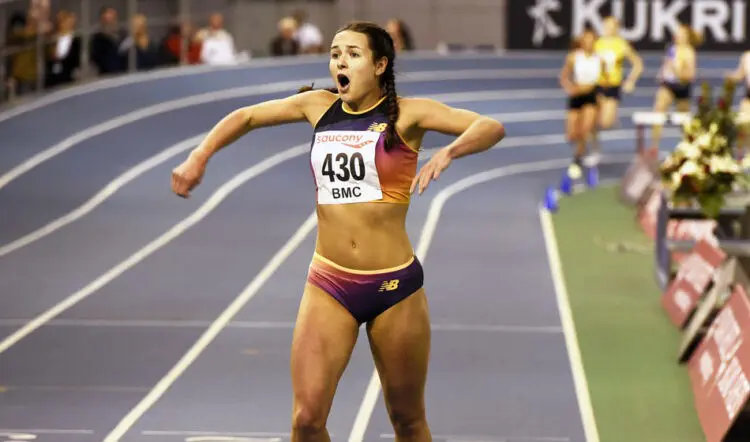
In amongst a myriad of highlights there are two images that stand out on Issy Boffey’s Instagram grid; the first is her reaction to breaking two minutes for 800m for the first time with a 1:59.30 clocking in Madrid in July 2023. The other is her delight, relief, even disbelief to running 1:57.43 in Boston in January 2026.
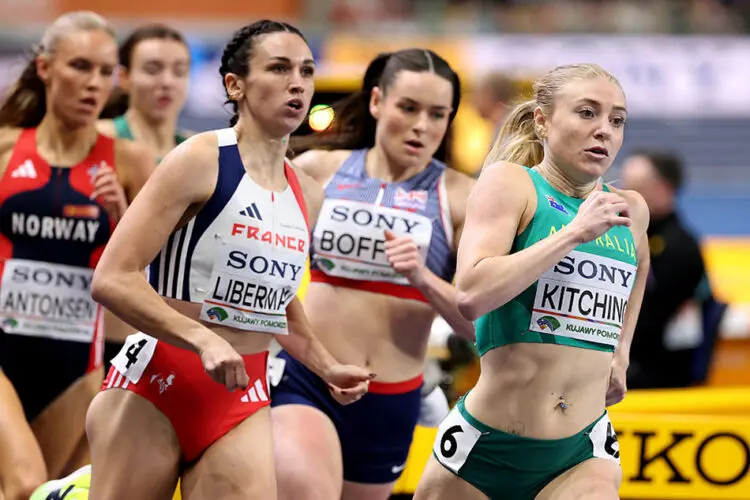
Both events were landmark occasions, each representing a significant breakthrough. That 1:59 opened up the opportunity to compete at the 2023 World Athletics Championships, Boffey’s first major senior international vest after completing a clean sweep of European age group titles from 2016-2021. But 1:57 has changed the game entirely. European Championships and Commonwealth Games qualifying times – targets for early summer – have already been achieved, while the World Athletics Indoor Championships, not initially on her agenda, was quickly pencilled in.
“We kind of made a joke, like: ‘Oh, maybe I'll just skip 1:58,” laughs Boffey, whose 1:59.30 remains her second-fastest time ever. “It’s so weird, because I think my aim for maybe the past two years, obviously bar injuries and stuff, has just been to be consistent with the 1:59s and then aiming to run a 1:58. All of a sudden every race is a 1:59 and I've jumped to a 1:57. It’s been a goal for so long, but it's only just come together.”
Progress is rarely linear and, for an athlete who enjoyed such incredible success as a junior, the challenges of progression and transition through to the senior ranks can appear more acute. While Boffey made it to the outdoor World Championships in Budapest three years ago, she suffered injury and illness throughout the summer of 2024 which put paid to any chance of going to the Olympics. Last year provided a wake-up call.
“I was really surprised at how long it took me to get back, and mentally, I was really, really struggling,” she admits. “Before the British Champs, I thought: ‘Do I quit?’. I just didn’t know what was going on. I felt like I’d been training so hard for so many years and it just wasn’t coming together. I didn't realise how much I was struggling until it sort of all hit me in the middle of the season. It was just an absolute mess. It wasn’t until the August that I started to see the results I knew I was capable of (Boffey ran back-to-back 1:59s to finish her season).
“There have been some lows for sure, but it makes the highs better. Running 1:57 [in January 2026] was three years in the making and it has definitely required some resilience and perseverance. Obviously it's so hard to see the highs coming when you're just feeling so run down and tired of it all, but I've been working on my mental attitude which I think has been a really big game-changer for me.”
Coach Luke Gunn had encouraged Boffey to see a sports psychologist for some time. “It’s taken me a while to find the right person,” she says. “Now that I have, it makes such a difference, just having that very open, judgment-free space to speak about how you're feeling and how running is going, but also how life is going generally. It’s definitely made me feel freer which has essentially just allowed me to be more relaxed and more stress-free. I think that’s now helping me to run better, which is amazing.”
While acknowledging the current depth of talent in the women’s 800m, Boffey has her sights set on the Commonwealth Games in Glasgow and the European Championships in Birmingham this summer. “I don't think I could be living here in Birmingham and not be at that Champs, I think it would break my heart a little bit, especially having already missed the Commonwealths in 2022,” she says.
As a 1:57 runner, the opportunities now afforded to her – for example competing on the Diamond League circuit where she’ll race against, and learn from, the best athletes in the world – are the ones that will best prepare her to succeed.
A typical training week (winter training week in Birmingham ahead of 2026 indoor season)
Boffey is based at the University of Birmingham, where she benefits from a Graduate Sport Scholarship. In addition to a refreshed mental attitude, an increase in mileage has also made a practical difference.
“It's been a very gradual progression over the years,” she says, explaining that her maximum weekly mileage is 50 miles, but she consistently aims for 40-45 miles per week. “A lot of it is just doing three miles in the morning and then a bigger session in the evening. I'm not doing anything fancy, but it works for me.”
As she progresses through winter, her focus moves from tempo to speed work (for example a winter VO2 session becomes an 800m pace session in the summer). “I’m someone with natural speed but not so much natural aerobic capacity,” she says. “Every athlete is different and, while my speed can increase really quickly, my aerobic capacity has to be built up over time and it's taken us a while to figure that out.”
Monday: (am) 20-minute run followed by gym/strength and conditioning session; (pm) track tempo e.g., 30 x 200m off 30 seconds or variation e.g., 3 x (10 x 200m), or speed session option e.g. 4 x 250m (off long recovery)
Tuesday: (am) 40-minute run; (pm) 30-minute cross train followed by sauna
Wednesday: (am) 25-minute run; (pm) VO2 max session e.g., 4 x 1000m or 6 x 600m (off 2-3 minutes) or 15 x 300m off a 100m jog (plus two miles warm up/two miles cool down)
Thursday: (am) gym including strength and conditioning session; (pm) 30-40-minute easy run
Friday: (am) tempo session 20-25min of 1min tempo/1min float or a steady run, e.g., 30 minutes steady plus warm up/cool down
Saturday: (am) hill or grass session, e.g., 5 x 45sec, 5 x 30sec, 5 x 20sec hills (off slow jog back recovery) or 6 x 3min off 90sec rest (using Metchley Fields); (pm) 20-minute run or 30-minute cross train
Sunday: rest day

Favourite session: speed session – 300m, 250m, 200m (off 12 min)
Least favourite session: long run