What will athletics look like in the 22nd century?

As AW’s 80th birthday year draws to a close, we go 'back to the future' and ask what the sport might look like in another 80 years’ time.
The year is 2105 and the scene is the 60th World Athletics Championships in a packed Seb Coe Memorial Stadium in the megalopolis of London. Due to air pollution and intense heat, the entire championships are being held in an air-conditioned indoor arena. As athletes in the opening event of the women’s decathlon settle into their blocks, a golden statue of Usain Bolt, who died eight years earlier aged 110, towers over the competitors.
Is this what athletics will look like in 80 years’ time? Probably not. In fact, maybe that is all beyond our imagination. Yet this doesn’t stop us speculating and posing some genuine questions.
Will world records continue to fall, for example, or will they reach their ceiling at some point? If so, which marks have scope for improvement and which are closer to plateauing? When will Bolt’s sprints records fall and what might they be eight decades from now? Will a sub-two-hour marathon be commonplace in 2105 – not just for men but women as well? Will our grandchildren and great grandchildren look back at the sub-four-minute mile for women with a smile as dozens of female runners in 2105 comfortably beat the barrier?
How much might climate change affect athletics, especially marathon running? Will drug cheats continue to give anti-doping police the runaround? Will injuries one day become a thing of the past due to advances in medical knowledge and treatment? Will we see any current track and field events die off… and new ones emerge?
Just look at the enormous changes that have taken place since AW was first published back in December of 1945. The sport has seen cinder and dirt tracks replaced by synthetic surfaces. Manual timing devices have been overtaken by hi-tech electronic methods.
Footwear and athletics equipment have advanced massively. Recreational running and women’s athletics have boomed. When it comes to simply following the sport, listening to the action on a crackly radio has been replaced by online streaming and instantaneous clips on social media, with the athletes themselves often breaking news on their own social channels.
World records have tumbled. In the marathon alone the men’s world record in 1945 was 2:26:42 and the idea of women even completing a marathon in a reasonable time was considered absurd.
Yet some things have not changed much at all. Apart from some notable innovations such as the Fosbury flop in the high jump, many “techniques” have remained the same over the decades. A handful of world records set in the 1980s have proved unbeatable thus far, too.
Despite organisers imaginatively toying with new events and competition formats, the basic disciplines of running, jumping and throwing that we saw in the days of Ancient Greece, let alone in 1945, are still popular today.
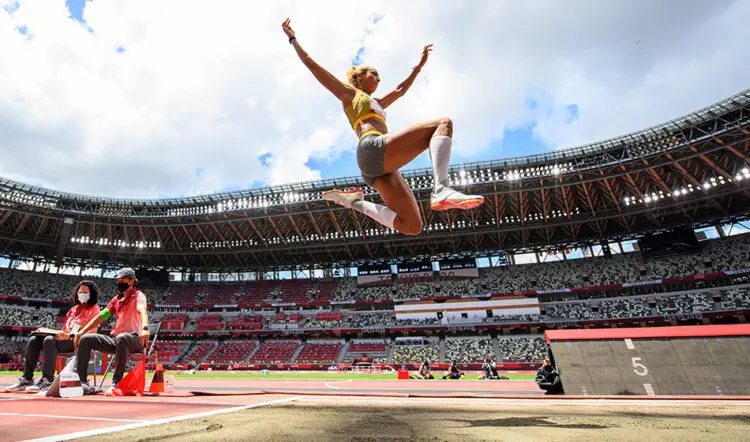
How much will world records improve?
Stan Greenberg attended the 1948 London Olympics as a teenager and went on to become long-time athletics statistician at the BBC and a founder member of the National Union of Track Statisticians. The 94-year-old has witnessed many of the changes in the sport over the past 80 years at close hand. He admits it’s difficult to make predictions over what might happen in future, but can see where advances could come.
“No doubt even more changes to shoes will happen and improve performances in most events,” he says, “although I think the sprints can't improve too much more – surely not a sub-nine 100m.
“I assume that other distances will get faster, as presumably better fed athletes, let alone ‘medically improved’ ones will be able to hold their basic speed for longer, so that distances like 400m-1500m will definitely get considerably better.
“Distances will still be governed most of the time by tactics which will generally keep improvements down, though I expect the marathons to get considerably faster as bodies improve. Field events will be generally more difficult, but I expect to have much taller high jumpers in the future.
“Techniques will change in the throws somehow to get more speed and surely the basically simple long jump will produce far faster athletes who will send the distances well over nine metres, whereas the triple jump needs somewhat more technique and control.
“Again, bigger and fitter athletes will send the shot and javelin further, while the discus and hammer will need different or better techniques. Bigger, stronger competitors will obviously improve the decathlon and heptathlon. I believe the mixed relays will get much faster, though I feel the men's 4x100m can't get too much better.”
Geoff Wightman, stadium commentator, father to world 1500m medallist Jake and a 2:13 marathon man himself in the 1990s, makes the bold predictions that we could see 100m records of 9.41 and 9.85 for men and women respectively in 2105, together with 800m records of 1:38.88 and 1:46.90, plus marathon records of 1:58:58 and 2:08:48.

Technology, doping and hypnosis
“Running shoe technology will have evolved to become a midsole and outer plate that can be bonded directly on to the sole of the athlete’s foot without inhibiting foot motion or toe-off,” Wightman predicts before adding another element that could play a vital role.
“Hypnosis is the cutting edge technology in training,” he says. “In conjunction with AI, it will allow better training, rest and recovery, sleep and injury prevention and treatment. In the warm-up area at major championships, athletes will use MP3 devices for last-minute hypnosis boosters to get in the right frame of mind for competition.”
Alfons Juck, athletics manager, commentator, journalist and statistician, believes performances will improve. “World records will be at a level we cannot foresee now,” he says, “and much better than we expect due to quality of life, health status and technology improvements.”
And could it be that doping might not be such a big factor in the future? Wightman explains: “Drug testing worries will have dissipated as all children will have a detailed sample of their blood and DNA taken and stored at birth and this can be used to avoid any suggestion of gene manipulation or artificial boosting outside their known parameters at any point in their lives.”
Matt Lawton, chief sports correspondent at The Times and a talented teenage runner, agrees that marathon world records could advance more slowly due to drug testers eventually winning the battle against cheats.
“The men's marathon world record has improved by 25 minutes in the last 80 years,” says Lawton, “but I don't anticipate that level of progression over the next eight decades. For a start, I suspect the advances in science – combined with more appropriate levels of investment – will pretty much eradicate doping. Experts have told me that gene testing would essentially end the war against drug cheats, and I'd like to think that day will eventually arrive.”

Stuart Mazdon from the National Union of Track Statisticians agrees, saying: “Doping will no longer be a major problem, as most people will have health-monitoring implants which scan the blood for diseases and chemicals continuously.”
Greenberg is not so optimistic, though, saying: “I fear that drugs use will become much more extensive, especially if prizes become bigger. It’s bad enough as it is now.”
And, drugs aside, there might still be ways for athletes to cheat. “For older or perennially-injured runners, training might be eased by use of a skeletor suit that takes the weight partially off ankles, knees and hips,” suggests Wightman. “But debates will rage about whether this should be a permitted category within races.”
Mazdon says we could have a problem with “genetically-engineered athletes” in 2105 and suggests: “This could start with a rogue state splicing a combination of advantageous genes on to an embryo’s DNA before birth.”
Will athletics prevail in the popularity contest?
What about the “appeal” of athletics? Will it remain the No.1 Olympic sport in 2105? Will the Olympic Games even still exist by then? Certainly, the future of the Commonwealth Games is in doubt. We could even see cross-country running in the Winter Olympics (although don’t hold your breath!).
“The sport will continue to evolve in its effort to make it more appealing to fans,” says Lawton. “This is a very personal view but I hope that means an end to race-walking; a discipline I've never understood when the pure essence of running, and racing, involves getting to the finish line as fast as you can!”
Mazdon agrees, predicting that despite shoe technology improving to require unbroken contact with the ground, “race-walking will barely exist any more in 2105”.
He adds: “World Athletics will farm it out to an independent federation, effectively abandoning it, and with no interest from sponsors, there will be a terminal decline.”
On the Diamond League, Wightman suggests: “It will have morphed into a ten-times-a-year, two-division competition around the world where elite athletes contest eight track and four field events but compete in team franchises that align with the main winter team sports around the world. In winter, the New York Giants fans support their NFL team. In summer, they support their track and field team against Barcelona, Chelsea, Ajax, AC Milan, the Toronto Maple Leafs and LA Dodgers.
“Agents will no longer have to worry about appearance money deals. Their job will be to try and get their clients signed by one of the franchises who also have a reserve team.”

On the Olympic Games, Mazdon says: “By 2105 there will have been problems with demand for tickets to attend the athletics, due to increased population, numbers of super-rich and fear of missing out. At first this will lead to ballots with ever-decreasing chances of success. This will be followed by ever-increasing prices and lavish hospitality. However, crowds will then be seen to be uninterested in the sport and only interested in being seen there on social media.
“There will be large gaps in the stands during many disciplines at the Olympics as the super-rich partake in the hospitality. Attendance at World Championships will also decline until World Athletics (if it still goes by this name) eventually follows other sports in requiring fans to attend other meetings in order to qualify for Olympic tickets. To qualify, fans will have to accrue points by attending a world or area championships (or other events with the required identification technology) since the last Games.”
In addition, Mazdon can see the Olympic venues being set long in advance and rotated around the world to avoid the kind of corruption associated with bidding wars. Along with most experts we asked, he also sees the sport being affected by climate change, with track and field becoming “largely an autumn and spring sport with two indoor seasons”.
On the future of the Paralympics, Mazdon believes it will decline due to advances in medical science eliminating many of the physical issues. Instead, he sees masters athletics growing.
“Decades of data will allow us to assign a fair handicap to all ages down to single-year age categories,” he explains, "so the World Masters Association will be able to operate their championships with only one competition at each discipline, which increases the popularity of the sport. With few tickets available to the masses for the Olympics, WMA will create what will be dubbed the ‘Oldlympics’ event to be held every four years after the Olympic Games at the same venue. This will prove to be popular among fans, particularly those who have missed-out on Olympic tickets.”

New events and old ones reborn?
What kind of track and field events will we see in 2105? There have already been experiments in recent years relating to a boardless long jump or triple jump, with athletes using take-off zones instead. Similarly, we could see more mixed relays in future with organisers tinkering with the changeover zones.
Might we see long forgotten techniques such as the ‘spinning javelin’ make a return? The standing long jump is another former Olympic event that could come back.
Is there potential for handicap races – a type of racing with a long history in the sport – where humans would potentially be handicapped like horses by wearing weighted vests as females and younger (or older) athletes take on the fastest men?
It seems only a matter of time before the height of the barriers in the women’s 400m hurdles is increased. Could we see ‘throwing for height’ instead of distance, or ‘long vaulting’?
Will women one day overtake men in some events, especially endurance running? Will we see more manufactured time trial events such as the INEOS 1:59 Challenge or Nike’s “Breaking 4”, with organisers pushing the limits to help athletes run faster?
Imagine an entire marathon on a flat and straight stretch of synthetic track, for example, with a mild tailwind and energy drinks ingested at the perfect moment thanks to smart wearables and a pacing truck to act as a windbreak right through to the finish.
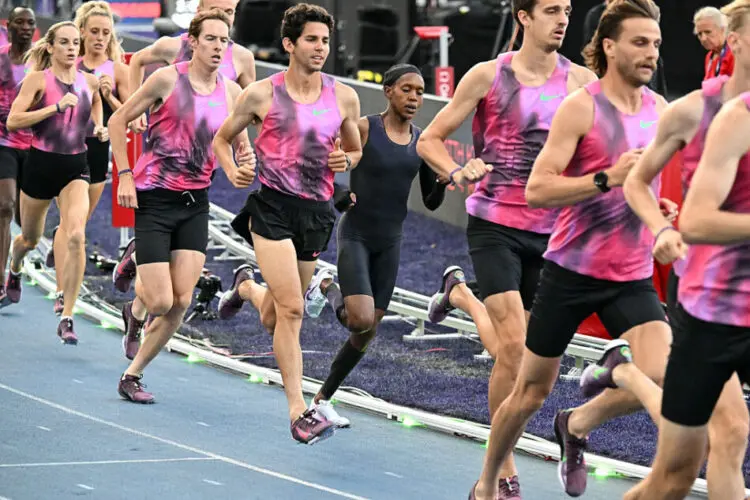
On the presentation of the sport, Juck reckons results will flash up immediately. “Hopefully this will come earlier than 80 years from now,” he adds.
Advances in technology, he believes, will help fans pick which competition, or athlete, they want to watch, whereas there could be wind measurements for every lane on the track and at continuous points in a race. What’s more, high jump and pole vault are likely to feature a ‘virtual bar’ (perhaps using a laser beam) and real-time results. Athletics stadia, he adds, are also likely to have retractable roofs due to climate change.
The next 80 years will almost certainly bring changes that are beyond our imagination right now. Who could have predicted in 1945, for example, that results from an event taking place on the other side of the world would now be visible instantly?
But it’s fun to speculate and Wightman in particular enjoys making predictions. In the world of road running, he suggests: “There will be no need for a race number because everyone will have their personal details on their wrist band or an implant in their upper arm and when viewed by spectators using virtual reality goggles this projects their name and details above them.”
READ MORE: AW celebrates 80th birthday
He adds: “All major marathons will be capped at 100,000 in-person participants but a further 100,000 can take part part virtually and in-real-time by using treadmills that re-create the race contours and conditions and enable the runner to have their personal avatar projected into the race alongside the in-person runners.”
Most importantly of all, will AW still be around to report on the sport in 2105? “Yes,” says Wightman. “AW will still be read in digital form but most people will prefer to absorb the detail subliminally overnight via their wrist and headset device!”
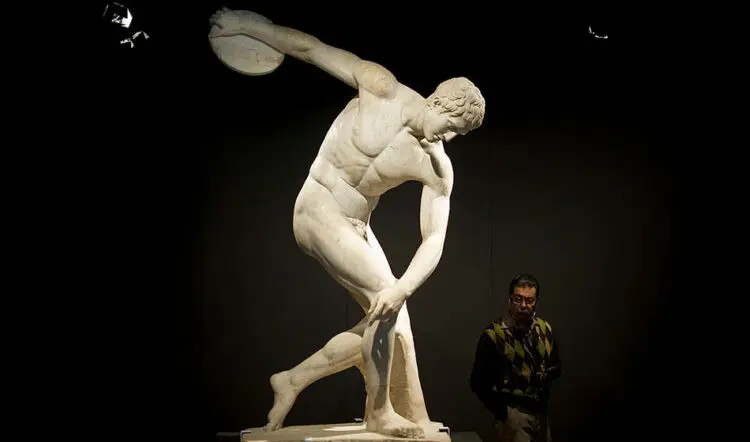
“Athletics has a habit of surprising us”
Jon Mulkeen of World Athletics has a stab at predicting the future...
Projecting the future of athletics is a little like trying to predict the path of a discus in a swirling wind – you can make an educated guess, but the sport has a habit of surprising us. Still, certain trends are already hinting at where the next eight decades may take us.
The first is climate. As global temperatures continue to rise, major championships – especially those fixed to summer months – will face mounting challenges. It’s not unthinkable that marathons and race walks could eventually be removed from track and field championships altogether, shifting to standalone events in cooler conditions. At the same time, there’s growing momentum behind adding cross country to the Winter Olympics. Give it a few decades and we might even see a hybrid discipline emerge, blending cross country with the ever-expanding world of trail running, breathing new life into the off-track landscape.
Technology, of course, won’t just tap politely on the door – it’ll stride right in. Advances will benefit every discipline, from sprint blocks that provide real-time micro-feedback to throwers using AI-driven biomechanics, to jumpers training in immersive, wind-controlled environments. In 80 years, ‘high-tech’ might simply be ‘standard’.
Sadly, I think it’s unlikely that doping will vanish entirely. In every corner of society, a small minority will always look for shortcuts, and sport is no exception. But as testing technology accelerates – with ultra-sensitive detection methods and data-driven profiling – the net will tighten. Retroactive bans and medal reallocations should continue to correct the record, ensuring rightful medallists ultimately receive the honours they earned.
The sport’s presentation will also continue to evolve. Future audiences, raised on fast-paced media, may favour competitions with sharper, more dynamic, formats. The combined events may also reach parity: perhaps the decathlon trims, the heptathlon expands, or they meet in the middle with an octathlon.
Whatever shape athletics takes, I hope it never loses the spark that first drew humanity to run, jump, and throw – a spark that urges each new generation to see just how far the body, and the spirit that drives it, can go.