The edge of human endeavour

The women’s 400m final in Tokyo produced extraordinary performances that showed the event has moved on to a different level. Former Olympic champion Christine Ohuruogu discusses the new age of one-lap running.
Christine Ohuruogu sums it up nicely. “I don’t think there are enough words or superlatives to explain what we saw,” says the former Olympic and world champion as she contemplates a women’s 400m final in Tokyo that sent tremors through the sport.
But for the rain that fell on Japan’s national stadium on that fateful evening last month, one of athletics’ longest-standing – and most controversial – world records would surely have fallen. The mark of 47.60 set by East Germany’s Marita Koch back in 1985, which is viewed with more than some suspicion given the nation’s history of doping, had long seemed almost permanently out of reach.
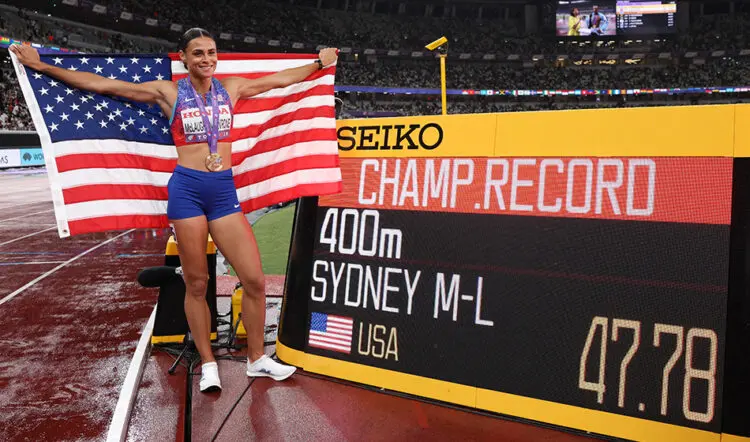
But that perception was changed completely by the events of September 18. The headlines, understandably, all went towards Sydney McLaughlin-Levrone after a championship record-breaking run of 47.78 that well and truly vindicated her decision to switch from her customary 400m hurdles to the flat 400m. But the fact that she was pushed all the way by the defending world, and reigning Olympic, champion Marileidy Paulino further highlighted that something very special indeed is happening in the one-lap event.
Previously, only Koch – who has always denied any allegations of cheating – and the now former championship record-holder Jarmila Kratochvilova (47.91) had managed to run under 48 seconds. The significance of that barrier being breached twice in the same race (Paulino ran a Dominican Republic record of 47.98) certainly wasn’t lost on Ohuruogu, world 400m gold medallist in 2007 and 2013, and the 2008 Olympic champion, who was there to see it.
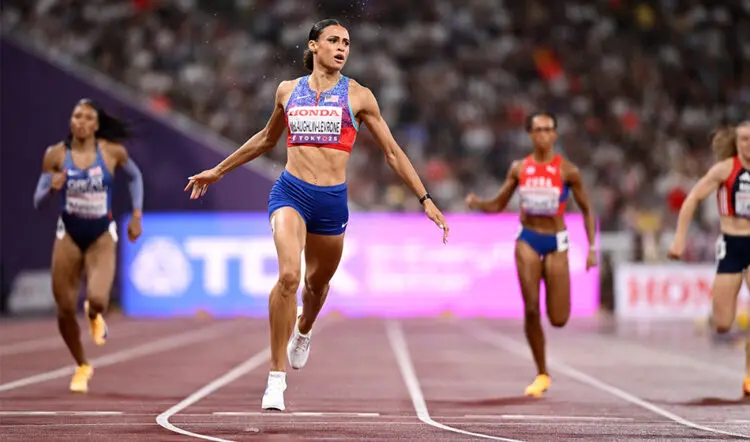
“The world record was set in 1985, a year after I was born and I never thought I would see a 47,” she says. “I thought we would possibly see 48 low, but before the athletes were coming out [in Tokyo], the commentator said: ‘Sydney might break the world record’, and I thought: ‘Come on, don’t be silly,’ but look at what happened. Sydney did it in style but Marileidy Paulino ran 47 as well so now we have two women [at that standard]. Wow.
“Sydney has dominated over the 400m hurdles. She can run a 200m, she can also run 100m and she can run the sprint hurdles. There's nothing she can't do so I think we are really seeing something that's once in a lifetime – almost like Usain.”
It’s one thing to see the final time on the clock and acknowledge that the numbers have come down. But how best can we understand why what happened was so special?
“The easiest way to break it down is to look at the splits,” says Ohuruogu. So let’s do just that. McLaughlin-Levrone covered the first 100m in 11.71, the second in 11.24, the third in 11.92 and produced 12.91 for the closing 100m despite the pain that would have been flooding her body.
“You have somebody who's running very, very quickly over the first 200m and is able to maintain the second 200m at a similar pace or with only a small difference,” says Ohuruogu. “The splits are out of this world. It’s impeccable running and very difficult to do. You're operating right at the edge of human endeavour to be able to do that and she did it in style.”
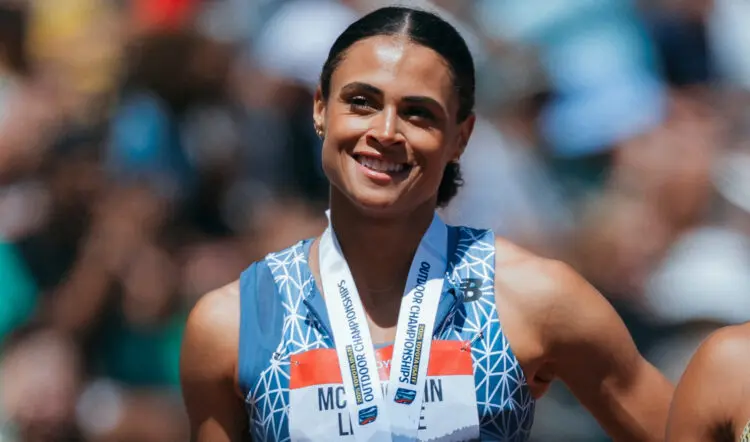
McLaughlin-Levrone had hinted that something special might be in the offing in Japan when, at the semi-final stage, she destroyed the US record with a run of 48.29. “It was like a jog,” chuckles Ohuruogu. “It's difficult to explain to somebody who wouldn't know the 400m as intimately as we do [just how good the performances were], but I suppose the easiest way is just to say: ‘Go and run a 400m, just have a try and from there we can try and break it down for you’. But it was brilliant and I was really happy to witness that in the stadium.”
She adds: “I can't even imagine what the pain of running 47 would feel like and I think, for Marileidy who was chasing and fighting, that burn probably feels even worse, because you're not really in control. You're really just trying to hang on for dear life and hang on for a medal.
“The 400m is not an easy race to run anyway. Whether you run 56 seconds, 52 seconds or 47 you're really pushing the body towards its maximum and the pain comes with that. What makes it even more special is to have two women [running 47] and even the third runner [Salwa Eid Naser], running 48.19 we can't turn our noses up on that but that's what it seems like we're doing. We are asking people to really look into that edge of human endeavour, which is very, very hard to put into any kind of context unless you've been in it.
“I liken it to Roger Bannister breaking the four-minute mile. Nobody thought it could be done but, when he did it, people started breaking that barrier. I think it might be the same thing now that people know it's actually achievable, it can be done. You can run 47 seconds. Who knows, maybe they might even go into 46 zone now!”
Ohuruogu is mentor to British athlete Amber Anning, who finished fifth in the final with a season’s best of 49.36. It might have been easy for the world indoor champion’s immediate reaction to be one of disillusionment, however it was quite the opposite.
“It is just amazing where the 400m has come in the last couple of years,” said the 24-year-old. “Five years ago my time would have been [enough to get] on the podium. It has just progressed every single year. I love it. It makes me want to step up my game. To see it [47 seconds] done just gives hope to us all. Anything is possible with the 400m.”
It is a response that impresses Ohuruogu.
“Amber's had a fantastic season,” she says. “We shouldn't lose sight of the fact that she is world indoor champion. She started the season with a bang and she carried on.
“I think she has a lot to be happy for in terms of taking her to next season – the fact that she's come off an Olympic year, which athletes often find quite difficult to do, and she's put together two good years back to back. She's made two finals and it can only be upwards for her.
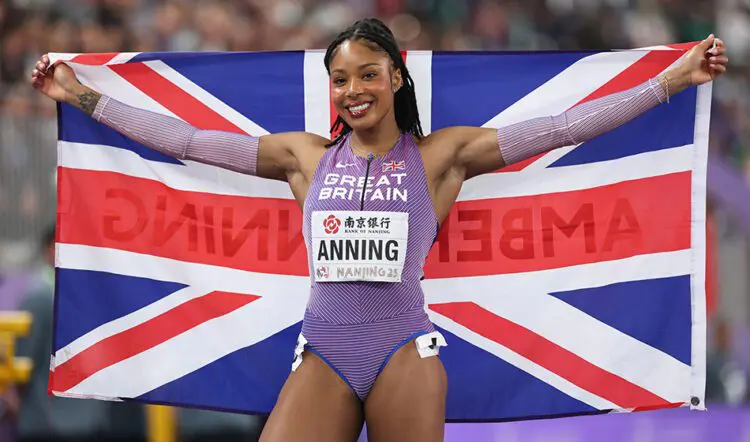
“Imagine that kind of learning and she’s watching these girls run 47 seconds. I don't think Amber's at her peak yet, so we have a lot to see from her, and I'm happy that she's looking at it positively. I don't think there's anything for her to be upset about.”
She adds: “I guess there's a gap [to the top two] but I think the worst position you start from is to start looking at it as a gap. What they do shouldn't have any bearing on how you consider your job and how you work on your craft. That's the position I would start from.
You have to just focus on yourself. You cannot determine what other people are going to do. What they did was phenomenal – it doesn't stop you from wanting to be phenomenal, too.”
Anning is one of a number of British athletes to have benefited from the National Lottery, which has invested over £6 billion into grassroots clubs and organisations over the last 30 years. More than £200 million of funding has boosted grassroots athletics, while more than 1000 elite athletes across a range of sports receive funding from the World Class Programme.
With this world championships providing a perfect showcase and inspiration for the athletes of the future, Ohuruogu sees any investment as vital.
“It's so important that we invest in elite sports but also grassroots, because we want this pipeline of athletes to come through,” she says. “There's no better feeling than to wear your country's colours and be out there competing, so we have to be grateful for what the National Lottery has done.”
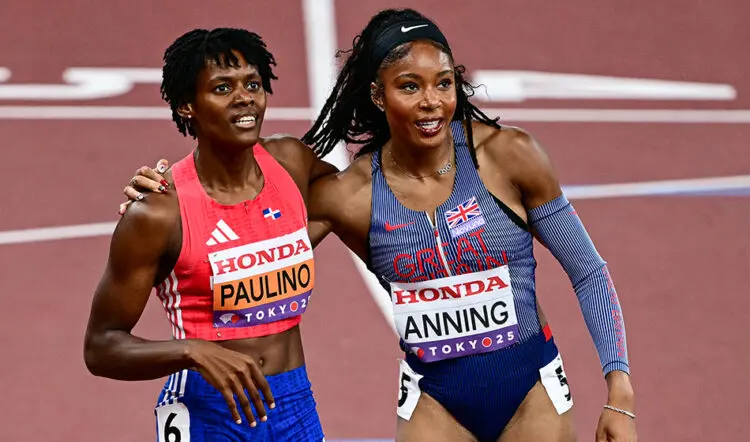
Paulino: “The world record? I’m nearly there’
Marileidy Paulino believes the world championships 400m final shows that the world record will soon be within reach. Rather than any disappointment over being dethroned as world champion, the Olympic gold medallist says that the adjustment of some small details will make for even greater performances.
“I’m super proud of what I’ve done in the last five years and I’m certain that I can continue to lower my time,” she told AW. “There are small details I need to work on in order to get to my objective.”
Of the Tokyo performance, she added: “I wasn’t actually that tired. I worked hard but I felt good about it. I don’t see it as a rivalry [with Sydney McLaughlin-Levrone]. I compete against the clock and that’s what I want to continue with. Whichever athlete is there doesn’t affect me.
“The 400m is not a race where you let it take the challenge to you, you have to go towards the challenge itself – you have to attack it on your terms. That’s what some people maybe don’t understand, especially with this long-standing world record, they think it’s so impossible to achieve, but now with how humanity has improved and with what I’ve shown with my potential strengths, I’m nearly there. I feel new, I feel great and I’m ready to go towards my goals.”