Sub-two: How low can we go?

Matt Majendie speaks to physiologist Andy Jones about what might happen next with the men’s marathon world record.
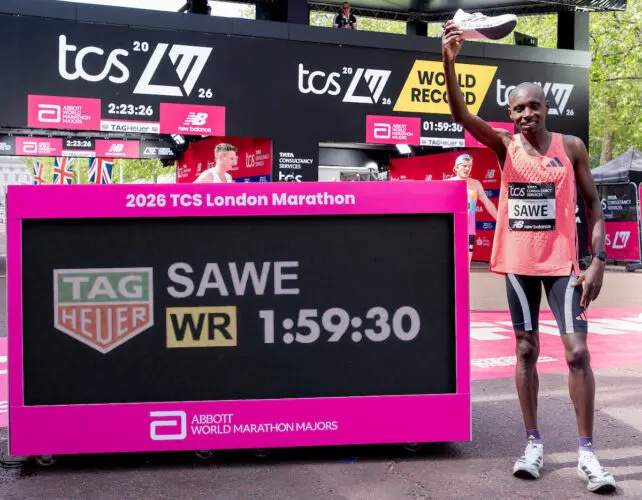
Sabastian Sawę had only just become the first person to run under two hours in a competitive marathon when attention quickly turned to the prospect of lowering the record further still.
Unsurprisingly, his jubilant coach Claudio Berardelli declared the best was yet to come to journalists gathered just off The Mall. Of the possibility of a sub-1:59, the Italian said: “I would say, yes, it is possible. Sabastian hasn’t reached his maximum potential.”
Just 17 days after breaking a record that for a long time had seemed unattainable, he announced his inclusion in the Berlin Marathon on September 27. A quicker course than London and where he was denied a realistic shot at the record last year because of the unseasonably hot weather, conjecture immediately began about how low he might go on a flat and notoriously rapid route known for its typically cool and benign conditions.
Nine world records have been broken there since 1998 and Sawe has every intention of taking that to double figures in a few months’ time, although he held back from saying so directly after his entry into the event was confirmed by organisers.
“Many people may be wondering what my goals are this time round,” he said. “After coming off my win in London and sub-two performance, I can only say that, like always, I plan to prepare myself to the best of my ability and to come to Berlin to honour this great event and organisation which have invited me, and to run as well and fast as possible. Then on the day we will see what will happen. I look at again experiencing the fantastic atmosphere and crowds that line the course.”
The sub-two marathon has long been the ultimate holy grail of distance running much like the four-minute mile once had been back in the Forties and Fifties. When Roger Bannister pulled off the feat ‒ previously deemed nigh-on impossible ‒ in May 1954, the mark didn’t last long. It was eclipsed less than seven weeks later by Bannister’s rival John Landy.
Andy Jones, a professor of applied physiology at the University of Exeter, is no stranger to witnessing record breaking first hand, having worked with the likes of Eliud Kipchoge on his sub-two quest and, before that, the long-time holder of the women’s world record in Paula Radcliffe.
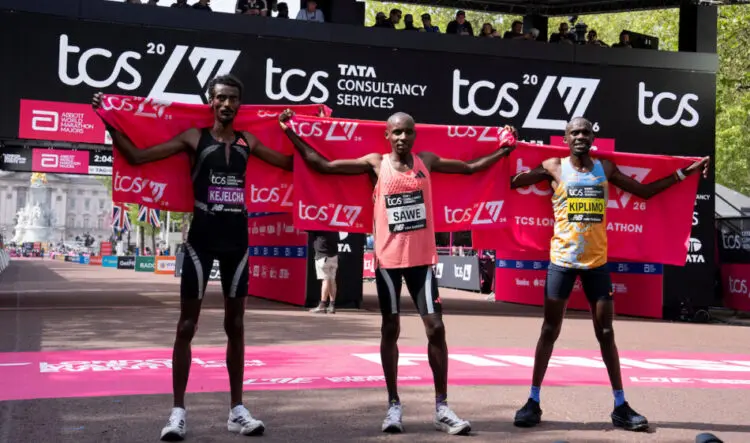
Drawing parallels between the current situation with the marathon and decades earlier the four-minute mile, he said: “With Roger Bannister and a seemingly impossible record weeks before, it was broken again just afterwards. I’m not saying we’ll see a 1:59 at every major city marathon but we’ll see a sub-two probably very soon, either by Sawe or Yomif Kejelcha [runner-up in London and will next race in Valencia in December where the course, like Berlin, is also notoriously quick].”
In Berlin, there will be no Kejelcha breathing down Sawe’s neck to push him on to quicker times yet but Jones argues it is not impossible to see a marathon in the 1:58s before the 2026 season reaches its conclusion.
With an imminently movable target, it begs the question how low can man potentially run 26.2 miles? “I can get 1:57:13,” says Jones, “and it’s hard to see beyond that. With regards to physiology, there’s four components. There’s the traditional three and a new one… resilience.
“You need a certain VO2 max, running economy, lactate or metabolic threshold, and the extent to which you can resist fatigue. Those first three won’t be the same at mile 25 and some athletes are more fatigue resilient than others. If I factor that all in, it comes to 1:57.13.
“Sawe’s run in London was reminiscent of Kipchoge with his 1:59.40. Both he and Sawe looked fresh as a daisy at the finish, they looked like they found it quite easy and it makes you wonder how fast Kipchoge could have gone and Sawe now can go.”
Jones understands better than most the work required behind such record-breaking feats and the almost monastic existence of athletes like Sawe, Kipchoge and Kejelcha, all men who have dipped under two hours in one form or another. In their respective East African nations, they both have sparse training camps where mileage, above all else, is the key. In the six-week lead-up to London, Sawe was averaging 125 miles a week with days where it peaked as high as 150 miles. It is perpetually the refrain of eat, sleep, repeat.
While Jones is in awe of Sawe and was among those glued to their television screens from the comfort of his home that Sunday morning, he also believes credit is due to Kipchoge too as the forerunner to this next generation of superhuman talents.
“While Kipchoge’s record was manufactured, it demonstrated what was possible with the perfect conditions, which essentially Sawe had in London,” he adds. “What Kipchoge did back then blazed a trail and I personally think we would have seen what Sawe did as soon as he did that without Kipchoge.”
Between now and their respective marathons in September and December in Berlin and Valencia, Sawe and Kejelcha will be spurred on by the mental image of their rival and the ticking clock on the streets of whichever global cities they do battle.
For now, the benchmark stands at 1:59:30 but, one suspects, not for much longer.
This article also appears in the Sub-two special edition of AW magazine, out now