AW celebrates its 80th birthday

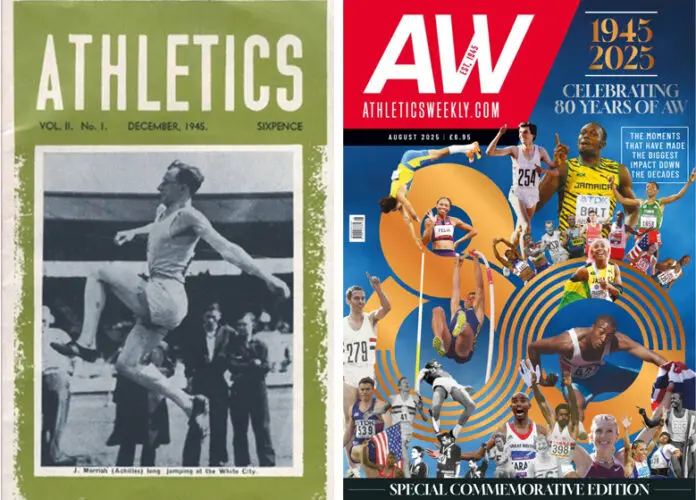
The world's No.1 athletics magazine was first published in December 1945 and is still going strong.
From the days of Fanny Blankers-Koen, Emil Zatopek and Roger Bannister to the era of Mondo Duplantis, Sydney McLaughlin-Levrone and Noah Lyles, AW has covered the sport since December 1945 and the magazine celebrates its 80th birthday this month.
The magazine was created just after World War II by Jimmy Green, an ex-athlete and official who initially published it from one of the rooms in his bungalow in Kent, south-east England. Curiously, the first-ever issue had "Vol II, No I" on the cover, but Green mischievously invented this white lie in order to get past post-war rationing rules that forbade the launch of new publications.
For the first five years the magazine came out once a month and was called Athletics. But such was the thirst for athletics news and results, it became weekly in 1950.
In 2019 World Athletics awarded AW one of its prestigious Heritage Plaques. In 2020 the magazine reverted to a monthly publication, but with more emphasis on its digital coverage of the sport – and it is still going strong under the current ownership of Iconic Media.
AW has chronicled every Olympics from London 1948 to 2024 in addition to countless grassroots, national and international events. Being based in the UK, the magazine invariably carries a British bias and all of the nation's top athletes can trace their early performances back to the pages of 'AW'.

Olympic heptathlon gold medallist Jessica Ennis-Hill, for example, first appeared in the magazine aged 13 when she finished a mere 10th equal in the 1999 English Schools high jump. Mo Farah's first mention was a similarly humble one as he was listed as 10th in the under-13 section of the London Mini Marathon at the age of 12 in 1995.
Greg Rutherford, another British Olympic champion, had a similarly inauspicious start, with the July 11, 2001, issue of AW including his fifth place in the English Schools long jump final. Others, meanwhile, got off to a winning start, such as Daley Thompson, the decathlon legend, who first appeared in AW in July 1974 after winning the Sussex Schools 200m title aged 15.
Seb Coe first appeared in the pages of AW on March 13, 1971, as winner of the colts' race at the Yorkshire Cross Country Championships. The list goes on and naturally Usain Bolt was featured with a photograph in the magazine's coverage of the 2002 World Junior Championships and subsequently appeared on the front cover several dozen times before hanging up his spikes in 2017.
Politicians such as Ming Campbell, Cecil Parkinson and Jeffrey Archer are among the many famous people who have popped up in the pages over the years, while Alan Turing, the scientist featured in the Hollywood film The Imitation Game, was an AW regular in the 1940s.
No one has appeared in the magazine more than Eric Shirley, though. The 1956 and 1960 Olympian in the 3000m steeplechase first appeared in after winning the Middlesex youths cross country title at the start of 1946 and the 96-year-old has still cropped up in our in recent years.
It's incredible to think that when AW was born, athletes competed on cinder tracks, with performances measured in feet and inches and the ticking hand of a clock. The sub-four-minute mile was still a dream and women competed in a tiny number of events compared to men.
Yet now the sub-four mile is relatively commonplace, women have run the marathon faster than the men's world record in 1945, which would have been unimaginable back then, and an official sub-two-hour marathon seems to be a case of ‘not if but when’.
Check out our August issue for a big feature that celebrates the 80 greatest athletes in the history of AW’s coverage of the sport.
Or see the latest, December issue of AW for a fun feature that asks various experts what athletics might look like in another 80 years’ time!