At the double – Laros and Caune impress in Jerusalem

With exciting, dominating displays of endurance running, Niels Laros of the Netherlands and Agate Caune of Latvia sealed double victories on the final day of the European Under-20 Championships in Jerusalem on Thursday (Aug 10).
Laros again demonstrated his blistering speed to out-kick Jonathan Grahn of Sweden in the men's 5000m, while Caune demolished her rivals in the women's 5000m to smash the long-standing championship record.
Intriguingly both athletes are entered for the World Championships, which start in Budapest next weekend, with Laros down to run the 1500m and Caune the 5000m.
Laros has drawn comparisons with Olympic 1500m champion Jakob Ingebrigtsen as he has already run 3:32.89 for 1500m this year aged 18. In Jerusalem he won the 1500m in a slow 3:56.78 but with an impressive 51.35 last 400m. Later, in the 5000m, he coolly sat off the early pace before making his move in the final stages to clock 14:11.82 as he comfortably beat a runner, Grahn, who had out-kicked Ireland's Nick Griggs to win the 3000m earlier in the week.
Behind Laros, Grahn and Kevin Kamenschak of Austria, James Dargan of Britain was fourth in 14:15.02.

“It was a tough race of course,” said Laros, who was able to show-boat a little in the final 50m. “Grahn was really good, I had to push the last metres to get rid of him. It gives you a boost of energy, you show yourself to the people and when I get to the homestretch and I know that I'm winning, it's nice to enjoy a few stands of people.”
Caune, who turned 19 on the first day of the championships, won the 3000m by 28 seconds in 8:53.20 on Wednesday (Aug 9) and followed that on Thursday with 15:03.85.
Lapping the majority of the field and winning by 47 seconds, the Latvian teenager broke Elvan Abeylegesse’s 22-year-old championship record by 17 seconds. What's more, she sliced nine seconds off her personal best as she improved her national under-20 record.
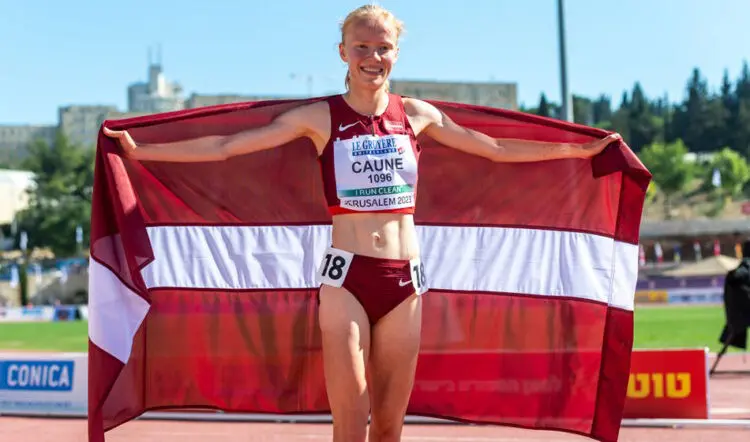
Germany’s Kira Weis beat Sofia Thogersen to take silver with 15:50.36 as Britain's Natasha Phillips – a relative novice on the track – was a fine fourth.
“I didn't think I would run so fast,” said Caune. “But I felt great during the race and I'm extremely happy about the record result. I had the splits and my coach told me to push if I feel great, so I did, and I'm so happy.
“Before the race I thought maybe I could break the record, and then during the race I felt great and I thought ‘Okay, you can push, you just need to push, you need to challenge yourself’.”
Laros and Caune weren't the only athletes to win double gold. In the sprints, Marek Zakrzewski of Poland became the first man to secure the 100m and 200m titles at these championships since Britain’s Darren Campbell in 1991.
After winning the 100m on Tuesday, Zakrzewski took the 200m in 20.63 (1.0).
Elsewhere in the championships, Mattia Furlani of Italy broke a 36-year-old championship record in the men’s long jump with 8.23m (-0.2) but he won by just one centimetre after Bozhidar Saraboyukov of Bulgaria jumped 8.22m (1.6).

In the men's high jump, Sweden's Melwin Lycke Holm has clearly inherited the talent of his father, Stefan, the 2004 Olympic champion, as he cleared 2.18m to beat Edoardo Stronati of Italy on countback.
Following Griggs' defeat in the men's 3000m, Ireland won an unexpected gold in the women's long jump as Elizabeth Ndudi soared out to an Irish under-20 record of 6.56m.
"I was confident in myself coming in here but it’s a huge improvement and to do it in such a high competition makes the national record so special," said the 18-year-old from Dublin.
Germany topped the medals table with eight golds and 23 medals in total. Sweden were runners up overall with five golds and seven medals, with the Czech Republic earning three golds and eight medals and Great Britain & Northern Ireland fourth with two golds and ten medals in total.
German victories came from Sandrina Sprengel in the heptathlon (5928), Amadeus Graber in the decathlon (8209), Rosina Schneider in the 100m hurdles (13.06), Lasse Schulz in the men's shot (20.21m), Nina Chioma Ndubuisi in the women's shot (17.97m), Frederick Weigel in the men's 10,000m race walk (41:53.58), Curly Brown in the women's discus (53.93m) and the women's 4x100m (43.82).
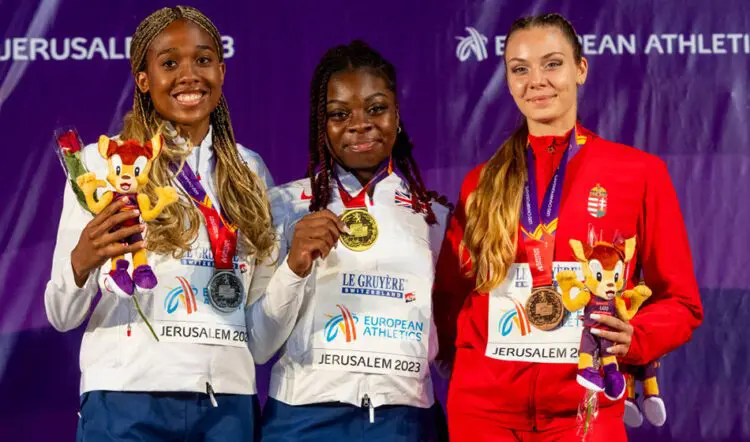
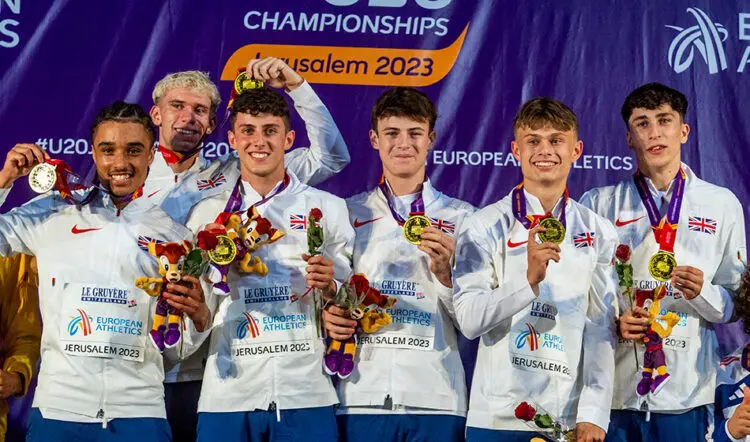
British victories came in the women's 100m where Joy Eze narrowly beat team-mate Renee Regis. Then, on the final night, Charlie Carvell, Jake Minshull, David Race and Sam Lunt combined to win the men's 4x400m.
Carvell also took individual 400m silver behind Jónas Gunnleivsson Isaksen of Denmark, as Britain's Abigail Ives also claimed an 800m silver behind runaway winner Audrey Werro of Switzerland.
Eze and Regis teamed up with Sophie Walton and individual 200m bronze medallist Suceess Eduan, too, in the women's 4x100m to take silver behind Germany in 43.86.
READ MORE: GB one-two in the 100m
There were further bronze medals for the Brits as well from Sean Anyaogu in the men's 100m, Bradley Giblin in the men's 3000m and Michael Allison in the men's javelin.
» >