Julia Paternain's incredible journey

The marathon runner who grew up in England but won world bronze for Uruguay in Tokyo reflects on her achievement and outlines her next steps.
In a World Championships full of surprises, Julia Paternain’s bronze medal in the women’s marathon was possibly the most unexpected result of all. Born in Mexico, raised in England, based in America and representing Uruguay, she was one of the most interesting stories, too.
“My phone blew up after the race. Even the president of Uruguay reached out to me. It’s been crazy!” she says, on the reaction to a race that saw her clock 2:27:23 to become the South American nation’s first-ever World Championships medallist.
The only two runners to beat her were 2021 Olympic champion Peres Jepchirchir of Kenya and marathon world record-breaker Tigist Assefa of Ethiopia. Going into Tokyo, Paternain was ranked a mere 288th in the world, too.
I meet the 26-year-old at her hotel in Tokyo a couple of days after her race. She is saying goodbye to her coach, Jack Polerecky, as he leaves to fly back to Flagstaff, Arizona, before turning her attention to our interview. During a surreal week in Japan, she has experienced almost every emotion possible, from exhaustion to elation, but have there been any tears? “Almost, in the medal ceremony,” she says, “but I think I was just feeling so much shock and was just so tired. I didn’t have the energy to cry!”
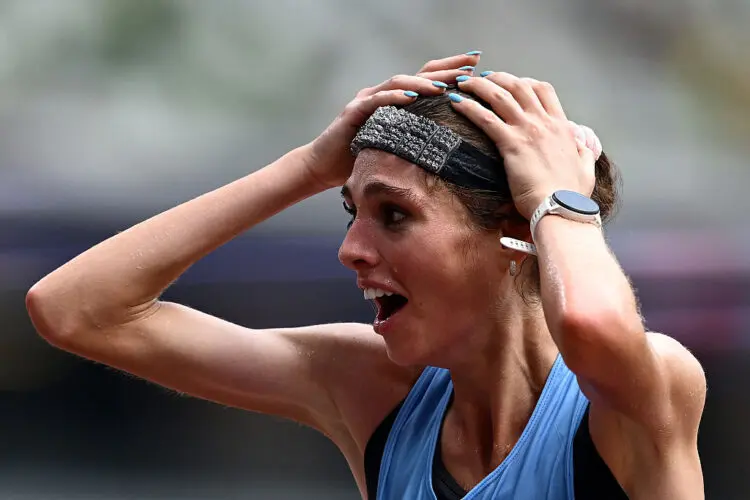
Paternain’s journey from teenage runner to the World Championships podium is incredible, illustrated by the fact she has a green card (to live in the United States) and three passports (Mexican, British and Uruguayan).
Born in León, Mexico, in 1999, when her parents were visiting the area, she believes the fact it sits 1800m above sea level might have contributed to her aerobic ability. Her parents, Gabriel and Graciela, are from Uruguay – and neither showed any previous sporting talent – but she moved to England when she was two years old because her father got a job at Cambridge University as a maths lecturer and head of department.
Her mum, meanwhile, is a professor of statistics and an expert in ageing and dementia research, although Julia showed more talent in athletics rather than academics. “I did maths A-level, plus history and politics, but that’s about it when it comes to maths!” she says.
As a child she did a lot of swimming but only at regional level. “My arms kind of do their own thing and they were all over the place!” she says, adding: “When I misbehaved, my punishment was not going to swim practice.”
She also played hockey and netball, the latter as a goalkeeper or in goal defence due to her height. “Even when I was younger I was pretty tall,” she says.
She didn’t start running seriously until she was 16. The hand of fate intervened as well as she wanted to join a triathlon club but found the waiting list was shorter for the local athletics club, so she joined that instead. Paternain hooked up with coach Mark Vile at Cambridge & Coleridge AC and he instilled a work ethic. He also encouraged her to specialise because she was still getting up early to swim and juggling different sports.
“It didn’t feel like the swimming was really paying off,” she remembers. “After a while it just almost felt pointless.”
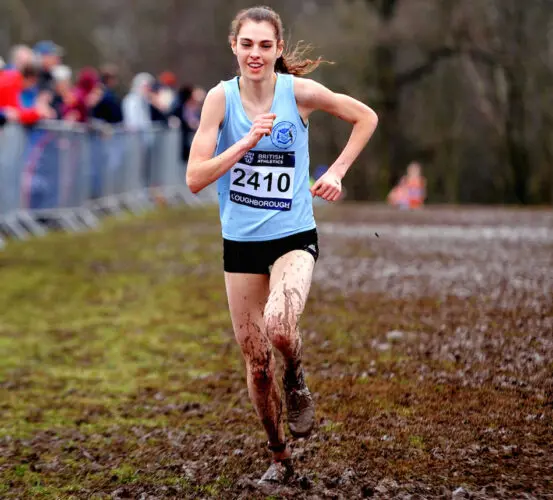
In her first English Schools Cross Country Championships, in Blackburn in 2015, she finished 106th. “I was so proud that I had just qualified. It felt like a big deal.”
The following year she improved to 20th in Nottingham and then 10th in 2017 in Norwich. At the Mini London Marathon, meanwhile, she finished three seconds behind the winner, Erin Wallace, in the under-17 women’s race. Racing in the under-15 age group on the same day, incidentally, a young Keely Hodgkinson ran a couple of minutes slower.
English Schools victories on the track at 3000m followed in 2017 and 2018. “I would say the elation I felt at the end of this World Champs race was very comparable to when I first won the English Schools,” she says. “It’s like the first big thing you win and that felt like a world championship to me at the time.
“It was a really cool moment and experience and that moment got me through a lot of times when I was in the US and injured or when running wasn't so great. I would think back to that and I wanted that feeling again.”
Paternain went to study at Penn State before moving to Arkansas University. During this period she competed for Britain, though, at the 2019 European Under-23 Championships in Sweden, finishing sixth in the 10,000m. So why did she start representing Uruguay?
“I think as time went on I found myself more removed from being in England,” she explains, “and it felt like it made more sense to try and run for Uruguay. Running for Britain in the Europeans felt right at the time. But I don't feel particularly one way or the other. I feel like I'm from all over.
“When I had the opportunity to run for Uruguay, I realised that I wanted to be able to be an example for younger kids in Uruguay. Great Britain already has a lot of really great examples, but Uruguay doesn't have that yet, and I thought that it was a way that I could try and make some sort of a difference.
“I knew it meant a lot to my family if I could do that. And I just knew that, at the point I'm at in my career, I'm going to have a lot more opportunities if I run for Uruguay. That’s no secret.”
Paternain still keeps in touch with British runners like Jodie Judd, Ellie Baker and Maisie Grice and occasionally bumps into Brits at Flagstaff, where she is based.
For a while after moving to the United States, her performances didn’t improve – she describes them as “a mess” – and she took a break from structured training to “figure out life”. Then, when visiting a friend in Flagstaff, she found herself drawn to the altitude and trails in the area and linked up with coach Polerecky at James McKirdy’s training group.
“When I was in the States and injured and not really having a great time, I truly think that my parents probably would have preferred it if I’d stopped running,” she reveals, “as they saw it wasn’t making me very happy.
“I’ve never felt any pressure from them at all. All the pressure I've ever felt has always been internal. They've always just been so supportive.”
On arriving in Flagstaff, it became increasingly clear Paternain had a talent for running longer distances.
“I think everyone that's ever run with me, coached me or been around me knew that,” she says. “But it was just a matter of: ‘You're too young to move up to the longer stuff’. I always knew the longer it was, I was better.”
Making her marathon debut in the McKirdy Micro Marathon in the spring, she ran a Uruguayan record of 2:27:09, which was just enough to squeeze into Tokyo via the World Athletics rankings.
On the eve of her race in Japan and as part of a nine-strong Uruguay team, she discovered her racing singlet was too long and didn’t really fit properly. Improvising, she borrowed a smaller top from a male athlete in the team.
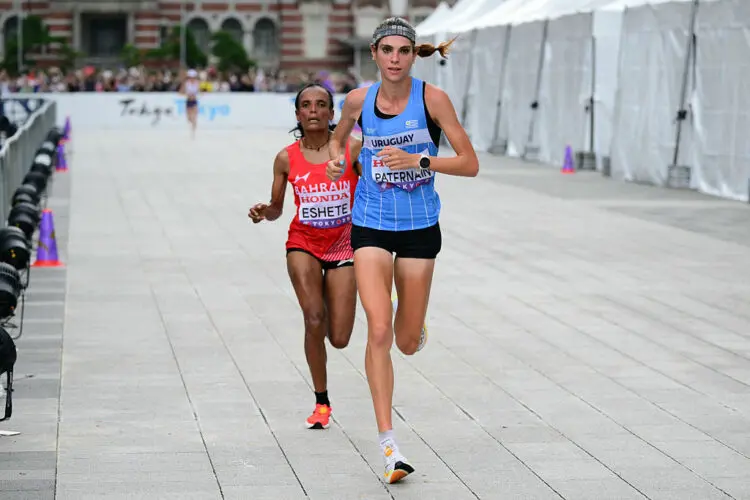
As the World Championships marathon unfolded, despite the heat and humidity Paternain was able to pick people off steadily from halfway onwards, moving relentlessly up the field but never quite knowing what position she was in, nor where exactly the finish line was.
“I was counting the amount of people I was picking off, but at the same time I was losing count and tired and my brain was all over the place,” she says. “I was also just trying to run. So then when I got into the stadium, I was just confused. I’m also very directionally challenged!”
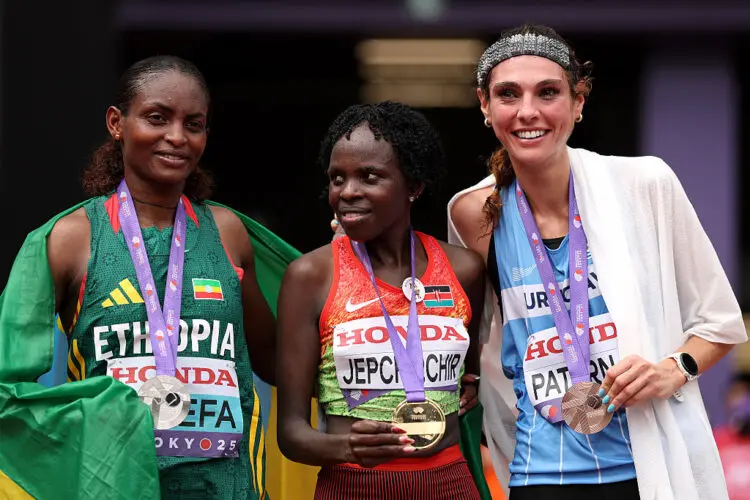
When Paternain eventually crossed the line and realised she had finished third, she could hardly believe it. In the melee, she says: “I didn't find my coach and my parents for two or three hours after the race. I didn't get back to my phone and my stuff until it was almost 12 noon and the race had finished at 9.30am.”
Her race sounds chaotic but Paternain’s personality is a curious mix and she is perhaps more serious and analytical than she appears. “I get told a lot that my personality doesn't make sense,” she says, “because I'm very high-strung in a lot of ways but also very relaxed in other ways. I'm a little ditzy and have my head in the clouds, but at the same time very aware and alert.
“In terms of everything else, my coach and myself were really well prepared. We really got ready for the last 5km, knowing it would be uphill, and I think that really helped a lot. In the build-up I’d had a sauna three times a week and did things like wear an ice vest pre-race.”
But she adds: “In the past I've almost been too well prepared, so that I've become too high strung and you kind of get in your head if something might go wrong. With the marathon, another thing that my coaches have really ingrained in me is that something will often go wrong.”
So what now for Paternain? She will no doubt be in demand from big-city marathons and shoe brands, although she is currently sponsored by Saucony.
Firstly, she was due to have a two-week break and the painful prospect of three wisdom teeth being removed. When it comes to running, she wants to bring her half-marathon best of 70:16 down and, in terms of future marathons, she will run the ones that best fit in with her development in the run-up to the 2028 Los Angeles Olympics.
“The London Marathon is one that I do definitely want to do,” she says, “because I raced the Mini Marathon and I did the Westminster Mile, which I think is a similar course. In England I only lived an hour away from London, so I'm very familiar with it. A lot of friends live in London, so it'd also just be cool to go back.”
Hopefully the finish line by The Mall might be easier to spot this time, too.