From heart surgery to London Marathon heroics: Ryan McLeod’s remarkable return

After collapsing in a car park and having to undergo heart surgery, Ryan McLeod thought his days of serious running were over. But finding some perspective – and producing a brilliant performance at the London Marathon – have changed all of that.
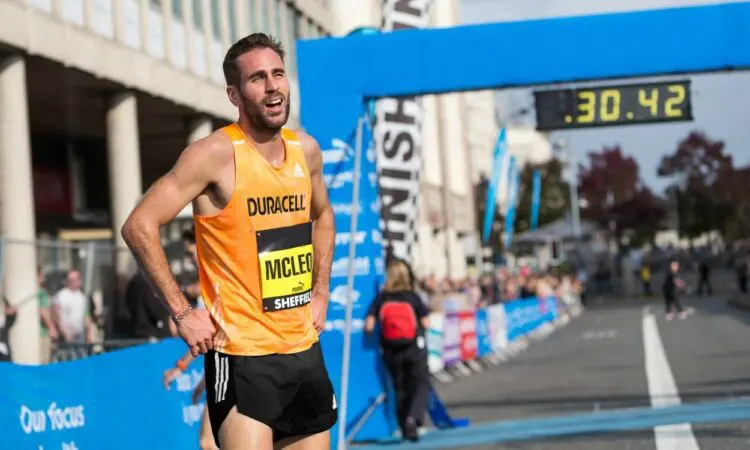
Ten years after a “DNS”, former British half marathon champion Ryan McLeod – who had heart surgery in 2016 – finished 13th and first M40 off the mass start in the 2026 London Marathon. His run of 2:19:41 represented a remarkable return from the Morpeth Harrier who was convinced he’d never race again.
“Before the race I thought I'd be disappointed with that time but I couldn't have been further from it,” he says. “I’m absolutely buzzing and I’m so proud of myself. It might not have been the time I wanted but, given the circumstances of the race, I feel like I ran to the best of my ability on the day.”
A race result is rarely just a number; perspective and context are everything.
McLeod version 1.0 was an elite athlete who had run personal best times of 29:04 for 10km (2011), 48:20 for 10 miles (2015), and 64:18 for the half marathon (2015). In March 2016 he represented Great Britain at the World Half Marathon Championships in Cardiff. He was disappointed with a 66-minute performance (“I was running as hard I could possibly run”), but he put his hard-fought effort down to a virus.
Blood tests returned normal results and he was advised to rest. He withdrew from London that April and took it easy for the next month. His first two outings back – a local parkrun just outside 15 minutes and a 10km just outside 31 minutes, both of which “should have been a dawdle” but felt flat out – did nothing to alleviate his concerns. A five-mile race in the July only reinforced them: “I knew at that point something really wasn’t right,” he says. “I couldn’t run as fast as I wanted to. I couldn’t push myself, and my heart rate wouldn’t go up.”
With no clear diagnosis, McLeod opted for more time off running before a steady build back into training. During one of his first sessions back that August he collapsed in a car park on Newcastle’s quayside – his natural pacemaker had malfunctioned and a defibrillator was needed to restart his heart and return it to its usual rhythm. It was the first of multiple incidents linked to cardiac arrhythmia that eventually led to ablation surgery, a treatment option recommended as the best route to living his most normal life.
At that point, having lost confidence in his body, he made the difficult decision to step away from running completely. “I didn’t want to take the risk and I didn’t want to go through that experience ever again,” he says.
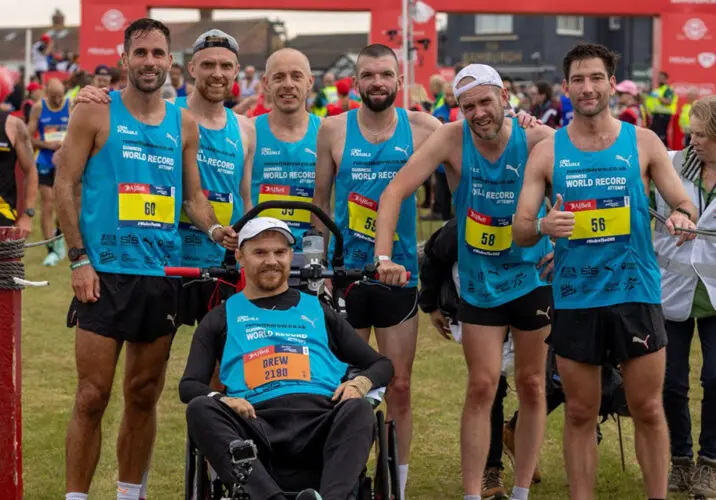
Time, though, is a great healer, and when his friend Drew Graham – a former elite athlete who was paralysed in an accident in 2014 – sent him a message suggesting he pushed him (as part of a team) in the 2023 Great North Run, he knew he couldn’t say no.
With just a handful of parkruns to his name in the preceding years, it was the motivation McLeod needed to get back into running. It also helped him to regain the confidence he’d lost.
That first year, the team crossed the line in 2:01:42. They lowered that to 1:26:09 in 2024 and in 2025 they broke the Guinness World Record for the “fastest half marathon whilst pushing a wheelchair as a team (male)” with an impressive 1:18:02. Across the three races the team raised around £30,000 for Graham’s Gym Possible, a purpose-built gym space for wheelchair users.

“So much of this has been about perspective and where you are in life,” reflects McLeod. “It’s not just about running; there’s so much more to it.”
Running as part of Puma’s Project 3 for London, he describes the marathon day as a “whirlwind from start to finish” with an amazing atmosphere. His intention had been to go off at 2:17 pace but he altered his plan slightly due to the warm conditions. He was also influenced by the words of fellow Loughborough athlete Paddy Dever, who went on to finish 11th in the elite race in 2:06:18. Dever featured in a Puma pre-race film and emphasised the importance of being relaxed at the start rather than hyped up like in a track race.
“I thought: ‘You know what? He's right there’, so I took that advice and made sure I was as mellow and as chilled as I possibly could be which really, really helped,” says McLeod. “If anything, I was actually too chilled, because I started so slowly.
“But my experience played a part there and that did come back to actually help me. I've run in hot conditions before and I've felt my performance drop off, so I went off very conservatively with that in the back of my mind. I thought, worst case, if I feel amazing three-quarters of the way through then I'll have loads left in the tank.”
While the sport has moved on dramatically since 2016, not least with the introduction and impact of carbon racing shoes and complex nutrition strategies, some things never change. McLeod’s coach Alan Storey remained typically direct in his post-race assessment: “It was pretty much, ‘Good run, well done, how was the heart?’. It was just Alan being Alan!”
McLeod had never planned to ask his former coach to link back up with him for London, but the perspective of a third party was influential in his decision-making process. London, he conceded, was a far more serious goal than his last-minute “fun” outing at Chester Marathon in October 2025 (he ran 2:33:17) and it merited structure and focus. He booked a call with a coach that came highly recommended by fellow GB international John Beattie, and after a lengthy conversation during which they talked about the training methods of his former coaches Storey and John Nuttall – the latter who had played a huge part in his development – the coach said: ‘Just one question; why have you not contacted Alan?’.
“I sat there, and I was like: ‘I don't think I'm good enough’, and he said: ‘Well, based on what you've said to me and where you want to go, I think you are’. I arranged a time to ring Alan and it was the briefest chat you can ever imagine. He said: ‘Alright, so you're back doing marathons. Just let me know what you want to do and we'll take it from there’. He was very concerned about my heart, but I told him I’d been running, I’d played a bit of football and that I’d be careful and listen to my body.”
McLeod’s London build was around 10 weeks with two sessions per week. His peak mileage was 100 but he averaged 72-mile weeks for the majority. Storey was very reactive and adaptive in his training approach; while his preference was to avoid rest days unless absolutely needed, he was also quick to advise him to back off if he didn’t feel ready to do a session.
“Recovery was the key,” he says, comparing his 2026 build to 2016’s training. “The old me would finish a session, be exhausted, then I’d get my shoes back on and go out again the next day. Some days I’d be doing double sessions – not this time – but years ago I’d just accept that my legs felt awful, get on with it and assume I’d be fine.
“I'm a lot more tuned into my body now because of what's gone on. I'm aware of things. If I do something really hard, I'd ideally like two days to recover. I think that, as you get older, you just need it more. The body just doesn't repair at the rate it did before.”
The focus will now turn to the Chicago Marathon in October, McLeod’s original “goal” race. By his own admission he has excelled beyond what he thought might be possible, his 2:19 in London destroying the 2:24 target he’d set himself at the outset.
Satisfied but left wanting more, he admits London was far from the perfect race. “It’s the athlete side of me, I start to critique everything,” he laughs. “There are a lot of things I can improve on. It's not like everything went perfectly and I’m scratching my head thinking, where now? There are gains to be made. I think the training I did worked well. I don't think I'm going to go as high as 100 miles, but I want to raise the base of the lower mileage weeks.
“Alan’s going to get me doing some 5km and 10km work for a few months and having those quicker times will really help, too. There’s also the compound of training effect. I've not got the base that a lot of the other runners have got, so I think another six months of training will really help. Even if I achieve a marginal improvement, I think I'll be delighted.”
McLeod v2.0 is emotional as he pauses to reflect on his London Marathon experience. It wasn’t just the culmination of ten weeks of hard work, but the cumulative impact of moments far greater than the sport itself.
“I’m proud of myself,” he says. “You’ve got to believe in yourself, you’ve got to back yourself, because you can do it.”
Finally, a lifetime and 26.2 miles later, he has also closed the loop on a decade of unfinished business.