British Olympic marathon trials analysis

Chris Thompson's international career dates back to 1998 when he ran the steeplechase in the World Junior Championships and he exited in the heats.
In 1999 he was 12th in the European Junior 5000m and in 2000 he was 11th in the World Junior Championships 5000m – just a second and one place down on a certain Mo Farah.
In 2003 he won the European under-23 5000m just ahead of Farah and arguably his win on Friday, 18 years later, was his best since.
It certainly was his best marathon win as it was 20 minutes quicker than his only other one!
His first completed marathon was a highly promising 2:11:19 for 11th in London in 2014. His second was a solid 2:15:05 for 16th in London 2016 but a 2:24:11 in 2017 saw him back to 52nd in the capital.
The times and placings were still going in the wrong way when he ran 2:28:54 for 53rd at New York in 2018.
The time was slower in 2019 but he did win at the Richmond Runfest Marathon at Kew in 2:30:09 by 14 minutes but he finally got the times going back in the right direction when he was a more positive 19th at London last October in 2:13:32.
So it was a narrow PB when he ran 2:10:52 to win the trials at Kew but significantly faster than anything else he had previously run in the M35 category.
In his next marathon at the Olympics he will be 40 and Andrew Davies, who was just over a minute down at Kew (2:15:50) on his British M40 record (2:14:36 at Valencia in 2019), may well lose his age-group record out in Japan.
Thompson's win was achieved with a well-judged race where he used his 23 years of international experience to his advantage and delighted everyone who had followed his career for over two decades. Here we analyse the men's race over each 5km section.
5km: 15:25 (1st 15:25)
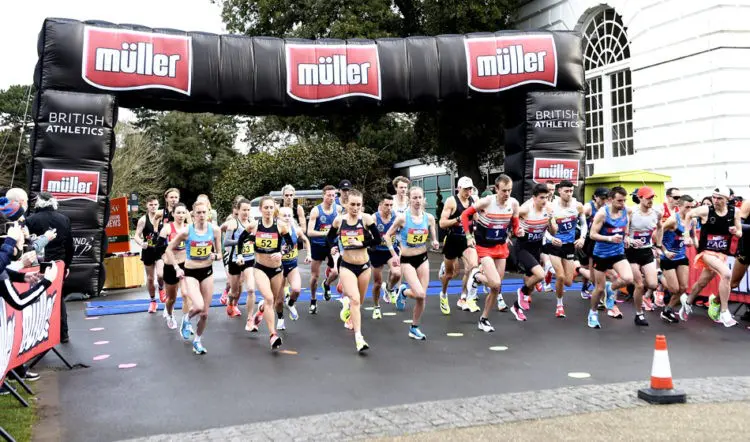
The first 5km with Callum Hawkins and Jake Smith bowling along in front was perfect and all the major contenders were tucked in and enjoying the ride.
10km : 30:52 (15:27) (1st 30:51)
Getting the first 5km right is relatively easy - the second 5km is sometimes harder as you warm up and not only feel fresh but also very easy but the 2:10 tempo was maintained.
15km: 46:04 (15:12) (1st 45:59)
The pacemakers did a brilliant selfless job but just possibly went too quick on this stretch upping the pace to 15:08 which is sub 2:08 pace for that section. Despite the acceleration, Dewi Griffiths, Ben Connor and Mo Aadan all looked comfortable but Thompson eased back a few seconds and dropped off the back.
20km 61:43 (15:38) (1st 61:27)
The pace eased back slightly (15:28) for the leaders but they were through halfway well inside 2:10 pace in 64:45.
Thompson lost 10 seconds and was now 16 seconds back and alone in the wind while the other trio still had the pacemakers for shelter. Most observers thought he was out of contention at this point. His 15:38 split was 26 seconds down on his previous one and it looked like his pace was in freefall.
25km 77:13 (15:30) (1st 76:44)
The pace up front actually got quicker again (15:18) and though Thompson got back near to the pace of his first 10km he was 31 seconds down on the trio who appeared to be disputing the British title and Olympic places. They were were well inside the necessary qualifying time tempo and, although Thompson was as well, it would be no good if he finished fourth!
30km 93:02 (15:48) (1st 92:27)
The pace dropped off again here for everyone as the pacemakers bowed out but the leaders still eked out a further three seconds. With Thompson dropping to a 15:48 split and 35 seconds in arrears he was still not considered a possible winner or Olympian.
35km 1:48:32 (15:30) (1st 1:48:32)
It all changed in 5km, Griffiths dropped back 19 seconds on his previous two rivals but Thompson upped his pace to 15:30 and joined the leaders who lost a stunning 35 seconds to their much older competitor.
40km 2:04:07 (15:35) (2nd 2:04:51)
Now at a different tempo to everyone else left in the race, and after surging clear, he carried on at sub-five minute miling all the way up through 25 miles. Connor and Aadan were left 44 seconds back as they took a laboured 16:19 and were now seemingly battling for one remaining spot on the team to Japan though Jonny Mellor with two sub 2:11's in 2020 would be in the mix for the final place if Aadan beat Connor with a time outside 2:11:30.
Finish 2:10:52 (6:44) (2nd 2:12:06)
Connor proved much the stronger than a finally fading but game Aadan as he made his effort on the last lap and already, possessing the qualifying time, he only needed a second place to secure a team spot. He still lost 30 seconds to Thompson in 2km and it would have been even more if Thompson had not slowed just before the line to celebrate wildly and joyously which has been seen by record numbers on the AW's social media.
https://twitter.com/AthleticsWeekly/status/1375391700118597634?s=20
The Alan Storey-coached Thompson set a PB despite the windy conditions and having to run most of the race on his own and having been very short of sleep for the previous days due to the arrival of his son, Theo. Connor found the last 5km hard but confirmed his ability at this level and Aadan, who looked so good until the last lap, ran a highly promising 2:12:20 and looks a future sub-2:10 performer.
Dewi Griffiths fell away after a very good 30km at 2:10 pace taking 16:24 and 17:20 for his last full 5kms.
He lost a minute to his namesake Josh from 30km who ran 16:17 and 16:37 and then got a further 14 seconds back over the last 2km.
Robbie Simpson showed admirable consistency. The first five 5kms were reeled off in 15:51, 15:48, 15:48, 15:45, 15:44 where a painful stitch slowed him to a slower but still steady 16:25, 16:26 and 16:26 and his last 2195m of 7:08 was better than all those ahead bar Thompson's 6:44.
Even better overall though was the leading M40 Andrew Davies. His 21-second span from fastest to slowest 5km was easily the best of the race. He ran 16:00, 16:04, 15:57, 16:11, 16:02, 16:18, 16:04 and 16:18 but then produced a 6:50 last 2195m for the second best of the race for a 2:15:50.
Davies missed his UK age-group record but Ian Leitch did not setting a rather overlooked UK M45 record of 2:17:26. He was with Davies until 30km but lost ground with 16:21 and 17:02 for his last two splits. It was a PB too (he ran 2:18:33 in 2019) and took over a minute off of the previous record of Olympic seventh-placer Don MacGregor who ran 2:19:01 in 1984, 12 years after his Munich Olympic run.
Women's race
While Thompson's win was certainly not expected before or even at well beyond halfway the women's victory of Stephanie Davis was more predictable before the race (she wanted a faster pace than what was agreed for the pacemakers) and during and she won by a clear margin.
5km: 17:38
The lead group of Davis, Natasha Cockram, Sarah Inglis, Lily Partridge, Charlotte Arter and Becky Briggs were paced by the men bang on target and included the top two though the eventual fourth and fifth (Rebecca Gentry and Clara Evans) were six seconds back on 17:44. Eventual third-placer Rosie Edwards (18:10) was way back.
10km 35:11 (17:33)
The lead group stayed together with a very slightly quicker split as Gentry and Evans were now 26 seconds back with Edwards slightly closing on 36:01.
15km 52:41 (17:30)
It was still a six-way battle and again a very slight up in pace. Gentry and Evans were still together almost a minute back (53:33) with Edwards again slightly closing (53:53).
20km 70:19 (17:38)
The pace eased back to that of the first 5km though 21 year-old Becky Briggs lost a few seconds (70:24) and it was down to five who went through halfway in 74:06. Gentry and Evans (71:27) gained 10 seconds on Edwards (71:57)
25km 87:38 (17:19)
Davis in the company of pacers Josh Grace and Kevin Quinn put in the quickest split of the race and that gave her a small lead over Cockram, Partridge and Inglis (87:42) though Arter had dropped well off on 88:17 with Briggs (88:42) being closed down by Evans and Gentry (89:05) who picked their pace up on a still steady Edwards (89:46).
30km 1:45:01 (17:23)
The Phil Kissi-coached Davis was still flying (1:45:13) and the gap was huge over the chasing pack (1:45:53) with Partridge to eventually join Inglis on the sidelines feeling she is needing a break from marathons. Evans (1:46:56) and Gentry (1:46:59) were well over a minute clear of Edwards (1:48:15) who had lost considerable ground.

35km 2:02:16 (17:15)
The fastest 5km split yet saw Davis well clear of Cockram (2:03:50) as Inglis (2:04:38) faded and was being closed by Evans (2:05:00) who was away from Gentry (2:05:13) with Edwards closing slightly (2:06:17) but not really looking like a medallist.
40km 2:19:45 (17:29)
The pace eased but the split was still better than any in the first half of the race and she pulled another minute from Cockram (2:22:16) with now Gentry (2:23:56) ahead of Evans (2:24:04) but both were being fast closed by Edwards (2:24:17) in the battle for British bronze with a very tired Inglis fading further (2:25:20).
Marathon 2:27:16 (7:30)
Davis completed a faster second half (73:10) to ease further away from the rest of the field with Cockram (2:30:03) and a fast finishing Edwards (2:31:56) taking the other medals and though missing the Olympic time gave themselves Commonwealth qualifiers.
Davis covered the last 2195m in 7:31 - the same as Dewi Griffiths with Edwards next best on 7:39 while Cockram (7:46) was the only other woman inside eight minutes for the section.
Davis should go quicker in better conditions and Cockram (Welsh record 2:30:03), Edwards (2:31:56), Gentry (2:32:01) and Evans (2:32:42) also look like they will get faster. Edwards and Evans went third and fourth in the all-time Welsh rankings. Inglis (20:42 for the last 5km for 2:34:09) and Briggs (21:39 and 21:21 for her last two 5kms for 2:38:58) both seemingly paid for their fast starts.
Overall the event was seen by all as a huge success. An all-British race at the head of the field rather than lost minutes behind an overseas contingent was appreciated by home fans though there is hope that in a non-covid year the event could have slightly more relaxed qualifying times and bigger fields (2:20-2:25 and 2:40-2:45 qualifying times?) and a separate men's and women's race, prize money and a big crowd. This year only twelve men (two outside 2:30) and eight women finished.
Having vaguely taken part in the 1980 Olympic Trials, it was interesting being an on-course observer 41 years later and witnessing a brilliant well-organised and exciting race, though typically you sometimes see more staying at home so I am looking forward to watching the broadcast in full.
» For more on the latest athletics news, athletics events coverage and athletics updates, check out the AW homepage and our social media channels on Twitter, Facebook and Instagram