Amy Hunt and the need for speed

Amy Hunt became a quadruple European champion in Birmingham this summer, but coach Marco Airale reveals the fainting scares, biomechanical quirks and strict word limits behind her breakthrough season.
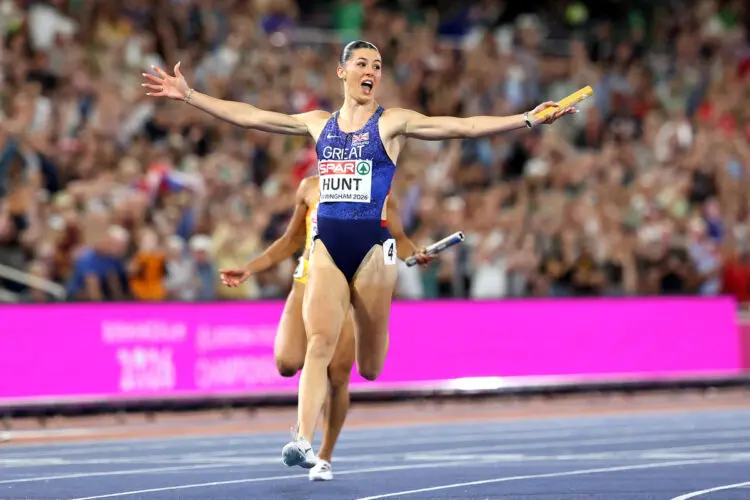
The KFC takeaway had never tasted so good. The champagne had never been so effervescent. After becoming a quadruple European champion over the space of seven days in Birmingham, Amy Hunt granted herself two rare treats by way of celebration – perhaps fitting for a week at the start of which she had declared: "I want it all".
The 24-year-old trains in modest surroundings in the Italian city of Padua, guided intently and meticulously by coach Marco Airale, who recommends his athletes keep their public ambitions similarly low-key. "I always say to my guys: 'Stay humble. Just don't talk. You can talk at the end [after the race].' And then, of course, [at the European Championships press conference] Amy came out and said: 'I want it all. I want four gold medals'," he smiles, knowingly.
He was far from upset with his star athlete, though. "I loved her commitment and I loved her fearlessness," he admits.
Both are qualities that the Italian admires but there was a point earlier in the summer when he did have to put his foot down. "If you ask her, she might say that she didn't go for everything because her original idea was to also go for the [100m and 200m] double at the Commonwealth Games, and I had to be very, very strict on this," he says.
There might have been a bye through the first round in each, but Airale had concerns over Hunt having to run a 200m semi-final and final – particularly the bend – in quick succession in Glasgow, especially when he was aware of the European ambitions to come.
Just this year, she has struggled with Achilles tendinopathy and an issue with low blood pressure that affected her training, especially over the longer event, plus her coach also says there remains a discrepancy in the strength of her legs – a legacy of the quadriceps injury she suffered back in 2022 that threatened to end her career before it had truly begun.
"Her body is still adapting to the load, is still adapting to recovery, is still adapting to get the left similar to the right," adds Airale. "The differences are still there, so it's risky because of course the plan is to go towards [the 2028 Olympics in] LA.
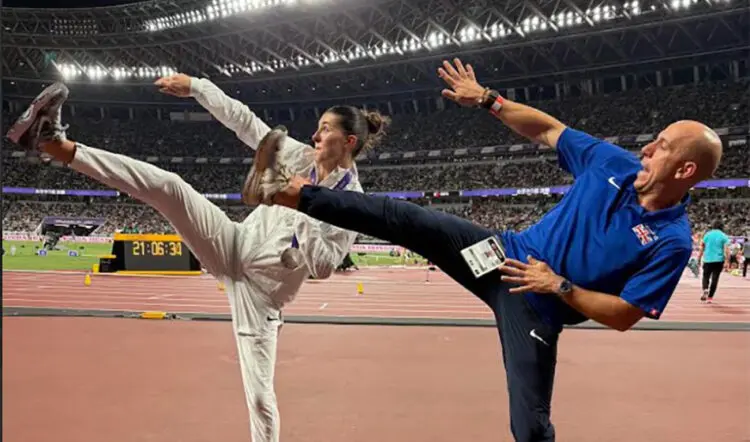
"But at Europeans, with only two rounds in the 100m, two rounds in the 200m, and then the relays it's honestly not too much for her. We put down so much work that it is easy."
And so it was settled. Hunt would contest only the 100m in Glasgow, then go prospecting for gold across the 100m, 200m, 4x100m and then mixed 4x100m relay in Birmingham. There was reason to be optimistic about the chances of success, too.
During the indoor season, she had taken her 60m personal best down by five hundredths to 7.04 and then, at the Stockholm Diamond League in June, came another big landmark. Her second place in the 100m didn't just come with a personal best, but also a first clocking under 11 seconds as she crossed the line in 10.97.
The fact that she went under that mark again, with 10.98 in the monsoon conditions of the Commonwealth 100m final to take silver behind New Zealand's Zoe Hobbs, represented another positive – especially as the preparation had been far from perfect.
"I truly think that, with the 10.97, we were on pace correctly," says Airale. "After that run, she had a few niggles that didn't allow us to run properly. I'm confident that, right now, we should be in 10.94, 10.95 shape, and unfortunately it didn't come out."
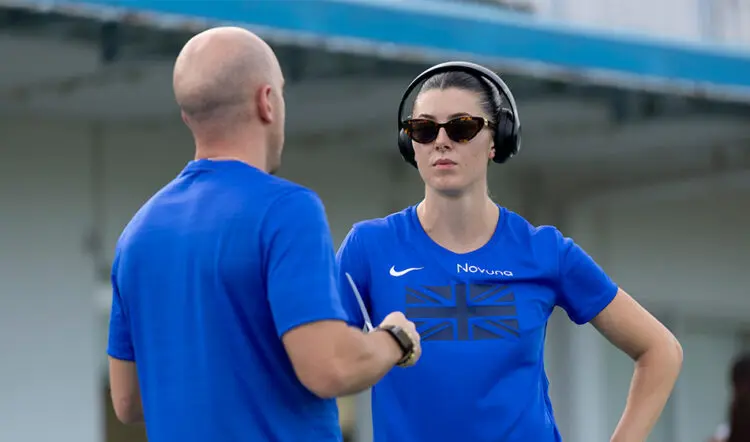
It didn't stop Hunt from winning a maiden senior individual international title in the 100m, though. There was another sub-11 time when Hunt ran 10.99 in the 100m semi-finals at the Alexander Stadium before grabbing her first European gold of the week with 11.00 in the final. Airale's expectations at the start of the season had also been higher for the 200m, namely going under 22 seconds for the first time.
"I was truly thinking that it was time to scratch around 21.95, maybe 21.98 – she was ready to do that because testing showed us that," he says. "But unfortunately, she has also been dealing with this low blood pressure, and she almost fainted after the 200m in London."
That post-race experience on July 18, after she had looked out of sorts and finished fifth, had been unnerving to say the least.
"I had to be taken off to the medical room," Hunt revealed in Birmingham. "I was on the floor on the verge of fainting and we had to do a lot of medical tests. We haven't been able to touch anywhere near my potential in the 200m. We've been able to do the speed work, but not so much the endurance work because I've just been on the verge of fainting."
Electrolytes, cold towels and daily blood pressure tests helped but there was understandable trepidation on Hunt's part when it came to tackling the 200m in Birmingham. "I was almost scared coming back into doing the 200m after London," she said.
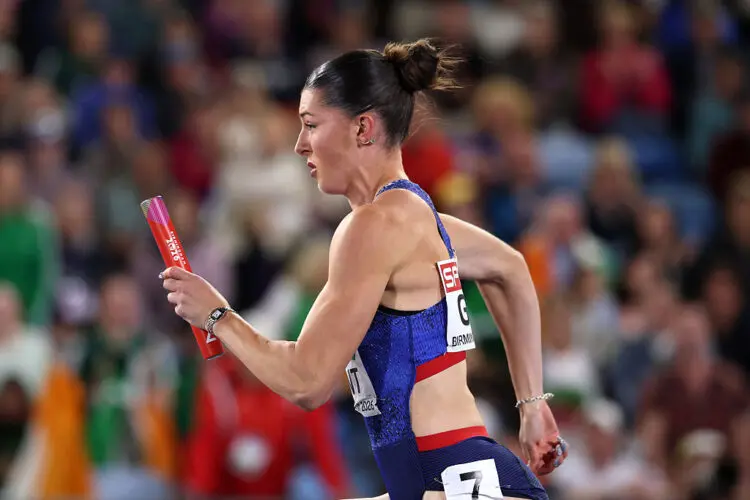
The half lap has always been her happy place and it was the distance where she first began to attract attention, breaking the world U18 record when she was 17. Winning the European semi-final in 22.37 helped ease the nerves slightly but, for the final, Airale had some important words of advice, too.
"I just told her: 'Tonight, you're not running against anyone. I know, based on the workouts you've been doing, no-one here can beat you. But I can beat you. You're running against me. I'm in lane 10 with the stopwatch. So let's see if you can beat me again. You beat me in training. Let's see if you can beat me now'." And I think that gave her the confidence to say: 'Hey, I'm actually the best one here. F*** it, I want to beat my coach'.
"But she didn't beat me! Every time they run, I write the schedule, and then next to it I write the prediction I have for them. Then we play if they beat me or not. Based on the wind and the warmth that night, I was thinking she was going to run sub 22 and, honestly, if she didn't start to fall over [in the final 10 metres], the projection of that race based on her usual split would be 22.09.
"I think that that 10th [of a second] was lost in between [it getting] cold and the fact that the race actually started late. We time everything to perfection, like when she needs to have caffeine, for example, but they delayed and instead of running at 9:50pm, they ran at 9:54 or 9:55 and five minutes for us makes a difference. The temperature went a bit lower than expected. I think her run, putting it down correctly, was a 22.0 so I said: 'I win, so now what are you going to do?' She goes: 'Okay, I'll beat you at the next race'. That was a good way to keep her calm."
During that race, there was a moment that felt like a changing of the guard, as Hunt moved level with, and then past, the British 100m and 200m record-holder and former world champion Dina Asher-Smith, on her way to victory in 22.19. At the time of writing, that mark was the fastest by a European woman so far this year, but still short of the 22.08 PB she set at the semi-final stage of last year's world championships, where she went on to take silver.
There is still speed to be found, though, and Airale believes that a time of under 22 seconds will be needed to win another 200m medal at next year's world championships. He also believes Asher-Smith's national marks of 10.83 and 21.88 can be taken down.
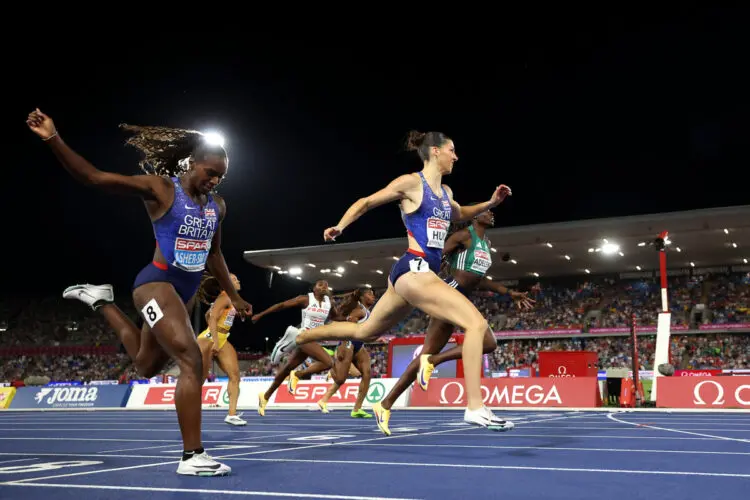
"There is still potential," he says. "In the 200m, I think there is still a big gap [between what she has run and what she can ultimately run]. There is a closer gap in the 100m, but I truly believe that we can get the national records with no issue. The hardest one will be the 100m."
The key over the shorter distance will be improving the early stages of the race. Hunt's closing speed, as anyone who has watched her surge through will know, is remarkable, but to take the next leap she needs to be right in the mix from the earliest possible point.
"We will need to fix zero to 30 metres," says Airale. "[Her] zero to 30 is not top class. She can do a top zero to 30, but you need to add the reaction and the ability to execute it in a race, and the zero to 30 is now the limitation to be a top 100m because we're basically losing everything there.
"At 30-60 she is elite, 60-100 she is top elite. Zero to 30? Okay. Once she reads this, she is going to be very upset, but it's fine for me."
He adds: "The gap is a bit different in the 200m. Our goal was to be able to go through 100m in 11.2. Once you're able to go through in 11.2, Amy has no issue on flying sub-11 [for the second half]. The goal is to bring her to a constant 10.8 and, once you can do 11.2 and 10.8, the barrier of 22 seconds can be broken.
"There is not a big margin in the first 100m. Once you are 11.20, you are top already. We can get down to 11.15, but to get down to 11.15 she needs to be a constant 10.9 [over the 100m], because also if we think about the top runners they can run the 100m in 10.6 and go through in 11.0. So there is a four-tenths gap. Amy has a gap of two tenths [to bridge].
"Her turn is really, really good. The problem is that we need to get down to improve that. But I believe sub 22 is easier than a sub 10.90 for sure."
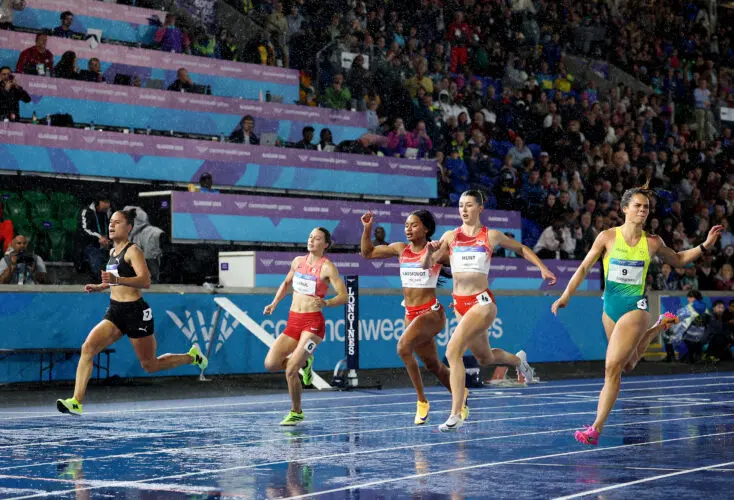
But why is her start proving to be so problematic? It turns out that Hunt is fighting against the laws of both physics and biology.
"You need to work on the angle," says Airale. "She has these long legs with a discrepancy because she has very, very long femurs and very, very short shins, and so it's really hard for her to start.
"And her angle actually doesn't match the real biomechanics. When you read books on biomechanics etc, they don't work with her because she is unusual. So it's not easy to deal with that, and it will be the key.
"And I tell you something more, it's not even the first 30m, it's the first 10m, because these girls cover the first 10m in 1.80, 1.85, 1.90. We go 2.0 so it's a tenth of a second. So zero to 10 is our issue. I will try my best. She will, for sure, try her best."
As Hunt has shown time and again, she is made of stern stuff and is not afraid to tackle a challenge head on, whether that be trying to balance athletics with completing a Cambridge degree, overcoming serious injury or moving to Italy to work with Airale.
"Let's recap for the audience where she came from," he says. "I want to say thanks to [UK Athletics Head of Sprints and Relays] Darren Campbell for having the idea of addressing Amy to us. She joined in the summer of 2023 and it was tough at the beginning.
"In 2024, she was in the B group, didn't make the 200m at the Europeans, didn't make any individual events at the Olympics, made only the 100m [at the Europeans] in Rome and finished seventh in the final, so it was a tough year.
"At the beginning of 2025, she was still in the B group, and then the departures of part of the group made her go to the A group, and both of us really wanted to show that we can actually win."
As has been written about previously in these pages, those "departures" of the likes of Daryll Neita and Jeremiah Azu left Airale reeling, but also with a point to prove. Unless he could take Hunt to a global medal, his future looked decidedly uncertain.
Yet the pair combined to win silver in Japan, Hunt has confirmed her star quality and now Airale's group – that also features the likes of 2024 European 200m champion and Birmingham bronze medallist Timothé Mumenthaler, as well as Hunt's British team-mate Imani Lansiquot – has the backing of Nike. Success, says the head coach, has changed them. But in an important way.
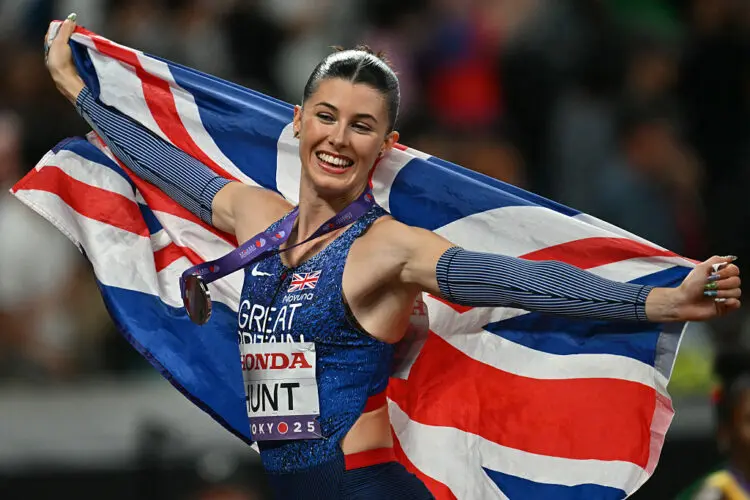
"Amy did amazingly in Tokyo and after that was a very key point," he says. "In the past I've seen athletes winning, getting a big contract, having more marketing stuff to do – photo shoots, blah blah blah. It can change everything. The commitment, the grit… honestly, if I was one of them, I would be comfortable. But she actually changed a lot in a positive way.
"She became even more professional. She knows where she wants to go. She knows already what she wants to invest in for herself next season, because she knows that there is an area where she can actually be more professional – and that's a commitment.
"She truly wants to win, and in this we match. As I said to the athletes, until last year, I needed to win. Now I don't need to win any more. For me, it was already a massive win. If people could see where I come from, it's already a massive win.
"Now I want to win. It's different. When you move from the need to the want, it's different. And for Amy it is the same. She still wants to win, and the fact that she wants to win is all that matters."