Sanya Richards-Ross talks 2016

Stuart Weir speaks with Sanya Richards-Ross about her desire to retain the Olympic 400m title and claim a fourth successive relay gold

For many of us, the women’s 400m was one of the great races of the London Olympics in 2012 as Christine Ohuruogu almost caught the eventual winner, Sanya Richards-Ross, with a characteristic late run.

But that is not how Richards-Ross remembers the race at all. She said: “My memory is seeing DeeDee Trotter a little bit ahead of me and thinking, ‘Come on San, go, go, go to the finish line’.

“I kept pushing and was 99% sure that I crossed the finish line first. And I was pleased to see my name first on the scoreboard, but I honestly thought that DeeDee was second and was surprised to see Christine’s name as I had only remembered passing DeeDee. I knew that Christine always finishes well but I had no idea that she was coming so fast.”

The individual Olympic gold was a crowning glory in an illustrious career which had brought Richards-Ross three World Championships titles – two outdoor and an indoor – as well as nine 4x400m relay gold medals (three Olympic, four world and two IAAF World Relays). She also won a medley relay gold at the 2015 World Relays.

She holds the US record in the 400m at 48.70 and incredibly she has run 49 times sub-50. She is finding the 50th rather elusive. It was a target in 2015 but it did not happen.

One of her remaining ambitions is to win a relay gold in Rio. “I don’t think anyone has won four successive relay golds so that’s what I’m going for in Rio as well as defending my individual title,” she said. “I have been very blessed to have had some great times and great team-mates to run relays with.”

"I don’t think anyone has won four successive relay golds so that’s what I’m going for in Rio as well as defending my individual title"

She started running when she was seven years old in Kingston, Jamaica. “Track and field and soccer are the biggest sports, so most children do it on the island,” she said. “I remember going to a sports day and I ran rather fast and I went for the track team and I have been running ever since.”

Her family moved to Florida when she was 12. She recalls at the time being really disappointed to leave Jamaica but looking back she sees it as the best thing her parents did because of the great opportunities available in the United States.

Ohuruogu and Richards-Ross’s careers have run in parallel. Both were in the 2004 Olympics as young hopefuls – the Brit reached the semi-final, Richards-Ross the final. In 2007, Ohuruogu became individual world champion in Osaka; Richards-Ross won a relay gold. In the 2008 Olympics, Ohuruogu took gold and the American bronze. Richards-Ross won the 2009 World Championships in Berlin with a not-fully-fit Ohuruogu fifth. In the 2012 Olympics, Richards-Ross took gold and Ohuruogu silver. In the 2015 World Championships, Richards-Ross ran only the relay. Inevitably in the final she ran her leg in direct competition with Ohuruogu.

Richards-Ross has a great respect for Ohuruogu. “Christine has been one of my greatest rivals and a phenomenal athlete,” she said. “She shows up at the big meets and is always a threat.

“I have enjoyed competing with her and hope we’ll be able to do it again in Rio. And if we could both medal, that would be three Olympics in a row that we were both in the medals. It’s been a great rivalry and I’ve enjoyed racing her.”

"Christine has been one of my greatest rivals and a phenomenal athlete. She shows up at the big meets and is always a threat."

The 2015 season was a strange one for Richards-Ross. She started well when she won the Kingston Jamaica International Invitational and then finished second in the Diamond League races in Doha, Eugene and Lausanne but then failed to make the final in the US trials, so missing out on the chance to compete in the individual event in the 2015 World Championships.

“This year I think I over-trained,” she admitted. “At the beginning of the year, I said, ‘Coach, I want to run faster than 48.7 this year. I want a PR.’ I was doing 1000 sit-ups a day. I started running with the boys and pushed myself really hard and felt great in practice but flat in races. We couldn’t figure it out.”

She talked to fellow former world champions Kim Collins and Felix Sanchez, who told her that as your body gets older you need to train less and rest more. She realised that the work-ethic which had served her well at 20 worked less well at 30. She felt that she had reached what she calls the point of diminishing returns. Next year she will be giving more emphasis to holding back a bit in training in order to be fresh and ready to race.

Having passed 30, she is nearer the end than the beginning of her career, but she has unfulfilled ambitions and who would bet against her adding to her extensive medal collection in Rio?
Official bids submitted for hosting of 2016 IAAF events

Accelerated bidding process was opened for the World U20 Champs and World Race Walking Team Champs following suspension of original host nation Russia, with five member federations having submitted bids

The International Association of Athletics Federations (IAAF) has received official bids from five member federations looking to host either the IAAF World U20 Championships or the IAAF World Race Walking Team Championships in 2016.

An accelerated bidding process was opened for the two events following the full suspension of the All-Russia Athletic Federation (ARAF) as an IAAF member last month. Next year’s World U20 Championships had originally been due to take place in Kazan, while the World Race Walking Team Championships had been set for Cheboksary.

Seven member federations initially submitted letters of interest and of those, five have made official bids. Poland (Bydgoszcz) has bid to host the World U20 Championships, while Ecuador (Guayaquil), Italy (Rome), Mexico (Monterrey) and Ukraine (Kiev) are the four member federations interested in hosting the World Race Walking Team Championships.

Australia and India had submitted letters of interest for the World U20 Championships but did not follow that up with an official bid.

On announcing the decision to withdraw their expression of interest to host the World U20 Championships, Athletics Australia's chief executive officer Phil Jones had said: "After much deliberation and consultation with our partners at Tourism Western Australia, we regrettably agreed to withdraw our candidacy to bid for hosting rights for the IAAF World Junior Championships.

"This decision has not been taken lightly, but reflects the challenges faced with regards to the heavily condensed timeframe and the significant new, support infrastructure required to augment the Western Australia Athletics Stadium within a matter of months."

The IAAF will now review the applications and an electronic vote among the IAAF Council will take place on January 7 to decide the two host venues, after which the successful candidate cities will be announced.

Why some take the recovery slow road

Scientists have found some people are genetically programmed to recover more quickly

What makes some athletes recover quickly from intense endurance efforts and others seemingly stall despite their best efforts to bounce back to training?

Dr David Nieman, a physiologist at the Appalachian State University human performance laboratory, set about trying to discover why recovery is sometimes lengthy, even among experienced athletes who have been training and competing for years.

After collecting muscle biopsies from 24 male runners who had run to exhaustion, he found that as muscle glycogen stores were depleted, all of the runners experienced a release of damaging, pro-inflammatory cytokines into their blood. The greater the loss of muscle glycogen, the higher the release of cytokines and the slower the recovery rate.

"Running is very stressful on the body. The more you mix it up, the better, especially if you have concerns about recovery"

In short, says Dr Nieman, a veteran of 58 marathons himself, “some people experience high levels of inflammation during exercise and some don’t”.

He adds that, perhaps, those who deplete their glycogen stores too readily “are not genetically endowed to be runners” and might benefit both from pre-training carb-loading and from cross-training.

“Running is very stressful on the body,” Dr Nieman says. “The more you mix it up, the better, especially if you have concerns about recovery.”

10 dos and don'ts for success

Top pole vault coach Allan Williams gives 10 commandments to maximise your potential, whatever your discipline

Don't just train

Ensure that you have a very specific focus at every training session and on every jump, run, throw or lift. Unless you engage mind and body, you will not get the most out of your efforts.

Do talk to yourself

How you “talk to yourself” is a pivotal part of building the belief system that will enable you to achieve more. By far the most important person you will ever communicate with as an athlete is yourself. So learn to develop a good, positive dialogue and an optimistic rapport with yourself.

Whether you tell yourself that you can or you can’t do something, you are right. Only you can give the embedded command that can switch on or shut down the belief system that will allow you to achieve something (or not).

Don’t let negativity hold you back

It is very easy to allow negative thoughts to take control if you constantly bombard yourself with the wrong thoughts or lose focus on what is valuable and productive in training. Although positive thinking won’t allow you to achieve anything you want, it will allow you to do everything much better than negative thinking will.

Do share your goals

It is not arrogant to confide in others about your goals and ambitions, particularly with people who help you stay focused and on track.

Don’t be afraid of failure

Failure itself is of little consequence, but how you respond to failure is of critical importance. The pathway to success is built on experiencing many failures and mistakes. If you never make mistakes then, apart from being very unusual, you probably aren’t challenging yourself enough or are not open-minded enough to try new things.

Do learn something from every training session or competition

No experience is wasted if you learn from it. If you learn from any outcome, then it becomes a positive and valuable experience that will help you improve.

Don’t make it personal

When you are competing, don’t ever make it a personal confrontation against your competitors. Everyone has to deal with up-and-down moments and you need all of your energy and focus to help you succeed. You cannot really influence what others do in competition and worrying unduly about others will only detract from your own efforts and most likely add to theirs.

Get to know your competitors

Not only will that help your own competitive campaign, but you may well make a friend of them. Everybody wins.

Don’t compete in a bubble

It is very easy to become too insular and disconnected from competition when you try to shut out everything and withdraw inside yourself. Far better to stay focused but also stay in the moment. That way, you can make good tactical decisions that might mean the difference between winning and losing.

Surround yourself with the right people

It is important that you interact with others that have a supportive influence on you and have a similar positive outlook. Stay away from those negative people who brighten a room simply by leaving it.

» Allan Williams is founder of the London Pole Vault Academy, four times world masters champion and coach to the GB junior athletics team

Kilty and Ujah to race at Glasgow Indoor Grand Prix

British duo to take on Kim Collins and Trayvon Bromell over 60m, as Richard Kilty aims to use the event as preparation for a world title defence

World and European 60m champion Richard Kilty and British 60m champion Chijindu Ujah will go up against 2003 world 100m champion Kim Collins and world 100m bronze medallist Trayvon Bromell when they race over 60m at the Glasgow Indoor Grand Prix on February 20.

Kilty added the European indoor title to his world indoor gold earlier this year and has a personal best of 6.49. He has never beaten Collins in four attempts over 60m but the 26-year-old remains unbeaten against British teammate Ujah.

"I love competing indoors and I can’t wait to run in Glasgow again," said Kilty. "This will be a good test for me against some of the best sprinters in the world and the best preparation for the British Championships where I want to secure my spot for Portland and try to defend my world title from Sopot two years ago."

At the age of 21, Ujah established himself as Britain’s best 100m sprinter this year, running sub-10 seconds for the second consecutive year and reaching the World Championships semi-finals. With a personal best of 6.53 for 60m, he will be confident of performing well at the Emirates Arena.

"2015 was another good year for me but I’m already excited for 2016 and getting started at the Glasgow Indoor Grand Prix," he said.

"I’ve got my eye on improving my personal best and pushing for sub-6.50. I’m sure we will all push each other to some really fast times in Glasgow."

Collins was the world’s best indoor sprinter in 2015, going unbeaten all season and improving his personal best to 6.47. After first competing in Britain in 2002, the 39-year-old St Kitts and Nevis sprinter has raced a number of times in Glasgow but is hoping for his first win on Scottish soil in February.

He said: "I always love competing in the UK and have been coming to Glasgow for many years. I can’t wait to get back there in February.

"Being unbeaten indoors in 2015 was an amazing achievement for me and I want to keep the run going this season, but it will be a tough race in Glasgow and the fans could be in for a great show."

At the other end of the age scale, USA's Bromell became the world’s fastest ever teenager over 100m in the summer, running 9.84 in June and then claiming world bronze. The Glasgow Indoor Grand Prix will be his first ever 60m in Europe and he will be looking to challenge his 6.54 personal best.

"2015 was a great year for me and I was delighted to win a medal in Beijing," said the now 20-year-old. "The Glasgow Indoor Grand Prix will be an important meet to set me up for another good year and I’m looking forward to testing myself in a world class 60m race."

Britain’s fastest ever woman, Dina Asher-Smith, and European record-holder Dafne Schippers are among those who will also be racing over 60m in Glasgow.

Double Olympic, world and European champion Mo Farah has also been announced for the meeting and is set to race over 3000m.

The Glasgow Indoor Grand Prix is to be the final meeting in the IAAF's new World Indoor Tour, which also has events in Karlsruhe, Boston and Stockholm.

Happy Christmas!

All the staff at Athletics Weekly wish our readers a very happy Christmas

Whether you are training or taking a well-earned day off, all the staff at Athletics Weekly and Running Monthly wish you a very happy Christmas.

If you’ve got some spare time on your hands over the festive period why not enjoy the latest edition of AW magazine or check out what athleticsweekly.com has to offer? Our online performance section is here, while interviews are here and videos can be found here.

The next edition of Athletics Weekly magazine is out on December 31 and is our end-of-year stats special including world and UK rankings plus merit lists.

Make sure you never miss an issue by taking out a subscription to AW - print subscriptions can be taken out here, while subscriptions to our digital edition are here.

If you are out and about on a run or doing some Christmas Day training, let us know! Why not send us a seasonal snap of you in action? Tweet us @AthleticsWeekly or get in touch on Facebook.

Happy Christmas!

Christmas nutrition

Don't feel too guilty about over-indulging on Christmas Day - some of what you eat could provide a training boost, says Peta Bee

Our traditional Christmas dinner has been branded the unhealthiest in Europe, providing a whopping 30% sugar and 46g of fat per plateful.

Along with mince pies and Christmas cake, selection boxes and Quality Street, the festive lunch contributes heavily to the 7000 calories the average Briton consumes on December 25. But it’s not all bad. Here we show how stocking up on the right kinds of foods this Christmas could benefit, not harm, your New Year training.

Turkey

Turkey breast contains one of the highest concentrations of an amino acid called beta-alanine that is converted in the body to a compound called carnosine and stored within the muscles. Beta-alanine and carnosine help to buffer so-called hydrogen ions that are produced alongside lactic acid during intense exercise.

A build-up of hydrogen ions causes an increase in acidity that affects the way muscles relax and contract, resulting in fatigue, so it’s important to prevent that as much as you can. Performance nutritionists recommend elite athletes consume turkey all year-round to aid recovery from training.

Chestnuts

Most nuts are low in carbohydrates, which is why they are often part of low-carb diet plans. Chestnuts, however, have a high amount of complex carbs, the kind that give you a longer-lasting energy boost, with 45g of carbs per 75g serving.

“They are a useful recovery food,” says nutritionist Dr Sarah Schenker. Chestnuts also have a high content of the trace mineral manganese, an antioxidant that helps with connective-tissue production and healthy blood clotting.

Sprouts

All vegetables provide some of the vitamins and minerals needed for optimal performance. But top of the lot are members of the cruciferous family including broccoli, cauliflower, and Brussels sprouts. These vegetables have higher concentrations of antioxidants, fibre, with sprouts being a particularly good source of folate, essential for the production of healthy red blood cells.

Pile up the Brussels over Christmas and they’ll also boost your levels of vitamin C, iron and beta carotene to help fight winter infections.

Brazil nuts

Rich in selenium, these nuts have powerful antioxidant properties. “Antioxidants clear up all of the reactive molecules produced during exercise that slow recovery and depress the immune system,” Alex Popple, a performance nutritionist at High Performance Sport New Zealand. “Eating five Brazil nuts after training helps to speed up recovery and reduce the risk of illness.”

Cranberry sauce

Ready-made cranberry sauces typically contain a lot of sugar. But make your own with less added sugar and there could be benefits.

A 2013 study published in the journal Sports looked at the effects of cranberry and grape seed consumption in elite athletes. Both cranberries and grape seeds are rich in polyphenols, disease-fighting antioxidant substances. When a team of Canadian researchers gave elite athletes a combination of these ingredients daily, they reported an improvement in blood flow to muscles at rest.

Fartlek - play with speed

Injecting speed into your running will pay huge dividends and fartlek is a fun way to do it, writes Paddy McGrath

Fartlek is the Swedish term for speed play and it should be precisely that. In essence, it involves bursts of faster-paced running interspersed with gentler recovery running. The beauty of it is that it removes the constraints of interval training so that you do not have to be a slave to the stopwatch or the track. It's used by athletes of all levels and is a way to boost confidence and speed along while at the same time rediscovering the pure enjoyment of running.

With my more experienced athletes, I often advocate a fartlek run in which they measure only the total duration of the run or the overall distance covered. Other than that, their aim is to enjoy the session, to rediscover the freedom of running as they feel without pressure.For these reasons, fartlek training is as psychologically refreshing as it is physically rewarding.

It's not just the fact that this kind of workout stimulates your VO2 max and enables you to handle the kind of changes in pace and terrain that you might encounter in a race - it's beneficial to the mind as well. Once you have become accustomed to the changing pace of a fartlek session, the best way to approach it is to run as you feel, adding bursts of speed and recovery based not on the ticking of your watch, but on what your body tells you is right.

Unlike many other types of running session, it is ideal for doing in mixed-ability groups. Fartlek is something I do regularly with the younger athletes I coach as it means they get to run together regardless of their basic speed and current level. It's all-inclusive and everyone enjoys it.

Each runner gets to select a distance over which they think they can lead the group - it might be 120m or 600m - and surprises the others with their choice. More than anything, Fartlek should be fun.

How often?

It's generally advisable to run a fartlek session every week, although much depends on your racing goals and aspirations. There is no reason why it shouldn't replace interval training on the track if your focus is local parkruns and 5km races. There is an added advantage to this - running on softer and mixed terrain means there is less chance of injury than on the hard surface of a track.

Where to do it

There really is no end to the variety of places you can do fartlek. Woodland trails and parks are ideal, although many runners do sessions on roads and a few even choose to run on tracks. The terrain can be undulating or flat, muddy or dry and can entail you running lots of small loops or one large one. What matters most is that it is different each time.

How to do it

Fartlek can be as long as you want it to be, but my advice is to aim for 35 minutes to 1 hour in duration. Always aim for 5-10 minutes gentle running to warm up before your first "burst", but beyond that, the key is to experiment and not to stick to a rigid format. Change it regularly so that you never get stuck in a rut. Below are some other Fartlek sessions you might want to try.

Group fartlek
If you are running in a group it is a good idea to give everyone a number so that they know when their burst will come. The key is to take people by surprise, as you might in a race, by running hard for a distance predetermined in your mind.

Fun fartlek
You can do this in a group or alone. Once you have decided on your total run duration and completed your gentle running as a warm-up, select markers that occur naturally in the environment between which you vary your pace. So, it might be that you run hard past three lamp posts and then jog for the next four lamp posts. On a hilly route you might decide to run hard up the hills and to jog to the next one.

Shorter-burst fartlek
After a warm-up, perform 10 to 12 bursts of faster-paced running lasting 1 minute with a 1-minute jog rest in between. Your effort should be slightly faster than 5km race-pace effort.

Longer-burst fartlek
After your warm-up, perform five or six bursts lasting 2 minutes, with a 1-2 minute jog between each hard effort. There are variations on this, of course, so do experiment. My athletes sometimes do a pyramid of 1-minute, 2-minute, 3-minute, 4-minute bursts and back down again, each with a recovery period. Again, your effort should be similar to 5km race-pace effort.

» Paddy McGrath is a former Irish international and qualified coach who currently coaches junior and senior athletes. He can be found at paddymcgrathrunning.com

Training on Christmas Day?

Who will, and who won't, be training this Christmas Day? Some of the stars of British athletics share their festive training plans

As Daley Thompson once said: “Train twice on Christmas Day. Your competitors may only train once…”

So who will, and who won't, be taking a leaf out of the double Olympic decathlon champion's book and be training on Christmas Day this year? Athletics Weekly took to Twitter and asked some of GB’s track and field stars to find out.

British 100m and 200m record-holder Dina Asher-Smith @dinaashersmith
No I won't! Simply because Christmas Day falls on a Friday this year, which is my rest day anyway.

Multiple British race walk record-holder Tom Bosworth @TomBosworth
I will be training on Christmas Day. It gives you such a buzz, and I hate missing a day for no reason.

World T37 400m record-holder and gold medallist Georgie Hermitage @Georgie400m
I will train on Christmas Day, probably at 6am before my daughter wakes up so I can still enjoy the day with her.

British long jump record-holder and world silver medallist Shara Proctor @SharaProctor
No, I will not be training on Christmas Day because that's a day I reserve to spend time with my family and celebrate the birth of Jesus.

2010 European 10,000m silver medallist Chris Thompson @Thommo10k
I'll most probably take a day off on Christmas Day as distance runners don't get many days off in a year. So this day is as good as any to give myself the excuse to chill. Any athlete knows a big key to success is being happy so a day off with lots of fun involved will help that.

Paralympic, world and European champion and multiple world record-holder Hannah Cockroft @HCDream2012
It's up to coach if I train on Christmas Day, but I expect I will be! I don't mind it though, as it makes you feel a little less guilty when you sit down for Christmas dinner (and open that third selection box)!

European 800m runner Alison Leonard @LENrun800
Yes, I run on Christmas Day but not serious training. I like to do a long slow run, usually with my dad so a bit slower than normal!

Paralympic and world champion and world record-holder Richard Whitehead @Marathonchamp
Yes will be training on Christmas Day, out on the road for a steady 40-minute jog with my Santa hat on! It is important to make use of training time as there's just eight months to Rio and it's also important to visualise how 2016 is going to pan out.

British outdoor high jump record-holder Isobel Pooley @IsobelPooley
No way! Christmas is a time for being together and my family is the most important thing in the world to me. There's plenty of rest and recovery in our training program already so it's not difficult to coincide days off with the festive period, especially when all the facilities are closed anyway! What everybody forgets is that you're still moving towards your goal when you're not actively training, as long as you've put the work in to get those wheels rolling in the first place! Although I'm a bit addicted to training I will limit myself to a few first-thing yoga moves and maybe some core work on Christmas Day.

European and Commonwealth 1500m medallist Laura Weightman @LauraWeightman
Yes, I always run Christmas morning. I love getting out on my usual beach loop after opening presents. It builds a good appetite for Christmas dinner and lots of chocolate!

British 5000m champion and world finalist Tom Farrell @farrell_osu
Yes I'll be training on Christmas Day, mainly so I will feel slightly less guilty for the copious amounts of turkey, trimmings and desserts I will be eating!

British pole vault record-holder Holly Bradshaw @HollyBleasdale
I will be having Christmas Day off as always. Christmas is a very special time for me, I always go home to spend time with all my family. All year round I live at the other end of the country to them so I like to make the most of it! I will be training in and around Christmas but Christmas Day itself is reserved for having a good time with my family.

European indoor 60m hurdles silver medallist Lucy Hatton @LucyHattonXxx
I will not be training on Christmas Day and I never will. I dedicate the majority of my days in the year to my athletics and like every other athlete that means sacrificing seeing family or the ones we love so Christmas is focused on my family because it's special for us.

Decathlete and British indoor heptathlon record-holder John Lane @85_lane
Yes I will be training on Christmas Day. Every facility is obviously closed on Christmas Day but there is a local grass track around the corner from my house that is always open. I will still go for a run followed by some circuits and some drills before I eat my own weight in food.

» Whether you will or won't be training this Christmas Day, remember you can still read about it! Check out Athletics Weekly's dedicated performance section online here

'Race The Tube' runners take on the Brownlees in race across London

James Heptonstall and Noel Carroll go up against Alistair and Jonny Brownlee in a triathlon with a twist

A year after beating the London Underground on foot, James Heptonstall and Noel Carroll took on the city's public transport network again in a unique triathlon against the Brownlee brothers.

The two Olympic and world medallists were recruited for the race across London with Alistair and Jonny taking on the unfamiliar. The two brothers completed their route from the starting point of Royal Victoria Dock by boarding the Emirates Air Line to cross the river. They then took a bus from the O2 down to Blackheath before a final leg on three wheels as the two jumped in a rickshaw to get to the finish point at the top of Greenwich Park.

Meanwhile, from the same starting point Heptonstall and Carroll echoed what their competitors do on a daily basis with a swim, bike and run through the city. Their route saw them swim across the Royal Victoria Dock before boarding their bikes to fly alongside the Thames and then under the river via the Woolwich Tunnel. Their final leg saw them go from Vanbrugh Park and take on a run up to the top of Greenwich Park to meet their challengers at the General Wolfe Statue overlooking London.

The race came about just over a year after Heptonstall and Carroll launched their first epic challenge ‘Race The Tube’ which grabbed global attention when they took on the London Underground in a foot race and won. Since then the pair have taken on challenges across the UK and US including the Oxford and Cambridge University Boat Race, the New York Subway and more. Heptonstall and Carroll have been supported on their journey by adidas and it was the sports brand that recruited the Brownlees for this latest race.

"It was great to be involved in the race against James and Noel," said Alistair Brownlee. "It is not the way we usually do a triathlon but it was a lot of fun and a good chance to see a bit of London on the way."

Jonny Brownlee added: "We had the much more comfortable journey than the guys but that didn’t stop us trying to win it. Unfortunately I didn’t feel quite as quick on the rickshaw as I do on a bike usually."

Find out which route was quickest...

Routes

Public transport route 7.46km
· Emirates Air Line
· 108 bus
· Rickshaw

Triathlon route 10.17km
· Swim across the Royal Victoria Dock (340m)
· Cycle from the Royal Victoria Dock under the Thames via the Woolwich Tunnel and west towards Greenwich Park (8.63km)
· Run through Greenwich Park to the General Wolfe Statue looking over London (1.2km)

» Video via Epic Challenges on YouTube

Dina Asher-Smith, a leading light

Britain’s fastest ever woman says she’s still getting her head around being a role model and admits she surprised herself with her record-breaking success this summer

Dina Asher-Smith might move faster than any other British woman ever has, but her approach when it comes to 2016 isn't to blast straight into seeking specific Olympic success, it's to take things one step at a time toward her main aim of becoming an Olympian.

The 20-year-old finished fifth in the world 200m final in Beijing in August, the then teenager's British record-breaking time of 22.07 putting her sixth on the world rankings for the half-lap event in 2015. Asher-Smith also broke the UK 100m record and equalled the national record mark for the 60m indoors, but rather than targeting the podium or voicing a more specific goal for Rio next summer, the sprint star insists that first making the GB team is what she seeks.

"I take things very much one step at a time," she tells AW. "Right now it’s very much that I’d like to make the Olympic team, that’s what my first target is.

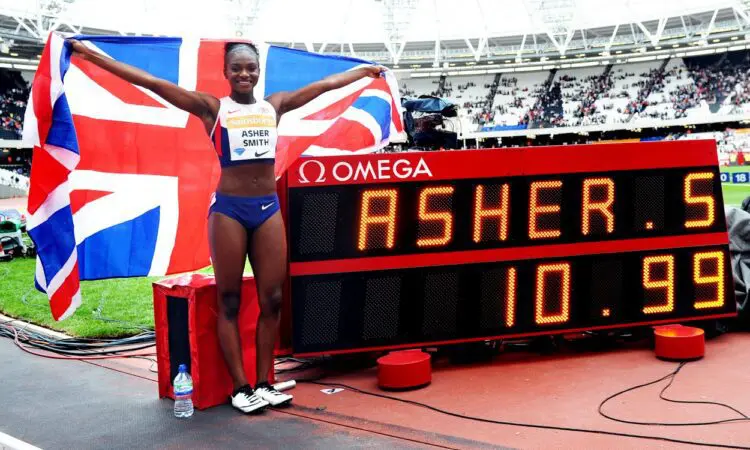
"It's going to be competitive to get into the team," adds the Blackheath & Bromley sprinter, who became the first British woman to legally clock sub-11 seconds for 100m with 10.99 at the London Anniversary Games. "To become an Olympian would be super special. That is my main aim for the season."

dina_asher_smith

Should she achieve her goal, Rio will not be the first Olympics at which Asher-Smith has played a part. A box carrier at London 2012, she was in the Olympic Stadium on 'Super Saturday' and since then has gone on to win double European junior gold, form part of Britain’s world bronze medal-winning relay team in Moscow and become world junior 100m champion before making the European 200m final only to sustain injury. She worked her way back to secure European indoor 60m silver in a British record-equalling time in Prague, then ran Americans Jeneba Tarmoh and Allyson Felix close at the Birmingham Diamond League in the summer and claimed that fifth-place finish in Beijing, while also breaking a number of national records along the way.

It is easy to see, then, why she is considered a great role model, especially for developing athletes. On Friday (December 18) Asher-Smith was involved with the Youth Sport Trust's National Talent Camp in Loughborough which brought together 350 young athletes, coaches and officials aged between 14 and 19. Only just out of that age range herself, Asher-Smith, who is currently in her second year studying history at King's College in London, says the thought of being a role model herself is taking some getting used to.

"I'm like 'I'm 20, how am I a role model!?'" says Asher-Smith with a smile. "This year I kind of surprised myself. I surpassed my expectations by breaking the 100m and 200m records.

"I'm in the same age range as the athletes at the talent camp so it kind of shows that with hard work and dedication it doesn’t matter how old you are or how long you have been doing it for, you can surpass your expectations and do some really cool stuff!"

Reflecting on her 2015 achievements, Asher-Smith adds: "It hasn’t really sunk in yet. Last season really did surpass my expectations. I still think it's weird that I'm a British record-holder, I still think it's very weird that I came fifth in the World Championships and I'm a world finalist.

"I haven't let it sink in because I can never ever risk getting complacent," she continues. "You can never risk getting comfortable where you are, you’ve always got to push the boundaries and try to work harder and that’s where the improvements lie. It hasn’t sunk in but that’s deliberate."

Dina Asher-Smith's top tips for sporting success

» Be patient because not everything you want comes overnight. It does take a lot of hard work.

» Be dedicated because if you consistently work hard then you will see improvement.

» Have faith in yourself. At the end of the day, you’ve got to be patient and work hard and that will build the confidence you have in yourself. If you’ve got faith in yourself and faith in your own ability then what you do on the track hopefully can speak for itself.

Nick Davies steps aside from IAAF role

IAAF deputy general secretary says he has "become the story" after an email discussing Russian doping cases was leaked

The deputy general secretary of the International Association of Athletics Federations (IAAF), Nick Davies, has "decided to step aside" from his role at the world governing body.

It comes after an email, which was sent from Davies to former IAAF marketing consultant Papa Massata Diack in 2013 and discussed Russian doping, was published by French newspaper Le Monde on Monday (December 21).

Extracts of the email highlighted an “unofficial PR campaign” for damage limitation regarding the release of details about failed doping tests by Russian athletes ahead of the 2013 IAAF World Championships in Moscow and mentioned preparing a “special dossier” on IAAF testing.

It also discussed potentially using CSM, the sports marketing firm chaired by the now IAAF president Seb Coe, who was then a vice-president of the world governing body, for the campaign to “benefit from Seb’s political influence in the UK”.

Extracts of the email Le Monde says was sent from Davies to Papa Massata Diack on July 19, 2013, read: “I need to be able to sit down with the anti-doping department and understand exactly what Russian ‘skeleton’ we have still in the cupboard regarding doping.

“I think that the time to have unveiled the various athletes was a long time ago and that now we need to be smart.”

Papa Massata Diack is the son of former IAAF president Lamine Diack. Both Lamine Diack and Papa Massata Diack are being investigated by French financial prosecutors, while the All-Russia Athletic Federation (ARAF) was suspended as an IAAF Member following a World Anti-Doping Agency (WADA) Independent Commission report which detailed findings including a “deeply rooted culture of cheating” in Russian athletics.

In a statement, Davies said: "In statements over recent days I have underlined that one of my key responsibilities is to manage and promote the reputation of the IAAF.

"What has become apparent today is that I have become the story. This is not helpful at the current time, with ongoing criminal investigations by the French police, the IAAF’s Ethics Board or WADA - all of whom I have voluntarily offered full assistance to and will continue to do so.

"In order to demonstrate that I am willing to have all allegations of unethical behaviour on my part in 2013 properly and fairly investigated I have referred my emails to Papa Massata Diack in 2013, my statements and the circumstances of the emails to the IAAF Ethics Board. I have decided to step aside from my role with the IAAF until such time as the Ethics Board is able to review the matter properly and decide if I am responsible for any breach of the IAAF Code of Ethics."

In a statement released on Monday (December 21), Davies had said in part: "My email to the IAAF’s then marketing consultant Papa Massata Diack, less than a month before the start of the Moscow World Championship, was brain storming around media handling strategies to deal with the serious challenges we were facing around the image of the event.

"No plan was implemented following that email and there is no possibility any media strategy could ever interfere with the conduct of the anti-doping process."


Secret Link