Could NMN make you a more efficient runner?

A peer-reviewed trial on recreational runners found that NMN supplementation improved key endurance markers within six weeks. The evidence is more nuanced than the longevity industry would have you believe, but more promising than most runners realise.
There is a particular type of supplement claim that should put any serious runner on guard: the one that promises to transform performance without the inconvenience of doing the work. NMN (nicotinamide mononucleotide) has attracted more than its share of that kind of coverage, particularly in longevity circles where enthusiasm often tends to outrun the evidence.
But a randomised, double-blind, placebo-controlled trial published in the Journal of the International Society of Sports Nutrition found measurable aerobic improvements in recreational runners taking NMN alongside regular training. For Mat Stuckey, an amateur ultra-runner who has been taking NMN for two years and went on to found UK supplement company Longevity Formulas, the study confirmed something he had already been tracking in his own training.
"I started taking it for recovery, not performance," he says. "The aerobic claims always seemed the harder case to make. But the Guangzhou study changed how I thought about it, and so did what I was seeing in my own numbers."
Who was studied and how
The trial, conducted by researchers at Guangzhou Sport University, recruited 48 amateur runners from the Guangzhou Pearl River running team, aged 27 to 50, with between one and five years of regular training behind them.
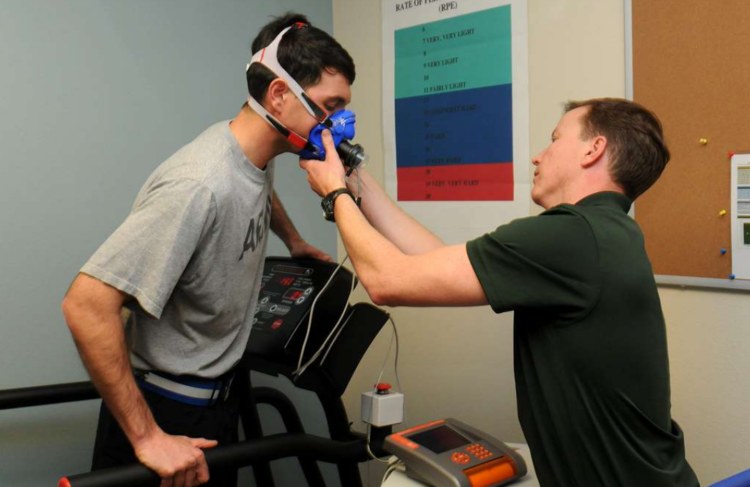
Participants were split into four groups for six weeks: a placebo group, and three NMN groups taking 300mg, 600mg, or 1,200mg per day. All trained five to six times a week, mixing running and cycling sessions of 40 to 60 minutes. Cardiopulmonary exercise testing, the gold standard for measuring aerobic capacity, assessed each runner before and after the intervention.
What the data showed
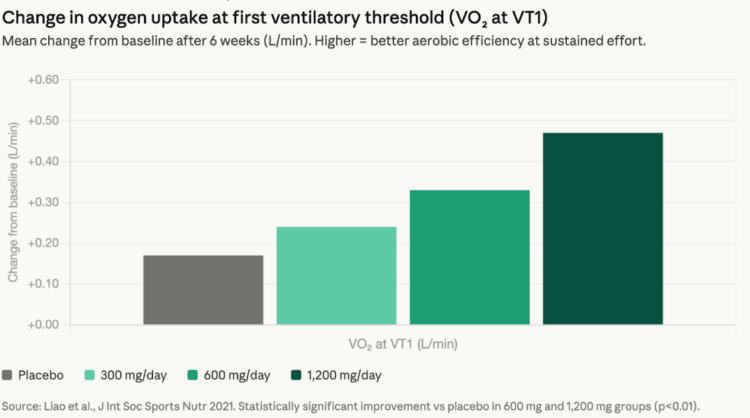
The headline finding was an improvement in ventilatory threshold in the medium and high dose groups. Specifically, VO2 at the first ventilatory threshold (VT1) and power at the second ventilatory threshold (VT2) both increased significantly compared to placebo in runners taking 600mg or 1,200mg per day. The effect was dose-dependent, with the 1,200mg group showing the largest gains.
Ventilatory threshold is the point at which breathing shifts from controlled to laboured, the moment a sustainable effort starts to feel hard. Raising that threshold means a runner can hold a stronger pace before hitting that transition. For an amateur competing over longer distances, that is the difference between cruising through the second half of a race at target pace and having to back off when it matters most.
VO2 max, the ceiling measure of how much oxygen the body can use at maximum effort, did not change in any group. Neither did O2-pulse, peak power, or body composition. The researchers concluded that the improvement appears to come from enhanced oxygen utilisation within skeletal muscle rather than any change in cardiovascular output. NMN does not appear to expand the engine. It makes the fuel burn more efficiently.
Why the mechanism matters
NMN works by raising NAD+ levels, a coenzyme central to cellular energy production that declines with age. That decline gradually impairs mitochondrial function and blunts the body's capacity to respond to training. Stuckey's company Longevity Formulas produces an NMN supplement specifically formulated to address that decline.
What the Guangzhou study adds is evidence that, in runners who are actively training, NMN may specifically amplify the muscular adaptations that exercise produces, improving how efficiently working muscle uses the oxygen it receives, rather than increasing how much the heart and lungs can deliver.
The implications stretch beyond race performance. VO2 max is the strongest single predictor of long-term health and all-cause mortality we can reliably measure. Anything that helps runners maintain and build aerobic capacity over time carries a longevity argument alongside the competitive one, which is precisely why NMN has attracted serious scientific interest beyond sport.
The caveats worth noting
The Guangzhou study is a single trial with 48 participants. That is not a reason to dismiss it, the design is rigorous and the controls appropriate, but it is a reason to hold the conclusions proportionately. The participants were tested on a cycloergometer rather than a treadmill, which the researchers themselves flag as a limitation for runners specifically. The trial ran for six weeks, so what happens over longer periods remains an open question.
Stuckey is straightforward about the limitations. "It's one study with a modest sample. You can't overstate it. But the design is solid and the effect is plausible given what we understand about how NMN works, so it's worth taking seriously rather than dismissing because it doesn't fit the usual supplement narrative."
The dosage finding also has practical implications. The low-dose group, taking 300mg per day, showed no statistically significant aerobic improvement over placebo. The meaningful results were at 600mg and above. For runners considering NMN primarily on price, ending up with an under-dosed product means not replicating the conditions that produced the results.
What the data suggests is improved efficiency at the intensities below the VO2 max ceiling, specifically zone 2 and zone 3, where the majority of amateur training actually happens and where the ventilatory threshold improvements the study recorded are most relevant.
What it feels like in practice
Stuckey noticed the difference around three to four weeks in, roughly half the duration of the study, and the change was not where he expected it.
"It wasn't on long runs. It was on back-to-back training days, holding a slightly higher pace for what felt like the same effort. Tempo sessions started to feel a fraction less breathless at intensities that would previously have had me working noticeably harder. Nothing dramatic, but consistent enough that I kept paying attention."
He tracks HRV using an Amazfit T-Rex 3 watch, using it as his primary indicator of whether a training block has actually landed or whether fatigue is accumulating without adaptation. "When I'm taking NMN consistently, my HRV runs around 10 to 15 per cent higher than when I'm not. That's not controlled evidence, I know that, but it aligns with what the study describes: better cellular energy production and a more efficient response to the training stimulus."
Stuckey is careful not to overstate the effect. "It's not a step-change in fitness. What I hear from runners who use it, particularly those in their 40s and 50s, is that they can string together harder weeks without the deep fatigue that usually forces them to back off. That's what the study describes too: not a higher ceiling, but a better ability to operate closer to it. Over months of training, that compounds."
Where to start if you want to try it
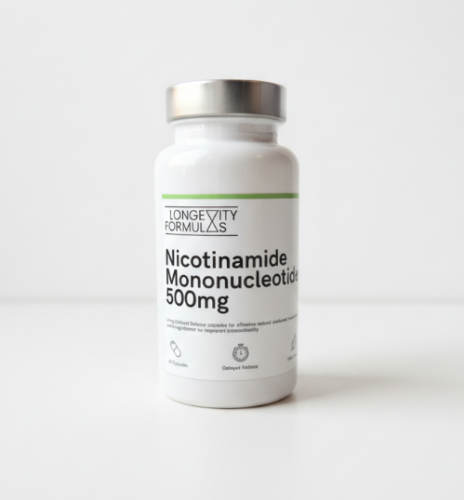
The study's dose-response finding is worth keeping in mind when choosing a product. Results were meaningful at 600mg and above, and how well NMN survives the digestive process affects how much of that dose actually reaches the bloodstream. Longevity Formulas' NMN supplement uses delayed release capsules and comes in 500mg doses, with batch certificates of analysis published on site. Two capsules puts you at 1,000mg, within the range the study found most effective.
The research is early and the sample size is modest. But for runners who train seriously and want their recovery to keep pace with their ambition, the evidence is now meaningful enough to warrant attention.
Study reference: Liao B, Zhao Y, Wang D, Zhang X, Hao X, Hu M. Nicotinamide mononucleotide supplementation enhances aerobic capacity in amateur runners: a randomized, double-blind study. J Int Soc Sports Nutr. 2021;18:54. doi:10.1186/s12970-021-00442-4